When politics faces a crisis, the order of words reveals instincts. This time was no different.
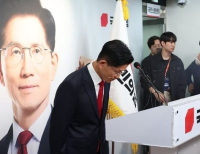
President Lee Jae-myung wrote on his X account on the 12th, "Those who harm national interests for selfish gain are called traitors." He added, "The sovereignty and universal human rights of each nation must be respected, and aggressive wars are denied. That is the spirit of our constitution and international common sense."
According to reports, the post was interpreted as a rebuttal, conscious of the controversy that arose after a post related to the Israeli military.
The problem is that the questions the public is asking are entirely different.
"Why did the President himself post such a video? Was the factual basis verified? Why did he not apologize first for causing confusion?" These are the questions the public is asking.
A president should have a clear order of operations. First, acknowledge the facts, then address responsibility, and finally, explain.
However, the post he later uploaded offered no apology. Instead of an apology, it contained the word 'traitor' and moralistic statements like 'aggressive war' rather than an explanation. As a result, the issue of fact verification was blurred, leaving only a fight over who is morally superior.
This is a typical left-wing frame shift.
What is more serious is the diplomatic implication.
The phrase "aggressive wars are denied" might seem like an abstract principle at first glance. However, within the context of the current controversy, it does not remain a mere general statement.
Readers naturally interpret it as, "Does this mean the current war in Iran is considered an aggressive war?" The moment it is read that way, it creates an effect of indirectly criticizing or mocking the judgment of the United States, which chose or supported that war, or more directly, the choice of U.S. President Trump.
By throwing in a statement judging the morality of war in a place where an apology should have come first, it reads as language of domestic politics rather than the language of diplomacy.
I want to ask again: is this truly helpful for the 'national interest' he spoke of? Is it helpful for international order and stability?
South Korea stands on security cooperation with the United States, and the situation in the Middle East is directly linked to energy supply and demand, maritime traffic, and financial market stability. In such a situation, the president's messages must be accurate and restrained above all else.
However, if one simultaneously invokes the frames of 'treason' and 'aggressive war' for domestic political defense, what is gained might be applause from supporters, but what is lost is the cost of diplomatic interpretation.
If, while speaking of national interest, unnecessary misunderstandings are cast upon an ally's leader and the nature of international conflict is made to sound emotional, it is not cautious statecraft.
But why did such words come out so naturally?
Behind it lies a culture of excessive praise within the Democratic Party of Korea.
In 2021, Song Young-gil, former leader of the Democratic Party of Korea, proposed a campaign called 'Getting to Know Lee Jae-myung' and a relay of book reviews on 'Human Lee Jae-myung,' telling party members and lawmakers that "we must study to persuade" Lee Jae-myung, who was a candidate at the time. This was a snapshot of a political culture that narrative-ized and repeatedly consumed the leader rather than critically examining him.
It is not inherently problematic for a political party to promote its candidate. The problem arises when that promotion, at some point, overwhelms verification, substitutes for explanation, and solidifies into a culture that brands criticism as disloyalty.
In a structure where only the leader's strengths are amplified and reproduced, and controversies and errors are covered up with the language of loyalty, even mistakes are not treated as mistakes.
Counterarguments are translated into attacks, and criticism is framed as an act that harms the community. That is precisely why the president's 'traitor' remark this time sounds not like a simple expression of emotion, but like the language of power protecting itself.
This is because, instead of correcting the facts and apologizing himself, he chose to label the critic with a moral stigma.
Here, the Democratic Party must recall its own past words.
During the Yoon Suk-yeol administration, the Democratic Party pressed the People Power Party to abandon its vertical relationship with the president and create a horizontal party-government relationship where direct advice could be given.
Indeed, public remarks at Democratic Party Supreme Council meetings included criticism to the effect of, "Despite the crushing defeat in the Gangseo-gu district mayoral by-election, they couldn't even criticize the president, nor did they attempt to establish a horizontal relationship with the president." Criticisms that the 'vertical party-government relationship' within the ruling party was a problem were also repeatedly reported by the media and political circles at the time.
So what is the Democratic Party doing now?
When they were the opposition party, they attacked, saying, "Why can't you give direct advice to the president?" but now that they are in power, have they shifted to an atmosphere of, "Why are you criticizing the president?"
If a party that once advocated for a 'horizontal party-government relationship' now displays an attitude closer to defense than direct advice, and praise rather than demands for apology, and loyalty rather than verification in the face of a controversy surrounding the president's error, then what has collapsed is not the opponent's principles, but the Democratic Party's own principles.
It is difficult to avoid criticism that it is a function of position rather than philosophy.
The essence of dictatorship lies not in the leader's error itself, but in the language of sycophancy that frames even that error as great.
When praise that is out of touch with reality, a culture that launders a leader's errors with loyalty, and politics that drives voices demanding accountability as treason accumulate, the nation loses its truth.
Therefore, the real danger is not just the power that errs. It also includes those who cover up those errors with praise and who turn a space for apology into a stage for good and evil.
True treason does not lie in criticizing the state's mistakes. Rather, it lies in preventing the power's mistakes from being called mistakes, covering up those errors with loyalty, and laundering that responsibility with praise.
If the president had truly wanted to speak of national interest, the order would not have been difficult.
If there was confusion about the facts, one should admit it first. If it was inappropriate as a public figure, one should apologize first. And only then can one speak of values and principles.
However, if one refuses that order and speaks of 'treason' and 'aggressive war,' the public can only ask in return:
For whom are these words intended? For the nation, or to protect one's own political authority?
It is not criticism that harms the nation. A culture that applauds the power that should apologize is what makes the country sick.
More dangerous than power that errs is politics that praises that error.
The Democratic Party must now apply to itself the very principles it demanded of the People Power Party in the past: a horizontal relationship where the president's mistakes can be pointed out and the responsibility of giving direct advice.
If they lack even that minimal self-consistency, they have no right to utter the word 'traitor'.
National interest is not protected by stigma. National interest is protected by responsibility and restraint.

 [Statement by the Seo-beo-kka Korea Military Academy Save-the-Nation Comrades Association] ㉛ Recount the Votes Publicly, as the Previous Recount Concealed Election Fraud
Tongyeong Mayoral Election Recount [Photo=Yonhap News]South Korea's liberal democracy is dying. The National Election Commission (NEC) and the judiciary, which have plummeted into criminal syndicates
[Statement by the Seo-beo-kka Korea Military Academy Save-the-Nation Comrades Association] ㉛ Recount the Votes Publicly, as the Previous Recount Concealed Election Fraud
Tongyeong Mayoral Election Recount [Photo=Yonhap News]South Korea's liberal democracy is dying. The National Election Commission (NEC) and the judiciary, which have plummeted into criminal syndicates
 What is the significance of the "Trump 2028" red hats that keep making a comeback?
It is noteworthy that President Donald Trump is "intentionally" fueling controversy over whether he can actually run in the 2028 presidential election, even though it is "highly likely he is seriously
What is the significance of the "Trump 2028" red hats that keep making a comeback?
It is noteworthy that President Donald Trump is "intentionally" fueling controversy over whether he can actually run in the 2028 presidential election, even though it is "highly likely he is seriously
 Jin Cummings: “North Korea says it will increase the number of spies, so what is the government doing?”
U.S. political columnist Gene Cummings has publicly questioned the South Korean government, asking, "North Korea is declaring that it will increase its number of spies, so what is the South Kore
Jin Cummings: “North Korea says it will increase the number of spies, so what is the government doing?”
U.S. political columnist Gene Cummings has publicly questioned the South Korean government, asking, "North Korea is declaring that it will increase its number of spies, so what is the South Kore
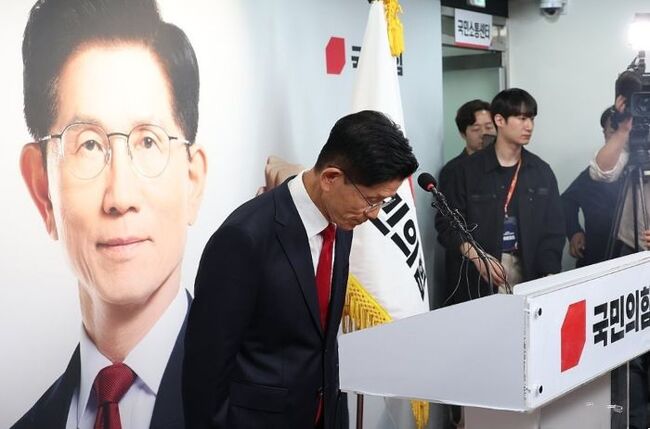 “Too little, too late?…” Kim Moon-soo, who previously conceded his presidential election defeat, now demands a special counsel investigation into ‘allegations of election fraud in the 2025 presidential election’
People Power Party presidential candidate Kim Moon-soo concedes defeat during a press conference at the party headquarters in Yeouido, Seoul, on June 4, 2025. [Joint Press Corps]As allegations emerge
“Too little, too late?…” Kim Moon-soo, who previously conceded his presidential election defeat, now demands a special counsel investigation into ‘allegations of election fraud in the 2025 presidential election’
People Power Party presidential candidate Kim Moon-soo concedes defeat during a press conference at the party headquarters in Yeouido, Seoul, on June 4, 2025. [Joint Press Corps]As allegations emerge
 Stock Market Crash 'Black Tuesday'… KOSPI down 10.8%, KOSDAQ down 7.7%
The KOSPI fell by more than 5% in early trading on the 28th, triggering a sell-side sidecar.On the 28th, the KOSPI plunged by more than 10%.Due to the sharp decline, a sell-side sidecar—a temporary
Stock Market Crash 'Black Tuesday'… KOSPI down 10.8%, KOSDAQ down 7.7%
The KOSPI fell by more than 5% in early trading on the 28th, triggering a sell-side sidecar.On the 28th, the KOSPI plunged by more than 10%.Due to the sharp decline, a sell-side sidecar—a temporary
 [World Heritage Committee] 25 New World Heritage Sites Inscribed in Busan… South Korea Successfully Expands 'Getbol' Listing
The Chairperson of the World Heritage Committee speaks at the plenary session of the 48th session of the World Heritage Committee, held at BEXCO in Busan on the 20th. [Photo: Yonhap News]A total of 25
[World Heritage Committee] 25 New World Heritage Sites Inscribed in Busan… South Korea Successfully Expands 'Getbol' Listing
The Chairperson of the World Heritage Committee speaks at the plenary session of the 48th session of the World Heritage Committee, held at BEXCO in Busan on the 20th. [Photo: Yonhap News]A total of 25
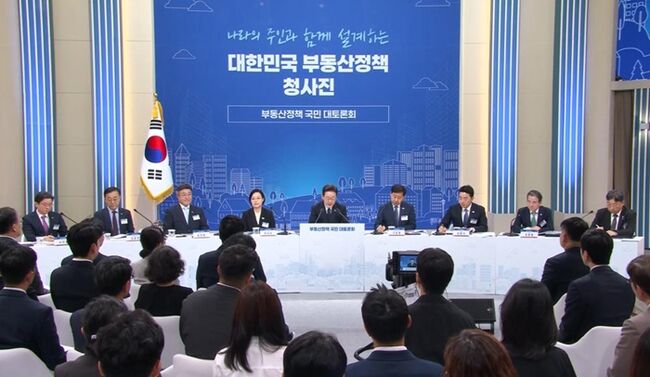 [Liberal Democratic Party Statement] Calling it a Grand Real Estate Debate… It Was Nothing More Than a Private Party Among Themselves
The 'National Grand Debate on Real Estate Policy' held on July 23rd and 27th. [Photo=Yonhap News]The 'National Grand Debate on Real Estate Policy,' hosted by the Lee Jae-myung administration under the
[Liberal Democratic Party Statement] Calling it a Grand Real Estate Debate… It Was Nothing More Than a Private Party Among Themselves
The 'National Grand Debate on Real Estate Policy' held on July 23rd and 27th. [Photo=Yonhap News]The 'National Grand Debate on Real Estate Policy,' hosted by the Lee Jae-myung administration under the
 [Photo] Evidence of Election Fraud Flooding U.S. Media… Trump Had 2.7 Million Votes Stolen
 [Video] U.S. Semiquincentennial Air Show... 'Art in the Sky' streaks across New York
 [Editorial Cartoon] A Draconian Law That Undermines Freedom of Expression

 List
List