On April 11, Hezbollah supporters protest in Beirut, Lebanon, against direct negotiations between Israel and Lebanon. [Photo=Reuters]
The Lebanese front that shook the ceasefire—why are explanations always half-hearted? When reading the recent Middle East situation, there are fundamental common senses that must be understood in advance. One of them is the correlation between Israel and Hezbollah, and Hezbollah and Iran. Shortly after the two-week ceasefire between Iran and the United States began on the 8th, Israel launched a massive strike on Hezbollah strongholds throughout Lebanon, citing "conditions outside negotiations."
Even when the high-level meeting between the US and Iran in Islamabad broke down on the 12th after 21 hours, the issue of the Lebanese ceasefire remained a key point of contention. Most domestic and international reports only highlighted Israel's preemptive strike and the resulting damage. It is difficult to find explanations as to why Israel cannot afford to ignore Hezbollah, and why Iran cannot let go of Hezbollah.
Hezbollah, the ‘Outer Heart’ of the Iranian Regime
Iran's inability to let go of Hezbollah is significantly influenced by its sense of supremacy as the guardian of Shia Islam. It is also an identity that supports the legitimacy of the regime.
Since the 1979 revolution, the Islamic Revolutionary Guard Corps (IRGC), established separately from the regular army to maintain the regime, reports directly to the Supreme Leader. Through its Quds Force, responsible for external operations, it has nurtured armed groups in Lebanon, Gaza, Yemen, and Iraq. A significant portion of the national budget that should have been allocated to public welfare has been poured into supporting these so-called ‘Axis of Resistance.’ Hezbollah in Lebanon is the most successful of Iran's overseas proxy forces.
Hezbollah is an armed political party that has grown amid Lebanon's turmoil and is Iran's 'greatest ally' outside its borders. In 1982, Israel entered Lebanon ostensibly to expel the Palestine Liberation Organization (PLO), which was threatening its northern border, and to defend the border, but the situation worsened.
As Lebanon's civil war intensified and state functions weakened amidst power distribution and cooperation between Christians and Muslims, Iran stepped in. It sent approximately 1,500 IRGC personnel to organize, train, and support Shia armed networks. Hezbollah, born from this, achieved entry into the Lebanese parliament, increasing its seats and rapidly growing as Iran's overseas asset.
Therefore, for the theocratic regime of Iran, abandoning Hezbollah is synonymous with abandoning its "strategic depth." The Iranian leadership has long created a structure that expands its ideology, armed organizations, land supply routes, and missile networks beyond its borders to absorb pressure from the United States and Israel from afar.
The core of this is Hezbollah in Lebanon. As long as Hezbollah exists, Israel must constantly be mindful of the northern front, and the United States cannot limit its containment of Iran to attacks on its mainland. Conversely, if Hezbollah is defeated, Iran loses both its hand reaching towards the Mediterranean and a symbol of its "export of revolution."
Hezbollah, Israel’s Constant Frontline
The reason Israel cannot let Hezbollah go is equally simple. Hezbollah is a massive missile and rocket military force located just beyond Israel's northern border. It was Hezbollah that attacked northern Israel during the Gaza War, influencing the course of the conflict.
The intention is to annihilate Hezbollah, whose capabilities were significantly weakened after the so-called "Pipi Terror," to a level from which it cannot recover. In 2006, UN Security Council Resolution 1701 proposed a long-term solution requiring the absence of armed personnel, weapons, and military assets other than the Lebanese Armed Forces and the United Nations Interim Force in Lebanon (UNIFIL) in the area between the Blue Line and the Litani River, but it has not been properly implemented.
From Israel's perspective, the situation where residents of border villages live within constant range of short-range fire cannot be accepted as normal order. Therefore, the objective of Israel's current military action is also presented as "ensuring the long-term security of northern residents."
Grief over the damage caused by Israel's current attacks should not lead to silence regarding the military and political structures that are the backdrop to such tragedies. If the fact that Hezbollah is an armed force that stands above the Lebanese state, with the IRGC behind it, is omitted, and only Israel is put on trial, the cause and effect will be reversed.
An International Order That Tolerated Abnormality, Media That Tells Only Half the Story
Reporting that only condemns Israel without also stating that Hezbollah is a permanently armed force targeting northern Israel is partisan moralism that remains silent on the structural truth.
The maladies of the Middle East are a catastrophe created by the confluence of neo-theocratic military powers masquerading as sovereign states, external proxy forces like Hezbollah, and an international order that has long tolerated such abnormal structures. The irresponsibility of the media, which has only spoken of half the problem and only the surface, cannot be overlooked.

◆ Dr. Lim Myung-shin
Ph.D. in Chinese Studies, Northeast Asia Researcher
Former Deputy Director of International Affairs, Sky Daily

 [Statement by the Seo-beo-kka Korea Military Academy Save-the-Nation Comrades Association] ㉛ Recount the Votes Publicly, as the Previous Recount Concealed Election Fraud
Tongyeong Mayoral Election Recount [Photo=Yonhap News]South Korea's liberal democracy is dying. The National Election Commission (NEC) and the judiciary, which have plummeted into criminal syndicates
[Statement by the Seo-beo-kka Korea Military Academy Save-the-Nation Comrades Association] ㉛ Recount the Votes Publicly, as the Previous Recount Concealed Election Fraud
Tongyeong Mayoral Election Recount [Photo=Yonhap News]South Korea's liberal democracy is dying. The National Election Commission (NEC) and the judiciary, which have plummeted into criminal syndicates
 What is the significance of the "Trump 2028" red hats that keep making a comeback?
It is noteworthy that President Donald Trump is "intentionally" fueling controversy over whether he can actually run in the 2028 presidential election, even though it is "highly likely he is seriously
What is the significance of the "Trump 2028" red hats that keep making a comeback?
It is noteworthy that President Donald Trump is "intentionally" fueling controversy over whether he can actually run in the 2028 presidential election, even though it is "highly likely he is seriously
 Jin Cummings: “North Korea says it will increase the number of spies, so what is the government doing?”
U.S. political columnist Gene Cummings has publicly questioned the South Korean government, asking, "North Korea is declaring that it will increase its number of spies, so what is the South Kore
Jin Cummings: “North Korea says it will increase the number of spies, so what is the government doing?”
U.S. political columnist Gene Cummings has publicly questioned the South Korean government, asking, "North Korea is declaring that it will increase its number of spies, so what is the South Kore
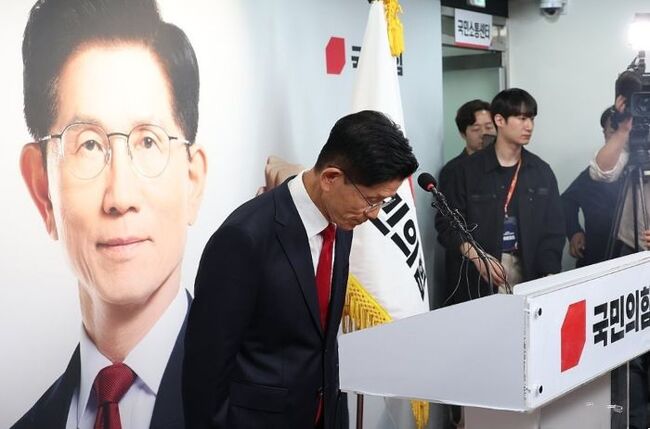 “Too little, too late?…” Kim Moon-soo, who previously conceded his presidential election defeat, now demands a special counsel investigation into ‘allegations of election fraud in the 2025 presidential election’
People Power Party presidential candidate Kim Moon-soo concedes defeat during a press conference at the party headquarters in Yeouido, Seoul, on June 4, 2025. [Joint Press Corps]As allegations emerge
“Too little, too late?…” Kim Moon-soo, who previously conceded his presidential election defeat, now demands a special counsel investigation into ‘allegations of election fraud in the 2025 presidential election’
People Power Party presidential candidate Kim Moon-soo concedes defeat during a press conference at the party headquarters in Yeouido, Seoul, on June 4, 2025. [Joint Press Corps]As allegations emerge
 Stock Market Crash 'Black Tuesday'… KOSPI down 10.8%, KOSDAQ down 7.7%
The KOSPI fell by more than 5% in early trading on the 28th, triggering a sell-side sidecar.On the 28th, the KOSPI plunged by more than 10%.Due to the sharp decline, a sell-side sidecar—a temporary
Stock Market Crash 'Black Tuesday'… KOSPI down 10.8%, KOSDAQ down 7.7%
The KOSPI fell by more than 5% in early trading on the 28th, triggering a sell-side sidecar.On the 28th, the KOSPI plunged by more than 10%.Due to the sharp decline, a sell-side sidecar—a temporary
 [World Heritage Committee] 25 New World Heritage Sites Inscribed in Busan… South Korea Successfully Expands 'Getbol' Listing
The Chairperson of the World Heritage Committee speaks at the plenary session of the 48th session of the World Heritage Committee, held at BEXCO in Busan on the 20th. [Photo: Yonhap News]A total of 25
[World Heritage Committee] 25 New World Heritage Sites Inscribed in Busan… South Korea Successfully Expands 'Getbol' Listing
The Chairperson of the World Heritage Committee speaks at the plenary session of the 48th session of the World Heritage Committee, held at BEXCO in Busan on the 20th. [Photo: Yonhap News]A total of 25
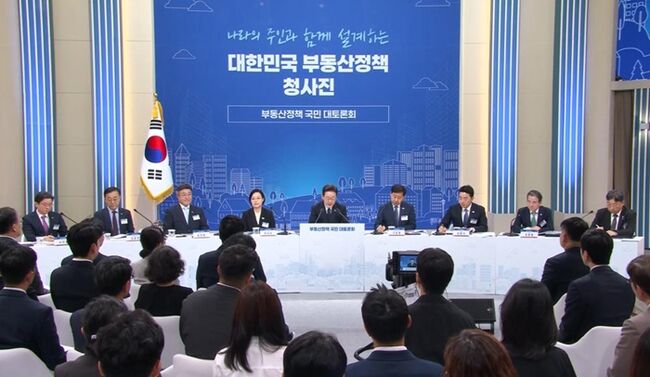 [Liberal Democratic Party Statement] Calling it a Grand Real Estate Debate… It Was Nothing More Than a Private Party Among Themselves
The 'National Grand Debate on Real Estate Policy' held on July 23rd and 27th. [Photo=Yonhap News]The 'National Grand Debate on Real Estate Policy,' hosted by the Lee Jae-myung administration under the
[Liberal Democratic Party Statement] Calling it a Grand Real Estate Debate… It Was Nothing More Than a Private Party Among Themselves
The 'National Grand Debate on Real Estate Policy' held on July 23rd and 27th. [Photo=Yonhap News]The 'National Grand Debate on Real Estate Policy,' hosted by the Lee Jae-myung administration under the
 [Photo] Evidence of Election Fraud Flooding U.S. Media… Trump Had 2.7 Million Votes Stolen
 [Video] U.S. Semiquincentennial Air Show... 'Art in the Sky' streaks across New York
 [Editorial Cartoon] A Draconian Law That Undermines Freedom of Expression

 List
List