The key theme of this week's stock movements was AI. However, it wasn't a simple AI rally.
The market did not buy every company with "AI" attached to its name. Instead, it began to differentiate between companies where AI translates into actual demand, revenue, and profits, and those facing increased AI investment burdens or concerns about cannibalizing existing businesses.
The first question in this week's stock radar is this:
For whom is AI a benefit, and for whom is it a cost?
This question was clearly evident in the US market.
Stocks linked to power semiconductors and AI infrastructure showed strong momentum, while some software and cloud companies faltered due to concerns about slowing growth. The weakness in ServiceNow and IBM was not merely an issue of individual companies.
The market has begun to re-evaluate whether AI is a force that complements the existing software ecosystem or one that replaces certain areas.
Conversely, the strength in Texas Instruments and Intel offered a different message.
It signifies that strong expectations still surround companies connected to AI's impact on data centers, semiconductors, power management, advanced processes, and industrial demand. The market's interest remains sustained in segments where AI investment translates into actual facility investment and semiconductor demand.
Tesla was also an important subject of observation.
Even if earnings are better than expected, stock prices can fluctuate if large capital expenditures and free cash flow burdens are highlighted. This demonstrates that the market's evaluation criteria for growth stocks are changing.
The market no longer solely looks at growth stories. It now considers the costs associated with growth and how those costs pressure cash flow.
In the Korean market, semiconductors remain the central axis.
The semiconductor trend, represented by Samsung Electronics and SK Hynix, directly benefits from AI demand and the recovery of the memory market. What's crucial isn't just that stock prices have risen significantly, but whether earnings forecasts can continue to be revised upward. For semiconductor stock price increases to be justified, AI demand must translate into actual orders, price increases, and margin improvements.
The next area to watch is the "diffusion stocks." After semiconductors move first, the market may turn its attention to sectors like automobiles, shipbuilding, machinery, transportation, refining, chemicals, and IT services.
However, this diffusion does not happen automatically. Each industry must demonstrate its own basis for profit improvement. A rotation where other sectors rise simply because semiconductors have risen is unlikely to be sustained.
The name for this week's stock movements is "AI Selective Filter."
The fact that AI is the market's central narrative remains unchanged. However, within AI, beneficiaries, cost-burdened stocks, and stocks facing replacement risk have begun to diverge. The earnings season is accelerating this differentiation.
This week, the market is asking stocks this:
"Show us what you can earn with AI, not just that you are related to AI."
Next week's checkpoints are threefold:
First, the earnings and capital expenditure plans of AI infrastructure companies. We need to verify if revenue growth is exceeding cost increases.
Second, whether semiconductor earnings forecasts will be further revised upward. Leading indicators in the Korean market are still semiconductors, and if earnings forecasts stagnate, stock prices may face pressure.
Third, the basis for profit improvement in diffusion stocks. For automobiles, shipbuilding, industrials, and IT services to follow semiconductors, they need a foundation for profit improvement, not just supply and demand dynamics.
※ This article is an explanatory commentary on market trends, not an investment recommendation. Actual stock prices and fund flows may vary depending on exchange rates, oil prices, geopolitical variables, corporate earnings, and policy changes.

 [Statement by the Seo-beo-kka Korea Military Academy Save-the-Nation Comrades Association] ㉛ Recount the Votes Publicly, as the Previous Recount Concealed Election Fraud
Tongyeong Mayoral Election Recount [Photo=Yonhap News]South Korea's liberal democracy is dying. The National Election Commission (NEC) and the judiciary, which have plummeted into criminal syndicates
[Statement by the Seo-beo-kka Korea Military Academy Save-the-Nation Comrades Association] ㉛ Recount the Votes Publicly, as the Previous Recount Concealed Election Fraud
Tongyeong Mayoral Election Recount [Photo=Yonhap News]South Korea's liberal democracy is dying. The National Election Commission (NEC) and the judiciary, which have plummeted into criminal syndicates
 What is the significance of the "Trump 2028" red hats that keep making a comeback?
It is noteworthy that President Donald Trump is "intentionally" fueling controversy over whether he can actually run in the 2028 presidential election, even though it is "highly likely he is seriously
What is the significance of the "Trump 2028" red hats that keep making a comeback?
It is noteworthy that President Donald Trump is "intentionally" fueling controversy over whether he can actually run in the 2028 presidential election, even though it is "highly likely he is seriously
 Jin Cummings: “North Korea says it will increase the number of spies, so what is the government doing?”
U.S. political columnist Gene Cummings has publicly questioned the South Korean government, asking, "North Korea is declaring that it will increase its number of spies, so what is the South Kore
Jin Cummings: “North Korea says it will increase the number of spies, so what is the government doing?”
U.S. political columnist Gene Cummings has publicly questioned the South Korean government, asking, "North Korea is declaring that it will increase its number of spies, so what is the South Kore
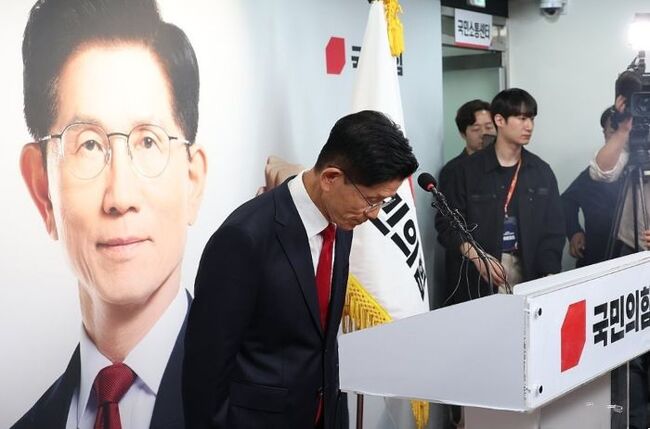 “Too little, too late?…” Kim Moon-soo, who previously conceded his presidential election defeat, now demands a special counsel investigation into ‘allegations of election fraud in the 2025 presidential election’
People Power Party presidential candidate Kim Moon-soo concedes defeat during a press conference at the party headquarters in Yeouido, Seoul, on June 4, 2025. [Joint Press Corps]As allegations emerge
“Too little, too late?…” Kim Moon-soo, who previously conceded his presidential election defeat, now demands a special counsel investigation into ‘allegations of election fraud in the 2025 presidential election’
People Power Party presidential candidate Kim Moon-soo concedes defeat during a press conference at the party headquarters in Yeouido, Seoul, on June 4, 2025. [Joint Press Corps]As allegations emerge
 Stock Market Crash 'Black Tuesday'… KOSPI down 10.8%, KOSDAQ down 7.7%
The KOSPI fell by more than 5% in early trading on the 28th, triggering a sell-side sidecar.On the 28th, the KOSPI plunged by more than 10%.Due to the sharp decline, a sell-side sidecar—a temporary
Stock Market Crash 'Black Tuesday'… KOSPI down 10.8%, KOSDAQ down 7.7%
The KOSPI fell by more than 5% in early trading on the 28th, triggering a sell-side sidecar.On the 28th, the KOSPI plunged by more than 10%.Due to the sharp decline, a sell-side sidecar—a temporary
 [World Heritage Committee] 25 New World Heritage Sites Inscribed in Busan… South Korea Successfully Expands 'Getbol' Listing
The Chairperson of the World Heritage Committee speaks at the plenary session of the 48th session of the World Heritage Committee, held at BEXCO in Busan on the 20th. [Photo: Yonhap News]A total of 25
[World Heritage Committee] 25 New World Heritage Sites Inscribed in Busan… South Korea Successfully Expands 'Getbol' Listing
The Chairperson of the World Heritage Committee speaks at the plenary session of the 48th session of the World Heritage Committee, held at BEXCO in Busan on the 20th. [Photo: Yonhap News]A total of 25
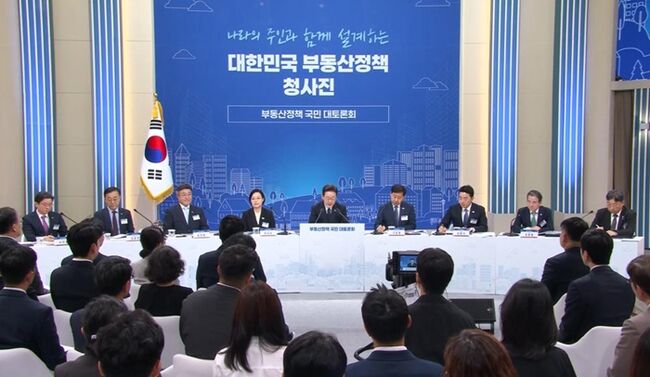 [Liberal Democratic Party Statement] Calling it a Grand Real Estate Debate… It Was Nothing More Than a Private Party Among Themselves
The 'National Grand Debate on Real Estate Policy' held on July 23rd and 27th. [Photo=Yonhap News]The 'National Grand Debate on Real Estate Policy,' hosted by the Lee Jae-myung administration under the
[Liberal Democratic Party Statement] Calling it a Grand Real Estate Debate… It Was Nothing More Than a Private Party Among Themselves
The 'National Grand Debate on Real Estate Policy' held on July 23rd and 27th. [Photo=Yonhap News]The 'National Grand Debate on Real Estate Policy,' hosted by the Lee Jae-myung administration under the
 [Photo] Evidence of Election Fraud Flooding U.S. Media… Trump Had 2.7 Million Votes Stolen
 [Video] U.S. Semiquincentennial Air Show... 'Art in the Sky' streaks across New York
 [Editorial Cartoon] A Draconian Law That Undermines Freedom of Expression

 List
List