Simply calling this week's market a "Middle East risk rally" is insufficient. Tensions in the Strait of Hormuz and the burden of rising oil prices certainly shook the market. However, that alone cannot explain this week's fund flows. While watching war news, the market simultaneously calculated corporate earnings, AI investments, semiconductor profit outlooks, and currency and interest rate paths.
This week's question for Money Insight is singular:
Why didn't the market collapse despite the fear?
The answer lies in earnings. Even if geopolitical risks escalate, the market holds firm if companies can maintain their profits. Companies with pricing power will survive even if rising oil prices increase costs. Companies with strong cash flow will endure even if interest rates do not easily decline. Funds will flow to companies where AI investments, despite their growing burden, translate into actual sales and productivity.
This week, the market began to make these distinctions. This is important.
In the past, escalating war risks meant all risk assets would shake together – a simple scenario. However, this week's market did not move that way. There were divisions even within tech stocks, disparities between national stock markets, and greater differences between individual stocks even within the same AI narrative. The market now prioritizes a company's resilience over the direction of news.
The Korean market is also within this structure.
The KOSPI entering its all-time high range might feel burdensome. However, we cannot conclude it's overheated simply because prices have risen. If the earnings outlook is also rising and valuations remain low, the market might not just be rising significantly but undergoing a re-evaluation.
However, this interpretation is conditional. The semiconductor earnings outlook must continue to be revised upward, oil prices and exchange rate pressures must be managed, and foreign investor inflows must be sustained. The key to the KOSPI's rise is not just the index number itself, but whether the grounds explaining that number continue to be built.
Three structures were confirmed in this week's market.
First, geopolitical risks create market fear but do not solely determine direction.
Second, earnings and profit outlooks create reasons for funds to remain, even amidst fear.
Third, the AI rally continues, but it is now shifting into a selective phase that distinguishes between beneficiaries and costs.
Therefore, the name for this week's trend is "Selection Amidst Fear."
The market is not reassured. The market is not unafraid. It has simply begun to differentiate between what can be bought and what cannot, even in the face of fear.
While Hormuz rattled oil prices, earnings anchored the direction of funds. AI maintained the market's narrative, but earnings season began to validate that narrative.
This week's market conclusion can be summarized as follows:
"War shook the backdrop of the market, and earnings held the market's center."
Next week's checkpoints are threefold.
First, the connection between oil prices and interest rates. If oil prices surpass the $100 mark again, inflation and interest rate expectations could be shaken.
Second, the quality of the earnings season. Beyond just the number of companies exceeding expectations, we must consider sales growth, margins, cash flow, and the burden of capital expenditures.
Third, the sustainability of the Korean market's re-evaluation. The KOSPI's upward momentum can only be sustained if the semiconductor earnings outlook, the won-dollar exchange rate, and foreign investor inflows stabilize together.
※ This article is a market trend commentary in article format, not investment advice. Actual stock prices and fund flows may vary depending on exchange rates, oil prices, geopolitical variables, corporate earnings, and policy changes.

 [Statement by the Seo-beo-kka Korea Military Academy Save-the-Nation Comrades Association] ㉛ Recount the Votes Publicly, as the Previous Recount Concealed Election Fraud
Tongyeong Mayoral Election Recount [Photo=Yonhap News]South Korea's liberal democracy is dying. The National Election Commission (NEC) and the judiciary, which have plummeted into criminal syndicates
[Statement by the Seo-beo-kka Korea Military Academy Save-the-Nation Comrades Association] ㉛ Recount the Votes Publicly, as the Previous Recount Concealed Election Fraud
Tongyeong Mayoral Election Recount [Photo=Yonhap News]South Korea's liberal democracy is dying. The National Election Commission (NEC) and the judiciary, which have plummeted into criminal syndicates
 What is the significance of the "Trump 2028" red hats that keep making a comeback?
It is noteworthy that President Donald Trump is "intentionally" fueling controversy over whether he can actually run in the 2028 presidential election, even though it is "highly likely he is seriously
What is the significance of the "Trump 2028" red hats that keep making a comeback?
It is noteworthy that President Donald Trump is "intentionally" fueling controversy over whether he can actually run in the 2028 presidential election, even though it is "highly likely he is seriously
 Jin Cummings: “North Korea says it will increase the number of spies, so what is the government doing?”
U.S. political columnist Gene Cummings has publicly questioned the South Korean government, asking, "North Korea is declaring that it will increase its number of spies, so what is the South Kore
Jin Cummings: “North Korea says it will increase the number of spies, so what is the government doing?”
U.S. political columnist Gene Cummings has publicly questioned the South Korean government, asking, "North Korea is declaring that it will increase its number of spies, so what is the South Kore
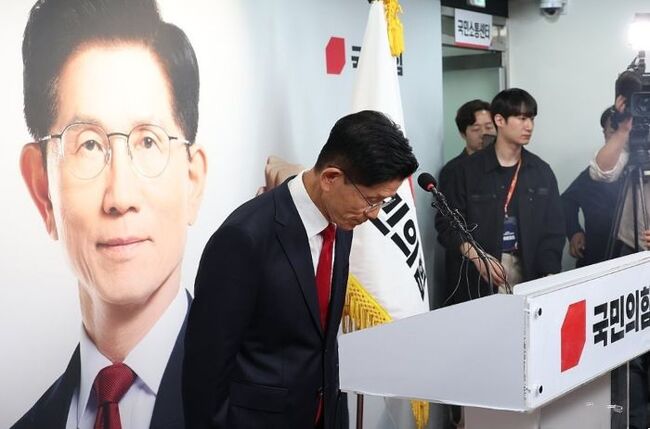 “Too little, too late?…” Kim Moon-soo, who previously conceded his presidential election defeat, now demands a special counsel investigation into ‘allegations of election fraud in the 2025 presidential election’
People Power Party presidential candidate Kim Moon-soo concedes defeat during a press conference at the party headquarters in Yeouido, Seoul, on June 4, 2025. [Joint Press Corps]As allegations emerge
“Too little, too late?…” Kim Moon-soo, who previously conceded his presidential election defeat, now demands a special counsel investigation into ‘allegations of election fraud in the 2025 presidential election’
People Power Party presidential candidate Kim Moon-soo concedes defeat during a press conference at the party headquarters in Yeouido, Seoul, on June 4, 2025. [Joint Press Corps]As allegations emerge
 Stock Market Crash 'Black Tuesday'… KOSPI down 10.8%, KOSDAQ down 7.7%
The KOSPI fell by more than 5% in early trading on the 28th, triggering a sell-side sidecar.On the 28th, the KOSPI plunged by more than 10%.Due to the sharp decline, a sell-side sidecar—a temporary
Stock Market Crash 'Black Tuesday'… KOSPI down 10.8%, KOSDAQ down 7.7%
The KOSPI fell by more than 5% in early trading on the 28th, triggering a sell-side sidecar.On the 28th, the KOSPI plunged by more than 10%.Due to the sharp decline, a sell-side sidecar—a temporary
 [World Heritage Committee] 25 New World Heritage Sites Inscribed in Busan… South Korea Successfully Expands 'Getbol' Listing
The Chairperson of the World Heritage Committee speaks at the plenary session of the 48th session of the World Heritage Committee, held at BEXCO in Busan on the 20th. [Photo: Yonhap News]A total of 25
[World Heritage Committee] 25 New World Heritage Sites Inscribed in Busan… South Korea Successfully Expands 'Getbol' Listing
The Chairperson of the World Heritage Committee speaks at the plenary session of the 48th session of the World Heritage Committee, held at BEXCO in Busan on the 20th. [Photo: Yonhap News]A total of 25
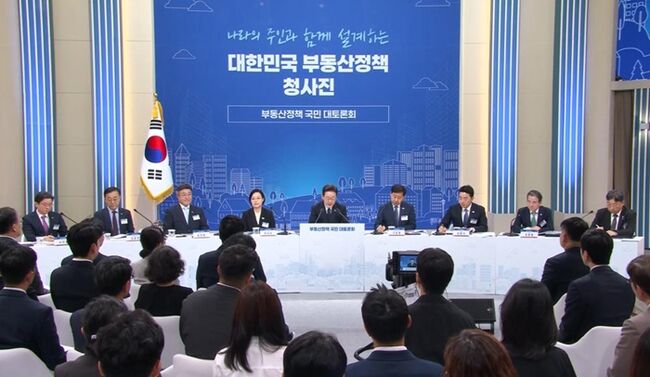 [Liberal Democratic Party Statement] Calling it a Grand Real Estate Debate… It Was Nothing More Than a Private Party Among Themselves
The 'National Grand Debate on Real Estate Policy' held on July 23rd and 27th. [Photo=Yonhap News]The 'National Grand Debate on Real Estate Policy,' hosted by the Lee Jae-myung administration under the
[Liberal Democratic Party Statement] Calling it a Grand Real Estate Debate… It Was Nothing More Than a Private Party Among Themselves
The 'National Grand Debate on Real Estate Policy' held on July 23rd and 27th. [Photo=Yonhap News]The 'National Grand Debate on Real Estate Policy,' hosted by the Lee Jae-myung administration under the
 [Photo] Evidence of Election Fraud Flooding U.S. Media… Trump Had 2.7 Million Votes Stolen
 [Video] U.S. Semiquincentennial Air Show... 'Art in the Sky' streaks across New York
 [Editorial Cartoon] A Draconian Law That Undermines Freedom of Expression

 List
List