While the first quarter growth rate rebounded thanks to semiconductors and currency effects,
the potential growth rate of the Korean economy is falling into the 1% range.
The semiconductor boom does not signify a recovery in the overall economy's strength.
More important than the growth rate figures is the question of what the next growth engine will be.
If electricity is national power, then the core after semiconductors is batteries,
and the long-term strategic axis after batteries is hydrogen.

The first-quarter growth rate of the Korean economy was stronger than market expectations.
Reuters reported that South Korea's Gross Domestic Product (GDP) in the first quarter of 2026 increased by 1.7% compared to the previous quarter, with exports growing by 5.1% driven by demand for IT components related to artificial intelligence (AI) infrastructure, such as semiconductors. The year-on-year growth rate also recorded 3.6%.
The numbers alone seem to signal an economic recovery.
However, there is an illusion in this growth rate.
This is because the base effect from last year's low growth, the sole strength of semiconductors, and the currency effect due to the weakening won all acted simultaneously. It is difficult to conclude that the fundamental strength of the entire Korean economy has improved just because semiconductors have boosted the growth rate.
Rather, the current rebound in growth is more akin to a scene showing how dependent the Korean economy is on specific industries.
The problem is the potential growth rate.
Potential growth rate is the maximum growth speed a country can achieve by utilizing labor, capital, and technology without inflationary pressure. A decrease in this figure means not just a short-term economic slump, but a weakening of the economy's long-term strength.
The OECD forecasts South Korea's potential growth rate to be 1.71% this year and 1.57% next year, and the KDI also projects that South Korea's potential growth rate will be in the high 1% range this year and could fall to around 0% by the 2040s. Fitch also lowered its estimate for South Korea's potential growth rate from 2.1% to 1.9% in January.
Although the growth rate has rebounded, the capacity for growth is declining. This is the core of this report.
It is not a coincidence that the Korean economy relies on semiconductors.
Semiconductors are the core infrastructure of the AI era. Data centers, servers, high-performance computing, autonomous driving, robotics, and defense systems all require more computational power. South Korea, with its strengths in memory semiconductors and High Bandwidth Memory (HBM), is directly benefiting from the expansion of AI investment.
However, semiconductors have large economic cycles and are sensitive to global demand and US-China technological conflicts. In a structure where a single industry props up the overall growth rate, the ability to absorb shocks inevitably weakens.
If semiconductor prices decline, export regulations intensify, or geopolitical risks like wars in the Middle East shake energy prices and exchange rates, the growth rate can quickly decrease.
Therefore, the question is not "Will semiconductors continue to do well?"
The real question is, "Where will we build the next growth engine after semiconductors?"
The first candidate is batteries.
However, the batteries mentioned here do not refer solely to electric vehicle battery cells. Future batteries will encompass the entire energy storage industry, including Energy Storage Systems (ESS), solid-state batteries, materials, recycling, grid stabilization, and long-duration storage technologies.
If semiconductors are an industry that processes information, batteries are an industry that stores electricity. AI data centers, electric vehicles, robots, smart factories, defense, and renewable energy are all moving towards increased electricity consumption. As electricity demand grows, how, when, where, and how reliably electricity is stored becomes the core of industrial competitiveness.
The International Energy Agency (IEA) evaluated in its review of Korea's energy policy that battery storage systems contribute to grid stabilization, peak demand response, and mitigation of renewable energy variability. South Korea launched its first centralized ESS contract market in July 2025 and is pursuing enhanced competitiveness in lithium battery-based ESS and the development of non-lithium long-duration storage technologies.
The direction is already changing in the industrial field.
LG Energy Solution has signed a contract to supply 5 GWh of LFP batteries for ESS to Hanwha Q CELLS USA for the period 2028-2030. SK On has also agreed to supply LFP batteries for ESS, with a capacity of up to 7.2 GWh, to Flatiron Energy in the U.S. for the period 2026-2030. Amidst the slowdown in EV demand, Korean battery companies are expanding their focus to the ESS market.
At this point, batteries become not just a manufacturing product but a strategic industry for power sovereignty. If electricity is national power, then the technology to store electricity is industrial power.
Even if power plants are built, the power grid becomes unstable if the electricity cannot be stored. Even if renewable energy is increased, supply variability cannot be avoided without storage. Even if AI data centers are established, the industrial foundation will be shaky without stable electricity storage and distribution.
Therefore, if we have to pick one industry after semiconductors, it would be batteries.
However, to be precise, it is not just "battery cells" but the "battery-based energy storage industry." This industry becomes a growth engine when it moves in conjunction with the power grid, materials, recycling, electricity market systems, and long-duration storage technologies.
The next long-term axis is hydrogen.
Hydrogen is not a competing technology with batteries. While batteries are strong in short-term storage and rapid discharge, hydrogen can have strengths in long-term storage, long-distance transportation, and industrial fuel.
Hydrogen holds strategic significance in areas difficult to electrify, such as steel, chemicals, shipping, large-scale transportation, and long-distance energy transport.
According to the IEA, global hydrogen demand reached nearly 100 million tons in 2024, but low-emission hydrogen production still accounts for less than 1% of the total. The hydrogen industry is still in its early stages, with significant uncertainties in cost, demand, and infrastructure. However, it is precisely for this reason that it needs to be considered a long-term strategic industry.
Ultimately, the next growth strategy for the Korean economy is not a choice between "semiconductors or batteries."
Semiconductors are the axis of information processing, batteries are the axis of power storage, and hydrogen is the axis of energy transport and long-term storage. These three industries do not move independently but are connected into a single industrial order through AI, electricity, defense, robotics, mobility, and the power grid.
The government is also emphasizing the need to rebound the potential growth rate.
Deputy Prime Minister Gu Yoon-cheol stated his intention to make this year the first year for a rebound in potential growth rate, mentioning the AI great transformation, the green great transformation, and the fostering of second and third semiconductor industries such as defense, biotech, and K-culture. He also announced plans to prepare the economic growth strategy for the second half of the year around June.
However, potential growth rates do not increase simply by listing industry names.
The growth engines after semiconductors are created when technology, capital, human resources, electricity, regulations, and markets move together. For batteries and hydrogen to become the second and third growth engines, beyond manufacturing promotion policies, reforms in the electricity market, investment in the power grid, supply chains for materials, recycling systems, safety standards, and the training of specialized personnel must be designed concurrently.
The risk for the Korean economy does not lie in the strength of semiconductors. The risk lies in the failure to build other growth engines while semiconductors are strong. The rebound in first-quarter growth figures is a number to be relieved about, but the decline in potential growth rate is an unavoidable warning.
The conclusion of this report is clear.
Semiconductors are still the present of the Korean economy. However, the next industry is batteries, and the subsequent strategic axis is hydrogen. More precisely, the future of the Korean economy depends on who designs the power sovereignty industry connecting semiconductors, batteries, and hydrogen first.
Growth rates can rebound with numbers. However, potential growth rates rebound only when the industrial structure changes.
The question the Korean economy must ask now is not "What percentage will it grow by this year?" but "Who will dominate the post-semiconductor power industry order?"

 [Statement by the Seo-beo-kka Korea Military Academy Save-the-Nation Comrades Association] ㉛ Recount the Votes Publicly, as the Previous Recount Concealed Election Fraud
Tongyeong Mayoral Election Recount [Photo=Yonhap News]South Korea's liberal democracy is dying. The National Election Commission (NEC) and the judiciary, which have plummeted into criminal syndicates
[Statement by the Seo-beo-kka Korea Military Academy Save-the-Nation Comrades Association] ㉛ Recount the Votes Publicly, as the Previous Recount Concealed Election Fraud
Tongyeong Mayoral Election Recount [Photo=Yonhap News]South Korea's liberal democracy is dying. The National Election Commission (NEC) and the judiciary, which have plummeted into criminal syndicates
 What is the significance of the "Trump 2028" red hats that keep making a comeback?
It is noteworthy that President Donald Trump is "intentionally" fueling controversy over whether he can actually run in the 2028 presidential election, even though it is "highly likely he is seriously
What is the significance of the "Trump 2028" red hats that keep making a comeback?
It is noteworthy that President Donald Trump is "intentionally" fueling controversy over whether he can actually run in the 2028 presidential election, even though it is "highly likely he is seriously
 Jin Cummings: “North Korea says it will increase the number of spies, so what is the government doing?”
U.S. political columnist Gene Cummings has publicly questioned the South Korean government, asking, "North Korea is declaring that it will increase its number of spies, so what is the South Kore
Jin Cummings: “North Korea says it will increase the number of spies, so what is the government doing?”
U.S. political columnist Gene Cummings has publicly questioned the South Korean government, asking, "North Korea is declaring that it will increase its number of spies, so what is the South Kore
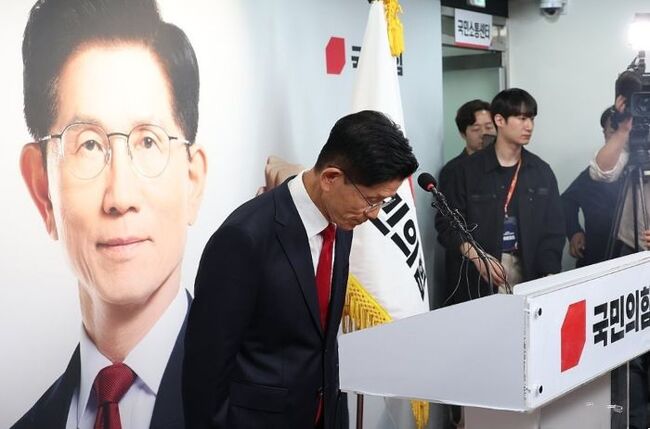 “Too little, too late?…” Kim Moon-soo, who previously conceded his presidential election defeat, now demands a special counsel investigation into ‘allegations of election fraud in the 2025 presidential election’
People Power Party presidential candidate Kim Moon-soo concedes defeat during a press conference at the party headquarters in Yeouido, Seoul, on June 4, 2025. [Joint Press Corps]As allegations emerge
“Too little, too late?…” Kim Moon-soo, who previously conceded his presidential election defeat, now demands a special counsel investigation into ‘allegations of election fraud in the 2025 presidential election’
People Power Party presidential candidate Kim Moon-soo concedes defeat during a press conference at the party headquarters in Yeouido, Seoul, on June 4, 2025. [Joint Press Corps]As allegations emerge
 Stock Market Crash 'Black Tuesday'… KOSPI down 10.8%, KOSDAQ down 7.7%
The KOSPI fell by more than 5% in early trading on the 28th, triggering a sell-side sidecar.On the 28th, the KOSPI plunged by more than 10%.Due to the sharp decline, a sell-side sidecar—a temporary
Stock Market Crash 'Black Tuesday'… KOSPI down 10.8%, KOSDAQ down 7.7%
The KOSPI fell by more than 5% in early trading on the 28th, triggering a sell-side sidecar.On the 28th, the KOSPI plunged by more than 10%.Due to the sharp decline, a sell-side sidecar—a temporary
 [World Heritage Committee] 25 New World Heritage Sites Inscribed in Busan… South Korea Successfully Expands 'Getbol' Listing
The Chairperson of the World Heritage Committee speaks at the plenary session of the 48th session of the World Heritage Committee, held at BEXCO in Busan on the 20th. [Photo: Yonhap News]A total of 25
[World Heritage Committee] 25 New World Heritage Sites Inscribed in Busan… South Korea Successfully Expands 'Getbol' Listing
The Chairperson of the World Heritage Committee speaks at the plenary session of the 48th session of the World Heritage Committee, held at BEXCO in Busan on the 20th. [Photo: Yonhap News]A total of 25
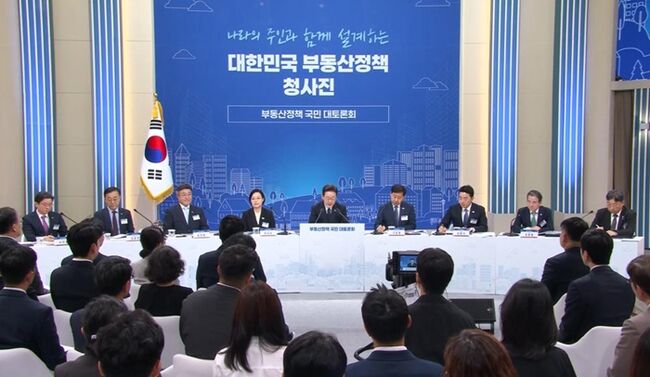 [Liberal Democratic Party Statement] Calling it a Grand Real Estate Debate… It Was Nothing More Than a Private Party Among Themselves
The 'National Grand Debate on Real Estate Policy' held on July 23rd and 27th. [Photo=Yonhap News]The 'National Grand Debate on Real Estate Policy,' hosted by the Lee Jae-myung administration under the
[Liberal Democratic Party Statement] Calling it a Grand Real Estate Debate… It Was Nothing More Than a Private Party Among Themselves
The 'National Grand Debate on Real Estate Policy' held on July 23rd and 27th. [Photo=Yonhap News]The 'National Grand Debate on Real Estate Policy,' hosted by the Lee Jae-myung administration under the
 [Photo] Evidence of Election Fraud Flooding U.S. Media… Trump Had 2.7 Million Votes Stolen
 [Video] U.S. Semiquincentennial Air Show... 'Art in the Sky' streaks across New York
 [Editorial Cartoon] A Draconian Law That Undermines Freedom of Expression

 List
List