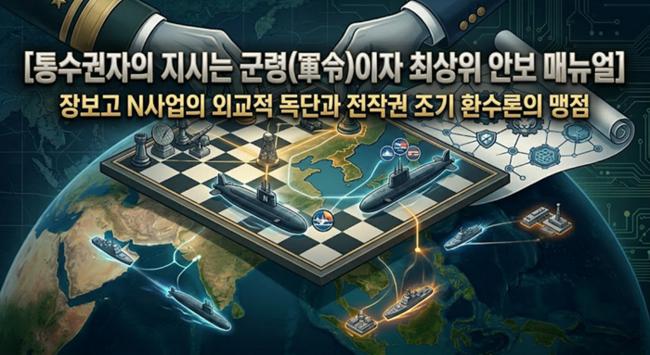
The unilateral announcement of the 'Jang Bogo N (nuclear-powered submarine) project' between South Korea and the US, without prior consultation, is an act of diplomatic autocracy that overlooks the harsh realities of alliance calculations and a financial gamble. The 3,000-ton class submarine 'Jang Bogo-III' [Photo = Yonhap News]
A commander-in-chief's directive and declaration are military orders and the highest security manuals.
In a field army, before a single order is issued, commanders and their staffs act as a unified decision-making body to analyze missions, assess friendly and enemy capabilities, devise the best strategies, and develop contingency plans to respond to the worst-case scenarios.
Therefore, orders are only given after numerous war games have been conducted to control risks to near zero. This is because diplomacy should not involve luck, 'tentative steps,' or 'bold moves' in the realm of security, which is the highest domain of national survival.
However, the recent announcement by the government regarding the development plan for a Korean-style nuclear-powered submarine (nuclear submarine), the 'Jang Bogo N project,' and President Lee's remarks surrounding the transfer (reclamation) of wartime operational control (OPCON) are shaking the fundamental security manual to its core.
There are no experts who would disagree with the necessity of strengthening defense capabilities in response to North Korea's nuclear advancements. The problem lies in the fact that the method of propulsion is not based on thorough strategic calculations, but rather on consolidating support for the upcoming June 3rd local elections and leaning towards an immature 'peace theory.'
1. Diplomatic Autocracy Overlooking the Harsh Calculations of the Alliance
The unilateral announcement of the 'Jang Bogo N (nuclear-powered submarine) project' between South Korea and the US, without prior consultation, is an act of diplomatic autocracy that overlooks the harsh realities of alliance calculations and a financial gamble.
The acquisition of 'low-enriched uranium,' the core component of a nuclear-powered submarine, and the domestic construction plan are blocked by the barriers of the South Korea-US Atomic Energy Agreement and the US Congress's strong non-proliferation stance, with no face-to-face consultations having taken place for the past six months.
Specifically, while South Korea views a nuclear submarine as an 'underwater kill chain' to counter North Korea's nuclear weapons, the United States sees it as a combined force to check China in the Western Pacific. Considering the case of Australia (AUKUS), which received nuclear submarine technology after demonstrating a firm military commitment, pursuing an independent path while ignoring the US demand to participate in the front against China will only lead to diplomatic friction.
Considering the introduction of France's 'Scorpène-class reactor' to avoid US obstruction is also a dangerous idea that invites a rupture in the combined defense posture. If the US later forces construction in US shipyards or links it to pressure for increased defense cost-sharing, the 29 trillion won budget for the nuclear submarine will skyrocket astronomically, and in conjunction with the 40 trillion won budget for OPCON transfer, a national financial conflict will be unavoidable.
It is urgent to secure practical understanding and trust through working-level negotiations between South Korea and the US, rather than engaging in a race against time driven by political motives.
2. The Danger of the Early OPCON Transfer Theory Claiming 'No Problem'
With North Korea's nuclear threat becoming a daily reality, the early transfer of OPCON is not simply a recovery of military sovereignty but an act of suicidal security for the Republic of Korea. Currently, North Korea is virtually solidifying its status as a nuclear-armed state and intensifying pressure southward through Russian troop deployment and close trilateral cooperation between North Korea, Russia, and China.
At a time when North Korea even declares nuclear war by defining the North and South as 'hostile states,' the commander-in-chief's assertion that there are 'no problems' with the early transfer of OPCON is a dangerously oblivious statement to the security reality.
Is the statement "no problems" regarding the early transfer, which would lead to the dissolution of the 'ROK-US Combined Forces Command,' the core of deterrence that has maintained peace on the Korean Peninsula for the past 70 years, a statement made on behalf of North Korea's position? Where does such a reckless remark originate?
The US has already indicated that upon the transfer of OPCON, it will dissolve the Combined Forces Command and move to a 'separated command structure for Korea and the US (parallel command structure).' This is due to the 'Pershing Principle,' which states that US forces do not come under the command of foreign forces. If the command separation system, which was actually pursued during the Roh Moo-hyun administration, becomes a reality, the automatic intervention and rapid deployment of US reinforcement forces in case of emergency will be completely nullified.
The moment we, who lack independent nuclear deterrence capabilities, reject the free nuclear umbrella shield of the world's strongest 'ROK-US Combined Forces Command,' the combined forces will collapse, and the Korean Peninsula will be reduced to a hostage of North Korea's nuclear weapons. This is the scenario that North Korea, which desires the collapse of our security, would most eagerly await.
We must immediately cease this reckless rush that gambles with the lives of our citizens, driven by the ideological illusion of self-reliance, and thoroughly verify our tactical capabilities in accordance with the 'conditions-based transfer' principle agreed upon in 2014.
3. Security is Not 'Words' but Diplomacy to Prevent War and a Struggle for Survival
Security is not a castle in the air built with words. It is constructed only on the triangular framework of the harsh 'alliance equation,' 'financial backing,' and 'contingency plans' that assume the worst-case scenario.
In modern international politics, no country advocates for 'independent defense.' Even the US, with the world's strongest military, operates NATO and expands its global alliance system. Japan also operates with the US-Japan alliance as its core. Immature directives thrown out without alternatives undermine policy credibility, expose our hand to the enemy, and only cause distrust and fatigue among allies.
The government should reflect on the security policies it has pursued so far. Have there been policies that instill fear in the enemy? We must examine whether these policies are benefiting the enemy under the guise of peace and serving as events to build up the achievements of a faction, and stop them now if necessary. The public hopes that the 'Jang Bogo N project' will reflect the fact that they crave one nuclear weapon more than 100 nuclear submarines.
A directive from the commander-in-chief that does not consider sophisticated security logic and meticulous contingency plans is not 'independent defense' but 'voluntary security self-harm.' We hope that the security line will directly inform the commander-in-chief about the harsh international situation and present clear alternatives that the public can accept.
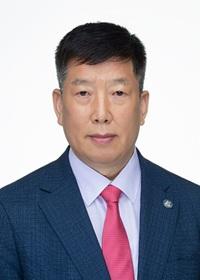
◆ Park Pil-gyu
Editorial Board Member, The Hankyoreh
40th graduating class, Korea Military Academy

 [Statement by the Seobeokka KMA Patriots Association] ㉛ Recount the ballots openly, as the previous recount covered up election fraud
Recount of the Tongyeong mayoral election [Photo=Yonhap News]South Korea's liberal democracy is dying. The National Election Commission (NEC), which has degraded into a criminal organization through t
[Statement by the Seobeokka KMA Patriots Association] ㉛ Recount the ballots openly, as the previous recount covered up election fraud
Recount of the Tongyeong mayoral election [Photo=Yonhap News]South Korea's liberal democracy is dying. The National Election Commission (NEC), which has degraded into a criminal organization through t
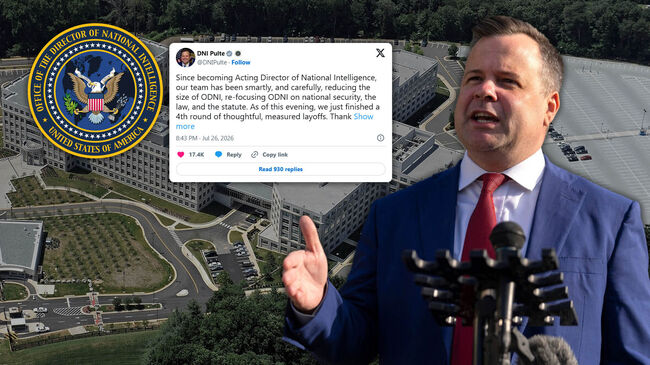 Bill Pulte to Restructure ‘Deep State’… Announces 4th Round of Layoffs at the Office of the Director of National Intelligence
Acting Director of National Intelligence Bill Pulte announced Sunday that he has carried out a fourth "deliberate and measured" reduction in personnel since taking office on June 19, as part of the Tr
Bill Pulte to Restructure ‘Deep State’… Announces 4th Round of Layoffs at the Office of the Director of National Intelligence
Acting Director of National Intelligence Bill Pulte announced Sunday that he has carried out a fourth "deliberate and measured" reduction in personnel since taking office on June 19, as part of the Tr
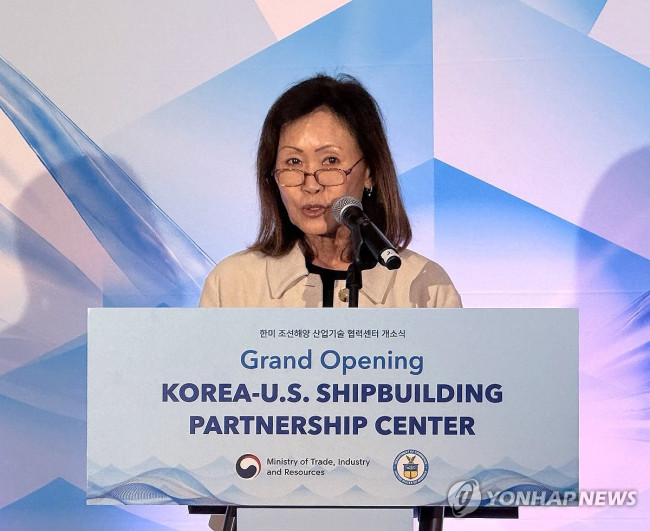 First U.S. Ambassador of Trump's Second Term to Arrive This Week… Will It Provide Momentum to Resolve Pending Issues?
U.S. Ambassador to South Korea Michelle Steel speaks at the opening ceremony of the Korea-U.S. Shipbuilding Cooperation Center held at the Mayflower Hotel in Washington, D.C., on the 23rd (local time)
First U.S. Ambassador of Trump's Second Term to Arrive This Week… Will It Provide Momentum to Resolve Pending Issues?
U.S. Ambassador to South Korea Michelle Steel speaks at the opening ceremony of the Korea-U.S. Shipbuilding Cooperation Center held at the Mayflower Hotel in Washington, D.C., on the 23rd (local time)
 President Yoon, regarding the first-instance ruling on the Public Official Election Act: “An excessive political verdict that distorts the facts… We will appeal immediately.”
The first-instance sentencing hearing for President Yoon Suk Yeol regarding violations of the Public Official Election Act is being broadcast live at Seoul Station on the 27th. [Photo=Yonhap News]Pres
President Yoon, regarding the first-instance ruling on the Public Official Election Act: “An excessive political verdict that distorts the facts… We will appeal immediately.”
The first-instance sentencing hearing for President Yoon Suk Yeol regarding violations of the Public Official Election Act is being broadcast live at Seoul Station on the 27th. [Photo=Yonhap News]Pres
 91% of Net Influx of MZ Generation Goes to Seoul Metropolitan Area… Population Migration Also Shows 'K-shaped Polarization' by Industry
[Provided by Leaders Index]Over the past four years, the MZ generation population has become increasingly concentrated in the Seoul metropolitan area and the Chungcheong region. While cities cen
91% of Net Influx of MZ Generation Goes to Seoul Metropolitan Area… Population Migration Also Shows 'K-shaped Polarization' by Industry
[Provided by Leaders Index]Over the past four years, the MZ generation population has become increasingly concentrated in the Seoul metropolitan area and the Chungcheong region. While cities cen
 'Godfather of Japanese Mystery Novels' Keigo Higashino Passes Away After Battle with Cancer at 68
Famous Japanese mystery novelist Keigo Higashino [AFP=Yonhap News]It has been belatedly reported that Keigo Higashino, the "godfather of Japanese mystery novels" and author of bestsellers such as "The
'Godfather of Japanese Mystery Novels' Keigo Higashino Passes Away After Battle with Cancer at 68
Famous Japanese mystery novelist Keigo Higashino [AFP=Yonhap News]It has been belatedly reported that Keigo Higashino, the "godfather of Japanese mystery novels" and author of bestsellers such as "The
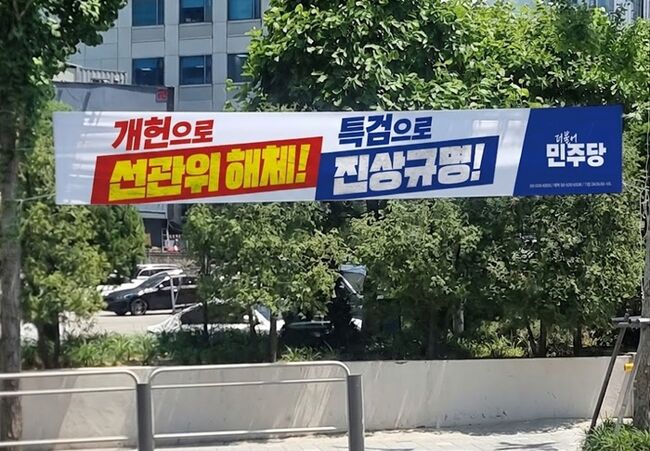 [Cho Yang-geon Column] The NEC: Facing a Fate of "Discarding the Dog After the Hunt"
Banner calling for the "dissolution of the NEC" posted by the Democratic Party. [AI-generated image]Banners calling for the "dissolution of the National Election Commission (NEC)" posted by the Democr
[Cho Yang-geon Column] The NEC: Facing a Fate of "Discarding the Dog After the Hunt"
Banner calling for the "dissolution of the NEC" posted by the Democratic Party. [AI-generated image]Banners calling for the "dissolution of the National Election Commission (NEC)" posted by the Democr
 [Photo] Evidence of Election Fraud Flooding U.S. Media… Trump Had 2.7 Million Votes Stolen
 [Video] U.S. Semiquincentennial Air Show... 'Art in the Sky' streaks across New York
 [Editorial Cartoon] A Draconian Law That Undermines Freedom of Expression

 List
List