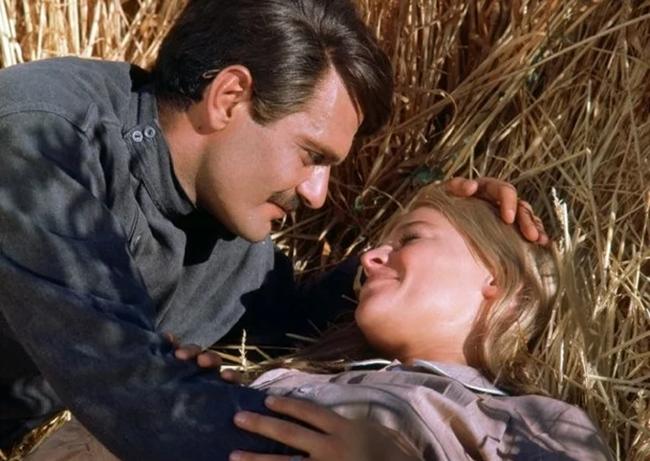
 Works that contained even the slightest hint of questioning the revolution or the regime were treated as dangerous. The novel Doctor Zhivago by Russian writer Boris Pasternak is a prime example. [Movie still cut]
Humans are inherently questioning beings. We ask why, doubt if something is truly right, and confirm if there are other perspectives. Civilization has evolved based on these questions. Philosophy, science, and literature all began with human doubt.
However, at some point, an era emerged where questioning itself became dangerous. The atmosphere became one where a person's attitude and intent behind a question were judged before the question itself.
“Why would you say that?” “Why do you specifically need to ask that?” “Which side are you on?”
When such remarks become commonplace, people don't change their thoughts; they first learn silence. It's not just about avoiding saying the wrong thing. People cease to express their inner thoughts at all. Remaining silent becomes safer than speaking.
This atmosphere has been repeated throughout history.
In 20th-century Soviet Union, countless writers had to write with the state's scrutiny in mind. Works that contained even the slightest hint of questioning the revolution or the regime were treated as dangerous. The novel Doctor Zhivago by Russian writer Boris Pasternak is a prime example.
This work was a novel depicting the suffering and confusion of individuals amidst revolution. However, Soviet authorities found it highly uncomfortable because it did not unconditionally praise the revolution. Consequently, the novel was not published within the Soviet Union and was first released abroad.
Later, Pasternak was selected as the recipient of the Nobel Prize in Literature but was forced to refuse the award under immense pressure.
What is important is that the Soviet Union at the time did not critique the work on literary grounds. They did not attack it by saying the prose was poor or the artistic merit was lacking. Instead, they questioned, “Why do you hold such a perspective?” Even a small doubt about the revolution was seen as dangerous. It was the moment when the question itself began to be considered an attack.
Similar events occurred during China's Cultural Revolution. Numerous professors, writers, and artists were dragged out for public criticism and struggle sessions. Lao She, a prominent Chinese writer, was also publicly insulted and beaten by the Red Guards.
Under extreme pressure and humiliation, he ended his life in Beijing's Taiping Lake in 1966. It wasn't because his works suddenly lost their value. It was because the era did not permit doubt or distance.
The revolution had to be always right. The regime could not be wrong. Questions were treated as betrayal. As a result, people began to practice self-censorship before discussion. “Will I get into trouble if I say this?” “Will I be singled out if I speak up unnecessarily?” “It’s better to just stay quiet.”
When this atmosphere persists for a long time, society becomes outwardly quiet. However, this silence is often not one of consensus but of fear. People fall silent not because they truly agree, but because they are weary and afraid.
One of the most chilling works that depicts this issue is '1984'. British author George Orwell portrayed a society in this novel where thought itself becomes a crime.
People in the work fear their thoughts more than their actions. The state feared not armed rebellion the most. It feared doubt that originated from within individuals. Therefore, people spy on each other and hide their true feelings even from friends. At some point, not wrong actions, but wrong thoughts themselves become dangerous.
This atmosphere is not unfamiliar today. Modern society is not an era where the state directly arrests writers as in the past. However, other forms of pressure still exist. When questions are posed about certain issues, the person is often attacked before the content of the question itself.
“That person’s intentions are strange.” “Why do they feel the need to say that?” “That’s a dangerous thought.”
As a result, people increasingly avoid sensitive topics. They avoid political discussions, social issue discussions, and refrain from making statements that could cause controversy. They are cautious at company gatherings, at school, and online.
At this point, society appears peaceful on the surface. However, it is not truly so. It is not that people are quiet because they speak freely, but because the cost of speaking out has become too high.
Literature is originally a genre that deals with human wavering. Humans always hesitate, regret, and doubt. Characters in good novels are not perfect beings. They falter, fail, and re-examine their own thoughts.
However, when society begins to demand "humans without doubt," literature also becomes increasingly barren. Characters who merely repeat correct answers increase, replacing living human beings.
Freedom of expression is not simply about speaking a lot. What is truly important is an atmosphere where questions can be asked. A society where questions are alive experiences conflict and debate. Sometimes it is noisy and uncomfortable. However, such a society endures.
Conversely, a society where everyone remains silent out of apprehension may appear stable on the surface, but internally, the capacity for thought gradually dies. People increasingly scrutinize the surrounding atmosphere before their own thoughts. They ponder what is safe before what is true.
The coercion of silence is not merely about silencing mouths. It is a process through which humans lose the power to think for themselves.
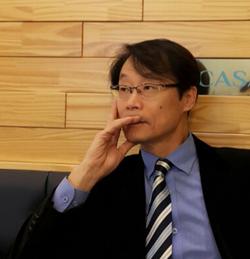
◆ Songsan
A poet and researcher of history and philosophy. Former director of the Syngman Rhee Institute. Currently serves as a research advisor for the Korean Modern and Contemporary History Research Society and as the representative of the philosophical forum Lyceum. He has published four poetry collections, co-translated 'Heroes of Hook Island,' and authored the humanities books 'Joseon, a Myth,' 'Humanities on the Tatami,' and 'A Liberal's Reading of Gramsci.' Songsan is a pen name.

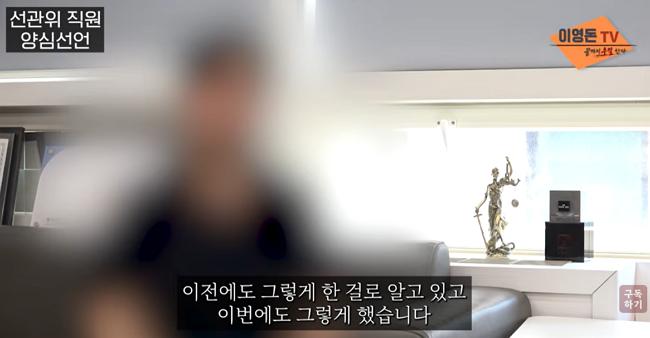 [Focus] Why did the dedicated communication network, checked three times, stop?... Three questions about the "Wi-Fi connection" for early voting
In the broadcast of Lee Young-don TV on the 16th, a current National Election Commission official exposes the reality of the 6.3 local elections based on direct experience. [Photo=Screenshot fr
[Focus] Why did the dedicated communication network, checked three times, stop?... Three questions about the "Wi-Fi connection" for early voting
In the broadcast of Lee Young-don TV on the 16th, a current National Election Commission official exposes the reality of the 6.3 local elections based on direct experience. [Photo=Screenshot fr
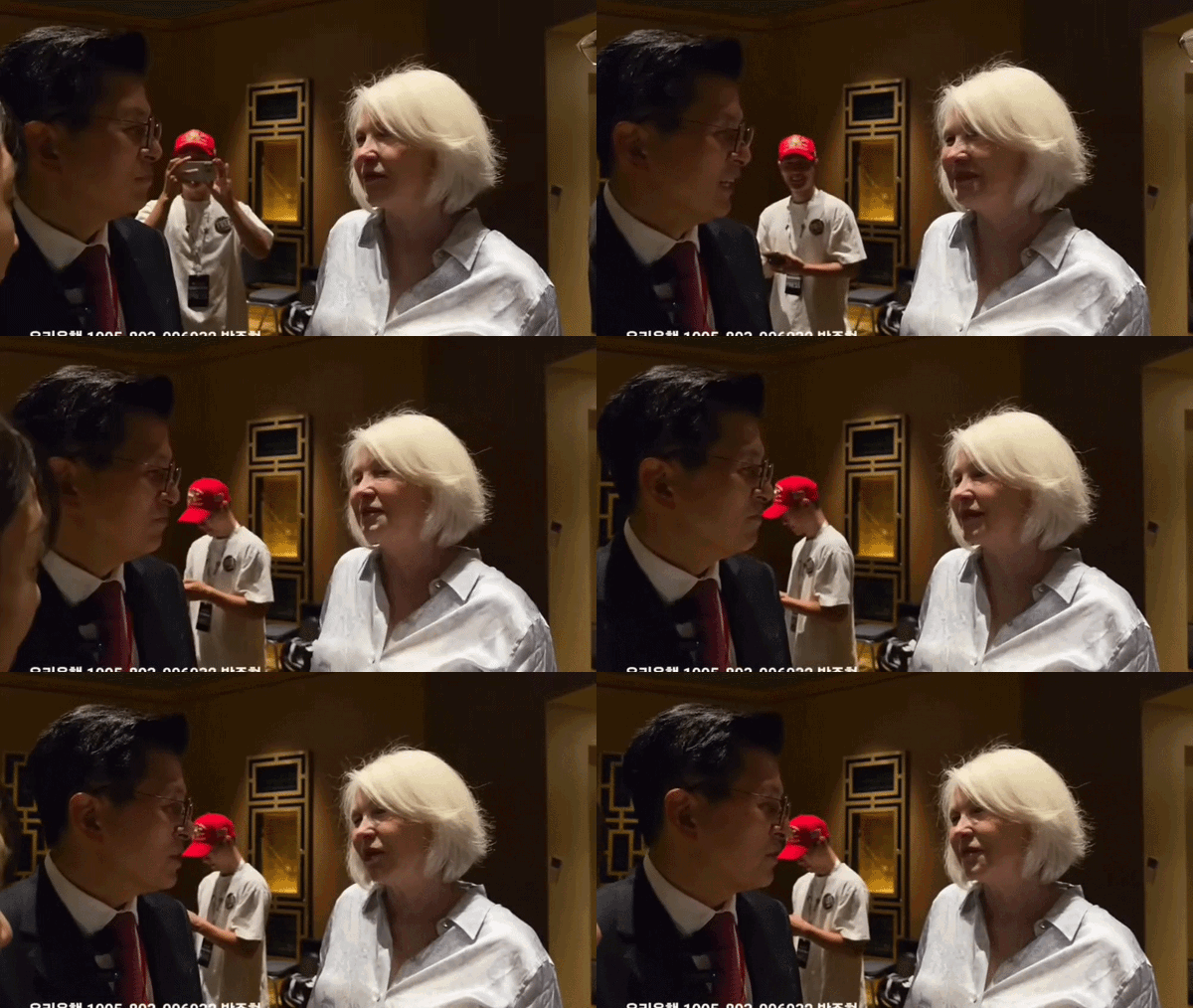 Hwang Kyo-ahn, Representative, Meets with US 'Election Fraud Warrior' and Says, "Korea is in crisis, please intervene, Mr. Trump."
Hwang Kyo-ahn, leader of the Freedom and Innovation Party (left), speaks with Tina Peters, former Mesa County Clerk from Colorado, known as an "election fraud warrior" in the US who has fought against
Hwang Kyo-ahn, Representative, Meets with US 'Election Fraud Warrior' and Says, "Korea is in crisis, please intervene, Mr. Trump."
Hwang Kyo-ahn, leader of the Freedom and Innovation Party (left), speaks with Tina Peters, former Mesa County Clerk from Colorado, known as an "election fraud warrior" in the US who has fought against
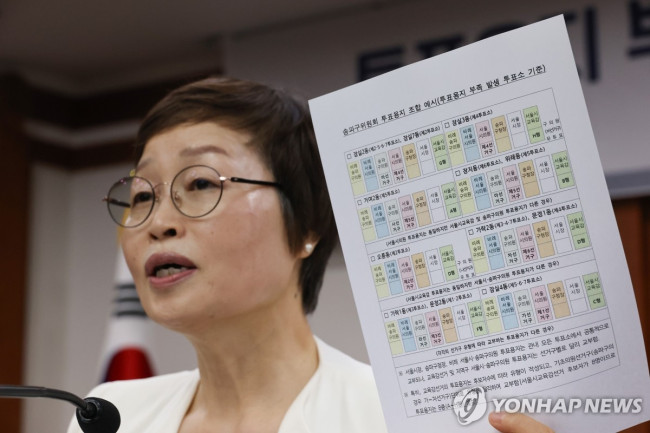 Fact-Finding Committee: "Total mismanagement of election administration... Recommend referral for investigation of Noh Tae-hak and others."
On the 19th, Cho Hyun-wook, chairman of the 'Investigation Committee for the Ballot Paper Shortage Incident', briefs the final investigation results at the National Election Commission in Gwacheon, Gy
Fact-Finding Committee: "Total mismanagement of election administration... Recommend referral for investigation of Noh Tae-hak and others."
On the 19th, Cho Hyun-wook, chairman of the 'Investigation Committee for the Ballot Paper Shortage Incident', briefs the final investigation results at the National Election Commission in Gwacheon, Gy
 Prosecution Demands 2 Years Imprisonment and Fine for Lee Hwa-young for Perjury and Splitting Donations
Former Gyeonggi Province Vice Governor Lee Hwa-young, who appeared as a witness at a hearing related to the Ssangbangul North Korea remittance case held by the parliamentary special committee for the
Prosecution Demands 2 Years Imprisonment and Fine for Lee Hwa-young for Perjury and Splitting Donations
Former Gyeonggi Province Vice Governor Lee Hwa-young, who appeared as a witness at a hearing related to the Ssangbangul North Korea remittance case held by the parliamentary special committee for the
 Is the JoongAng Ilbo's dominance crumbling? With no money, JoongAng Ilbo finally files for workout program.
There is intense interest in whether a major seismic shift will occur in the South Korean newspaper industry, potentially toppling the long-standing dominance of the JoongAng, Chosun, and Dong-A Ilbo
Is the JoongAng Ilbo's dominance crumbling? With no money, JoongAng Ilbo finally files for workout program.
There is intense interest in whether a major seismic shift will occur in the South Korean newspaper industry, potentially toppling the long-standing dominance of the JoongAng, Chosun, and Dong-A Ilbo
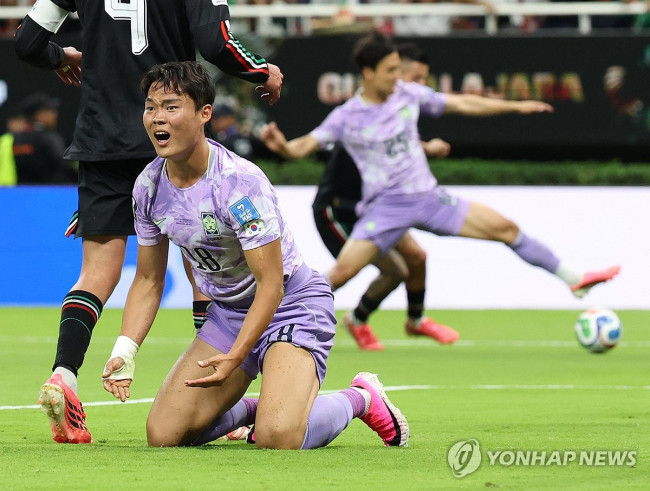 Hong Myung-bo's team loses 0-1 to host nation Mexico
The 2026 North, Central America and Caribbean World Cup Group A second round match between South Korea and Mexico held at the Guadalajara Stadium in Zapopan, Mexico, on the 18th (local time). National
Hong Myung-bo's team loses 0-1 to host nation Mexico
The 2026 North, Central America and Caribbean World Cup Group A second round match between South Korea and Mexico held at the Guadalajara Stadium in Zapopan, Mexico, on the 18th (local time). National
 [Photo] Current status of Chairman Hwang Kyo-ahn and lawyer Park Joo-hyun attending the US election fraud fighter summit
Lawyer Park Joo-hyun with lawyer Peter Ticktin, who was pardoned by U.S. President Donald Trump. [Facebook]Hwang Kyo-ahn, leader of the Liberty and Innovation Party (second from left), informing about
[Photo] Current status of Chairman Hwang Kyo-ahn and lawyer Park Joo-hyun attending the US election fraud fighter summit
Lawyer Park Joo-hyun with lawyer Peter Ticktin, who was pardoned by U.S. President Donald Trump. [Facebook]Hwang Kyo-ahn, leader of the Liberty and Innovation Party (second from left), informing about
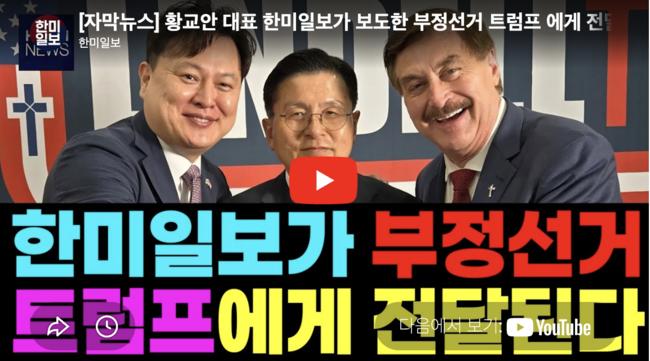 [Video] 'Trump's close friend' Lindell "I will inform Trump about South Korea's fraudulent election"
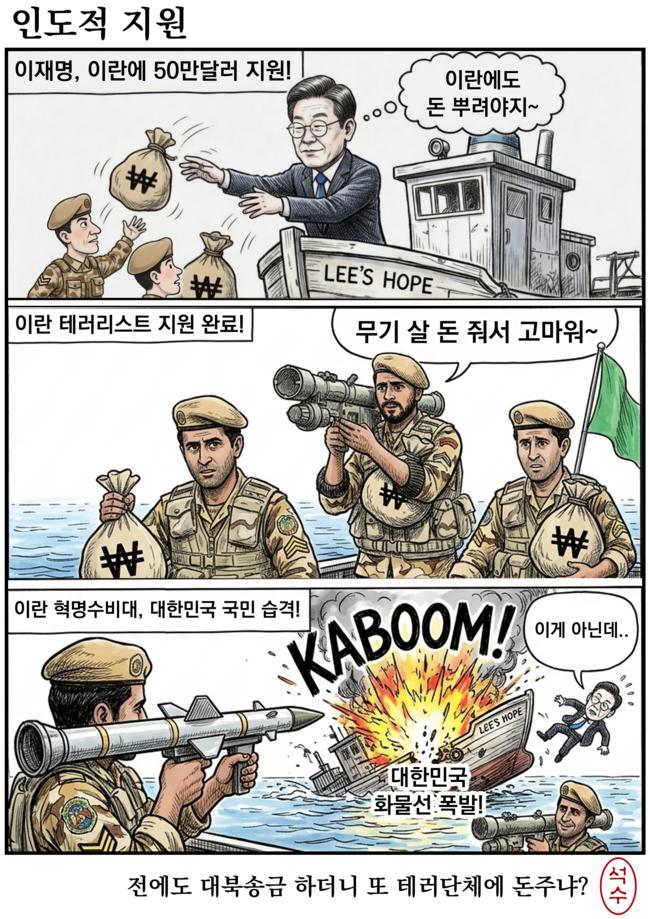 [Editorial Cartoon] Humanitarian Aid

 List
List