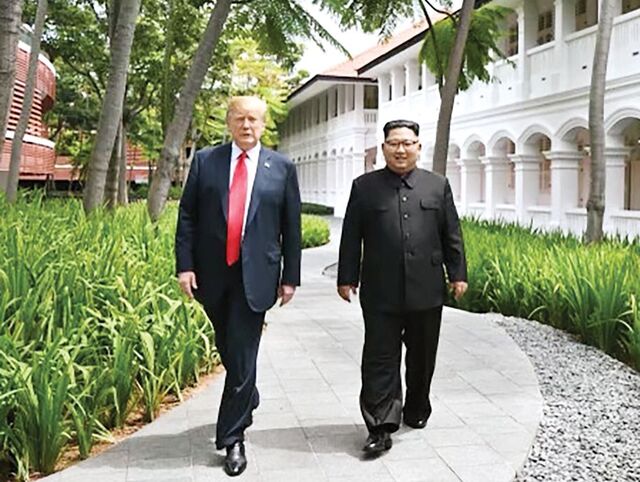
 On June 12, 2018, U.S. President Donald Trump walks with Kim Jong Un in the garden of the Capella Hotel, the summit venue, during the first North Korea-U.S. summit held in Singapore. President Trump posted the photo on social media on the 13th (local time) without further explanation. [Photo=Truth Social]
On the 19th (local time), U.S. political columnist Gene Cummings asked on Facebook what Trump's critics had been doing while Trump was bringing Iran to its knees.
He clarified that the "U.S.-Iran interim Memorandum of Understanding (MOU)" signed by U.S. President Donald Trump is "not a final peace agreement. It is a memorandum of understanding created to finalize the remaining technical details and implementation procedures within 60 days after the U.S. and Iran have already reached a provisional agreement on broad terms."
In other words, it is not the starting point for ending the war, but rather a document from the final negotiation stage before reaching a final agreement.
He then explained the document, stating, "This is a structure where if Iran implements the opening of the Strait of Hormuz, a nuclear freeze, and acceptance of monitoring of nuclear facilities, the U.S. will gradually provide sanctions relief and asset unfreezing."
However, he emphasized that since Iran is a country that can break the agreement and provoke again at any time, the situation could change in a completely different direction depending on how Iran acts over the next 60 days.
"The core point is clear. Iran must reaffirm its stance of abandoning nuclear weapons, high-enriched uranium must be diluted on-site, and IAEA supervision must be accepted. If Iran properly implements this agreement, the U.S. can offer a reconstruction program worth approximately $300 billion."
Gene Cummings then stated that there is a lot of noise surrounding this matter, not only from the Democratic Party but also from within some factions of the Republican Party, and asked, "President Trump is the only one who has actually accomplished what no one has been able to do for 47 years. What have you all been doing during that time?"
He also revealed that the scale of investment attracted by the U.S. to date is approximately $19.4 trillion (29.6646 trillion won), which is the highest investment attraction in U.S. history, and that no country in human history has ever received such a scale of investment.
Gene Cummings emphasized Trump's remark about "holding all the cards" and pointed out that the only hope is for Iran to implement the negotiations well and behave like a normal country.
He concluded his post by saying, "President Trump has prevented Iran from obtaining nuclear weapons, something no one else has been able to do. The next is North Korea."
Below is the full text of Gene Cummings' Facebook post.
Trump Brought Iran to its Knees - What Have the Critics Been Doing?
President Trump, attending the G7 summit in Évian-les-Bains, eastern France, on June 2026, signed the U.S.-Iran interim Memorandum of Understanding (MOU) under his presidential authority during a dinner with President Emmanuel Macron at the Palace of Versailles on the evening of the 17th, U.S. Eastern Time.
This document is not a final peace agreement. It is a memorandum of understanding created to finalize the remaining technical details and implementation procedures within 60 days after the U.S. and Iran have already reached a provisional agreement on broad terms. In other words, it is not the starting point for ending the war, but rather a document from the final negotiation stage before reaching a final agreement.
According to Vice President Pence's explanation, the memorandum was digitally signed by the negotiating teams on Sunday, June 14th, U.S. Eastern Time. At that point, the key terms of the agreement were already settled. However, immediately after the signing, the Iranian side requested that the contents of the document not be immediately disclosed to the U.S. negotiating team.
Vice President Pence conveyed to the Iranian side the position that the U.S. public has the right to know the contents of the agreement and that it should be disclosed immediately. However, Iran, possibly due to internal reasons, requested that the disclosure be postponed until Friday, June 19th. The U.S. negotiating team initially accepted this.
However, the situation changed between Monday and Tuesday.
While President Trump was attending the G7 summit, several foreign leaders directly engaged with the Iranian side and encouraged the disclosure of the agreement. Ultimately, Iran agreed to the disclosure. As a result, President Trump signed the U.S.-Iran memorandum of understanding during the dinner at the Palace of Versailles, placing this agreement within official diplomatic procedures.
This memorandum is structured around 14 articles agreed upon by the U.S. and Iran, which include the temporary cessation of the four-month military operation initiated by President Trump in February.
The key points of the 14 articles, as released by the White House for congressional reporting, namely the Islamabad Memorandum of Understanding, are as follows:
[1] The U.S. and Iran shall cease all military actions.
[2] Both countries shall respect each other's sovereignty and territory and shall not interfere in internal affairs.
[3] Negotiate a final peace agreement within 60 days.
[4] The U.S. shall gradually lift the maritime blockade.
[5] Iran shall immediately reopen the Strait of Hormuz and guarantee the passage of merchant vessels.
[6] The U.S. and regional countries shall promote a reconstruction and economic development program for Iran, with a scale discussed at a minimum of $300 billion.
[7] Maintain a ceasefire on all fronts, including Lebanon.
[8] Iran shall reaffirm its commitment not to develop or possess nuclear weapons.
[9] Issues regarding the nuclear program and the processing of enriched uranium shall be negotiated separately under IAEA supervision.
[10] Iran shall freeze its nuclear program at its current level until the final agreement.
[11] The U.S. shall not impose new sanctions.
[12] The U.S. shall gradually unfreeze Iranian assets.
[13] Both countries shall establish an implementation monitoring mechanism.
[14] Upon the conclusion of a final agreement, pursue a guarantee through a UN Security Council resolution.
In essence, if Iran implements the opening of the Strait of Hormuz, a nuclear freeze, and acceptance of nuclear facility monitoring, the U.S. will gradually provide sanctions relief and asset unfreezing. However, Iran is a country that can break the agreement and provoke again at any time. Therefore, the outcome can change in a completely different direction depending on how Iran acts over the next 60 days.
The core point is clear. Iran must reaffirm its stance of abandoning nuclear weapons, high-enriched uranium must be diluted on-site, and IAEA supervision must be accepted.
If Iran properly implements this agreement, the U.S. can offer a reconstruction program worth approximately $300 billion.
There is a lot of noise surrounding this matter, not only from the Democratic Party but also from within some factions of the Republican Party.
"We should not unfreeze Iran's frozen assets," "We should not ease oil sanctions," "Why help with a $300 billion reconstruction program?" "Why dilute uranium within Iran instead of exporting it overseas?" — all sorts of unnecessary words are being thrown around. Hawks like Lindsey Graham are also criticizing Trump for conceding too much to Iran.
However, I want to ask them:
What have you all been doing regarding the Iran issue?
Nothing.
You've only talked behind backs, judged, and pointed fingers. But President Trump is the only one who has actually accomplished what no one has been able to do for 47 years.
As Vice President Pence and the White House have explained, the war must end for now.
Do you want the U.S. to completely eliminate the entire country of Iran from the face of the earth?
The U.S. is a democratic country. Even if the other party is a nation that has committed evil deeds, while eliminating extremist forces and nuclear facilities, we cannot proceed by completely destroying and eradicating an entire nation.
What is important now is to bring the Iranian leadership to the negotiating table and create a structure where the U.S. can seize and control Iran's internal nuclear facilities and nuclear materials. Pressuring, persuading, and pushing Iran until the end to implement the agreement is a wiser strategy.
To subdue an opponent, you need not only a whip but also a carrot.
If you only push unconditionally, the opponent will resist more viciously, and the weak will eventually be ruined. That is not the way Trump wants it.
Trump's genuine desire is for Iran to be rebuilt as a normal country, not a mad state that massacres its citizens and threatens neighboring countries with nuclear weapons.
The goal of the Trump administration is to quickly end the war, normalize oil supply, and for the U.S. to control Iran's nuclear capabilities so that it can no longer develop nuclear weapons. This is because it is absolutely intolerable for world peace for extremist terrorist groups to possess nuclear weapons.
If Iran were to possess nuclear weapons, Asian countries importing oil through the Strait of Hormuz would have to live under the constant threat of Iran's nuclear blackmail and maritime blockade.
Countries like South Korea, Japan, Taiwan, and India would have to entrust their energy security to Iran's whims and ultimately pay political and economic costs while appeasing Iran over a single oil transport route.
When the Strait of Hormuz was briefly blockaded this time, the first thing Lee Jae-myung did was not to pressure Iran, but to give money to Iran. Despite this, a South Korean oil tanker was attacked by Iran. This is precisely the reality South Korea would face if Iran were to acquire nuclear weapons.
A situation where Iran controls the oil transport route and the South Korean government cannot be protected even after paying money. If such a country also possessed nuclear weapons, South Korea would become a nation that entrusts its energy security to Iran's blackmail. The mere thought of living like this is terrifying.
President Trump did not initiate Operation Epic Fury from the beginning with the aim of completely destroying Iran. The goal was to eliminate Iran's nuclear facilities, prevent extremist forces from further massacring civilians, stop them from threatening neighboring countries, and open a path for Iran to return to being a normal nation.
Those who chatter behind the scenes should at least shut their mouths instead of helping, now that President Trump has succeeded this much in accomplishing what no one else has done.
Yet, sitting in the back, they are offering unsolicited advice to entertain their supporters by exploiting this incident. They merely repeat noisy remarks like "We shouldn't give this to Iran," and "We shouldn't give that to Iran."
President Trump also knows that this is not an easy task to be completed overnight. He also knows that Iran might not properly implement the terms of the memorandum. However, negotiation is about giving the opponent an opportunity while simultaneously cornering them to the end.
All current processes are steps towards the final stage.
If Trump were a dictator like Hitler, as some trash media outlets in Korea claim, he could have ended it with a single nuclear missile. However, the U.S. is not proposing negotiations because it lacks the power to completely collapse Iran. It is merely giving an opportunity to implement it, to avoid mutual destruction.
What if they don't implement it? We can pick up the stick and beat them again. All time is on Trump's side.
At this point, what is most important is not the 14 articles themselves, but the nuclear negotiations that will take place over the next 60 days. The actual outcome will be determined by how the uranium enrichment and stockpiles are handled.
The U.S. has been in a de facto adversarial relationship with Iran for nearly 47 years since the Iranian Revolution in 1979 and the hostage crisis at the U.S. embassy in Iran. At that time, 52 Americans were held hostage for 444 days. However, over that long period, no president other than President Trump has directly addressed the Iran issue as he has.
Carter failed to resolve the hostage crisis, Reagan was embroiled in the Iran-Contra affair, and Bush fought the Gulf War but did not directly settle with Iran.
Clinton only pressured with sanctions, and George W. Bush designated Iran as part of the "Axis of Evil" but was tied down in Iraq.
Obama's nuclear deal actually opened the door for Iran to continue developing nuclear weapons. Biden also only condemned Iran's nuclear program, proxy forces, and sanctions verbally, doing nothing concrete. It was all talk.
Despite the numerous sanctions the U.S. has imposed on Iran over the past 47 years, no president has been able to bring the Iranian regime to its knees or fundamentally reverse the nuclear issue.
However, President Trump attacked Iran's nuclear facilities and effectively paralyzed Iran's military infrastructure. Furthermore, by strongly pressuring Iran's oil exports and financial resources, he brought Iran to the negotiating table.
While a final agreement has not yet been reached, it is clear that Trump is the only president who is directly confronting the Iran issue in a way that the previous seven presidents did not even attempt.
So, who are these people who are now pouring out criticisms like "disappointed in Trump" and "we must never lift sanctions on Iran"? Could they be suffering from amnesia? Or did they perhaps not even consider looking into this operation from the beginning?
What have the critics been doing all this time?
For decades, Iran has continued its nuclear development, expanded its influence across the Middle East, and survived despite U.S. sanctions. They spoke tough words, but in reality, no one has brought Iran to the negotiating table or forced it to capitulate through military or economic pressure.
The current G7 summit clearly illustrates the reality. Leaders from around the world moved around Trump at this summit. President Trump is not simply the President of the United States now. He is the most powerful leader on the global stage.
Trump chairs the Board of Peace, a body involving 35 countries. Including observer states, approximately 48-50 countries are connected to this system.
This organization is a new international peace cooperation initiative driven by President Trump. While short-term, it was launched to rebuild and stabilize Gaza, and in the long term, it will expand its role to other conflict zones.
Discussions about dispatching troops for peacekeeping operations in major conflict zones and multilateral interventions will inevitably be discussed within this framework.
To this extent, world leaders, while publicly criticizing Trump due to domestic politics and public opinion, actually compete to meet with the absolute power, Trump. Wherever Trump is, they try to take even a single photo with him and line up to have even a brief conversation.
Regardless of what they say to criticize Trump domestically, the actions of world leaders who meet him directly show the truth. Therefore, by observing the actual actions of world leaders, one can easily understand the extent of Trump's influence in international politics right now.
Thus, many of those who are raising their voices against Trump regarding the Iran issue are not criticizing him because they have the power to stop him. They are merely criticizing for the sake of criticism, to enhance their own presence, rally their supporters, and gain political attention by exploiting this incident.
We must face reality.
Currently, the only person who can simultaneously mobilize military, economic, and diplomatic power against Iran, bring them to the negotiating table, and achieve results at this level is Trump. Whether you like him or not, Trump is the one actually moving the Iran issue forward today. That is the reality unfolding on the international political stage.
Currently, oil prices have fallen to $70 per barrel. The Dow Jones index has reached an all-time high, and Iran has also signed the agreement. And Trump finished all of this before his dinner with Macron.
For reference, the dinner at the Palace of Versailles was arranged at a time when President Trump was scheduled to leave France. Macron, who had often criticized Trump, personally invited him, and Trump delayed his return to attend.
Macron may have been checking Trump at the White House, but at the G7, he invited him to the most magnificent palace. This is how European leaders deal with Trump. They criticize him publicly, treat him with utmost hospitality when necessary, and pretend to be close friends.
Macron's actions bear a strange resemblance to Lee Jae-myung.
While Lee Jae-myung creates a negative public opinion against Trump through the media and political circles domestically, when he meets Trump, he lowers himself to a degree of servility just to get a handshake. Seeing him boast about a simple White House souvenir fountain pen as a great diplomatic achievement is pathetic and shameful.
To that extent, the world today is in a state where everyone is desperately eager to become a part of President Trump.
The most impressive leader at this summit was UAE President Sheikh Mohamed bin Zayed Al Nahyan. He did not make a fuss or raise his voice. Speaking in a very low and calm voice, President Trump remarked, "A person this wealthy doesn't need to raise their voice. True confidence comes from quietness," eliciting laughter.
The scale of investment from Gulf countries in the U.S. is overwhelming. Qatar has pledged economic cooperation worth $1.2 trillion, and the UAE has presented a framework for $1.4 trillion in U.S. investment over 10 years. President Trump evaluated this as "getting on board with the U.S.-centric economic order."
The total investment attracted by the U.S. to date, once new figures are reflected, will be around $19.4 trillion. This is the highest investment attraction in U.S. history, and no country in human history has ever received such a scale of investment.
Trump said the following about the memorandum of understanding with Iran:
"I will release that document. I will probably hold a press conference and read every single word myself. So that the media can report it accurately. Because it is a very important document."
"It's different from Obama. Obama's JCPOA was the worst agreement that could have destroyed the Middle East. It was Iran's path to nuclear weapons. But my agreement is a wall that prevents nuclear weapons. The Obama administration paid a huge amount of money for such an agreement, but we paid nothing."
All the G7 leaders came for one reason: the Iran issue. They want this agreement to be concluded immediately for the sake of their own economies. However, Trump has no need to rush. Trump has already obtained almost everything he wanted.
Iran's missiles have been destroyed by 90%, and 85% of its military defense facilities have been demolished to the point where rearmament is impossible. Iran now has no navy, no air force, and no air defense system.
Most importantly, there are no nuclear weapons. And they will not be able to build them in the future. If Iran is to build nuclear weapons again, it will require an enormous amount of funds. However, Iran cannot secure such vast sums of money unless the U.S. unfreezes them.
Iran is now a country that can no longer possess nuclear weapons.
Their uranium is also buried deep underground. Three nuclear facilities, caves, tunnels, and secret facilities have all collapsed, and centrifuges have been completely destroyed. Furthermore, the nuclear scientists are all dead. Iran can no longer access nuclear facilities, and only the U.S. can.
Once the U.S. enters and completely processes Iran's internal uranium and nuclear-related materials, Iran can receive sanctions relief. However, the U.S. does not necessarily have to provide sanctions relief to Iran.
All the cards are in Trump's hands. Iran has now promised for the U.S. to enter and process the nuclear materials. However, Trump has no reason to rush even this.
President Trump said:
"We are watching everything with cameras in space. We see and know everyone who goes there. So, in fact, no one can go."
The Strait of Hormuz will reopen on Friday. The reason the Strait of Hormuz was not open until now was because the U.S. was blockading it.
However, the war is now over. Oil is flowing again, and ships have already started moving. With the resumption of oil supply, oil prices are rapidly falling.
Inflation?
Despite fighting such a war, inflation in the U.S. was lower than under Biden. It wavered for a moment but is quickly stabilizing again. Why has it been able to recover so quickly? Because the U.S. economy's fundamental strength has become so robust since Trump's second term.
Economists who claim the U.S. economy will collapse are still looking at past examples and repeating words like dollar collapse, Great Depression in the U.S., and default. However, reality is different. U.S. employment is strong, companies are making enormous profits, and factories are being built everywhere. Repeating only collapse while looking at these figures is not analysis. They are merely repeating broken prophecies.
What is most important now is that Iran can no longer possess nuclear weapons. Obama's agreement document was 159 pages long. However, that agreement opened the door for Iran to build nuclear weapons and even poured money into it.
Trump's agreement document is less than 2 pages long. However, that short document eliminated Iran's nuclear capability and completely destroyed Iran's military power.
How many journalists among the media actually read Obama's 159-page agreement thoroughly? The trash media, who praised it as a genius agreement without understanding its content, are still spewing false reports as if Trump failed in the Iran operation.
If Iran causes problems again, Trump can simply blockade Iran again. If they still don't listen, he can bomb them again. Trump has no urgency in the current situation.
Trump is creating a new world order. Allied nations that do not cooperate with Trump will pay the price.
President Trump proposed to Israel to step away from the Hezbollah issue and let Syria handle Hezbollah. At the same time, he warned Iran that there would be no sanctions relief if they could not control Hezbollah. This is a measure to suppress anti-Trump hardliners within Israel who want to prolong the war.
Truly an astonishing strategist.
Trump said, "We hold all the cards." This means that if Iran does not keep its promise, he can resume bombing at any time.
However, President Trump hopes that Iran will now implement the negotiations and surrender, and act like a normal country with its new leadership and people.
If Iran can do that, Trump will help rebuild Iran splendidly again.
But if they resist to the end, then a hellish price will be paid by Iran.
The full text of the memorandum of understanding will also be released soon. President Trump has prevented Iran from obtaining nuclear weapons, something no one else has been able to do in the past.
The next is North Korea.

 [Special Feature - National Investigation on Deprivation of Political Rights ①] A National Investigation without Eyewitnesses is like 'a steamed bun without red bean paste'
On the 16th, Lee Young-don TV exposed the reality of the June 3rd local elections through the direct experience of a current National Election Commission (NEC) official. [Photo=Screen capture from Lee
[Special Feature - National Investigation on Deprivation of Political Rights ①] A National Investigation without Eyewitnesses is like 'a steamed bun without red bean paste'
On the 16th, Lee Young-don TV exposed the reality of the June 3rd local elections through the direct experience of a current National Election Commission (NEC) official. [Photo=Screen capture from Lee
 U.S. envoy "Negotiations with Iran in Switzerland, could start as early as the 21st"
Amidst Iran's announcement to re-blockade the Strait of Hormuz, citing violations of a ceasefire memorandum of understanding (MOU) by the United States and Israel, U.S. Vice President JD Vance stated
U.S. envoy "Negotiations with Iran in Switzerland, could start as early as the 21st"
Amidst Iran's announcement to re-blockade the Strait of Hormuz, citing violations of a ceasefire memorandum of understanding (MOU) by the United States and Israel, U.S. Vice President JD Vance stated
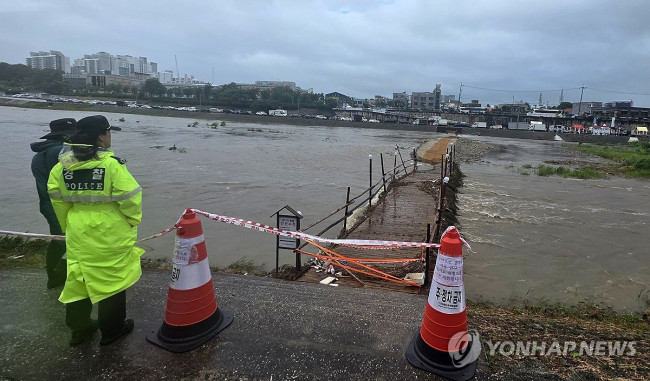 Miryeong 223.0mm heavy rain… Seoraksan is controlled and Gangneung Danoje also faces disruptions.
The Seopdari, a traditional wooden bridge set up for the Gangneung Danoje Festival, is being controlled due to rising water levels in the Namdaecheon River caused by heavy rain in Gangneung, Gangwon P
Miryeong 223.0mm heavy rain… Seoraksan is controlled and Gangneung Danoje also faces disruptions.
The Seopdari, a traditional wooden bridge set up for the Gangneung Danoje Festival, is being controlled due to rising water levels in the Namdaecheon River caused by heavy rain in Gangneung, Gangwon P
 Is the JoongAng Ilbo's dominance crumbling? With no money, JoongAng Ilbo finally files for workout program.
There is intense interest in whether a major seismic shift will occur in the South Korean newspaper industry, potentially toppling the long-standing dominance of the JoongAng, Chosun, and Dong-A Ilbo
Is the JoongAng Ilbo's dominance crumbling? With no money, JoongAng Ilbo finally files for workout program.
There is intense interest in whether a major seismic shift will occur in the South Korean newspaper industry, potentially toppling the long-standing dominance of the JoongAng, Chosun, and Dong-A Ilbo
 [Travel Destinations for the Month of National Defense] ③ Walking the Border Area of the Demilitarized Zone... DMZ Peace Trail Goseong Course
'DMZ Peace Road,' where visitors can see the ecological, cultural, and historical resources of the border areas of the Demilitarized Zone and experience the preciousness of peace firsthand. [Photo by
[Travel Destinations for the Month of National Defense] ③ Walking the Border Area of the Demilitarized Zone... DMZ Peace Trail Goseong Course
'DMZ Peace Road,' where visitors can see the ecological, cultural, and historical resources of the border areas of the Demilitarized Zone and experience the preciousness of peace firsthand. [Photo by
 [Photo] Current status of Chairman Hwang Kyo-ahn and lawyer Park Joo-hyun attending the US election fraud fighter summit
Lawyer Park Joo-hyun with lawyer Peter Ticktin, who was pardoned by U.S. President Donald Trump. [Facebook]Hwang Kyo-ahn, leader of the Liberty and Innovation Party (second from left), informing about
[Photo] Current status of Chairman Hwang Kyo-ahn and lawyer Park Joo-hyun attending the US election fraud fighter summit
Lawyer Park Joo-hyun with lawyer Peter Ticktin, who was pardoned by U.S. President Donald Trump. [Facebook]Hwang Kyo-ahn, leader of the Liberty and Innovation Party (second from left), informing about
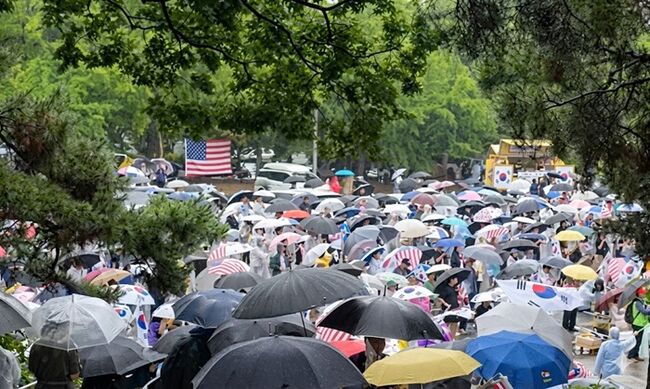 [Cho Yang-kun Column] The reason for the ever-increasing heat at Olympic Park
At noon on the 20th, citizens chanted "Re-election for fraudulent elections, same-day voting and manual counting!" at Olympic Park in Seoul, even amidst heavy rain. ⒸHanmi Ilbo The fervor of th
[Cho Yang-kun Column] The reason for the ever-increasing heat at Olympic Park
At noon on the 20th, citizens chanted "Re-election for fraudulent elections, same-day voting and manual counting!" at Olympic Park in Seoul, even amidst heavy rain. ⒸHanmi Ilbo The fervor of th
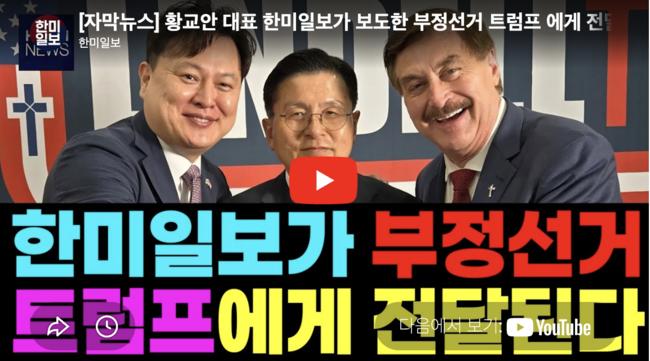 [Video] 'Trump's close friend' Lindell "I will inform Trump about South Korea's fraudulent election"
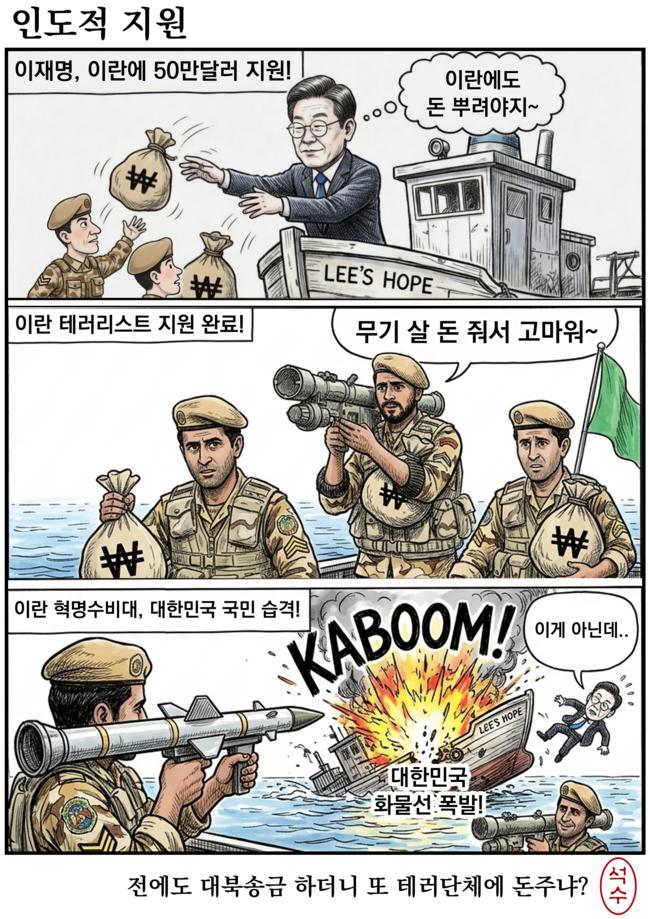 [Editorial Cartoon] Humanitarian Aid

 List
List