A view of an anti-tank barrier, 4-5 meters high and tens to hundreds of meters long, being installed by North Korea. Provided by the Joint Chiefs of Staff.
 Editorial Board Member, ROK Military Academy Class of '40.Since 2024, North Korea has installed barrier-type facilities, maintained tactical roads, and newly laid mines in some sections north of the Demilitarized Zone (DMZ). While the exaggerated phrase "barriers across the entire 248km ceasefire line" once spread, what has been publicly confirmed is that the anti-tank obstacles in the form of barriers installed in some DMZ sections amount to about 10km in total across four sections.
However, the length of the barriers should not diminish their significance. Directly interpreting North Korea's ceasefire line barriers as "defensive construction" is premature. Following Kim Jong Un's statement in December 2023 referring to two "hostile countries," the North Korean regime has rejected unification discourse and removed unification from its regime objectives. It has defined the South as a foreign country rather than a fellow nation, demolished the Monument to the Three Charters for National Reunification, and installed barriers. This appears to be a more intensified form of North Korea's deceptive tactics than its previous line of southward reunification.
1. Are North Korea's Barriers for Defense Against Northern Invasion or to Block Defections?
Although the barriers installed by North Korea appear to be military defense lines on the surface, their essence is a psychological barrier to prevent defections. They are a political device to block defections and contain the possibility of residents leaving. The barriers are a psychological symbol of the division between North and South and the maintenance of the North Korean regime. North Korea's barriers are not a means of defense but a multi-purpose device to control the internal population while reinforcing its hostile stance towards South Korea.
Structures like anti-tank barriers are closer to controlling the movement of residents and psychological deterrence rather than obstructing tank movements. This is a result of fearing internal unrest in North Korea and population outflow stemming from comparisons between the North and South, rather than external invasion. This nature is similar to the Berlin Wall, which aimed to block internal escape rather than external defense, and can be seen as a physical symbol of authoritarian rule that seeks to strengthen resident control under the guise of military necessity.
2. Is Interpreting North Korea's Barriers as "Defense Against Northern Invasion" a Diversion from the North Korean Nuclear Threat?
President Lee stated that the North Korean barriers were "defensive measures by North Korea to prevent a northern invasion." While the background of this statement is unknown, it contradicts the historical and strategic facts of North Korean southward aggression and reduces our precarious security situation to a matter of misunderstanding and mutual distrust, sidestepping the fundamental nature of the structural threat posed by North Korea's nuclear weapons. It appears to be a sophisticated psychological warfare statement that indirectly negates the nuclear threat through the term "northern invasion" and thus sides with North Korea.
If a North Korea without nuclear weapons had built barriers out of fear of a northern invasion, it would be convincing. However, for a nuclear-armed North Korea to claim it built mini-barriers out of fear of a northern invasion is an absurdity that even a child would not believe. Misinterpreting the enemy's threat in reverse is itself a security risk and an act that exacerbates security anxiety. Having been deceived by North Korea for a long time, interpreting North Korea's barriers not as simple defense but as strategic deception aligns with military realities.
North Korea's tactics have been offensive, and they have not repeated the same methods. Isn't it strange that North Korean leader Kim Jong Un would suddenly choose front-line defense, which is disadvantageous for mobile and offensive warfare? It is also strange that they would build barriers of only about 10km in some parts of the DMZ, disregarding the historical lesson that even the Maginot Line, built by France over 450km in the 1930s, was neutralized by the German army's mobile tactics. Interpreting North Korea's barriers as "for defense against northern invasion" is also a distortion of military facts.
Interpreting North Korea's barriers as for defense against northern invasion is either ignorance of North Korea's united front strategy, a way to obscure the North Korean nuclear threat, or merely a diversionary tactic that hides North Korea's sophisticated deception strategy. This is not a peace discourse but another dangerous element that obscures the enemy's threat under the guise of peace.
3. Security Policies That Misperceive and Misjudge the Security Situation
The proposal to abolish the National Security Act, which prevents the apprehension of North Korean spies; the Ministry of National Defense's directive to restrict proportional response fire during enemy provocations; the Joint Chiefs of Staff's directive to concede territory to the enemy by yielding the Military Demarcation Line, secured with blood until the last five minutes of the Korean War; the politicians who distort the truth by calling North Korea's barriers "for defense against northern invasion"; the assertion that Rodong Sinmun should be freely accessible; and the special provisions intended to allow peaceful access to the DMZ regardless of the Armistice Agreement—these are all manifestations of ignorance that misinterprets and distorts the security situation, constituting treason that plunges the nation and its people into a security crisis.
While North Korean citizens live like slaves in an information desert where they cannot access free broadcasts or the internet, the demand to open Rodong Sinmun, a propaganda tool of the North Korean regime, while labeling loudspeakers and leaflets directed at North Korea as illegal, appears to be a ploy to dismantle our vigilance towards North Korea and create grounds for repealing the National Security Act.
Security is not a matter for a particular political faction. It is a constitutional duty directly linked to the lives of all citizens and the survival of the nation. North Korea's repeated, multi-faceted military provocations and nuclear threats have clear intentions. Statements by those in power who, in the name of peace, impede rules of engagement, concede territory, and misinterpret security history to generate conflict and obscure the essence of security, while failing to protect the people, sovereignty, and territory from enemy provocations, are unconstitutional acts that destroy security.
The identity of "One Republic of Korea" as stipulated by the Constitution and the principles of security are not subject to negotiation. North Korea's mini-barriers are not for defense but are a physical marker of its hostile stance and a sophisticated deception disguised as weakness. To misjudge this and be naively drawn into North Korea's strategy, or to result in speaking on behalf of North Korea, is grounds for impeachment.
At least the military must focus on its inherent mission of national defense, not political directives. The directive that adjusted the Military Demarcation Line southward and ceded territory to the enemy must be immediately rescinded. Security, above all, must be protected by national consensus, transcending party lines. It is imperative to recognize that peace policies that ignore the grave security reality are "security illusions" and "self-inflicted security harm" disguised as peace.
Editorial Board Member, Hanmi Daily

 [Statement by the Seo-beo-kka Korea Military Academy Save-the-Nation Comrades Association] ㉛ Recount the Votes Publicly, as the Previous Recount Concealed Election Fraud
Tongyeong Mayoral Election Recount [Photo=Yonhap News]South Korea's liberal democracy is dying. The National Election Commission (NEC) and the judiciary, which have plummeted into criminal syndicates
[Statement by the Seo-beo-kka Korea Military Academy Save-the-Nation Comrades Association] ㉛ Recount the Votes Publicly, as the Previous Recount Concealed Election Fraud
Tongyeong Mayoral Election Recount [Photo=Yonhap News]South Korea's liberal democracy is dying. The National Election Commission (NEC) and the judiciary, which have plummeted into criminal syndicates
 What is the significance of the "Trump 2028" red hats that keep making a comeback?
It is noteworthy that President Donald Trump is "intentionally" fueling controversy over whether he can actually run in the 2028 presidential election, even though it is "highly likely he is seriously
What is the significance of the "Trump 2028" red hats that keep making a comeback?
It is noteworthy that President Donald Trump is "intentionally" fueling controversy over whether he can actually run in the 2028 presidential election, even though it is "highly likely he is seriously
 Jin Cummings: "North Korea says it will increase the number of spies, so what is the government doing?"
U.S. political columnist Gene Cummings has publicly questioned the South Korean government, asking, "North Korea is announcing plans to increase its number of spies, yet what is the South Korean
Jin Cummings: "North Korea says it will increase the number of spies, so what is the government doing?"
U.S. political columnist Gene Cummings has publicly questioned the South Korean government, asking, "North Korea is announcing plans to increase its number of spies, yet what is the South Korean
 Attorney Do Tae-woo: “Discrepancies in Voter Count and Improper Sealing Confirmed in Tongyeong Mayoral Recount… Official Request for Additional Verification Submitted to Gyeongnam Election Commission”
A bundle of mail-in early voting ballots captured by lawyer Do Tae-woo at the Tongyeong mayoral election recount site. A clear solid line, raising suspicions of election fraud, is visible on the side
Attorney Do Tae-woo: “Discrepancies in Voter Count and Improper Sealing Confirmed in Tongyeong Mayoral Recount… Official Request for Additional Verification Submitted to Gyeongnam Election Commission”
A bundle of mail-in early voting ballots captured by lawyer Do Tae-woo at the Tongyeong mayoral election recount site. A clear solid line, raising suspicions of election fraud, is visible on the side
 Stock Market Crash 'Black Tuesday'… KOSPI down 10.8%, KOSDAQ down 7.7%
The KOSPI fell by more than 5% in early trading on the 28th, triggering a sell-side sidecar.On the 28th, the KOSPI plunged by more than 10%.Due to the sharp decline, a sell-side sidecar—a temporary
Stock Market Crash 'Black Tuesday'… KOSPI down 10.8%, KOSDAQ down 7.7%
The KOSPI fell by more than 5% in early trading on the 28th, triggering a sell-side sidecar.On the 28th, the KOSPI plunged by more than 10%.Due to the sharp decline, a sell-side sidecar—a temporary
 [World Heritage Committee] 25 New World Heritage Sites Inscribed in Busan… South Korea Successfully Expands 'Getbol' Listing
The Chairperson of the World Heritage Committee speaks at the plenary session of the 48th session of the World Heritage Committee, held at BEXCO in Busan on the 20th. [Photo: Yonhap News]A total of 25
[World Heritage Committee] 25 New World Heritage Sites Inscribed in Busan… South Korea Successfully Expands 'Getbol' Listing
The Chairperson of the World Heritage Committee speaks at the plenary session of the 48th session of the World Heritage Committee, held at BEXCO in Busan on the 20th. [Photo: Yonhap News]A total of 25
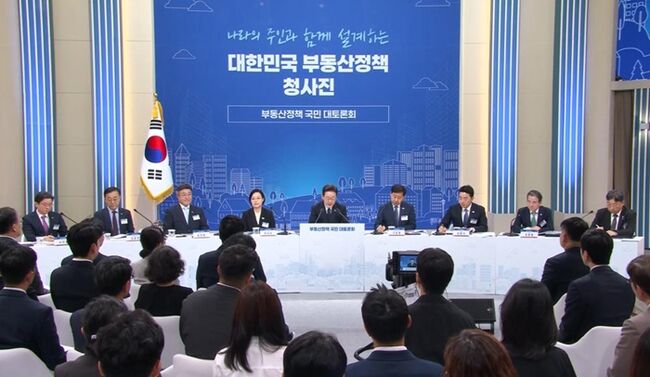 [Liberal Democratic Party Statement] Calling it a Grand Real Estate Debate… It Was Nothing More Than a Private Party Among Themselves
The 'National Grand Debate on Real Estate Policy' held on July 23rd and 27th. [Photo=Yonhap News]The 'National Grand Debate on Real Estate Policy,' hosted by the Lee Jae-myung administration under the
[Liberal Democratic Party Statement] Calling it a Grand Real Estate Debate… It Was Nothing More Than a Private Party Among Themselves
The 'National Grand Debate on Real Estate Policy' held on July 23rd and 27th. [Photo=Yonhap News]The 'National Grand Debate on Real Estate Policy,' hosted by the Lee Jae-myung administration under the
 [Photo] Evidence of Election Fraud Flooding U.S. Media… Trump Had 2.7 Million Votes Stolen
 [Video] U.S. Semiquincentennial Air Show... 'Art in the Sky' streaks across New York
 [Editorial Cartoon] A Draconian Law That Undermines Freedom of Expression

 List
List