On the 6th, Minister of National Defense Ahn Kyu-baek shakes hands with Commander of the ROK-US Combined Forces Command, Gen. Paul LaCamera, during his visit to the ROK-US Combined Forces Command. [Photo: Ministry of National Defense]
The situation where the FY2025 defense budget approved by the National Assembly was not executed at the end of the year, causing disruptions in military operations and defense industry contracts, is a significant problem in itself.
This is because the operational costs and defense capability enhancement funds are not new or supplementary budgets, but are established regular budgets that have been executed for nearly a year.
The fact that an established budget was halted at the end of the year indicates a structural problem in the budget execution system, rather than a problem with fiscal conditions.
Operational costs are essential expenses for the daily functioning of the military, and defense capability enhancement funds are budgets that must be paid at predetermined times according to already signed defense industry contracts.
Given that these two budget items experienced disruptions simultaneously, this situation cannot be easily dismissed as a mere administrative delay or an issue with individual projects. The halt of budgets that support both the "military of today" and the "military of tomorrow" is a signal that the entire defense budget execution needs to be reviewed.
What further raises questions is the government's fiscal management situation during the same period.
According to data submitted by the Bank of Korea to Rep. Park Sung-hoon of the People Power Party on the National Assembly's Strategy and Finance Committee, the government also borrowed 5 trillion won from the Bank of Korea in December of last year.
This system, colloquially known as "the Bank of Korea's overdraft," is a method where the government borrows funds from the Bank of Korea for a short period and repays them when temporary cash shortages arise due to the time lag between revenue and expenditure, similar to a personal overdraft account for households.
This means that a tool for managing short-term liquidity was indeed in operation.
Considering these circumstances, it is difficult to explain the non-execution of the defense budget as a lack of fiscal capacity. The issue lies not in the availability of funds, but in the priorities of budget execution.
The Ministry of National Defense cites "concentration of expenditure demand at year-end" as the reason, but this is more of a restatement of the phenomenon than a valid reason. The concentration of execution at year-end is a structural phenomenon that repeats every year.
If the execution of the established defense budget approved by the National Assembly was halted for this reason, the problem lies in the execution order and control.
There is still insufficient explanation as to why the defense budget, particularly operational costs and defense capability enhancement funds, was delayed simultaneously.
This is where suspicions of budget reallocation arise.
While it is too early to definitively determine reallocation in a legal sense, the question of whether the established defense budget was effectively pushed back by being prioritized for other expenditures during the execution process is reasonable.
Even if there was no explicit reallocation, the possibility of an effect similar to reallocation occurring during the execution phase cannot be ruled out.
What exacerbates the problem is the attitude of the Ministry of National Defense.
Despite being directly responsible for budget execution, the Ministry of National Defense is not actively explaining or publicly addressing this issue, even though actual disruptions are occurring in military operations and defense companies.
The silence of the responsible ministry in the face of the fact that an established budget was not executed is difficult to comprehend.
What is needed now is not explanation, but verification.
Why the defense budget approved by the National Assembly was halted at year-end, and whether it was absorbed or prioritized for other expenditures during that process, must be clearly revealed through settlement reports, audits by the Board of Audit and Inspection, and investigations by the National Assembly.
This is not a matter of political infighting, but a matter of examining the fundamental order of national finance and defense operations.
If the established defense budget was not executed, and the reasons for it are not adequately explained, that in itself is already a serious problem.
This situation cannot end without a thorough investigation into the suspicions of budget reallocation and the establishment of measures to prevent recurrence.

 [Statement by the Seo-beo-kka Korea Military Academy Save-the-Nation Comrades Association] ㉛ Recount the Votes Publicly, as the Previous Recount Concealed Election Fraud
Tongyeong Mayoral Election Recount [Photo=Yonhap News]South Korea's liberal democracy is dying. The National Election Commission (NEC) and the judiciary, which have plummeted into criminal syndicates
[Statement by the Seo-beo-kka Korea Military Academy Save-the-Nation Comrades Association] ㉛ Recount the Votes Publicly, as the Previous Recount Concealed Election Fraud
Tongyeong Mayoral Election Recount [Photo=Yonhap News]South Korea's liberal democracy is dying. The National Election Commission (NEC) and the judiciary, which have plummeted into criminal syndicates
 What is the significance of the "Trump 2028" red hats that keep making a comeback?
It is noteworthy that President Donald Trump is "intentionally" fueling controversy over whether he can actually run in the 2028 presidential election, even though it is "highly likely he is seriously
What is the significance of the "Trump 2028" red hats that keep making a comeback?
It is noteworthy that President Donald Trump is "intentionally" fueling controversy over whether he can actually run in the 2028 presidential election, even though it is "highly likely he is seriously
 Jin Cummings: "North Korea says it will increase the number of spies, so what is the government doing?"
U.S. political columnist Gene Cummings has publicly questioned the South Korean government, asking, "North Korea is announcing plans to increase its number of spies, yet what is the South Korean
Jin Cummings: "North Korea says it will increase the number of spies, so what is the government doing?"
U.S. political columnist Gene Cummings has publicly questioned the South Korean government, asking, "North Korea is announcing plans to increase its number of spies, yet what is the South Korean
 Attorney Do Tae-woo: “Discrepancies in Voter Count and Improper Sealing Confirmed in Tongyeong Mayoral Recount… Official Request for Additional Verification Submitted to Gyeongnam Election Commission”
A bundle of mail-in early voting ballots captured by lawyer Do Tae-woo at the Tongyeong mayoral election recount site. A clear solid line, raising suspicions of election fraud, is visible on the side
Attorney Do Tae-woo: “Discrepancies in Voter Count and Improper Sealing Confirmed in Tongyeong Mayoral Recount… Official Request for Additional Verification Submitted to Gyeongnam Election Commission”
A bundle of mail-in early voting ballots captured by lawyer Do Tae-woo at the Tongyeong mayoral election recount site. A clear solid line, raising suspicions of election fraud, is visible on the side
 Stock Market Crash 'Black Tuesday'… KOSPI down 10.8%, KOSDAQ down 7.7%
The KOSPI fell by more than 5% in early trading on the 28th, triggering a sell-side sidecar.On the 28th, the KOSPI plunged by more than 10%.Due to the sharp decline, a sell-side sidecar—a temporary
Stock Market Crash 'Black Tuesday'… KOSPI down 10.8%, KOSDAQ down 7.7%
The KOSPI fell by more than 5% in early trading on the 28th, triggering a sell-side sidecar.On the 28th, the KOSPI plunged by more than 10%.Due to the sharp decline, a sell-side sidecar—a temporary
 [World Heritage Committee] 25 New World Heritage Sites Inscribed in Busan… South Korea Successfully Expands 'Getbol' Listing
The Chairperson of the World Heritage Committee speaks at the plenary session of the 48th session of the World Heritage Committee, held at BEXCO in Busan on the 20th. [Photo: Yonhap News]A total of 25
[World Heritage Committee] 25 New World Heritage Sites Inscribed in Busan… South Korea Successfully Expands 'Getbol' Listing
The Chairperson of the World Heritage Committee speaks at the plenary session of the 48th session of the World Heritage Committee, held at BEXCO in Busan on the 20th. [Photo: Yonhap News]A total of 25
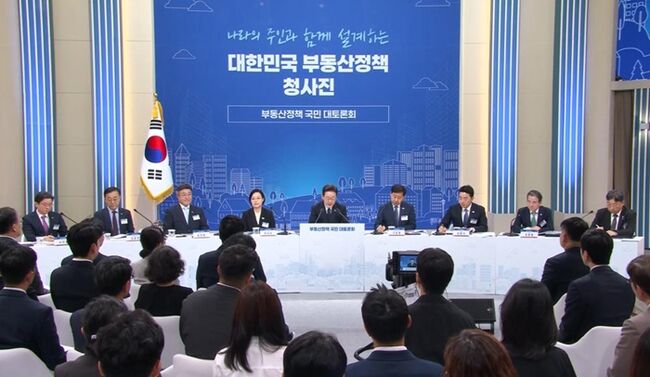 [Liberal Democratic Party Statement] Calling it a Grand Real Estate Debate… It Was Nothing More Than a Private Party Among Themselves
The 'National Grand Debate on Real Estate Policy' held on July 23rd and 27th. [Photo=Yonhap News]The 'National Grand Debate on Real Estate Policy,' hosted by the Lee Jae-myung administration under the
[Liberal Democratic Party Statement] Calling it a Grand Real Estate Debate… It Was Nothing More Than a Private Party Among Themselves
The 'National Grand Debate on Real Estate Policy' held on July 23rd and 27th. [Photo=Yonhap News]The 'National Grand Debate on Real Estate Policy,' hosted by the Lee Jae-myung administration under the
 [Photo] Evidence of Election Fraud Flooding U.S. Media… Trump Had 2.7 Million Votes Stolen
 [Video] U.S. Semiquincentennial Air Show... 'Art in the Sky' streaks across New York
 [Editorial Cartoon] A Draconian Law That Undermines Freedom of Expression

 List
List