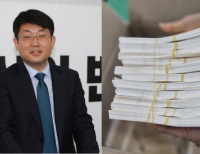
On July 15, 2025, approximately 270 rounds of 5.56mm standard ammunition, left outside the fence of an ammunition depot at a military unit in Incheon Metropolitan City, were discovered by a soldier. [Photo=Yonhap News]
The Board of Audit and Inspection (BAI) announced the results of its special inspection on public integrity in the defense sector on the 8th, stating that instances of inadequate management were identified across the board in the execution of national defense budgets, management of military donations, and the state of armory and ammunition depot management.
According to the audit results, some defense budgets were not executed as planned despite parliamentary approval, and military donations were used for purposes other than their original intent or had unclear usage details within an internal review structure lacking civilian participation.
Furthermore, the appropriateness of armory and ammunition depot management was also included as a key inspection item; however, this information was classified as non-public in accordance with the Act on Disclosure of Information by Public Institutions, citing national security reasons.
The core of the audit report released by the BAI is not a mere enumeration of individual findings. The essence revealed by this audit is that the management system in national defense administration, which spans planning, execution, inspection, and accountability, is not functioning properly.
And the most stark illustration of the depth of this collapse is precisely the fact that the state of armory and ammunition depot management remained entirely non-public.
Ammunition depot management is an area in national defense administration that must not collapse under any circumstances.
While there is room for post-adjustment and system improvement even if budgets are mismanaged, the failure in ammunition and weapons management can lead to irreversible consequences from a single accident.
This is an issue directly linked not only to internal safety accidents but also to the potential for leakage, theft, and criminal misuse. Despite this, the fact that this matter remains in a "state that cannot even be explained publicly" suggests that the nature of the management failure has already reached a national security level.
However, the BAI explicitly listed the appropriateness of armory and ammunition depot management as a key audit item, yet processed this content as non-public based on Article 9, Paragraph 1, Subparagraph 2 of the Act on Disclosure of Information by Public Institutions.
This provision allows for the restriction of information disclosure if there is a risk of significant harm to national security and defense.
The important point is that this provision is not a mandatory rule that applies automatically, but rather a discretionary regulation that allows the BAI to determine what constitutes dangerous information.
It is undeniable that a certain level of non-disclosure may be necessary regarding ammunition depot management. Revealing storage locations, quantities, specific control methods, and vulnerable points could pose actual risks if disclosed.
However, whether it was unavoidable to process even the minimal explanation regarding the existence of problems, the possibility of structural flaws in the management system, and the need for improvement as entirely non-public is a separate question.
The BAI had options such as summarizing while concealing specific vulnerable points, or partially disclosing only the nature of the management failure.
The controversy surrounding this non-disclosure decision is not about questioning the BAI's 'intent'.
The core issue is verifiability.
When the BAI determines that "it would harm national security," there are virtually no institutional mechanisms to externally review the appropriateness of that judgment or demand at least a minimal explanation.
As a result, non-disclosure serves as a protective measure and simultaneously as a barrier that makes it difficult to gauge the extent to which the national defense administration system has collapsed.
At this point, the issue of ammunition depot management is by no means isolated.
The audit report pointed out that military donations were reviewed and executed internally without civilian oversight, some were used for purposes other than their original intent of welfare for conscripts, and there were cases where even the usage details were difficult to ascertain clearly.
At the same time, recently, defense budgets approved by the National Assembly remained unexecuted by the end of the year, with no clear explanation or accountability provided for why they were not executed.
On the surface, these issues may seem like distinct problems. However, structurally, they converge to a single conclusion.
The link in management that controls and takes responsibility for resources and risks in national defense administration has been broken.
Money was not executed as planned, donations were not managed as intended, and the management of ammunition depots, the most critical control target, remains an area that cannot even be explained publicly. This cannot be the state of a normal system.
Therefore, the question of this editorial does not stop at "Was the non-disclosure appropriate?".
It questions whether the management failure in national defense administration has reached a stage so severe that even partial disclosure is impossible, in other words, whether the depth of system collapse has already permeated the national security domain.
Non-disclosure should be a means of managing risk, not a tool for hiding it.
National defense is not maintained solely by weapons and troops.
It functions only when there is a structure that takes responsibility for budgets to the end, a system that controls resources according to their purpose, and a framework where the entire process is explainable and verifiable.
The issue of ammunition depot management, which remains non-public in the audit report, is a warning signal asking how far the collapse of the national defense administration system has progressed.
What is needed now is not an explanation, but a responsible answer to comprehensively inspect and restore this system.

 [Statement by the Seo-beo-kka Korea Military Academy Save-the-Nation Comrades Association] ㉛ Recount the Votes Publicly, as the Previous Recount Concealed Election Fraud
Tongyeong Mayoral Election Recount [Photo=Yonhap News]South Korea's liberal democracy is dying. The National Election Commission (NEC) and the judiciary, which have plummeted into criminal syndicates
[Statement by the Seo-beo-kka Korea Military Academy Save-the-Nation Comrades Association] ㉛ Recount the Votes Publicly, as the Previous Recount Concealed Election Fraud
Tongyeong Mayoral Election Recount [Photo=Yonhap News]South Korea's liberal democracy is dying. The National Election Commission (NEC) and the judiciary, which have plummeted into criminal syndicates
 What is the significance of the "Trump 2028" red hats that keep making a comeback?
It is noteworthy that President Donald Trump is "intentionally" fueling controversy over whether he can actually run in the 2028 presidential election, even though it is "highly likely he is seriously
What is the significance of the "Trump 2028" red hats that keep making a comeback?
It is noteworthy that President Donald Trump is "intentionally" fueling controversy over whether he can actually run in the 2028 presidential election, even though it is "highly likely he is seriously
 Jin Cummings: "North Korea says it will increase the number of spies, so what is the government doing?"
U.S. political columnist Gene Cummings has publicly questioned the South Korean government, asking, "North Korea is announcing plans to increase its number of spies, yet what is the South Korean
Jin Cummings: "North Korea says it will increase the number of spies, so what is the government doing?"
U.S. political columnist Gene Cummings has publicly questioned the South Korean government, asking, "North Korea is announcing plans to increase its number of spies, yet what is the South Korean
 Attorney Do Tae-woo: “Discrepancies in Voter Count and Improper Sealing Confirmed in Tongyeong Mayoral Recount… Official Request for Further Verification Filed with Gyeongnam Election Commission”
A bundle of out-of-district early voting ballots photographed by attorney Do Tae-woo at the Tongyeong mayoral election recount site. A clear, solid line visible on the side of the ballots raises suspi
Attorney Do Tae-woo: “Discrepancies in Voter Count and Improper Sealing Confirmed in Tongyeong Mayoral Recount… Official Request for Further Verification Filed with Gyeongnam Election Commission”
A bundle of out-of-district early voting ballots photographed by attorney Do Tae-woo at the Tongyeong mayoral election recount site. A clear, solid line visible on the side of the ballots raises suspi
 Stock Market Crash 'Black Tuesday'… KOSPI down 10.8%, KOSDAQ down 7.7%
The KOSPI fell by more than 5% in early trading on the 28th, triggering a sell-side sidecar.On the 28th, the KOSPI plunged by more than 10%.Due to the sharp decline, a sell-side sidecar—a temporary
Stock Market Crash 'Black Tuesday'… KOSPI down 10.8%, KOSDAQ down 7.7%
The KOSPI fell by more than 5% in early trading on the 28th, triggering a sell-side sidecar.On the 28th, the KOSPI plunged by more than 10%.Due to the sharp decline, a sell-side sidecar—a temporary
 [World Heritage Committee] 25 New World Heritage Sites Inscribed in Busan… South Korea Successfully Expands 'Getbol' Listing
The Chairperson of the World Heritage Committee speaks at the plenary session of the 48th session of the World Heritage Committee, held at BEXCO in Busan on the 20th. [Photo: Yonhap News]A total of 25
[World Heritage Committee] 25 New World Heritage Sites Inscribed in Busan… South Korea Successfully Expands 'Getbol' Listing
The Chairperson of the World Heritage Committee speaks at the plenary session of the 48th session of the World Heritage Committee, held at BEXCO in Busan on the 20th. [Photo: Yonhap News]A total of 25
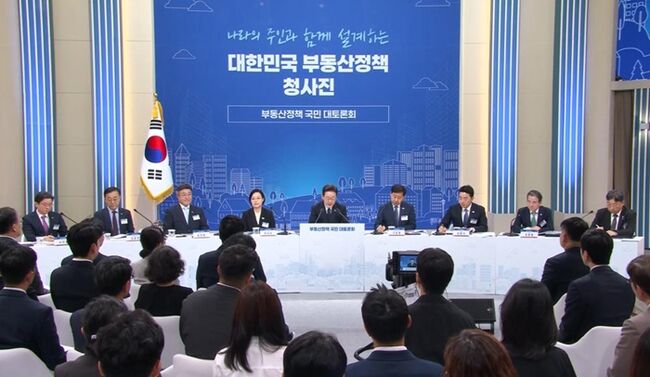 [Liberal Democratic Party Statement] Calling it a Grand Real Estate Debate… It Was Nothing More Than a Private Party Among Themselves
The 'National Grand Debate on Real Estate Policy' held on July 23rd and 27th. [Photo=Yonhap News]The 'National Grand Debate on Real Estate Policy,' hosted by the Lee Jae-myung administration under the
[Liberal Democratic Party Statement] Calling it a Grand Real Estate Debate… It Was Nothing More Than a Private Party Among Themselves
The 'National Grand Debate on Real Estate Policy' held on July 23rd and 27th. [Photo=Yonhap News]The 'National Grand Debate on Real Estate Policy,' hosted by the Lee Jae-myung administration under the
 [Photo] Evidence of Election Fraud Flooding U.S. Media… Trump Had 2.7 Million Votes Stolen
 [Video] U.S. Semiquincentennial Air Show... 'Art in the Sky' streaks across New York
 [Editorial Cartoon] A Draconian Law That Undermines Freedom of Expression

 List
List