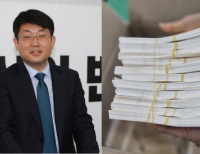
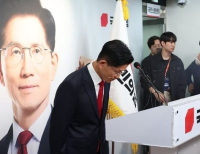
Jang Dong-hyuk, leader of the People Power Party, and Lee Jun-seok, leader of the New Reform Party, shake hands at the People Power Party Leader's Meeting Room at the National Assembly on the 13th. [Photo=Yonhap News]
While Jang Dong-hyuk, leader of the People Power Party, and Queen Elizabeth I of England (1533-1603) are figures from vastly different eras, their positions of power are remarkably similar. Both stood at the center of power at times when society was extremely divided, approaching civil war.
Elizabeth inherited a Britain clashing between Catholics and Protestants, while Jang Dong-hyuk inherited a conservative political landscape fractured by divisions such as pro-Yoon vs. anti-Yoon, traditional conservatives vs. Lee Jun-seok's faction, and legacy media vs. new media.
And both, in common, had weak, inherent power bases. Consequently, neither received absolute loyalty from anyone from the start, nor were they completely captured by any single faction.
Such figures always appear vulnerable. Nobles thought they could easily manipulate Elizabeth, and European kings believed they could absorb Britain through marriage.
The current situation with Jang Dong-hyuk is similar. The pro-Yoon faction believes, "Jang Dong-hyuk will eventually have no choice but to come to us," while Lee Jun-seok's faction believes, "We are playing hard to get now, but they will choose us for expansion in the end."
Because both sides are convinced they can win him over as their own, they are in fact more actively courting and pressuring him.
Queen Elizabeth I, more than anyone, skillfully leveraged this dynamic. She did not refuse marriage; rather, she acted as if she might marry.
She gave hope to Philip II of Spain, the Duke of Anjou of France, and princes of the Holy Roman Empire. They exchanged engagement rings, publicly expressed affection, and drafted negotiation documents.
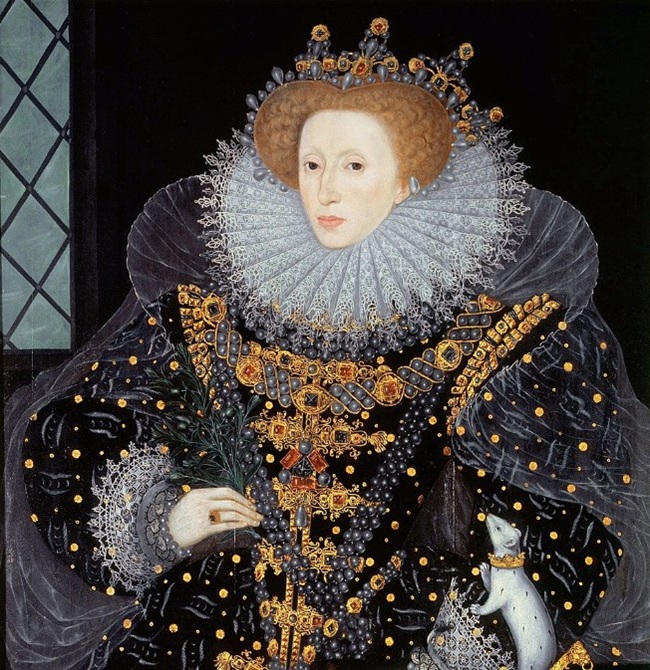 Portrait of Queen Elizabeth I of England (1585).
However, at the last moment, she always retreated, citing "the will of the people," "religious issues," or "national security." Each time a marriage failed, the suitor became angry, but during that time, Britain was not attacked, and Elizabeth's position was further solidified. By not marrying, she became the center of diplomacy.
The distance Jang Dong-hyuk currently maintains with Lee Jun-seok resembles this situation. On the surface, he seems poised to join forces with Lee Jun-seok. He extends an invitation to legacy media and the moderate bloc, uses language of "expansion," and makes gestures that seem to distance himself from the pro-Yoon faction.
Many interpret this as a declaration of engagement. However, as was the case with Elizabeth, what is important to Jang Dong-hyuk is not the actual union, but the possibility of a union.
The moment he fully unites with Lee Jun-seok, he loses the party's legitimacy and core supporters. The moment he fully unites with the pro-Yoon faction, he closes the door to expansion among moderates, youth, and legacy voters. Therefore, he chooses neither side at present.
Instead, he makes both sides believe that "this person needs us." As long as this state persists, the two factions will keep each other in check while being unable to easily discard Jang Dong-hyuk. This very structure is his real power.
The most dangerous moment in politics is not making a decision, but making one too early. Elizabeth ruled for 45 years by delaying marriage.
Jang Dong-hyuk is also currently at the center of "politics of non-marriage." His gesture of extending an arm to Lee Jun-seok may be an engagement, but it is not a marriage. He is currently buying time. And within that time, the initiative is gradually shifting to his side.
Just as Elizabeth said, "I am already married to my people," Jang Dong-hyuk says, "Everything is according to the will of the party members."
Therefore, his announcement to institutionalize the entire party vote by linking it with supreme council decision-making in the reform plan, putting the party name change to a party-wide vote, and simultaneously extending an olive branch to Lee Jun-seok while delivering a strong message to Han Dong-hoon is all the more significant.
※ The opinions of external contributors may differ from the editorial stance of this publication.

◆ Professor Shim Gyu-jin
Assistant Professor, Department of Digital Media, IE University, Spain. Formerly served as a policy advisor to the Ministry of National Defense and head of the Data Lab at the Yeouido Research Institute. He also worked as a full-time professor at the University of Melbourne, Australia, and an assistant professor at Singapore Management University. His books include 'K-Drama Yoon Suk-yeol' and 'Hyper Gender.'

 [Statement by the Seo-beo-kka Korea Military Academy Save-the-Nation Comrades Association] ㉛ Recount the Votes Publicly, as the Previous Recount Concealed Election Fraud
Tongyeong Mayoral Election Recount [Photo=Yonhap News]South Korea's liberal democracy is dying. The National Election Commission (NEC) and the judiciary, which have plummeted into criminal syndicates
[Statement by the Seo-beo-kka Korea Military Academy Save-the-Nation Comrades Association] ㉛ Recount the Votes Publicly, as the Previous Recount Concealed Election Fraud
Tongyeong Mayoral Election Recount [Photo=Yonhap News]South Korea's liberal democracy is dying. The National Election Commission (NEC) and the judiciary, which have plummeted into criminal syndicates
 What is the significance of the "Trump 2028" red hats that keep making a comeback?
It is noteworthy that President Donald Trump is "intentionally" fueling controversy over whether he can actually run in the 2028 presidential election, even though it is "highly likely he is seriously
What is the significance of the "Trump 2028" red hats that keep making a comeback?
It is noteworthy that President Donald Trump is "intentionally" fueling controversy over whether he can actually run in the 2028 presidential election, even though it is "highly likely he is seriously
 Jin Cummings: "North Korea says it will increase the number of spies, so what is the government doing?"
U.S. political columnist Gene Cummings has publicly questioned the South Korean government, asking, "North Korea is announcing plans to increase its number of spies, yet what is the South Korean
Jin Cummings: "North Korea says it will increase the number of spies, so what is the government doing?"
U.S. political columnist Gene Cummings has publicly questioned the South Korean government, asking, "North Korea is announcing plans to increase its number of spies, yet what is the South Korean
 Attorney Do Tae-woo: “Discrepancies in Voter Count and Improper Sealing Confirmed in Tongyeong Mayoral Recount… Official Request for Further Verification Filed with Gyeongnam Election Commission”
A bundle of out-of-district early voting ballots photographed by attorney Do Tae-woo at the Tongyeong mayoral election recount site. A clear, solid line visible on the side of the ballots raises suspi
Attorney Do Tae-woo: “Discrepancies in Voter Count and Improper Sealing Confirmed in Tongyeong Mayoral Recount… Official Request for Further Verification Filed with Gyeongnam Election Commission”
A bundle of out-of-district early voting ballots photographed by attorney Do Tae-woo at the Tongyeong mayoral election recount site. A clear, solid line visible on the side of the ballots raises suspi
 Stock Market Crash 'Black Tuesday'… KOSPI down 10.8%, KOSDAQ down 7.7%
The KOSPI fell by more than 5% in early trading on the 28th, triggering a sell-side sidecar.On the 28th, the KOSPI plunged by more than 10%.Due to the sharp decline, a sell-side sidecar—a temporary
Stock Market Crash 'Black Tuesday'… KOSPI down 10.8%, KOSDAQ down 7.7%
The KOSPI fell by more than 5% in early trading on the 28th, triggering a sell-side sidecar.On the 28th, the KOSPI plunged by more than 10%.Due to the sharp decline, a sell-side sidecar—a temporary
 [World Heritage Committee] 25 New World Heritage Sites Inscribed in Busan… South Korea Successfully Expands 'Getbol' Listing
The Chairperson of the World Heritage Committee speaks at the plenary session of the 48th session of the World Heritage Committee, held at BEXCO in Busan on the 20th. [Photo: Yonhap News]A total of 25
[World Heritage Committee] 25 New World Heritage Sites Inscribed in Busan… South Korea Successfully Expands 'Getbol' Listing
The Chairperson of the World Heritage Committee speaks at the plenary session of the 48th session of the World Heritage Committee, held at BEXCO in Busan on the 20th. [Photo: Yonhap News]A total of 25
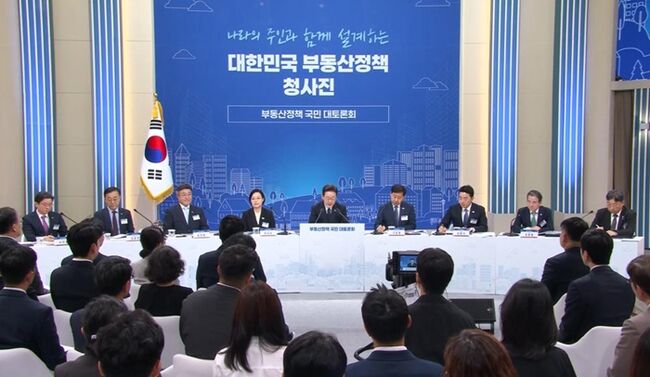 [Liberal Democratic Party Statement] Calling it a Grand Real Estate Debate… It Was Nothing More Than a Private Party Among Themselves
The 'National Grand Debate on Real Estate Policy' held on July 23rd and 27th. [Photo=Yonhap News]The 'National Grand Debate on Real Estate Policy,' hosted by the Lee Jae-myung administration under the
[Liberal Democratic Party Statement] Calling it a Grand Real Estate Debate… It Was Nothing More Than a Private Party Among Themselves
The 'National Grand Debate on Real Estate Policy' held on July 23rd and 27th. [Photo=Yonhap News]The 'National Grand Debate on Real Estate Policy,' hosted by the Lee Jae-myung administration under the
 [Photo] Evidence of Election Fraud Flooding U.S. Media… Trump Had 2.7 Million Votes Stolen
 [Video] U.S. Semiquincentennial Air Show... 'Art in the Sky' streaks across New York
 [Editorial Cartoon] A Draconian Law That Undermines Freedom of Expression

 List
List