President Lee Jae-myung and Japanese Prime Minister Sanae Takaichi performing a drum ensemble [Photo: Captured from Lee Jae-myung's SNS]
The success or failure of national governance is not determined by the number of policies implemented.
True competence in governance lies in how conflicting policies are aligned, the criteria used to establish priorities, and who takes responsibility for those choices.
These high-level functions are the mandate of the Presidential Office and the Prime Minister's Office.
Looking at the policy management of the Lee Jae-myung administration, one is confronted with a more fundamental question before even examining the merits of individual policies.
That question is whether the authority and responsibility to coordinate policy actually functioned at all.
The costs incurred when coordination fails are not abstract. The price of confusion and uncertainty is borne by the public in their daily lives.
Policies regarding real estate, welfare, labor, and finance were pursued simultaneously, yet there was no clear signal that these policies were aligned in a singular direction.
Conflicts repeatedly surfaced between housing stability and household debt management, the expansion of welfare and fiscal sustainability, and labor protections and industrial competitiveness.
The result was not a debate between policies, but a direct blow to the public’s livelihood in the form of housing instability, financial burdens on households, and stagnant corporate investment.
At this point, the responsibility cannot lie with individual ministries. Ministries are merely units for policy design and implementation; they lack the authority to reconcile conflicts between policies or determine the overall priorities of the nation.
That authority and responsibility are vested in the Presidential Office and the Prime Minister's Office under the Constitution and the Government Organization Act.
The policy timetable, too, lacked coordination.
Policies with short-term, visible effects were introduced rapidly, while management plans for medium- to long-term costs and fiscal burdens failed to follow.
This demonstrates that policy responded more sensitively to the timing of politics than to the requirements of administration.
As a result, uncertainty became prolonged, and the public was left in a position where it was difficult to plan for the future in the face of policies that could change at any moment.
The responsibility of the Prime Minister's Office is no less significant.
The Prime Minister's Office is the control tower responsible for coordinating inter-ministerial policy conflicts in advance and translating the President’s governance direction into an executable structure.
If, despite this, there were repeated instances of confusion in policy messaging, redundancy, and buck-passing, it signifies that the coordination function of the Prime Minister's Office was not effectively operational.
The vacuum left by failed coordination is ultimately passed on as costs to be borne by the public on the ground.
The absence of a coordination function is also evident in the response following policy failures.
While the causes of failure were blamed on external variables, the market, or the previous administration, it is difficult to find evidence that those failures were systematically reflected in the design of subsequent policies.
Meanwhile, the costs of policy experimentation and correction continue to accumulate, ultimately becoming a burden on the public.
In the end, the core of the problem is clear.
The Lee Jae-myung administration was proactive in creating policies, but it failed to effectively operate the central mechanisms of national governance needed to coordinate them.
Within that vacuum, policies multiplied, and the direction of state affairs became blurred.
And the costs of that uncertainty and confusion were shifted onto the people.
National governance is a matter of structure, not just messaging.
When the structure fails to function, it is always the people who suffer.
State affairs without coordination can no longer be left unaddressed.
For the Presidential Office and the Prime Minister's Office to stand again as the center of coordination, there must be clear political accountability for coordination failures, followed by personnel reforms that reflect that responsibility.
That is the minimum starting point for restoring the collapsed function of national coordination and reducing the burden on the public.

 [Statement by the Seo-beo-kka Korea Military Academy Save-the-Nation Comrades Association] ㉛ Recount the Votes Publicly, as the Previous Recount Concealed Election Fraud
Tongyeong Mayoral Election Recount [Photo=Yonhap News]South Korea's liberal democracy is dying. The National Election Commission (NEC) and the judiciary, which have plummeted into criminal syndicates
[Statement by the Seo-beo-kka Korea Military Academy Save-the-Nation Comrades Association] ㉛ Recount the Votes Publicly, as the Previous Recount Concealed Election Fraud
Tongyeong Mayoral Election Recount [Photo=Yonhap News]South Korea's liberal democracy is dying. The National Election Commission (NEC) and the judiciary, which have plummeted into criminal syndicates
 What is the significance of the "Trump 2028" red hats that keep making a comeback?
It is noteworthy that President Donald Trump is "intentionally" fueling controversy over whether he can actually run in the 2028 presidential election, even though it is "highly likely he is seriously
What is the significance of the "Trump 2028" red hats that keep making a comeback?
It is noteworthy that President Donald Trump is "intentionally" fueling controversy over whether he can actually run in the 2028 presidential election, even though it is "highly likely he is seriously
 Jin Cummings: "North Korea says it will increase the number of spies, so what is the government doing?"
U.S. political columnist Gene Cummings has publicly questioned the South Korean government, asking, "North Korea is announcing plans to increase its number of spies, yet what is the South Korean
Jin Cummings: "North Korea says it will increase the number of spies, so what is the government doing?"
U.S. political columnist Gene Cummings has publicly questioned the South Korean government, asking, "North Korea is announcing plans to increase its number of spies, yet what is the South Korean
 Attorney Do Tae-woo: “Discrepancies in Voter Count and Improper Sealing Confirmed in Tongyeong Mayoral Recount… Official Request for Further Verification Filed with Gyeongnam Election Commission”
A bundle of out-of-district early voting ballots photographed by attorney Do Tae-woo at the Tongyeong mayoral election recount site. A clear, solid line visible on the side of the ballots raises suspi
Attorney Do Tae-woo: “Discrepancies in Voter Count and Improper Sealing Confirmed in Tongyeong Mayoral Recount… Official Request for Further Verification Filed with Gyeongnam Election Commission”
A bundle of out-of-district early voting ballots photographed by attorney Do Tae-woo at the Tongyeong mayoral election recount site. A clear, solid line visible on the side of the ballots raises suspi
 Stock Market Crash 'Black Tuesday'… KOSPI down 10.8%, KOSDAQ down 7.7%
The KOSPI fell by more than 5% in early trading on the 28th, triggering a sell-side sidecar.On the 28th, the KOSPI plunged by more than 10%.Due to the sharp decline, a sell-side sidecar—a temporary
Stock Market Crash 'Black Tuesday'… KOSPI down 10.8%, KOSDAQ down 7.7%
The KOSPI fell by more than 5% in early trading on the 28th, triggering a sell-side sidecar.On the 28th, the KOSPI plunged by more than 10%.Due to the sharp decline, a sell-side sidecar—a temporary
 [World Heritage Committee] 25 New World Heritage Sites Inscribed in Busan… South Korea Successfully Expands 'Getbol' Listing
The Chairperson of the World Heritage Committee speaks at the plenary session of the 48th session of the World Heritage Committee, held at BEXCO in Busan on the 20th. [Photo: Yonhap News]A total of 25
[World Heritage Committee] 25 New World Heritage Sites Inscribed in Busan… South Korea Successfully Expands 'Getbol' Listing
The Chairperson of the World Heritage Committee speaks at the plenary session of the 48th session of the World Heritage Committee, held at BEXCO in Busan on the 20th. [Photo: Yonhap News]A total of 25
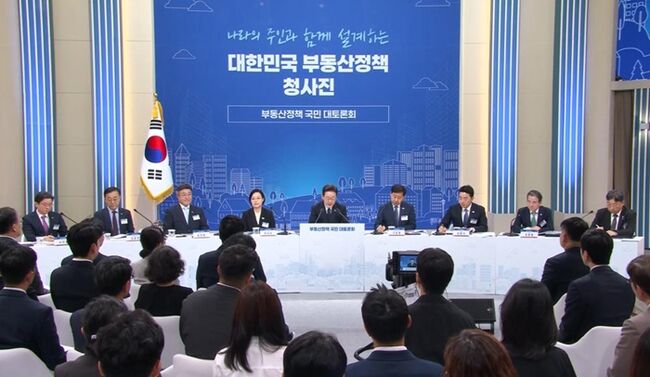 [Liberal Democratic Party Statement] Calling it a Grand Real Estate Debate… It Was Nothing More Than a Private Party Among Themselves
The 'National Grand Debate on Real Estate Policy' held on July 23rd and 27th. [Photo=Yonhap News]The 'National Grand Debate on Real Estate Policy,' hosted by the Lee Jae-myung administration under the
[Liberal Democratic Party Statement] Calling it a Grand Real Estate Debate… It Was Nothing More Than a Private Party Among Themselves
The 'National Grand Debate on Real Estate Policy' held on July 23rd and 27th. [Photo=Yonhap News]The 'National Grand Debate on Real Estate Policy,' hosted by the Lee Jae-myung administration under the
 [Photo] Evidence of Election Fraud Flooding U.S. Media… Trump Had 2.7 Million Votes Stolen
 [Video] U.S. Semiquincentennial Air Show... 'Art in the Sky' streaks across New York
 [Editorial Cartoon] A Draconian Law That Undermines Freedom of Expression

 List
List