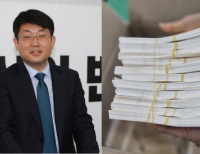
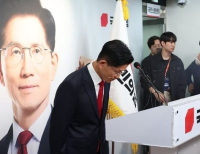
Bank of Korea Governor Rhee Chang-yong speaks at a press conference at the Bank of Korea in Jung-gu, Seoul, on the 15th. [Photo=Yonhap News]
At a press conference held after the Bank of Korea's Monetary Policy Board meeting on the 15th, Bank of Korea Governor Rhee Chang-yong could not hide his anger. This was a highly unusual scene.
This is interpreted as a defense against the structure where the central bank is shouldering issues that go beyond the scope of monetary policy, and simultaneously a warning to the administration that has failed in policy adjustments.
Furthermore, his remarks about "the burden of exchange rates and prices leading to polarization" are likely to be interpreted as implying that without policy adjustments, the damage will inevitably be passed on to the public, and are expected to cause controversy.
At the conference, Governor Rhee strongly refuted some criticisms attributing the rise in the won-dollar exchange rate to an increase in M2 (broad money), even using expressions such as "unfair" and "angry." It is unusual for the head of a central bank to express emotions in a public forum.
On the surface, this is an economic debate surrounding monetary supply and exchange rates, but the level of reaction goes beyond academic rebuttal.
Governor Rhee's explanation itself is not significantly flawed from an economic perspective.
Exchange rates are influenced by a combination of factors such as a strong global dollar, the U.S. Federal Reserve's high-interest rate policy, and geopolitical uncertainties. It is difficult to explain recent exchange rate movements solely by the money supply.
Despite this, the reason 'unfairness' and 'anger' are accompanied is that the core of the problem does not lie in a single exchange rate indicator.
Exchange Rate and Price Issues Beyond the Scope of Monetary Policy
Recent trends in exchange rates and prices have already gone beyond the scope of unilateral monetary policy responses.
Governor Rhee himself has repeatedly stated that high exchange rates stimulate import prices, and that this burden can concentrate on low-income and vulnerable groups, exacerbating polarization.
This reflects the perception that recent price pressures are largely cost-push inflation stemming from exchange rates and import costs, rather than overheating demand.
When exchange rates fluctuate, import costs rise, which directly translates into consumer prices.
In this process, the segment of the population that lacks the capacity to absorb price increases is hit first.
In fact, the recent rise in import prices has outpaced the rise in consumer prices, with exchange rates being identified as a key factor driving up perceived inflation.
The reason Governor Rhee mentioned exchange rates, prices, and polarization together was not simply a warning, but a clear indication of where the costs of policy failure are being shifted.
Deletion of Interest Rate Cut Clause, Declaration of Central Bank's Limitations
In this situation, the Bank of Korea's choice was to freeze the base interest rate.
What deserves more attention is not the freeze itself, but the deletion of the phrase related to "interest rate cuts" from the monetary policy direction statement, which had been maintained until then.
A unanimous freeze without dissenting opinions, a consensus freeze for the next three months, and the withdrawal of any mention of possible rate cuts are read as signals that the central bank has formally acknowledged its entry into a limited phase where interest rate cuts are no longer a viable policy option.
This means the central bank has drawn a line, saying, "This is as far as we can go."
Lowering interest rates could stimulate exchange rates and import prices, while raising them carries a significant risk of destabilizing household debt and domestic demand. The only remaining option is a freeze.
The interest rate freeze is not a signal of stability, but a warning that monetary policy alone cannot manage this situation.
Regarding this point, a former high-ranking official from the financial authorities stated, "The current price pressure is not a demand problem but largely a cost shock stemming from exchange rates," adding, "In such a situation, traditional prescriptions like lowering or raising interest rates have clear limitations and exceed the scope that the central bank can handle alone."
It is assessed that the central bank can no longer fight a solo all-out war.
It is rare for a central bank to voluntarily withdraw its policy options.
Especially the deletion of a phrase like the possibility of rate cuts, which directly impacts market expectations, signifies an entry into a phase where monetary policy can no longer function as a buffer.
Unadjusted Governance Leads to Costs Being Passed On to the Public
The problem is what comes next. When monetary policy reveals its limitations, governance must shift to other functions. This involves setting policy priorities and coordinating conflicts on exchange rates, prices, and distribution issues.
This responsibility does not lie with the Bank of Korea. Under the constitution and administrative structure, it falls to the Presidential Office and the Prime Minister's Office.
However, since the launch of the Lee Jae-myung administration, there has been a conspicuous lack of such policy coordination.
No criteria have been presented on how much exchange rate burden will be tolerated or how the impact of price increases will be absorbed, and it is unclear what priorities will be combined in fiscal, energy, and industrial policies.
In the vacuum of coordination, the burden of exchange rates and prices is being directly passed on to the living expenses of the public.
A former official with a background in economic ministries pointed out, "A situation where exchange rates and prices are both volatile is not a problem that monetary policy alone can solve," adding, "What is needed in such situations is a control tower function that coordinates fiscal, industrial, and energy policies, but there are no signs that this function is operating properly."
He added, "If there is no coordination, the weakest link is bound to break first."
Given this situation, the responsibility for exchange rate and price issues is concentrated on the Bank of Korea and its governor.
Governor Rhee Chang-yong's anger is not a matter of personal temperament, but can be interpreted as an expression of unfairness stemming from the central bank bearing the burden of governance failure that extends beyond the limits of monetary policy.
One economist commented, "The very fact that the central bank governor is publicly expressing his unfairness is unusual," and evaluated it as, "This should be seen as a structural signal that responsibility is being transferred to areas that monetary policy cannot handle."
Ultimately, the core of this issue is not Rhee Chang-yong's attitude. It is the administration's incompetence in failing to transition to policy adjustments, despite the central bank acknowledging its limitations and issuing a warning in its documentation.
The unadjusted impact of exchange rates and prices accumulates as a burden on the vulnerable and the working class, and polarization deepens.
The public is bearing the costs left by the administration's failure to adjust policies, even at this very moment.
By Reporter Kim Young

 [Statement by the Seo-beo-kka Korea Military Academy Save-the-Nation Comrades Association] ㉛ Recount the Votes Publicly, as the Previous Recount Concealed Election Fraud
Tongyeong Mayoral Election Recount [Photo=Yonhap News]South Korea's liberal democracy is dying. The National Election Commission (NEC) and the judiciary, which have plummeted into criminal syndicates
[Statement by the Seo-beo-kka Korea Military Academy Save-the-Nation Comrades Association] ㉛ Recount the Votes Publicly, as the Previous Recount Concealed Election Fraud
Tongyeong Mayoral Election Recount [Photo=Yonhap News]South Korea's liberal democracy is dying. The National Election Commission (NEC) and the judiciary, which have plummeted into criminal syndicates
 What is the significance of the "Trump 2028" red hats that keep making a comeback?
It is noteworthy that President Donald Trump is "intentionally" fueling controversy over whether he can actually run in the 2028 presidential election, even though it is "highly likely he is seriously
What is the significance of the "Trump 2028" red hats that keep making a comeback?
It is noteworthy that President Donald Trump is "intentionally" fueling controversy over whether he can actually run in the 2028 presidential election, even though it is "highly likely he is seriously
 Jin Cummings: "North Korea says it will increase the number of spies, so what is the government doing?"
U.S. political columnist Gene Cummings has publicly questioned the South Korean government, asking, "North Korea is announcing plans to increase its number of spies, yet what is the South Korean
Jin Cummings: "North Korea says it will increase the number of spies, so what is the government doing?"
U.S. political columnist Gene Cummings has publicly questioned the South Korean government, asking, "North Korea is announcing plans to increase its number of spies, yet what is the South Korean
 Attorney Do Tae-woo: “Discrepancies in Voter Count and Improper Sealing Confirmed in Tongyeong Mayoral Recount… Official Request for Further Verification Filed with Gyeongnam Election Commission”
A bundle of out-of-district early voting ballots photographed by attorney Do Tae-woo at the Tongyeong mayoral election recount site. A clear, solid line visible on the side of the ballots raises suspi
Attorney Do Tae-woo: “Discrepancies in Voter Count and Improper Sealing Confirmed in Tongyeong Mayoral Recount… Official Request for Further Verification Filed with Gyeongnam Election Commission”
A bundle of out-of-district early voting ballots photographed by attorney Do Tae-woo at the Tongyeong mayoral election recount site. A clear, solid line visible on the side of the ballots raises suspi
 Stock Market Crash 'Black Tuesday'… KOSPI down 10.8%, KOSDAQ down 7.7%
The KOSPI fell by more than 5% in early trading on the 28th, triggering a sell-side sidecar.On the 28th, the KOSPI plunged by more than 10%.Due to the sharp decline, a sell-side sidecar—a temporary
Stock Market Crash 'Black Tuesday'… KOSPI down 10.8%, KOSDAQ down 7.7%
The KOSPI fell by more than 5% in early trading on the 28th, triggering a sell-side sidecar.On the 28th, the KOSPI plunged by more than 10%.Due to the sharp decline, a sell-side sidecar—a temporary
 [World Heritage Committee] 25 New World Heritage Sites Inscribed in Busan… South Korea Successfully Expands 'Getbol' Listing
The Chairperson of the World Heritage Committee speaks at the plenary session of the 48th session of the World Heritage Committee, held at BEXCO in Busan on the 20th. [Photo: Yonhap News]A total of 25
[World Heritage Committee] 25 New World Heritage Sites Inscribed in Busan… South Korea Successfully Expands 'Getbol' Listing
The Chairperson of the World Heritage Committee speaks at the plenary session of the 48th session of the World Heritage Committee, held at BEXCO in Busan on the 20th. [Photo: Yonhap News]A total of 25
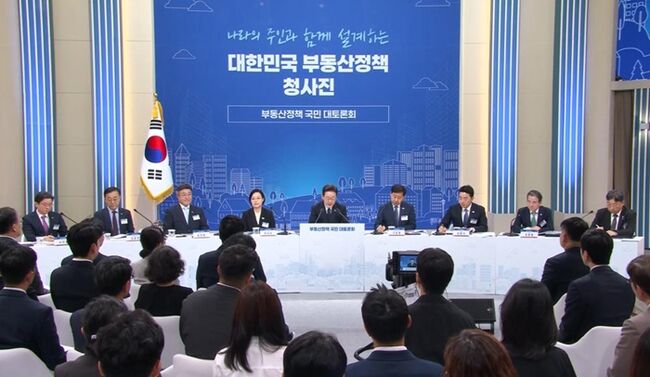 [Liberal Democratic Party Statement] Calling it a Grand Real Estate Debate… It Was Nothing More Than a Private Party Among Themselves
The 'National Grand Debate on Real Estate Policy' held on July 23rd and 27th. [Photo=Yonhap News]The 'National Grand Debate on Real Estate Policy,' hosted by the Lee Jae-myung administration under the
[Liberal Democratic Party Statement] Calling it a Grand Real Estate Debate… It Was Nothing More Than a Private Party Among Themselves
The 'National Grand Debate on Real Estate Policy' held on July 23rd and 27th. [Photo=Yonhap News]The 'National Grand Debate on Real Estate Policy,' hosted by the Lee Jae-myung administration under the
 [Photo] Evidence of Election Fraud Flooding U.S. Media… Trump Had 2.7 Million Votes Stolen
 [Video] U.S. Semiquincentennial Air Show... 'Art in the Sky' streaks across New York
 [Editorial Cartoon] A Draconian Law That Undermines Freedom of Expression

 List
List