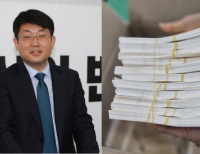
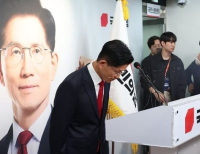
Jang Dong-hyuk's indefinite hunger strike is not merely a protest or an emotional gesture. It is a high-risk, high-reward political pivot he has chosen to regain leadership. [Photo=Yonhap News]
As backlash intensified within the party during the disciplinary proceedings against Han Dong-hoon, Jang Dong-hyuk opted for a procedural delay through a rehearing. This was not a concession born of pressure, but rather the most politically stable decision, one that dispersed responsibility while compelling the party in question to make a choice.
Had the disciplinary action been pushed through immediately, Jang Dong-hyuk would have borne all the blame individually. Conversely, the delay left a justification of "an opportunity was given," transforming subsequent outcomes into consequences of the structure rather than personal arbitrariness.
And his next move was the hunger strike.
An indefinite hunger strike is not merely a protest or an emotional gesture. It is a high-risk, high-reward political pivot he has chosen to regain leadership.
With this choice, he has moved from a managerial position to a combative one. He has redefined himself not as a representative mediating internal party conflicts, but as a figure standing at the forefront of the struggle against the ruling party.
The effect of the hunger strike is clear. Firstly, it shifts the focus of the debate. Instead of the legitimacy of the disciplinary process or internal power struggles, the question of "what is being done with one's body on the line?" takes center stage.
From this moment on, any force attacking Jang Dong-hyuk risks appearing not as a political opponent, but as a ruthless entity demeaning self-sacrifice. This creates a structure where the cost of criticism escalates rapidly.
Secondly, the hunger strike creates an agenda. Even without uttering a word, his very presence becomes a message. Jang Dong-hyuk is no longer a representative who reacts; he becomes the subject of news reports.
He stands at the center of headlines and serves as a benchmark for interpretation. Cooperation with the New Reform Party is also tied into the 'Jang Dong-hyuk-centric narrative of struggle,' allowing him to act as a link in the opposition's fight.
Thirdly, this choice removes the most damaging frame of "a representative who does nothing." In politics, incompetence is fatal, but controversy is evidence of survival. The very fact that his hunger strike is being criticized is proof that he remains at the center of the political arena.
Of course, a hunger strike is risky. Accusations of it being "excessive" or a "stunt" may follow. However, Jang Dong-hyuk has already calculated. He judges that the symbolic capital accumulated through action, even while enduring criticism, is greater than the political stamina eroded by inaction. This choice is not a strategy relying on sympathy, but a method of visually demonstrating leadership.
The picture Jang Dong-hyuk is painting now is clear:
I did not evade responsibility,
I did not postpone my decision,
And I am still fighting.
The hunger strike is a means, not an end. Through this means, he is once again fixing his message: the image of himself at the center of the struggle against the ruling party.
And in politics, whoever first paints this picture ultimately leads the game.
※ Columns by external contributors may differ from the editorial direction of this publication.

◆ Professor Shim Kyu-jin
Assistant Professor, Department of Digital Media, IE University, Spain. He previously served as a policy advisor to the Ministry of National Defense and head of the Data Lab at the Yoido Institute, and has worked as a full-time professor at the University of Melbourne, Australia, and an assistant professor at Singapore Management University. His books include 'K-Drama Yoon Suk-yeol' and 'Hyper Gender.'

 [Statement by the Seo-beo-kka Korea Military Academy Save-the-Nation Comrades Association] ㉛ Recount the Votes Publicly, as the Previous Recount Concealed Election Fraud
Tongyeong Mayoral Election Recount [Photo=Yonhap News]South Korea's liberal democracy is dying. The National Election Commission (NEC) and the judiciary, which have plummeted into criminal syndicates
[Statement by the Seo-beo-kka Korea Military Academy Save-the-Nation Comrades Association] ㉛ Recount the Votes Publicly, as the Previous Recount Concealed Election Fraud
Tongyeong Mayoral Election Recount [Photo=Yonhap News]South Korea's liberal democracy is dying. The National Election Commission (NEC) and the judiciary, which have plummeted into criminal syndicates
 What is the significance of the "Trump 2028" red hats that keep making a comeback?
It is noteworthy that President Donald Trump is "intentionally" fueling controversy over whether he can actually run in the 2028 presidential election, even though it is "highly likely he is seriously
What is the significance of the "Trump 2028" red hats that keep making a comeback?
It is noteworthy that President Donald Trump is "intentionally" fueling controversy over whether he can actually run in the 2028 presidential election, even though it is "highly likely he is seriously
 Jin Cummings: "North Korea says it will increase the number of spies, so what is the government doing?"
U.S. political columnist Gene Cummings has publicly questioned the South Korean government, asking, "North Korea is announcing plans to increase its number of spies, yet what is the South Korean
Jin Cummings: "North Korea says it will increase the number of spies, so what is the government doing?"
U.S. political columnist Gene Cummings has publicly questioned the South Korean government, asking, "North Korea is announcing plans to increase its number of spies, yet what is the South Korean
 Attorney Do Tae-woo: “Discrepancies in Voter Count and Improper Sealing Confirmed in Tongyeong Mayoral Recount… Official Request for Further Verification Filed with Gyeongnam Election Commission”
A bundle of out-of-district early voting ballots photographed by attorney Do Tae-woo at the Tongyeong mayoral election recount site. A clear, solid line visible on the side of the ballots raises suspi
Attorney Do Tae-woo: “Discrepancies in Voter Count and Improper Sealing Confirmed in Tongyeong Mayoral Recount… Official Request for Further Verification Filed with Gyeongnam Election Commission”
A bundle of out-of-district early voting ballots photographed by attorney Do Tae-woo at the Tongyeong mayoral election recount site. A clear, solid line visible on the side of the ballots raises suspi
 Stock Market Crash 'Black Tuesday'… KOSPI down 10.8%, KOSDAQ down 7.7%
The KOSPI fell by more than 5% in early trading on the 28th, triggering a sell-side sidecar.On the 28th, the KOSPI plunged by more than 10%.Due to the sharp decline, a sell-side sidecar—a temporary
Stock Market Crash 'Black Tuesday'… KOSPI down 10.8%, KOSDAQ down 7.7%
The KOSPI fell by more than 5% in early trading on the 28th, triggering a sell-side sidecar.On the 28th, the KOSPI plunged by more than 10%.Due to the sharp decline, a sell-side sidecar—a temporary
 [World Heritage Committee] 25 New World Heritage Sites Inscribed in Busan… South Korea Successfully Expands 'Getbol' Listing
The Chairperson of the World Heritage Committee speaks at the plenary session of the 48th session of the World Heritage Committee, held at BEXCO in Busan on the 20th. [Photo: Yonhap News]A total of 25
[World Heritage Committee] 25 New World Heritage Sites Inscribed in Busan… South Korea Successfully Expands 'Getbol' Listing
The Chairperson of the World Heritage Committee speaks at the plenary session of the 48th session of the World Heritage Committee, held at BEXCO in Busan on the 20th. [Photo: Yonhap News]A total of 25
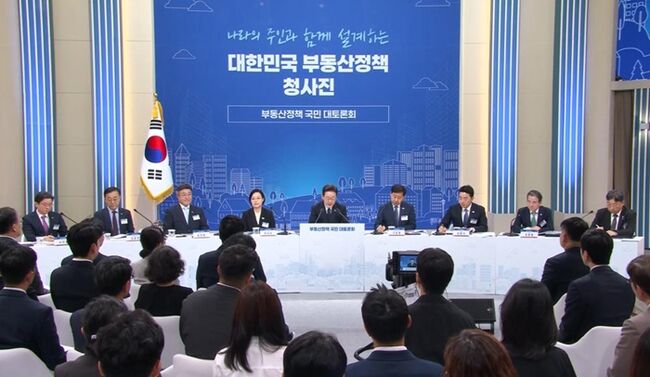 [Liberal Democratic Party Statement] Calling it a Grand Real Estate Debate… It Was Nothing More Than a Private Party Among Themselves
The 'National Grand Debate on Real Estate Policy' held on July 23rd and 27th. [Photo=Yonhap News]The 'National Grand Debate on Real Estate Policy,' hosted by the Lee Jae-myung administration under the
[Liberal Democratic Party Statement] Calling it a Grand Real Estate Debate… It Was Nothing More Than a Private Party Among Themselves
The 'National Grand Debate on Real Estate Policy' held on July 23rd and 27th. [Photo=Yonhap News]The 'National Grand Debate on Real Estate Policy,' hosted by the Lee Jae-myung administration under the
 [Photo] Evidence of Election Fraud Flooding U.S. Media… Trump Had 2.7 Million Votes Stolen
 [Video] U.S. Semiquincentennial Air Show... 'Art in the Sky' streaks across New York
 [Editorial Cartoon] A Draconian Law That Undermines Freedom of Expression

 List
List