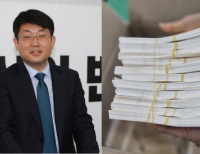
From left, Shin Young-bok, who was involved in the pro-North Korea underground party Tonghyokdang, and Kim Mi-young, CEO of VON News, author of the new book ‘The Hidden Nation’. Also pictured is Kim Young-hwan, who led the establishment of Minhyokdang. [Photo=Sungkonghoe University, Sage, Yonhap News]
Kim Mi-young, CEO of VON News, who has unraveled complex ideological issues from the Juche faction problem to election fraud allegations, has published ‘The Hidden Nation’.
The Korean Peninsula, divided by the 38th parallel in 1945, was later split by the longer and wider Demilitarized Zone after the Korean War. It wasn't just the geographical positions of North and South that were divided; a wall of ideology split South Korea in two.
Tonghyokdang Planned, Minhyokdang Spread It
Of the two divided nations, one went underground to form a ‘Hidden Nation.’ The author identifies two parties that ruled this hidden nation: the Tongil Hyokmyeong Dang (Tonghyokdang) and the Minjok Minju Hyokmyeong Dang (Minhyokdang).
The author points to Tonghyokdang as the leadership of the hidden nation that is quietly occupying South Korea today. She believes that Minhyokdang was responsible for the proliferation of the hidden nation's populace, which constitutes the majority of its citizens.
“The efforts to turn South Korean anti-establishment intellectuals into a communist revolutionary force have been meticulously and repeatedly carried out for a long time, culminating in the establishment of pro-North Korea underground parties, the Tongil Hyokmyeong Dang (Tonghyokdang) right after the April 19 Revolution, and the Minjok Minju Hyokmyeong Dang (Minhyokdang) after the May 18 Gwangju Uprising.”
These two parties, though operating as illegal secret organizations, existed as tangible entities, merely concealing themselves rather than disappearing.
Tonghyokdang in the 1960s was intrinsically linked to Minhyokdang in the 1990s. This connection is understandable because Kim Il-sung's lineage, which gained power in North Korea in 1945, continues to effectively rule North Korea even after the end of the Cold War.
The author laments, “South Korea is facing a true crisis.” This is because the true power holders in this country are not liberal democracy but the hidden nation. That nation, which has been hidden for a long time, is confronting South Korea in alliance with North Korea, China, and at times, Russia.
Pro-North Korea Underground Parties Still Active
Kim Young-hwan, the author of ‘Gangcheol Seosin’ (Steel Letters), is considered the progenitor of the NL faction of the Juche ideology and led the establishment of Minhyokdang.
“I do not deny the legitimacy of the founding of South Korea, but at the same time, I actively recognize the legitimacy of the founding of the Democratic People's Republic of Korea. This was true in the past and remains true now.”
In every interview, Kim Young-hwan has insisted, “It is not a conversion, but a transformation. As times change, the spirit of the age changes.”
When this interview was published in the June 1999 issue of 'Wolgan Chosun' magazine, he specifically requested that the editorial department not use the word ‘conversion,’ and indeed, the department complied, using the word ‘transformation’ in the title instead of ‘conversion.’
Furthermore, Kim Young-hwan has openly stated, “We are still Juche faction members. We do not abandon the Juche ideology. We do not surrender to South Korea.”
What does it mean to have not converted? The author asserts, “Recognizing the legitimacy of North Korea's founding directly contradicts Articles 3 and 4 of the South Korean Constitution.”
Shin Young-bok, a Materialistic Kim Il-sungist
The author states that the hidden nation is no longer a hidden country.
“The hidden nation has replaced Korea. Before this happened in the judiciary, the occupation by the hidden nation began in the cultural and intellectual spheres. People are no longer interested in what Tonghyokdang was or why Shin Young-bok went to prison. His handwriting is now used on the national intelligence agency's marker stone, going beyond just a soju brand.”
Who is Shin Young-bok? Isn't he the number one figure admired by the left-wing, including Moon Jae-in? However, Kim Gil-rak, who led Tonghyokdang, revealed in his prison memoirs that Shin Young-bok was "nothing more than a materialistic Kim Il-sungist."
The author explains that while Tonghyokdang was a typical North Korean underground party, Minhyokdang had distinct characteristics.
They succeeded in forming a comprehensive political force against the backdrop of large-scale student activist organizations in the 1980s. Minhyokdang was the first underground party that served as a vanguard organization while simultaneously mobilizing large-scale popular movements.
Minhyokdang is a party that, while maintaining its vanguard organization as an underground party, possessed the political capability to establish legitimate parties in South Korea and produced local government leaders, members of the National Assembly, and even a president.
According to the book, the original Minhyokdang, after being disbanded, transformed into a New Right political force and successfully merged chemically with conservative right-wing parties.
Meanwhile, the re-established Minhyokdang, despite the trial-and-error of the dissolution of the United Progressive Party, has not abandoned its pro-North Korea Juche identity and has succeeded in establishing a legitimate party, even becoming a parliamentary party.
The author laments, “Even before the founding of South Korea, malicious forces threatening South Korea had spread their operational networks like fine capillaries throughout the southern part of the Korean Peninsula, as well as in allied countries such as Japan, the United States, and Europe. Since the mid-1990s, legitimate political parties have fallen under the extensive influence of Minhyokdang, and true South Korean institutional parties have disappeared.”
Finally, the author states that it is misguided to consider this hidden nation (Eunguk) as mere pawns of North Korea or the Chinese Communist Party. In short, the hidden nation is a 'complex system.'
It is important to understand their beliefs, but their capabilities should not be underestimated. The author emphasizes the need for new people and a new generation to emerge who can overcome their beliefs and capabilities. She confesses that the state of emergency on December 3, 2024, became that catalyst.
Reporter Lim Yo-hee

 [Statement by the Seo-beo-kka Korea Military Academy Save-the-Nation Comrades Association] ㉛ Recount the Votes Publicly, as the Previous Recount Concealed Election Fraud
Tongyeong Mayoral Election Recount [Photo=Yonhap News]South Korea's liberal democracy is dying. The National Election Commission (NEC) and the judiciary, which have plummeted into criminal syndicates
[Statement by the Seo-beo-kka Korea Military Academy Save-the-Nation Comrades Association] ㉛ Recount the Votes Publicly, as the Previous Recount Concealed Election Fraud
Tongyeong Mayoral Election Recount [Photo=Yonhap News]South Korea's liberal democracy is dying. The National Election Commission (NEC) and the judiciary, which have plummeted into criminal syndicates
 What is the significance of the "Trump 2028" red hats that keep making a comeback?
It is noteworthy that President Donald Trump is "intentionally" fueling controversy over whether he can actually run in the 2028 presidential election, even though it is "highly likely he is seriously
What is the significance of the "Trump 2028" red hats that keep making a comeback?
It is noteworthy that President Donald Trump is "intentionally" fueling controversy over whether he can actually run in the 2028 presidential election, even though it is "highly likely he is seriously
 Jin Cummings: "North Korea says it will increase the number of spies, so what is the government doing?"
U.S. political columnist Gene Cummings has publicly questioned the South Korean government, asking, "North Korea is announcing plans to increase its number of spies, yet what is the South Korean
Jin Cummings: "North Korea says it will increase the number of spies, so what is the government doing?"
U.S. political columnist Gene Cummings has publicly questioned the South Korean government, asking, "North Korea is announcing plans to increase its number of spies, yet what is the South Korean
 Attorney Do Tae-woo: “Discrepancies in Voter Count and Improper Sealing Confirmed in Tongyeong Mayoral Recount… Official Request for Further Verification Filed with Gyeongnam Election Commission”
A bundle of out-of-district early voting ballots photographed by attorney Do Tae-woo at the Tongyeong mayoral election recount site. A clear, solid line visible on the side of the ballots raises suspi
Attorney Do Tae-woo: “Discrepancies in Voter Count and Improper Sealing Confirmed in Tongyeong Mayoral Recount… Official Request for Further Verification Filed with Gyeongnam Election Commission”
A bundle of out-of-district early voting ballots photographed by attorney Do Tae-woo at the Tongyeong mayoral election recount site. A clear, solid line visible on the side of the ballots raises suspi
 Stock Market Crash 'Black Tuesday'… KOSPI down 10.8%, KOSDAQ down 7.7%
The KOSPI fell by more than 5% in early trading on the 28th, triggering a sell-side sidecar.On the 28th, the KOSPI plunged by more than 10%.Due to the sharp decline, a sell-side sidecar—a temporary
Stock Market Crash 'Black Tuesday'… KOSPI down 10.8%, KOSDAQ down 7.7%
The KOSPI fell by more than 5% in early trading on the 28th, triggering a sell-side sidecar.On the 28th, the KOSPI plunged by more than 10%.Due to the sharp decline, a sell-side sidecar—a temporary
 [World Heritage Committee] 25 New World Heritage Sites Inscribed in Busan… South Korea Successfully Expands 'Getbol' Listing
The Chairperson of the World Heritage Committee speaks at the plenary session of the 48th session of the World Heritage Committee, held at BEXCO in Busan on the 20th. [Photo: Yonhap News]A total of 25
[World Heritage Committee] 25 New World Heritage Sites Inscribed in Busan… South Korea Successfully Expands 'Getbol' Listing
The Chairperson of the World Heritage Committee speaks at the plenary session of the 48th session of the World Heritage Committee, held at BEXCO in Busan on the 20th. [Photo: Yonhap News]A total of 25
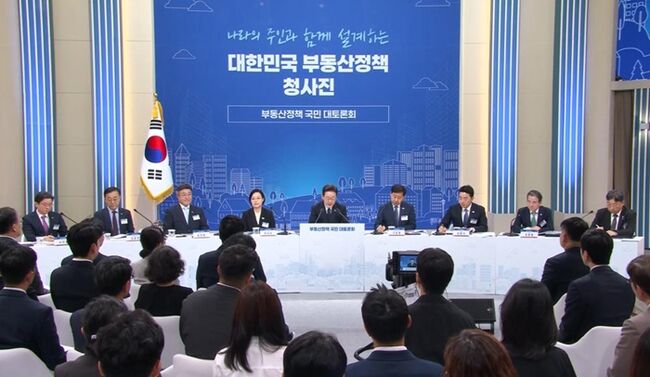 [Liberal Democratic Party Statement] Calling it a Grand Real Estate Debate… It Was Nothing More Than a Private Party Among Themselves
The 'National Grand Debate on Real Estate Policy' held on July 23rd and 27th. [Photo=Yonhap News]The 'National Grand Debate on Real Estate Policy,' hosted by the Lee Jae-myung administration under the
[Liberal Democratic Party Statement] Calling it a Grand Real Estate Debate… It Was Nothing More Than a Private Party Among Themselves
The 'National Grand Debate on Real Estate Policy' held on July 23rd and 27th. [Photo=Yonhap News]The 'National Grand Debate on Real Estate Policy,' hosted by the Lee Jae-myung administration under the
 [Photo] Evidence of Election Fraud Flooding U.S. Media… Trump Had 2.7 Million Votes Stolen
 [Video] U.S. Semiquincentennial Air Show... 'Art in the Sky' streaks across New York
 [Editorial Cartoon] A Draconian Law That Undermines Freedom of Expression

 List
List