Large tractors are occupying a square around the European Parliament in protest of the push to conclude a Free Trade Agreement (FTA) between the EU and South America's Mercosur. [YTN News Capture]The farmer protests that have shaken Europe are no longer industrial conflicts over subsidies or prices.
The accumulated anger since the end of 2023 exploded with the conclusion of the EU-Mercosur FTA in early 2026, and that energy was immediately absorbed as political momentum for the New Right.
Farmers, once typical beneficiaries of left-wing protectionism, have now transformed into a vanguard pushing most clearly for anti-elite, anti-regulation, and national-first rhetoric.
Farmers are the real people
The core of the shift is not policy, but framing. Brussels' environmental bureaucrats have been redefined as "climate elites out of touch with reality," and farmers as "the real people."
While the Green Deal and the "Farm to Fork" strategy were couched in the language of morality, on the ground they translated into survival costs through regulations on diesel, fertilizers, and nitrogen, as well as mandatory fallow periods.
Regardless of the rightness or wrongness of the goals, environmental policies that ignored speed and method have inevitably led to "Greenlash," and this backlash has precisely aligned with the New Right's message calling for deregulation.
Free trade was also a decisive catalyst. The influx of Ukrainian grain and the opening to South American agricultural products shattered farmers' sense of fairness.
The perception that "we have become expensive by adhering to strict standards, while imports with looser regulations enter duty-free" overpowered the abstract utility of free trade.
As farmers organized their anger by calling this "Cars for Cows," national-first ideology immediately became the language of elections.
Political forces that harvested this anger have rapidly risen. The Farmers-Citizens' Movement (BBB) in the Netherlands, the National Rally (RN) in France, and the Alternative for Germany (AfD) are representative examples.
Farmers are no longer objects of protection but subjects of mobilization, and the New Right has succeeded in translating that anger into institutional politics.
Farmers want respect for the value of their production
This situation offers clear implications for the Korean right.
First, regulations that directly impact daily life must be brought to the forefront of ideological battles. European New Right parties focused on on-the-ground issues like diesel subsidies and fertilizer regulations, rather than grand narratives.
When prices, energy costs, and excessive environmental regulations are redefined as "tyranny by elite power out of touch with reality," a right-wing narrative centered on public welfare can be formed.
Second, while not negating free trade, neo-protectionism must be institutionalized.
Unless explicit compensatory measures such as direct payments, insurance, and conversion investments for affected groups are placed at the center of policy promises, while acknowledging the benefits of openness, FTAs will always become a political backlash. "Korea First" is a matter of design, not just a slogan.
Third, a producer solidarity against political correctness and elites must be built. The European farmers' question was simple: "Why should we sacrifice ourselves for their moral superiority?"
In Korea, a value-based solidarity is needed to connect farmers, manufacturing workers, and self-employed individuals who are tired of excessive environmental fundamentalism and regulations. This is a choice to place producers, not consumers, at the center of politics.
Finally, the center of gravity of organizations must shift. The New Right's victories did not begin in large cities but in the provinces and on the ground where tractors roam. Transforming beyond Seoul-centric discourse to make agricultural fields and provincial industrial complexes permanent bases for organization is what guarantees the sustainability of mobilization.
The lesson from Europe is clear. The destructive power of politics is maximized when groups of producers groaning under regulations coalesce. Remaining a "sophisticated conservative" lacks momentum.
What is needed now is a militant conservatism that converts the anger on the ground into institutional power. The reason farmers, once the protected class of the left, became the engine of the New Right is simple.
They produce, and they demand to be respected for it.

◆ Professor Sim Kyu-jin
Professor of Digital Media at IE University, Spain. He previously served as a policy advisor to the Ministry of National Defense and head of the Data Lab at the Yeouido Research Institute. He also worked as a full-time professor at the University of Melbourne, Australia, and an assistant professor at Singapore Management University. His books include "K-Drama Yoon Suk Yeol" and "Hyper Gender."

 [Statement by the Seo-beo-kka Korea Military Academy Save-the-Nation Comrades Association] ㉛ Recount the Votes Publicly, as the Previous Recount Concealed Election Fraud
Tongyeong Mayoral Election Recount [Photo=Yonhap News]South Korea's liberal democracy is dying. The National Election Commission (NEC) and the judiciary, which have plummeted into criminal syndicates
[Statement by the Seo-beo-kka Korea Military Academy Save-the-Nation Comrades Association] ㉛ Recount the Votes Publicly, as the Previous Recount Concealed Election Fraud
Tongyeong Mayoral Election Recount [Photo=Yonhap News]South Korea's liberal democracy is dying. The National Election Commission (NEC) and the judiciary, which have plummeted into criminal syndicates
 What is the significance of the "Trump 2028" red hats that keep making a comeback?
It is noteworthy that President Donald Trump is "intentionally" fueling controversy over whether he can actually run in the 2028 presidential election, even though it is "highly likely he is seriously
What is the significance of the "Trump 2028" red hats that keep making a comeback?
It is noteworthy that President Donald Trump is "intentionally" fueling controversy over whether he can actually run in the 2028 presidential election, even though it is "highly likely he is seriously
 Jin Cummings: "North Korea says it will increase the number of spies, so what is the government doing?"
U.S. political columnist Gene Cummings has publicly questioned the South Korean government, asking, "North Korea is announcing plans to increase its number of spies, yet what is the South Korean
Jin Cummings: "North Korea says it will increase the number of spies, so what is the government doing?"
U.S. political columnist Gene Cummings has publicly questioned the South Korean government, asking, "North Korea is announcing plans to increase its number of spies, yet what is the South Korean
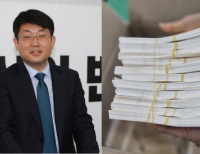
 Attorney Do Tae-woo: “Discrepancies in Voter Count and Improper Sealing Confirmed in Tongyeong Mayoral Recount… Official Request for Further Verification Filed with Gyeongnam Election Commission”
A bundle of out-of-district early voting ballots photographed by attorney Do Tae-woo at the Tongyeong mayoral election recount site. A clear, solid line visible on the side of the ballots raises suspi
Attorney Do Tae-woo: “Discrepancies in Voter Count and Improper Sealing Confirmed in Tongyeong Mayoral Recount… Official Request for Further Verification Filed with Gyeongnam Election Commission”
A bundle of out-of-district early voting ballots photographed by attorney Do Tae-woo at the Tongyeong mayoral election recount site. A clear, solid line visible on the side of the ballots raises suspi
 Stock Market Crash 'Black Tuesday'… KOSPI down 10.8%, KOSDAQ down 7.7%
The KOSPI fell by more than 5% in early trading on the 28th, triggering a sell-side sidecar.On the 28th, the KOSPI plunged by more than 10%.Due to the sharp decline, a sell-side sidecar—a temporary
Stock Market Crash 'Black Tuesday'… KOSPI down 10.8%, KOSDAQ down 7.7%
The KOSPI fell by more than 5% in early trading on the 28th, triggering a sell-side sidecar.On the 28th, the KOSPI plunged by more than 10%.Due to the sharp decline, a sell-side sidecar—a temporary
 [World Heritage Committee] 25 New World Heritage Sites Inscribed in Busan… South Korea Successfully Expands 'Getbol' Listing
The Chairperson of the World Heritage Committee speaks at the plenary session of the 48th session of the World Heritage Committee, held at BEXCO in Busan on the 20th. [Photo: Yonhap News]A total of 25
[World Heritage Committee] 25 New World Heritage Sites Inscribed in Busan… South Korea Successfully Expands 'Getbol' Listing
The Chairperson of the World Heritage Committee speaks at the plenary session of the 48th session of the World Heritage Committee, held at BEXCO in Busan on the 20th. [Photo: Yonhap News]A total of 25
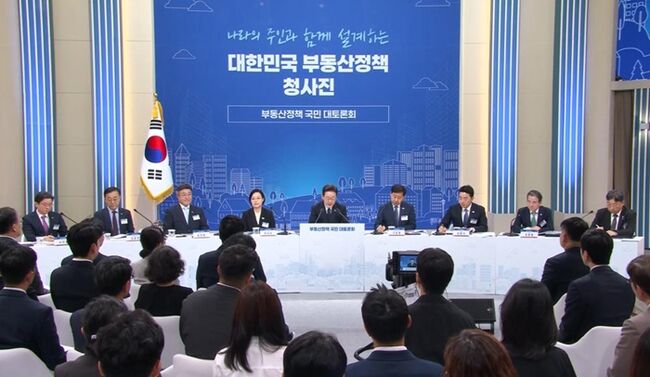 [Liberal Democratic Party Statement] Calling it a Grand Real Estate Debate… It Was Nothing More Than a Private Party Among Themselves
The 'National Grand Debate on Real Estate Policy' held on July 23rd and 27th. [Photo=Yonhap News]The 'National Grand Debate on Real Estate Policy,' hosted by the Lee Jae-myung administration under the
[Liberal Democratic Party Statement] Calling it a Grand Real Estate Debate… It Was Nothing More Than a Private Party Among Themselves
The 'National Grand Debate on Real Estate Policy' held on July 23rd and 27th. [Photo=Yonhap News]The 'National Grand Debate on Real Estate Policy,' hosted by the Lee Jae-myung administration under the
 [Photo] Evidence of Election Fraud Flooding U.S. Media… Trump Had 2.7 Million Votes Stolen
 [Video] U.S. Semiquincentennial Air Show... 'Art in the Sky' streaks across New York
 [Editorial Cartoon] A Draconian Law That Undermines Freedom of Expression

 List
List