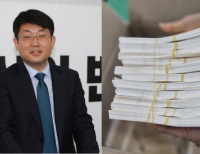
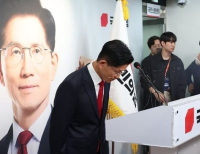
A vacant seat is seen as People Power Party lawmakers walk out in protest after the special bill for the establishment of an integrated special city in Jeonnam and Gwangju was passed at a plenary session of the Legislation and Judiciary Committee at the National Assembly on February 24th. 2026.2.24 [Photo=Yonhap News]
The National Assembly's Legislation and Judiciary Committee's decision to defer the Daegu-Gyeongbuk administrative integration special bill while approving only the Gwangju-Jeonnam special bill is not a trivial matter to be dismissed as a simple regional conflict.
The essence of this debate is less about the vested interests of a specific region and more about questioning how much the power structure of the National Assembly has changed.
If a bill can be halted due to a lack of consensus, who then determines the criteria for that consensus? This is the question the political sphere is grappling with right now.
The original role of the Legislation and Judiciary Committee was clear: to review the system and wording, examine constitutionality, and serve as the final technical gateway in the legislative process.
However, in practical politics, the Legislation and Judiciary Committee has long functioned as a "final negotiation table." The more intensely the ruling and opposition parties clashed, the more the committee slowed down and acted as a mechanism to induce compromise.
There was only one reason why this practice could be accepted to a certain extent: the National Assembly operated on the premise of consensus.
But the situation has changed with the 22nd National Assembly.
The speed of legislation has increased, and politics centered on majority seats has been strengthened. As the structure of bills being pushed forward without sufficient consensus accumulated at the standing committee level became repetitive, the committee's halting of bills citing "lack of consensus" began to appear far more political than before.
The practice, which was created based on consensus, remains intact even though consensus politics has weakened.
The National Assembly's practice, which operated on the premise of consensus, has at some point lost its premise and is now just a shell.
If unilateralism and forceful passage are repeated at the standing committee level, and then the justification of "lack of consensus" reappears at the final gate, that judgment is bound to be political.
When consensus existed, the practice functioned as a balancing mechanism, but in an environment where consensus has disappeared, the practice transforms into a tool to justify the overreach of authority.
The problem is not the pros and cons of a specific bill, but the structure itself, where passage is pushed by one side and the brakes are applied by the other.
Ultimately, when consensus and practice are selectively invoked based on advantage or disadvantage, the National Assembly inevitably appears as a space where political calculations take precedence over procedural legitimacy.
The "20 trillion won in support" debate surrounding the Gwangju-Jeonnam special bill should also be understood in this context.
The issue lies not so much in the size of the financial support itself, but in the criteria used to determine which bills are deemed to have sufficient consensus and which do not.
The moment "consensus" begins to be used as a language of political choice, the Legislation and Judiciary Committee ceases to be a legal review body and becomes a gatekeeper of legislation.
What is needed here is the confirmation of judicial standards beyond political arguments.
Whether the political judgment of "lack of consensus" can be used as a reason to halt the legislative process, and the extent of authority exercised under the name of practice, are ultimately matters to be resolved within the constitutional order.
As long as efforts are made to resolve this solely through the logic of power within the National Assembly, the debate will only be repeated.
What is needed now is not a question of who is right, but a clear determination within the realm of judicial judgment of what constitutes a legitimate exercise of authority.
Of course, a solution that completely incapacitates the Legislation and Judiciary Committee is also dangerous.
If the final braking mechanism in the National Assembly disappears, the speed of legislative power will only increase.
However, the current structure, where practices are maintained while consensus politics has weakened, is also unlikely to last long.
Maintaining authority, which was premised on consensus, in an era without consensus is highly likely to erode the credibility of the system itself.
The question facing the National Assembly now is simple yet grave.
Will the Legislation and Judiciary Committee return to being a technical body that organizes legislation, or will it remain a political balancing wheel?
A choice is necessary either way. Leaving only practices in a National Assembly without consensus will not lead to institutional stability but rather to increased chaos.
In an era where a president elected nationwide is subject to judicial review, the National Assembly, which holds collective power, cannot be an exception to constitutional judgment regarding the boundaries of its authority.
Representation is not a basis for exemption from responsibility, but rather a reason for demanding stricter procedural legitimacy.
The question "Can the President be held accountable but not the National Assembly?" is not a slogan directed at a specific individual, but a question of standards that democracy poses to itself.
If the weight of power is not equal, the method of responsibility may differ.
However, the moment responsibility itself disappears, representation transforms from a shield of democracy into a certificate of political absolution.
Practice can explain authority, but it cannot justify it.
If politics labels something "practice" when there is consensus and "authority" when there is no consensus, then the National Assembly's procedures can no longer be neutral.
What is needed now is not a dispute surrounding a specific region, but a sober self-examination that re-questions the power structure of the National Assembly.

 [Statement by the Seo-beo-kka Korea Military Academy Save-the-Nation Comrades Association] ㉛ Recount the Votes Publicly, as the Previous Recount Concealed Election Fraud
Tongyeong Mayoral Election Recount [Photo=Yonhap News]South Korea's liberal democracy is dying. The National Election Commission (NEC) and the judiciary, which have plummeted into criminal syndicates
[Statement by the Seo-beo-kka Korea Military Academy Save-the-Nation Comrades Association] ㉛ Recount the Votes Publicly, as the Previous Recount Concealed Election Fraud
Tongyeong Mayoral Election Recount [Photo=Yonhap News]South Korea's liberal democracy is dying. The National Election Commission (NEC) and the judiciary, which have plummeted into criminal syndicates
 What is the significance of the "Trump 2028" red hats that keep making a comeback?
It is noteworthy that President Donald Trump is "intentionally" fueling controversy over whether he can actually run in the 2028 presidential election, even though it is "highly likely he is seriously
What is the significance of the "Trump 2028" red hats that keep making a comeback?
It is noteworthy that President Donald Trump is "intentionally" fueling controversy over whether he can actually run in the 2028 presidential election, even though it is "highly likely he is seriously
 Jin Cummings: "North Korea says it will increase the number of spies, so what is the government doing?"
U.S. political columnist Gene Cummings has publicly questioned the South Korean government, asking, "North Korea is announcing plans to increase its number of spies, yet what is the South Korean
Jin Cummings: "North Korea says it will increase the number of spies, so what is the government doing?"
U.S. political columnist Gene Cummings has publicly questioned the South Korean government, asking, "North Korea is announcing plans to increase its number of spies, yet what is the South Korean
 Attorney Do Tae-woo: “Discrepancies in Voter Count and Improper Sealing Confirmed in Tongyeong Mayoral Recount… Official Request for Further Verification Filed with Gyeongnam Election Commission”
A bundle of out-of-district early voting ballots photographed by attorney Do Tae-woo at the Tongyeong mayoral election recount site. A clear, solid line visible on the side of the ballots raises suspi
Attorney Do Tae-woo: “Discrepancies in Voter Count and Improper Sealing Confirmed in Tongyeong Mayoral Recount… Official Request for Further Verification Filed with Gyeongnam Election Commission”
A bundle of out-of-district early voting ballots photographed by attorney Do Tae-woo at the Tongyeong mayoral election recount site. A clear, solid line visible on the side of the ballots raises suspi
 Stock Market Crash 'Black Tuesday'… KOSPI down 10.8%, KOSDAQ down 7.7%
The KOSPI fell by more than 5% in early trading on the 28th, triggering a sell-side sidecar.On the 28th, the KOSPI plunged by more than 10%.Due to the sharp decline, a sell-side sidecar—a temporary
Stock Market Crash 'Black Tuesday'… KOSPI down 10.8%, KOSDAQ down 7.7%
The KOSPI fell by more than 5% in early trading on the 28th, triggering a sell-side sidecar.On the 28th, the KOSPI plunged by more than 10%.Due to the sharp decline, a sell-side sidecar—a temporary
 [World Heritage Committee] 25 New World Heritage Sites Inscribed in Busan… South Korea Successfully Expands 'Getbol' Listing
The Chairperson of the World Heritage Committee speaks at the plenary session of the 48th session of the World Heritage Committee, held at BEXCO in Busan on the 20th. [Photo: Yonhap News]A total of 25
[World Heritage Committee] 25 New World Heritage Sites Inscribed in Busan… South Korea Successfully Expands 'Getbol' Listing
The Chairperson of the World Heritage Committee speaks at the plenary session of the 48th session of the World Heritage Committee, held at BEXCO in Busan on the 20th. [Photo: Yonhap News]A total of 25
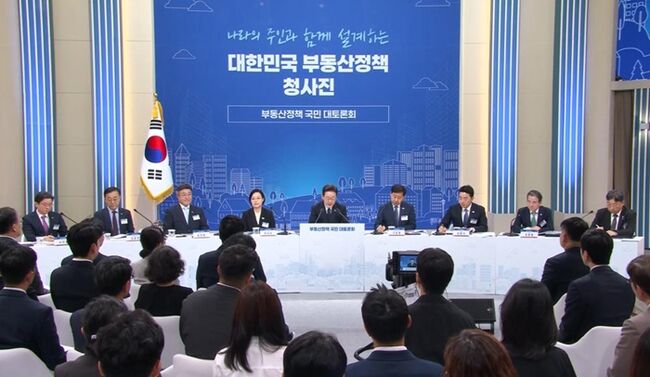 [Liberal Democratic Party Statement] Calling it a Grand Real Estate Debate… It Was Nothing More Than a Private Party Among Themselves
The 'National Grand Debate on Real Estate Policy' held on July 23rd and 27th. [Photo=Yonhap News]The 'National Grand Debate on Real Estate Policy,' hosted by the Lee Jae-myung administration under the
[Liberal Democratic Party Statement] Calling it a Grand Real Estate Debate… It Was Nothing More Than a Private Party Among Themselves
The 'National Grand Debate on Real Estate Policy' held on July 23rd and 27th. [Photo=Yonhap News]The 'National Grand Debate on Real Estate Policy,' hosted by the Lee Jae-myung administration under the
 [Photo] Evidence of Election Fraud Flooding U.S. Media… Trump Had 2.7 Million Votes Stolen
 [Video] U.S. Semiquincentennial Air Show... 'Art in the Sky' streaks across New York
 [Editorial Cartoon] A Draconian Law That Undermines Freedom of Expression

 List
List