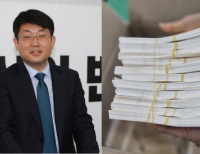
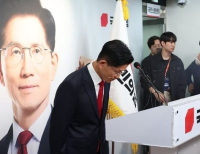
On April 2nd, a bereaved victim's family shed tears as the 'Act on Special Cases Concerning Compensation for Damages from COVID-19 Vaccination' passed the National Assembly plenary session. [Photo=Yonhap News]
Numbers do not speak emotions. However, the numbers chosen as benchmarks ultimately reveal a nation's choices.
The figures of 1,285 reports of foreign substances, 2,137 reported deaths following vaccination, and the 23 cases recognized by the government for causal links prompt us to reconsider the direction of discretion exercised by the South Korean administration during the COVID-19 pandemic.
Numbers explain events, but they do not inherently dictate the direction of judgment.
During the COVID-19 period, the Korea Disease Control and Prevention Agency (KDCA) opted to recall and discard individual vaccines where foreign substances were found, while not suspending vaccinations from the same manufacturing batch. The justification was that no manufacturing defects had been confirmed.
This was not a mandatory action dictated by law, but a result of administrative discretion exercised during a crisis.
At the time, public health authorities explained that they considered the pace of vaccination, supply realities, and the burden on the healthcare system.
However, subsequent audits raised different questions.
The question was whether it was possible to halt the process even at the stage of 'potential risk,' rather than waiting for 'confirmed risk.'
Japan made a different choice around the same time.
Even when the cause was not clearly identified, they proactively suspended entire lots.
Neither country had legally mandated automatic suspension provisions.
Ultimately, the difference lay in the direction of discretion rather than the system itself.
One was a decision to continue vaccinations until the risk was confirmed, while the other was a choice to stop preemptively in anticipation of the worst-case scenario.
The issue is not which choice was right, but on what basis that choice was made.
Therefore, the numbers 1,285, 2,137, and 23 remain as different languages.
1,285 was an administrative management figure, 2,137 was the number remembered by bereaved families, and 23 was the number officially recognized by the state.
The reason why numbers born in the same period point to different realities is that discretion does not always operate neutrally.
Discretion is a choice, and choices involve priorities.
No public officials were punished because the administration acted within legally permissible limits.
However, the absence of legal liability does not mean that social questions have also disappeared.
For those still calling out the names of the deceased in front of City Hall, discretion is not a technical term of administration but another name for the questions left behind.
Ultimately, we are left with one question to ask again.
In the midst of the crisis, what was the choice made by the state in exercising its discretion intended to protect?
Discretion is the language of last resort that a state possesses in a crisis.
However, the criteria by which that discretion operated does not disappear with time. Numbers remain, records remain, and memories remain.
As long as the numbers 1,285, 2,137, and 23 exist as different faces of the same era, the judgments made during the COVID-19 period will not simply end as past administrative actions.
Discretion can be explained by law, but whose safety was prioritized by that discretion is a question society will ultimately ask again.
And as long as that question persists, this story is not over; it is still unfolding.

 [Statement by the Seo-beo-kka Korea Military Academy Save-the-Nation Comrades Association] ㉛ Recount the Votes Publicly, as the Previous Recount Concealed Election Fraud
Tongyeong Mayoral Election Recount [Photo=Yonhap News]South Korea's liberal democracy is dying. The National Election Commission (NEC) and the judiciary, which have plummeted into criminal syndicates
[Statement by the Seo-beo-kka Korea Military Academy Save-the-Nation Comrades Association] ㉛ Recount the Votes Publicly, as the Previous Recount Concealed Election Fraud
Tongyeong Mayoral Election Recount [Photo=Yonhap News]South Korea's liberal democracy is dying. The National Election Commission (NEC) and the judiciary, which have plummeted into criminal syndicates
 What is the significance of the "Trump 2028" red hats that keep making a comeback?
It is noteworthy that President Donald Trump is "intentionally" fueling controversy over whether he can actually run in the 2028 presidential election, even though it is "highly likely he is seriously
What is the significance of the "Trump 2028" red hats that keep making a comeback?
It is noteworthy that President Donald Trump is "intentionally" fueling controversy over whether he can actually run in the 2028 presidential election, even though it is "highly likely he is seriously
 Jin Cummings: "North Korea says it will increase the number of spies, so what is the government doing?"
U.S. political columnist Gene Cummings has publicly questioned the South Korean government, asking, "North Korea is announcing plans to increase its number of spies, yet what is the South Korean
Jin Cummings: "North Korea says it will increase the number of spies, so what is the government doing?"
U.S. political columnist Gene Cummings has publicly questioned the South Korean government, asking, "North Korea is announcing plans to increase its number of spies, yet what is the South Korean
 Attorney Do Tae-woo: “Discrepancies in Voter Count and Improper Sealing Confirmed in Tongyeong Mayoral Recount… Official Request for Further Verification Filed with Gyeongnam Election Commission”
A bundle of out-of-district early voting ballots photographed by attorney Do Tae-woo at the Tongyeong mayoral election recount site. A clear, solid line visible on the side of the ballots raises suspi
Attorney Do Tae-woo: “Discrepancies in Voter Count and Improper Sealing Confirmed in Tongyeong Mayoral Recount… Official Request for Further Verification Filed with Gyeongnam Election Commission”
A bundle of out-of-district early voting ballots photographed by attorney Do Tae-woo at the Tongyeong mayoral election recount site. A clear, solid line visible on the side of the ballots raises suspi
 Stock Market Crash 'Black Tuesday'… KOSPI down 10.8%, KOSDAQ down 7.7%
The KOSPI fell by more than 5% in early trading on the 28th, triggering a sell-side sidecar.On the 28th, the KOSPI plunged by more than 10%.Due to the sharp decline, a sell-side sidecar—a temporary
Stock Market Crash 'Black Tuesday'… KOSPI down 10.8%, KOSDAQ down 7.7%
The KOSPI fell by more than 5% in early trading on the 28th, triggering a sell-side sidecar.On the 28th, the KOSPI plunged by more than 10%.Due to the sharp decline, a sell-side sidecar—a temporary
 [World Heritage Committee] 25 New World Heritage Sites Inscribed in Busan… South Korea Successfully Expands 'Getbol' Listing
The Chairperson of the World Heritage Committee speaks at the plenary session of the 48th session of the World Heritage Committee, held at BEXCO in Busan on the 20th. [Photo: Yonhap News]A total of 25
[World Heritage Committee] 25 New World Heritage Sites Inscribed in Busan… South Korea Successfully Expands 'Getbol' Listing
The Chairperson of the World Heritage Committee speaks at the plenary session of the 48th session of the World Heritage Committee, held at BEXCO in Busan on the 20th. [Photo: Yonhap News]A total of 25
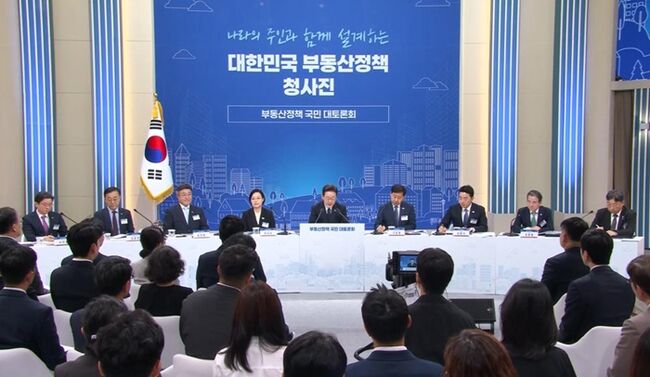 [Liberal Democratic Party Statement] Calling it a Grand Real Estate Debate… It Was Nothing More Than a Private Party Among Themselves
The 'National Grand Debate on Real Estate Policy' held on July 23rd and 27th. [Photo=Yonhap News]The 'National Grand Debate on Real Estate Policy,' hosted by the Lee Jae-myung administration under the
[Liberal Democratic Party Statement] Calling it a Grand Real Estate Debate… It Was Nothing More Than a Private Party Among Themselves
The 'National Grand Debate on Real Estate Policy' held on July 23rd and 27th. [Photo=Yonhap News]The 'National Grand Debate on Real Estate Policy,' hosted by the Lee Jae-myung administration under the
 [Photo] Evidence of Election Fraud Flooding U.S. Media… Trump Had 2.7 Million Votes Stolen
 [Video] U.S. Semiquincentennial Air Show... 'Art in the Sky' streaks across New York
 [Editorial Cartoon] A Draconian Law That Undermines Freedom of Expression

 List
List