 The April Revolution was remembered as a political revolution that overthrew fraudulent elections and restored constitutional order.
In the spring of 1960, Korean society experienced a monumental political upheaval. On March 15, massive election fraud occurred during the presidential and vice-presidential elections, and protests against it spread nationwide.
While protests were ongoing in Masan, on April 11, the body of high school student Kim Ju-yeol, who had been missing, was discovered in the sea off Masan. Public outrage erupted.
The People's Choice, Defined as an Unfinished Revolution
Student protests at Korea University on April 18, nationwide protests on April 19, and professor protests on April 25 followed, ultimately leading to President Syngman Rhee's resignation on April 26. This is what is known in modern Korean political history as the April Revolution.
For many citizens, this event was remembered as a political revolution that overthrew fraudulent elections and restored constitutional order. Having expelled the dictatorship, the people now expected politics centered around elections and parliament to function normally. Indeed, the political process moved in that direction.
Through constitutional amendment in June 1960, the presidential system was changed to a parliamentary cabinet system, and general elections were held in July. As a result, the Democratic Party won, and the Chang Myon cabinet was inaugurated. This marked the beginning of the Second Republic.
However, within the student movement, which was at the forefront of the April Revolution, entirely different interpretations began to emerge. Some student leaders and organizations defined the April Revolution not merely as a democratic revolution but as an 'unfinished revolution'.
This phrasing was not mere rhetoric. It carried clear political implications. If the revolution was unfinished, it meant the revolution must continue.
With the emergence of this logic, the criteria for politics shifted. Regardless of the direction indicated by election results, they became temporary states rather than the final judgment of the revolution.
Consequently, the forces pushing for the continuation of the revolution appeared to possess historical legitimacy. It was during this period that radical slogans within the student movement grew increasingly intense.
In the immediate aftermath of the April Revolution, various student organizations emerged on university campuses. With the dissolution of the Student Defense Corps, student council organizations revived, and student committees and political discussion groups appeared at each university.
The agenda of the movement also rapidly expanded. Initially confined to denouncing fraudulent elections and demanding academic democratization, it broadened to encompass all social issues. Land issues, labor issues, diplomatic issues, and unification issues emerged as major agendas for the student movement.
Unification, in particular, was a core agenda for the student movement. In the autumn of 1960, a movement emerged on university campuses advocating for inter-Korean student talks. The organization at the center of this was the National League for Korean Unification Students, or MinTongJeonHakRyeon.
This organization argued that students from both North and South should meet directly to discuss unification. A famous slogan that emerged at student movement rallies at the time was "Let's go North, come South, let's meet at Panmunjom."
This slogan was not a mere demand for unification. It contained a strong political message: the assertion that there were forces preventing students from North and South from meeting to discuss unification, and the logic that these obstacles must be overcome through struggle. Such language further stimulated competition within the student movement.
The Overheating of Street Politics and the Shaky Second Republic
Competition arose among student movement organizations over who could put forth more radical slogans. Some organizations advocated for unification, while others added anti-foreign intervention slogans.
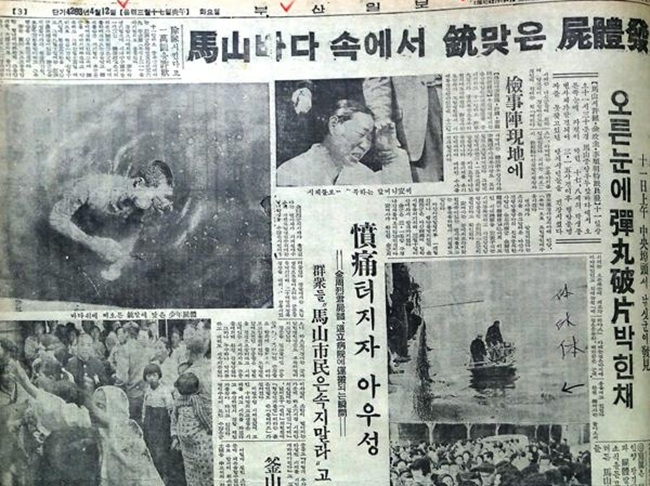 The April 12, 1960, edition of the Busan Ilbo newspaper, which ignited the April 19 Revolution. [Photo Credit: Busan Ilbo DB]
Still other groups began to talk about an anti-feudal revolution. An atmosphere formed where using more radical language increased influence within the student movement.
This leftist competition also affected the political consciousness of the student movement. In the July 1960 general elections, the public chose the Democratic Party government. Many citizens saw political stability and economic recovery as primary tasks.
However, radical factions within the student movement did not accept this outcome as is. Instead, interpretations of the election results as a 'retreat of the revolution' became more common.
The argument was that the April Revolution was not merely the overthrow of a dictatorship but the starting point of a revolution that would transform society as a whole. Therefore, the next stages should involve anti-foreign struggles, social reforms, and unification movements.
However, if election results did not move in that direction, it was possible to interpret them as a retreat of the revolution. In this process, the public's political choices themselves sometimes became objects of criticism.
A significant shift occurred here. In a democratic system, election results become the standard for politics. However, when the concept of an 'unfinished revolution' emerged, the standard changed.
Elections became provisional outcomes, and groups advocating for revolution assumed the position of judging the historical direction. The public's votes began to be treated not as objects of respect but as objects to be corrected.
This perception gradually created a distance between the student movement and the general public. Protests continued in the streets, and political slogans grew increasingly intense. Meanwhile, citizens desired a stable political order and economic recovery. The difference in perceptions of the pace of politics widened.
Ultimately, the Second Republic government failed to secure a stable governing foundation amidst political chaos. The Chang Myon cabinet attempted to establish a parliamentary-centered political system, but as street politics and political conflicts continued, the government's governing power weakened. This political instability became one of the conditions that later allowed the military to claim the pretext of revolution.
Of course, the student movement alone cannot explain the causes of the May 1961 military coup. Various factors, including internal military power struggles, the Cold War structure, and economic problems, played a combined role.
Leftward Competition Within the Student Movement
However, it is also true that the radicalization and leftist competition that emerged within the student movement after the April Revolution contributed to the instability of the political environment.
The student movement of 1960 played a significant role in Korean democratic history. It was the force that overthrew the dictatorial regime and the agent that drove political change. At the same time, another political culture was being formed within it.
It was a method of reinterpreting the public's choices, when they differed from one's own expectations, under the guise of an 'unfinished revolution'.
This attitude has been repeatedly seen in Korean politics since then. When election results are unsatisfactory, they are explained as 'public delusion' or 'an unfinished revolution'.
The core of democracy is to accept the results of the vote and compete in the next political process. However, when revolutionary language becomes the center of politics, elections are treated as temporary states rather than final judgments.
The leftist competition that emerged within the student movement in 1960 was one of its starting points. The April Revolution overthrew the dictatorship, but another political experiment was underway on university campuses thereafter.
That experiment was a competition over 'who is more radical'. And that competition led to the redefinition of the public's political choices under the name of an 'unfinished revolution'.
This experience from 1960 shows one facet of Korean political culture. As the language of revolution grows stronger, the meaning of elections and institutional politics, the fundamental principles of democracy, can weaken.
Street slogans are powerful, but the force that maintains political order ultimately comes from institutions. The leftist competition that took place within the student movement after the April Revolution was the first instance where this tension was significantly revealed.
◆ Songsan
Poet and researcher of history and philosophy. Former director of the Syngman Rhee Academy. Currently serves as a senior researcher at the Research Society for Modern Korean History and as the representative of the philosophy forum Lyceum. He has published four poetry collections, co-translated "Heroes of Khokho Ridge," and authored the historical psychology commentary "Joseon That Became Myth" (2026). He is actively engaged in research and practice of liberal cultural movements. Songsan is a pen name.

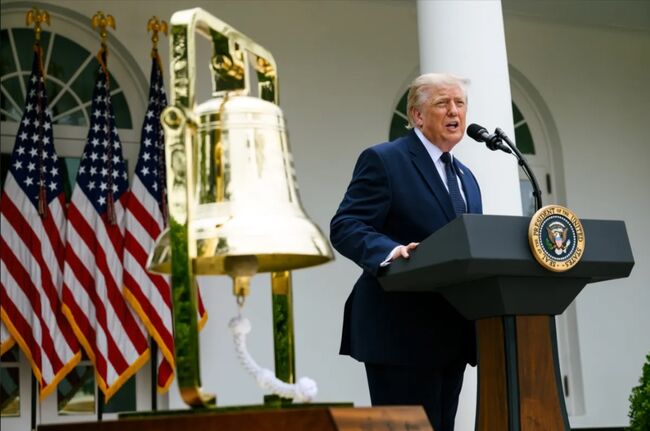 Trump pressures for rate cut again ahead of FOMC... "Should be the lowest in the world"
U.S. President Donald Trump. [Photo = The White House] U.S. President Donald Trump once again pressured the Federal Reserve, the U.S. central bank, to lower interest rates on the 27th (local time
Trump pressures for rate cut again ahead of FOMC... "Should be the lowest in the world"
U.S. President Donald Trump. [Photo = The White House] U.S. President Donald Trump once again pressured the Federal Reserve, the U.S. central bank, to lower interest rates on the 27th (local time
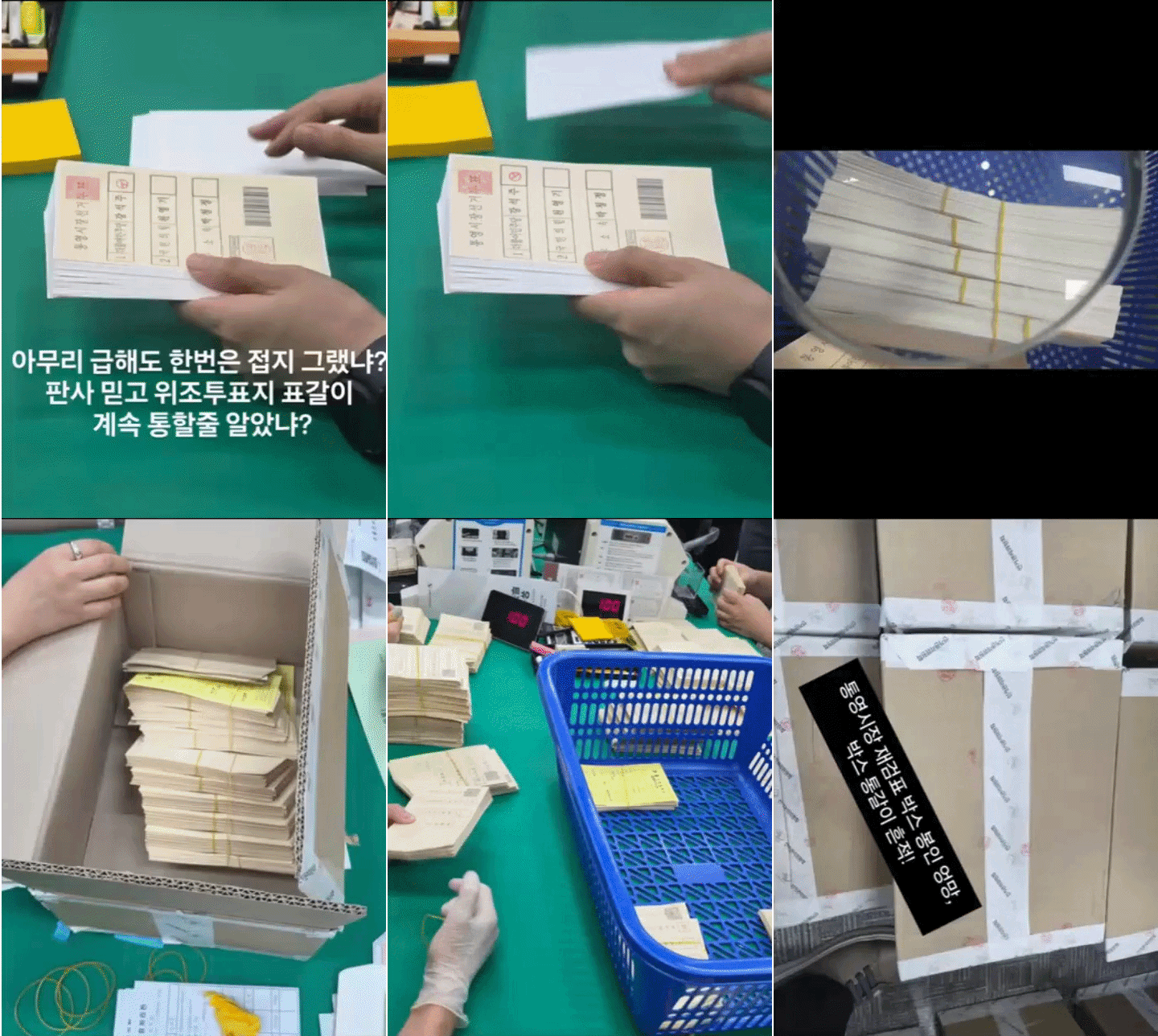 “Ignoring crisp ballots and damaged seals”… Tongyeong mayoral recount concludes with ‘no change in outcome,’ leaving suspicions and public outrage behind
Suspected counterfeit ballots discovered in Tongyeong [GIF from social media of Representative Hwang Kyo-ahn / Attorney Park Joo-hyun]During a recount of the Tongyeong mayoral election in South Gyeong
“Ignoring crisp ballots and damaged seals”… Tongyeong mayoral recount concludes with ‘no change in outcome,’ leaving suspicions and public outrage behind
Suspected counterfeit ballots discovered in Tongyeong [GIF from social media of Representative Hwang Kyo-ahn / Attorney Park Joo-hyun]During a recount of the Tongyeong mayoral election in South Gyeong
 President Yoon, regarding the first-instance ruling on the Public Official Election Act: “An excessive political verdict that distorts the facts… We will appeal immediately.”
The first-instance sentencing hearing for President Yoon Suk Yeol regarding violations of the Public Official Election Act is being broadcast live at Seoul Station on the 27th. [Photo=Yonhap News]Pres
President Yoon, regarding the first-instance ruling on the Public Official Election Act: “An excessive political verdict that distorts the facts… We will appeal immediately.”
The first-instance sentencing hearing for President Yoon Suk Yeol regarding violations of the Public Official Election Act is being broadcast live at Seoul Station on the 27th. [Photo=Yonhap News]Pres
 WSJ: "SK Hynix ADR Premium Is a Sign of AI Trading Overheat"
Advertisement for SK Hynix ADR listing in New York's Times Square [Reuters=Yonhap News file photo]The Wall Street Journal (WSJ) has pointed out that the price of SK Hynix’s American Depositary Recei
WSJ: "SK Hynix ADR Premium Is a Sign of AI Trading Overheat"
Advertisement for SK Hynix ADR listing in New York's Times Square [Reuters=Yonhap News file photo]The Wall Street Journal (WSJ) has pointed out that the price of SK Hynix’s American Depositary Recei
 'Godfather of Japanese Mystery Novels' Keigo Higashino Passes Away After Battle with Cancer at 68
Famous Japanese mystery novelist Keigo Higashino [AFP=Yonhap News]It has been belatedly reported that Keigo Higashino, the "godfather of Japanese mystery novels" and author of bestsellers such as "The
'Godfather of Japanese Mystery Novels' Keigo Higashino Passes Away After Battle with Cancer at 68
Famous Japanese mystery novelist Keigo Higashino [AFP=Yonhap News]It has been belatedly reported that Keigo Higashino, the "godfather of Japanese mystery novels" and author of bestsellers such as "The
 [Park Pil-kyu Security Column] To the Ignorant Trying to Clothe a Beast in Sheep's Clothing
Rep. Kim Byung-joo of the Democratic Party of Korea [Photo=Yonhap News]“The Air Force Academy doesn't teach you how to fly a plane!” “The Army, Navy, and Air Force academies are exactly the
[Park Pil-kyu Security Column] To the Ignorant Trying to Clothe a Beast in Sheep's Clothing
Rep. Kim Byung-joo of the Democratic Party of Korea [Photo=Yonhap News]“The Air Force Academy doesn't teach you how to fly a plane!” “The Army, Navy, and Air Force academies are exactly the
 [Issue Diagnosis] Two Effects of the Election Petition Review
 [Photo] Evidence of Election Fraud Flooding U.S. Media… Trump Had 2.7 Million Votes Stolen
 [Video] U.S. Semiquincentennial Air Show... 'Art in the Sky' streaks across New York
 [Editorial Cartoon] A Draconian Law That Undermines Freedom of Expression

 List
List









