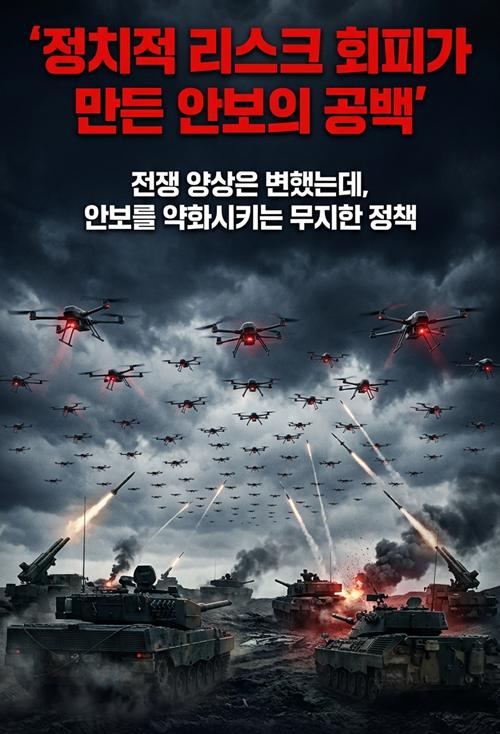
The greatest threat to South Korea's security today is not external attack, but internal 'political risk aversion'.
Just as the US military lost its will to fight in the Vietnam War due to anti-war sentiment, despite holding a strategic advantage, politics that appeases public opinion paralyzes security and obscures the military's role. As a result, the nation creates its own security vacuum despite possessing military potential.
Warfare in the 21st century no longer operates under the same rules as in the past.
The wars in Ukraine and the Middle East have become experimental grounds for new forms of warfare, combining drones, AI, and precision strike systems. This change signals not just a technological evolution of warfare, but a fundamental shift in its very nature, while political interference in security effectively renders even current military strength unusable.
The battlefield is becoming more dispersed, changing more rapidly, and reorganizing into a structure where cheaper weapons can overwhelm more expensive ones. The sight of thousand-dollar drones neutralizing multi-billion dollar tanks is no longer an exception, but commonplace. When the rules of war change, the definition of military power must also change, and the strategies a nation prepares must be fundamentally reconfigured.
This transformation holds even more direct implications for the Korean Peninsula. North Korea is closely analyzing the war in Ukraine and rapidly absorbing drone tactics, expanding its drone capabilities both quantitatively and qualitatively through cooperation with Russia and Iran.
When North Korean small drones infiltrated the airspace over the Seoul metropolitan area in 2022, South Korea's air defense system was virtually ineffective. If North Korea were to launch hundreds of low-cost drones simultaneously, it has already been confirmed that defense would be impossible with existing air defense systems alone.
This is why South Korea can no longer claim superiority with conventional weapons or remain bound by past concepts of warfare.
However, the more serious problem is not the technological gap, but the gap in security perceptions between the security apparatus and politicians, in other words, 'security ignorance.' It is far more dreadful for a minister not to understand defense concepts and systems than to be unfamiliar with basic military terminology.
South Korea's defense concept aims to protect national survival, territory, citizens, and sovereignty. Its highest-level systems consist of the △National Security Strategy (NSS), △Basic Defense Reform Plan, and △Mid-term Defense Plan. Based on these, a joint-centric command structure, where the Army, Navy, Air Force, and Marine Corps conduct integrated operations under the command of the Chairman of the Joint Chiefs of Staff, and the three-axis system, represented by Kill Chain, KAMD, and KMPR, form the core deterrence structure.
There is a clear tendency in our society today to oversimplify security or treat it as an appendage to political debate, without even a basic understanding of it.
Those who lack a fundamental understanding of the structure of international conflicts tend to reduce security threat signals to emotional confrontation or partisan logic.
Even though we live in an era where cyber warfare and information warfare can shake the foundations of a nation, this is ignored, and personnel policies are enacted in ways that weaken the morale and combat effectiveness of active-duty personnel. No matter how advanced the equipment, the core of combat is the active-duty soldier. Personnel disruption is a grave destruction at the level of national security.
Such security ignorance undermines national strategy, weakens alliance trust, and provides openings to adversarial forces. As history has repeatedly shown, internal ignorance and division are more dangerous than external threats.
In a society where even issues requiring strategic judgment are consumed by emotional frameworks or fragmented interpretations, no national strategy can maintain consistency. The moment discussions surrounding security are consumed by partisan politics, the vast military becomes a victim of political games, and the nation loses its foundation for survival.
The path South Korea must now choose is clear. The United States is officially demanding 'role-sharing' from its allies in its Indo-Pacific strategy, and Japan is accelerating its militarization by adopting 'counterstrike capabilities' for the first time in half a century.
Within this structural transformation, South Korea has a strategic opportunity to achieve a grand transition to a military power, rather than merely following others. Therefore, the modernization of military power and the restructuring of capabilities must be prioritized as the nation's strategic imperatives. The core of this can be summarized in three directions.
First, achieve absolute superiority in battlefield awareness.
To win a war, it is most important to be the first to see and judge more accurately. Therefore, South Korea is building a system that simultaneously surveils the sky, space, and ground using assets like satellites, drones, and early warning aircraft, and employs artificial intelligence to rapidly analyze this information and display battlefield conditions in real-time. This allows for preemptive response by identifying enemy movements first, making information itself a powerful asset.
Second, mass-produce and integrate drone and AI-based capabilities.
Attack, reconnaissance, and electronic warfare drones must be systematically integrated. Simultaneously, low-cost interception systems, laser weapons, and jamming technologies must be developed to reverse the asymmetrical structure of 'attacking cheaply and defending expensively.' Future military strength will be determined not by size, but by speed, accuracy, and intelligence.
Third, cultivate experts and strengthen the defense industry ecosystem.
A military power is not just a country that makes good weapons, but a country that nurtures talent capable of designing the future of warfare. Experts in AI, electronic warfare, cyber, and space must be systematically trained, and a national talent system involving the military, academia, and industry must be established. The defense industry, too, must be elevated from a mere export industry to a national strategic industry.
South Korea already possesses the capabilities to leap forward as a military power. The issue is will and choice. Security policies that weaken the military and go against common sense are unacceptable from the perspective of national survival. The path to becoming a military power is not a choice of a particular faction, but a command of the entire populace and a strategic decision that determines the nation's future.
I hope that the military, the security apparatus, and the changed battlefield will be faced directly, and that the fundamental framework of national security will be maintained through a comprehensive transformation that moves even faster than these changes.
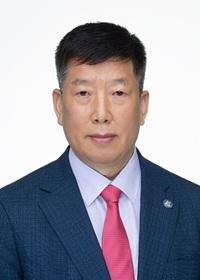
◆ Park Pil-gyu
Editorial Board Member, The Hankyoreh
Korea Military Academy, Class of 40

 Trump pressures for rate cut again ahead of FOMC... "Should be the lowest in the world"
U.S. President Donald Trump. [Photo = The White House] U.S. President Donald Trump once again pressured the Federal Reserve, the U.S. central bank, to lower interest rates on the 27th (local time
Trump pressures for rate cut again ahead of FOMC... "Should be the lowest in the world"
U.S. President Donald Trump. [Photo = The White House] U.S. President Donald Trump once again pressured the Federal Reserve, the U.S. central bank, to lower interest rates on the 27th (local time
 “Ignoring crisp ballots and damaged seals”… Tongyeong mayoral recount concludes with ‘no change in outcome,’ leaving suspicions and public outrage behind
Suspected counterfeit ballots discovered in Tongyeong [GIF from social media of Representative Hwang Kyo-ahn / Attorney Park Joo-hyun]During a recount of the Tongyeong mayoral election in South Gyeong
“Ignoring crisp ballots and damaged seals”… Tongyeong mayoral recount concludes with ‘no change in outcome,’ leaving suspicions and public outrage behind
Suspected counterfeit ballots discovered in Tongyeong [GIF from social media of Representative Hwang Kyo-ahn / Attorney Park Joo-hyun]During a recount of the Tongyeong mayoral election in South Gyeong
 President Yoon, regarding the first-instance ruling on the Public Official Election Act: “An excessive political verdict that distorts the facts… We will appeal immediately.”
The first-instance sentencing hearing for President Yoon Suk Yeol regarding violations of the Public Official Election Act is being broadcast live at Seoul Station on the 27th. [Photo=Yonhap News]Pres
President Yoon, regarding the first-instance ruling on the Public Official Election Act: “An excessive political verdict that distorts the facts… We will appeal immediately.”
The first-instance sentencing hearing for President Yoon Suk Yeol regarding violations of the Public Official Election Act is being broadcast live at Seoul Station on the 27th. [Photo=Yonhap News]Pres
 WSJ: "SK Hynix ADR Premium Is a Sign of AI Trading Overheat"
Advertisement for SK Hynix ADR listing in New York's Times Square [Reuters=Yonhap News file photo]The Wall Street Journal (WSJ) has pointed out that the price of SK Hynix’s American Depositary Recei
WSJ: "SK Hynix ADR Premium Is a Sign of AI Trading Overheat"
Advertisement for SK Hynix ADR listing in New York's Times Square [Reuters=Yonhap News file photo]The Wall Street Journal (WSJ) has pointed out that the price of SK Hynix’s American Depositary Recei
 'Godfather of Japanese Mystery Novels' Keigo Higashino Passes Away After Battle with Cancer at 68
Famous Japanese mystery novelist Keigo Higashino [AFP=Yonhap News]It has been belatedly reported that Keigo Higashino, the "godfather of Japanese mystery novels" and author of bestsellers such as "The
'Godfather of Japanese Mystery Novels' Keigo Higashino Passes Away After Battle with Cancer at 68
Famous Japanese mystery novelist Keigo Higashino [AFP=Yonhap News]It has been belatedly reported that Keigo Higashino, the "godfather of Japanese mystery novels" and author of bestsellers such as "The
 [Park Pil-kyu Security Column] To the Ignorant Trying to Clothe a Beast in Sheep's Clothing
Rep. Kim Byung-joo of the Democratic Party of Korea [Photo=Yonhap News]“The Air Force Academy doesn't teach you how to fly a plane!” “The Army, Navy, and Air Force academies are exactly the
[Park Pil-kyu Security Column] To the Ignorant Trying to Clothe a Beast in Sheep's Clothing
Rep. Kim Byung-joo of the Democratic Party of Korea [Photo=Yonhap News]“The Air Force Academy doesn't teach you how to fly a plane!” “The Army, Navy, and Air Force academies are exactly the
 [Issue Diagnosis] Two Effects of the Election Petition Review
 [Photo] Evidence of Election Fraud Flooding U.S. Media… Trump Had 2.7 Million Votes Stolen
 [Video] U.S. Semiquincentennial Air Show... 'Art in the Sky' streaks across New York
 [Editorial Cartoon] A Draconian Law That Undermines Freedom of Expression

 List
List