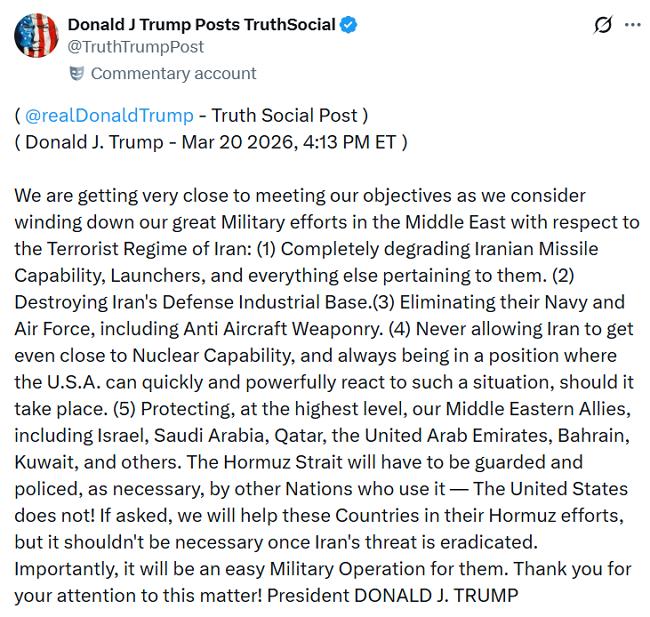
U.S. President Donald Trump's remarks on the 20th (local time) are interpreted not just as an update on military operations, but as a message revealing the direction of the post-war international order.
On the surface, he mentioned the possibility of a phased withdrawal along with an assessment that the goals of the military operation against Iran were nearing completion. However, in reality, the remarks strongly indicated how the security structure would be reshaped afterward.
President Trump stated that the goal of neutralizing Iran's missile capabilities and defense industry base was entering its final stages. Simultaneously, regarding the defense of the Strait of Hormuz, he said, "The countries that use it must take responsibility, and the United States will not play that role."
These remarks go beyond explaining the scope of military operations and can be seen as a clear indication of a shift in the role the United States has traditionally played.
Up until now, the United States has virtually acted as a 'protector' in the international security order, including major maritime transit routes. This structure involved direct intervention in conflict zones and military guarantees of allies' security. However, this recent statement suggests that this approach may no longer be sustainable.
The direction the United States is choosing is closer to a redeployment of roles rather than a complete withdrawal.
It involves maintaining military intervention capabilities and strategic control while sharing the execution and cost burden on the ground with allies and user nations. This aligns with a conceptual shift from viewing alliances as entities to be protected to viewing them as active participants in fulfilling roles.
This change is not sudden.
President Trump has repeatedly called for increased defense cost-sharing and enhanced military roles from allies in the past. U.S. defense strategy documents and annual threat assessments have consistently emphasized the need for expanded allied contributions and regional burden-sharing.
The recent remarks regarding the Strait of Hormuz can be seen as a concrete example of this trend materializing into actual policy. The Strait of Hormuz is particularly symbolic as a critical passage for global energy transport.
The announcement of a policy to distribute responsibilities in a region that the United States has historically guaranteed safety signifies a change at the core of the international order.
The essence of this change lies not in military power itself, but in the structure of costs and responsibilities.
The burden required to maintain the international order is no longer solely borne by the United States but is transitioning to a model where allies and user nations share it.
This is interpreted as a process of transforming alliance relations from 'protection and dependence' to a structure of 'sharing and responsibility.'
It is highly likely that this trend will not be confined to the Middle East.
Predictions suggest that similar demands for role-sharing may arise in the Indo-Pacific region in the future, particularly in the Taiwan Strait.
The Taiwan Strait is a region where semiconductor supply chains, maritime logistics, and U.S.-China strategic competition converge, making its importance comparable to that of the Middle East. South Korea is also not immune to these changes.
The Strait of Hormuz is directly linked to energy imports, and the Taiwan Strait is connected to semiconductors, export structures, and maritime routes. As both regions are closely tied to the core of the Korean economy, these are issues with tangible interests beyond mere diplomatic matters.
Ultimately, the question posed by these remarks is clear.
In a situation where the United States is moving towards a structure that maintains control while dispersing responsibility, each allied nation will be required to make judgments on the extent to which they will fulfill their roles.
President Trump's message this time is not a sign of the U.S. stepping back, but rather a formal declaration of his intent to change the operational method of the international order.
The Strait of Hormuz is merely the point where that change first became apparent, and this trend is highly likely to expand to other regions. The United States is not withdrawing; it is redesigning the structure of responsibility.
There is growing interest in how the Lee Jae-myung administration will respond to these changes.

 [Statement by the Seo-beo-kka Korea Military Academy Save-the-Nation Comrades Association] ㉛ Recount the Votes Publicly, as the Previous Recount Concealed Election Fraud
Tongyeong Mayoral Election Recount [Photo=Yonhap News]South Korea's liberal democracy is dying. The National Election Commission (NEC) and the judiciary, which have plummeted into criminal syndicates
[Statement by the Seo-beo-kka Korea Military Academy Save-the-Nation Comrades Association] ㉛ Recount the Votes Publicly, as the Previous Recount Concealed Election Fraud
Tongyeong Mayoral Election Recount [Photo=Yonhap News]South Korea's liberal democracy is dying. The National Election Commission (NEC) and the judiciary, which have plummeted into criminal syndicates
 What is the significance of the "Trump 2028" red hats that keep making a comeback?
It is noteworthy that President Donald Trump is "intentionally" fueling controversy over whether he can actually run in the 2028 presidential election, even though it is "highly likely he is seriously
What is the significance of the "Trump 2028" red hats that keep making a comeback?
It is noteworthy that President Donald Trump is "intentionally" fueling controversy over whether he can actually run in the 2028 presidential election, even though it is "highly likely he is seriously
 Jin Cummings: "North Korea says it will increase the number of spies, so what is the government doing?"
U.S. political columnist Gene Cummings has publicly questioned the South Korean government, asking, "North Korea is announcing plans to increase its number of spies, yet what is the South Korean
Jin Cummings: "North Korea says it will increase the number of spies, so what is the government doing?"
U.S. political columnist Gene Cummings has publicly questioned the South Korean government, asking, "North Korea is announcing plans to increase its number of spies, yet what is the South Korean
 Attorney Do Tae-woo: “Discrepancies in Voter Count and Improper Sealing Confirmed in Tongyeong Mayoral Recount… Official Request for Additional Verification Submitted to Gyeongnam Election Commission”
A bundle of mail-in early voting ballots captured by lawyer Do Tae-woo at the Tongyeong mayoral election recount site. A clear solid line, raising suspicions of election fraud, is visible on the side
Attorney Do Tae-woo: “Discrepancies in Voter Count and Improper Sealing Confirmed in Tongyeong Mayoral Recount… Official Request for Additional Verification Submitted to Gyeongnam Election Commission”
A bundle of mail-in early voting ballots captured by lawyer Do Tae-woo at the Tongyeong mayoral election recount site. A clear solid line, raising suspicions of election fraud, is visible on the side
 Stock Market Crash 'Black Tuesday'… KOSPI down 10.8%, KOSDAQ down 7.7%
The KOSPI fell by more than 5% in early trading on the 28th, triggering a sell-side sidecar.On the 28th, the KOSPI plunged by more than 10%.Due to the sharp decline, a sell-side sidecar—a temporary
Stock Market Crash 'Black Tuesday'… KOSPI down 10.8%, KOSDAQ down 7.7%
The KOSPI fell by more than 5% in early trading on the 28th, triggering a sell-side sidecar.On the 28th, the KOSPI plunged by more than 10%.Due to the sharp decline, a sell-side sidecar—a temporary
 [World Heritage Committee] 25 New World Heritage Sites Inscribed in Busan… South Korea Successfully Expands 'Getbol' Listing
The Chairperson of the World Heritage Committee speaks at the plenary session of the 48th session of the World Heritage Committee, held at BEXCO in Busan on the 20th. [Photo: Yonhap News]A total of 25
[World Heritage Committee] 25 New World Heritage Sites Inscribed in Busan… South Korea Successfully Expands 'Getbol' Listing
The Chairperson of the World Heritage Committee speaks at the plenary session of the 48th session of the World Heritage Committee, held at BEXCO in Busan on the 20th. [Photo: Yonhap News]A total of 25
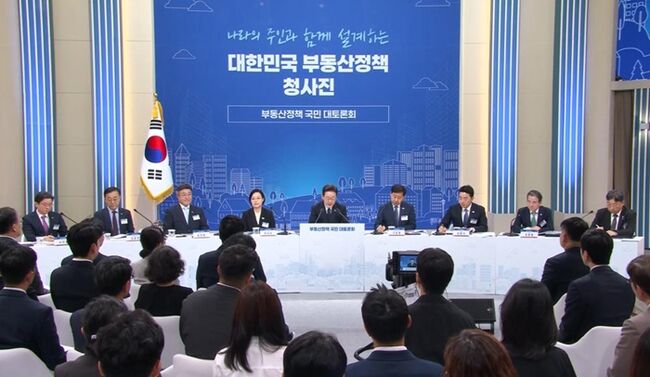 [Liberal Democratic Party Statement] Calling it a Grand Real Estate Debate… It Was Nothing More Than a Private Party Among Themselves
The 'National Grand Debate on Real Estate Policy' held on July 23rd and 27th. [Photo=Yonhap News]The 'National Grand Debate on Real Estate Policy,' hosted by the Lee Jae-myung administration under the
[Liberal Democratic Party Statement] Calling it a Grand Real Estate Debate… It Was Nothing More Than a Private Party Among Themselves
The 'National Grand Debate on Real Estate Policy' held on July 23rd and 27th. [Photo=Yonhap News]The 'National Grand Debate on Real Estate Policy,' hosted by the Lee Jae-myung administration under the
 [Photo] Evidence of Election Fraud Flooding U.S. Media… Trump Had 2.7 Million Votes Stolen
 [Video] U.S. Semiquincentennial Air Show... 'Art in the Sky' streaks across New York
 [Editorial Cartoon] A Draconian Law That Undermines Freedom of Expression

 List
List