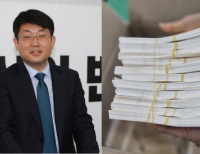
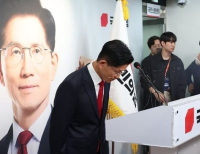
Writers affiliated with the Korean Literature Writers Association leaving their offices to attend the preliminary meeting for the inter-Korean writers' conference at Panmunjom in March 1989. They were arrested by the police en route.
There is a long-standing lineage within the Korean literary scene. Its starting point is November 18, 1974. The beginning was the formation of the Writers for Freedom of Expression Conference, established amidst the Yushin regime with the "Declaration of 101 Literary Figures."
This organization emerged in opposition to the Park Chung-hee regime's media censorship and suppression of expression. Among the participants were poet Ko Un, novelist Hwang Sok-yong, and critic Baek Nak-chung. They undoubtedly played a significant role in the context of that era. It is a historical fact that literature became a channel of resistance in a system where freedom of expression was limited.
However, from its inception, this organization did not define literature as an autonomous area of creation. Literature was a tool for intervention in reality. This starting point became the origin of all subsequent problems.
2007: From ‘Minjok Munhak Writers Association’ to ‘Korean Writers Association’
In March 1980, just before the expansion of martial law, the magazine "Practicing Literature" was launched. As its name suggests, this magazine defined literature as a means of "practice." Following this, after the June Democratic Struggle in 1987, the Writers for Freedom of Expression Conference was reorganized into the Minjok Munhak Writers Association.
Here, the concept of "Minjok Munhak" (National Literature) came to the forefront. This was not merely a literary theory but a political declaration. Subsequently, grand narratives such as anti-dictatorship, anti-foreign influence, unification, and national liberation were established as criteria for literature.
At this point, the nature of literature clearly changed. Instead of exploring individuals' inner lives or complex human experiences, it became a tool for expressing collective goals. Works began to function as means of conveying messages rather than as explorations.
In the early 1990s, internal conflict arose within this group. As a result, the "Practicing Literature" faction split, forming the Writers Association of Practicing Literature. However, this split was not a change in direction. It was merely a difference between pushing the existing line more strongly or adjusting it. The fundamental structure of combining literature with politics remained intact.
This lineage was later reorganized again. In 2007, the Minjok Munhak Writers Association changed its name to the Korean Writers Association. Ostensibly, this appeared to be a change. By removing the word "Minjok" (National), it was an attempt to transition to a more neutral image. However, looking at their actual activities, the essence did not change significantly.
The Korean Writers Association has continuously expressed collective stances on political issues since then. Let's look at a specific example. On December 4, 2024, following an emergency martial law situation, the organization issued an urgent statement demanding the nullification of martial law and the impeachment of the president.
Subsequently, in April 2025, they issued a statement to the Constitutional Court demanding "immediate dismissal." These two events are not mere expressions of opinion. They are clear examples of a literary organization repeatedly intervening directly in real-world politics.
What is important here is not the content of the positions. The problem is the method. When a literary organization systematically takes a stance on specific political issues and repeats this, it is difficult to consider that organization a purely literary one anymore. The boundary with political organizations becomes blurred.
This structure impacts the entire literary scene. When one lineage occupies the center for a long period, its direction becomes the de facto standard. National Literature, Practicing Literature, and politically engaged literature are considered "normal," while other trends are pushed to the periphery. Liberal perspectives, viewpoints that affirm the market economy, narratives that view the nation positively, or even works that simply aim for non-political literature are all marginalized.
This is not natural competition. It is structural bias.
Return to a Structure Where Questions Precede Conclusions
Another issue is the weakening of literary form itself. When political objectives take precedence, works become easily schematized. Characters become spokespersons for a position, and events transform into devices for conveying a message. Complex humans disappear, leaving behind simple structures. Texts resembling manifestos rather than literature are repeated.
This phenomenon has been pointed out repeatedly since the 1980s. It is a criticism that formal experimentation and linguistic tension have weakened due to literature's preoccupation with real-world engagement. However, the lineage has not changed significantly. While there have been splits, the direction has been maintained.
Ultimately, this trend creates a formula: literature is a tool of politics. This formula, which began with the Writers for Freedom of Expression Conference in 1974, has been maintained through the Minjok Munhak Writers Association in 1987, the Practicing Literature faction in the 1990s, and the Korean Writers Association in 2007.
The problem is that this formula is no longer valid. We are not in the 1970s. Freedom of expression is institutionally guaranteed. There is no necessity for literature to function as a tool of political practice. Rather, it is the opposite. It has become a more important task to maintain distance from politics and explore humanity.
Despite this, this lineage continues to operate in the same manner. Statements on current affairs, political participation, expressing collective positions. This repetition pushes literature into an increasingly narrow domain.
Literature is not a domain that can be organized in one direction. It comes alive when different perspectives collide and coexist. However, when a specific lineage dominates the center, its diversity cannot be sufficiently guaranteed.
Now, different criteria are needed. Criteria that return literature to literature. A structure where works precede positions, humans precede slogans, and questions precede conclusions.
The lineage up to this point will remain a scene from modern Korean history. However, there is no reason it must continue into the future. What is needed is not another name change, but a completely different direction. A direction that returns literature to the realm of freedom.
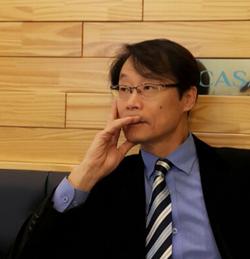
◆ Songsan
A poet and researcher of history and philosophy. Former director of the Rhee Syngman Academy. Currently serves as a senior researcher at the Korean Modern and Contemporary History Research Association and as the representative of the philosophy forum Lyceum. He has published four poetry collections, co-translated "Heroes of Cape Horn," and authored the historical psychology commentary "Joseon Becomes Myth" (2026). He is actively engaged in research and practice of liberal cultural movements. Songsan is a pen name.

 [Statement by the Seo-beo-kka Korea Military Academy Save-the-Nation Comrades Association] ㉛ Recount the Votes Publicly, as the Previous Recount Concealed Election Fraud
Tongyeong Mayoral Election Recount [Photo=Yonhap News]South Korea's liberal democracy is dying. The National Election Commission (NEC) and the judiciary, which have plummeted into criminal syndicates
[Statement by the Seo-beo-kka Korea Military Academy Save-the-Nation Comrades Association] ㉛ Recount the Votes Publicly, as the Previous Recount Concealed Election Fraud
Tongyeong Mayoral Election Recount [Photo=Yonhap News]South Korea's liberal democracy is dying. The National Election Commission (NEC) and the judiciary, which have plummeted into criminal syndicates
 What is the significance of the "Trump 2028" red hats that keep making a comeback?
It is noteworthy that President Donald Trump is "intentionally" fueling controversy over whether he can actually run in the 2028 presidential election, even though it is "highly likely he is seriously
What is the significance of the "Trump 2028" red hats that keep making a comeback?
It is noteworthy that President Donald Trump is "intentionally" fueling controversy over whether he can actually run in the 2028 presidential election, even though it is "highly likely he is seriously
 Jin Cummings: "North Korea says it will increase the number of spies, so what is the government doing?"
U.S. political columnist Gene Cummings has publicly questioned the South Korean government, asking, "North Korea is announcing plans to increase its number of spies, yet what is the South Korean
Jin Cummings: "North Korea says it will increase the number of spies, so what is the government doing?"
U.S. political columnist Gene Cummings has publicly questioned the South Korean government, asking, "North Korea is announcing plans to increase its number of spies, yet what is the South Korean
 Attorney Do Tae-woo: “Discrepancies in Voter Count and Improper Sealing Confirmed in Tongyeong Mayoral Recount… Official Request for Additional Verification Submitted to Gyeongnam Election Commission”
A bundle of mail-in early voting ballots captured by lawyer Do Tae-woo at the Tongyeong mayoral election recount site. A clear solid line, raising suspicions of election fraud, is visible on the side
Attorney Do Tae-woo: “Discrepancies in Voter Count and Improper Sealing Confirmed in Tongyeong Mayoral Recount… Official Request for Additional Verification Submitted to Gyeongnam Election Commission”
A bundle of mail-in early voting ballots captured by lawyer Do Tae-woo at the Tongyeong mayoral election recount site. A clear solid line, raising suspicions of election fraud, is visible on the side
 Stock Market Crash 'Black Tuesday'… KOSPI down 10.8%, KOSDAQ down 7.7%
The KOSPI fell by more than 5% in early trading on the 28th, triggering a sell-side sidecar.On the 28th, the KOSPI plunged by more than 10%.Due to the sharp decline, a sell-side sidecar—a temporary
Stock Market Crash 'Black Tuesday'… KOSPI down 10.8%, KOSDAQ down 7.7%
The KOSPI fell by more than 5% in early trading on the 28th, triggering a sell-side sidecar.On the 28th, the KOSPI plunged by more than 10%.Due to the sharp decline, a sell-side sidecar—a temporary
 [World Heritage Committee] 25 New World Heritage Sites Inscribed in Busan… South Korea Successfully Expands 'Getbol' Listing
The Chairperson of the World Heritage Committee speaks at the plenary session of the 48th session of the World Heritage Committee, held at BEXCO in Busan on the 20th. [Photo: Yonhap News]A total of 25
[World Heritage Committee] 25 New World Heritage Sites Inscribed in Busan… South Korea Successfully Expands 'Getbol' Listing
The Chairperson of the World Heritage Committee speaks at the plenary session of the 48th session of the World Heritage Committee, held at BEXCO in Busan on the 20th. [Photo: Yonhap News]A total of 25
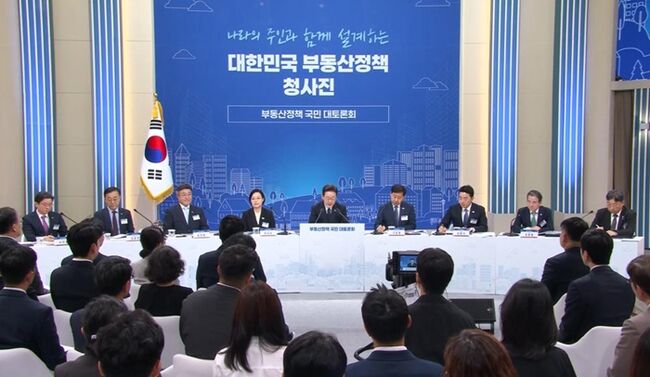 [Liberal Democratic Party Statement] Calling it a Grand Real Estate Debate… It Was Nothing More Than a Private Party Among Themselves
The 'National Grand Debate on Real Estate Policy' held on July 23rd and 27th. [Photo=Yonhap News]The 'National Grand Debate on Real Estate Policy,' hosted by the Lee Jae-myung administration under the
[Liberal Democratic Party Statement] Calling it a Grand Real Estate Debate… It Was Nothing More Than a Private Party Among Themselves
The 'National Grand Debate on Real Estate Policy' held on July 23rd and 27th. [Photo=Yonhap News]The 'National Grand Debate on Real Estate Policy,' hosted by the Lee Jae-myung administration under the
 [Photo] Evidence of Election Fraud Flooding U.S. Media… Trump Had 2.7 Million Votes Stolen
 [Video] U.S. Semiquincentennial Air Show... 'Art in the Sky' streaks across New York
 [Editorial Cartoon] A Draconian Law That Undermines Freedom of Expression

 List
List