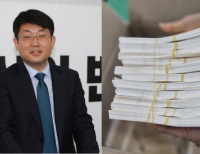
Kim Byung-heon, representative of the National Action to Abolish the Comfort Women Law, arrested for defamation while protesting the demolition of comfort women. [Photo = Kim Byung-heon's Facebook]
On the 20th, Judge Lee Ji-young (34th graduating class of the Judicial Research and Training Institute) of the Seoul Central District Court issued an arrest warrant for Kim Byung-heon, representative of the National Action to Abolish the Comfort Women Law, citing "fear of flight" on charges of defamation of the deceased and defamation under the Information and Communications Network Act.
This case is a criminal case concerning statements and writings, not a crime involving violence or property damage. The decision, which involves a measure of physical detention for a case targeting expression rather than physical harm, prompts reconsideration of the application of the law itself, extending beyond a mere individual case.
Arrest of Kim Byung-heon... The Purpose of the Law is Shaken
First, the premise must be corrected. This case is not, as is often stated, a "violation of the Comfort Women Law." Such a penal provision does not exist.
The Act on the Protection and Support of and Commemoration of the Victims of Japanese Military Comfort Women during the Japanese Colonial Period, often cited as the relevant law, is intended for the protection, support, and commemoration of victims.
Its core provisions concern livelihood support, medical support, and record preservation; it does not include penal provisions. Therefore, the structure of arresting someone for violating this law is not established from the outset.
The actual legal issue lies elsewhere. The question is whether defamation of the deceased under the Criminal Act of the Republic of Korea and defamation under the Act on Promotion and Information Protection of Information and Communications Networks are established.
In other words, the key is whether specific statements constitute false facts and whether they have led to a decline in social evaluation. Ultimately, this case is not about violating a specific law, but about determining whether the expression has crossed the threshold for criminal punishment.
If so, the question of whether detention is an appropriate measure in such a case cannot be avoided. For defamation cases, investigative detention is generally not pursued. Detention is an exception made only when there is a high likelihood of the suspect fleeing or a clear risk of evidence tampering.
Especially in cases involving statements and writings, the scope for destroying physical evidence is limited, and relevant materials are mostly already recorded. Considering these points, the necessity of detention should be scrutinized more strictly.
The reason provided by the court in this case is "fear of flight." However, this judgment gains persuasiveness when based on concrete circumstances. Factors such as whether the individual has been publicly active, has a stable residence and occupation, and has cooperated with the investigation are considered comprehensively.
If these factors are met, the possibility of flight is typically assessed as low. If detention nonetheless occurred, an explanation is needed regarding the extent to which the criteria have been expanded. The less clear the criteria, the weaker the predictability of law application, which in turn leads to a weakening of legal stability.
This issue does not end with the personal detention of an individual. If detention begins to be actively utilized in defamation cases, its impact will spread to the entirety of expressive activities.
Is Historical Interpretation to Be Drawn into the Realm of Criminal Punishment?
This is especially true in areas such as historical issues where interpretations are bound to diverge. In fields where different interpretations of the same materials are natural, if the perception arises that a particular interpretation could lead to criminal charges, the debate itself becomes suppressed. The space for diverse opinions to coexist gradually shrinks.
The case of defamation of the deceased requires even greater caution. As the subject is deceased, the balance between protecting reputation and freedom of expression must be more finely calibrated. Drawing historical evaluations into the realm of criminal punishment is always accompanied by controversy.
Interpretations of past events can change with the times, and existing evaluations may be revised with the discovery of new evidence. If criminal punishment precedes in such areas, the diversity of interpretation will be sharply limited.
Ultimately, the question this case poses is how far we will allow criminal detention for acts of expression. Protection of reputation is undoubtedly a necessary value. However, if it operates in a way that excessively restricts freedom of expression, the law loses its balance. Criminal punishment should be a last resort, and detention, among all measures, should be used with the utmost caution.
The Kim Byung-heon case is not a case of violating a specific law, but a case where the establishment of defamation and the response to it were at issue. And the fact that the response led to the strongest measure, detention, compels us to ask again about the boundaries of the law.
The law exists to protect rights. If its application begins to operate in a way that chills expression, from that moment, the purpose of the law begins to waver.
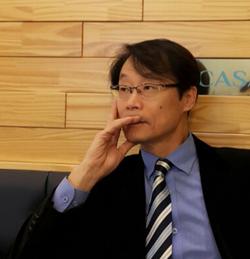
◆ Songsan
Poet and researcher of history and philosophy. Former director of the Syngman Rhee Academy. Currently serves as an advisory board member for the Korean Modern and Contemporary History Research Association and as the representative of the philosophical forum Lyceum. He has published four poetry collections, co-translated "Heroes of Geochie Peak," and authored the historical psychology commentary "Joseon Become a Myth" (2026). He is actively engaged in the research and practice of the liberal cultural movement. Songsan is a pen name.

 [Statement by the Seo-beo-kka Korea Military Academy Save-the-Nation Comrades Association] ㉛ Recount the Votes Publicly, as the Previous Recount Concealed Election Fraud
Tongyeong Mayoral Election Recount [Photo=Yonhap News]South Korea's liberal democracy is dying. The National Election Commission (NEC) and the judiciary, which have plummeted into criminal syndicates
[Statement by the Seo-beo-kka Korea Military Academy Save-the-Nation Comrades Association] ㉛ Recount the Votes Publicly, as the Previous Recount Concealed Election Fraud
Tongyeong Mayoral Election Recount [Photo=Yonhap News]South Korea's liberal democracy is dying. The National Election Commission (NEC) and the judiciary, which have plummeted into criminal syndicates
 What is the significance of the "Trump 2028" red hats that keep making a comeback?
It is noteworthy that President Donald Trump is "intentionally" fueling controversy over whether he can actually run in the 2028 presidential election, even though it is "highly likely he is seriously
What is the significance of the "Trump 2028" red hats that keep making a comeback?
It is noteworthy that President Donald Trump is "intentionally" fueling controversy over whether he can actually run in the 2028 presidential election, even though it is "highly likely he is seriously
 Jin Cummings: “North Korea says it will increase the number of spies, so what is the government doing?”
U.S. political columnist Gene Cummings has publicly questioned the South Korean government, asking, "North Korea is declaring that it will increase its number of spies, so what is the South Kore
Jin Cummings: “North Korea says it will increase the number of spies, so what is the government doing?”
U.S. political columnist Gene Cummings has publicly questioned the South Korean government, asking, "North Korea is declaring that it will increase its number of spies, so what is the South Kore
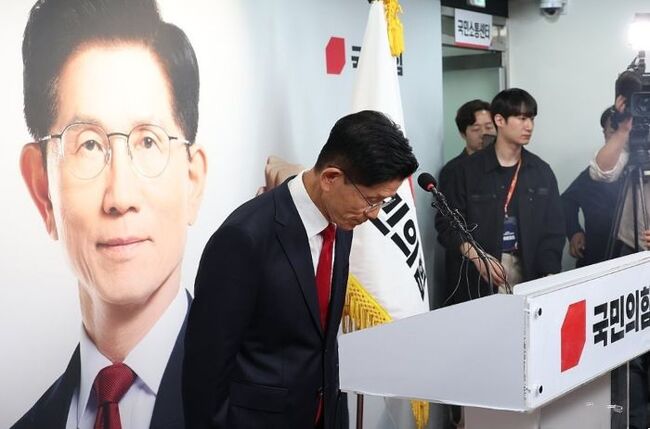 “Too little, too late?…” Kim Moon-soo, who previously conceded his presidential election defeat, now demands a special counsel investigation into ‘allegations of election fraud in the 2025 presidential election’
People Power Party presidential candidate Kim Moon-soo concedes defeat during a press conference at the party headquarters in Yeouido, Seoul, on June 4, 2025. [Joint Press Corps]As allegations emerge
“Too little, too late?…” Kim Moon-soo, who previously conceded his presidential election defeat, now demands a special counsel investigation into ‘allegations of election fraud in the 2025 presidential election’
People Power Party presidential candidate Kim Moon-soo concedes defeat during a press conference at the party headquarters in Yeouido, Seoul, on June 4, 2025. [Joint Press Corps]As allegations emerge
 Stock Market Crash 'Black Tuesday'… KOSPI down 10.8%, KOSDAQ down 7.7%
The KOSPI fell by more than 5% in early trading on the 28th, triggering a sell-side sidecar.On the 28th, the KOSPI plunged by more than 10%.Due to the sharp decline, a sell-side sidecar—a temporary
Stock Market Crash 'Black Tuesday'… KOSPI down 10.8%, KOSDAQ down 7.7%
The KOSPI fell by more than 5% in early trading on the 28th, triggering a sell-side sidecar.On the 28th, the KOSPI plunged by more than 10%.Due to the sharp decline, a sell-side sidecar—a temporary
 [World Heritage Committee] 25 New World Heritage Sites Inscribed in Busan… South Korea Successfully Expands 'Getbol' Listing
The Chairperson of the World Heritage Committee speaks at the plenary session of the 48th session of the World Heritage Committee, held at BEXCO in Busan on the 20th. [Photo: Yonhap News]A total of 25
[World Heritage Committee] 25 New World Heritage Sites Inscribed in Busan… South Korea Successfully Expands 'Getbol' Listing
The Chairperson of the World Heritage Committee speaks at the plenary session of the 48th session of the World Heritage Committee, held at BEXCO in Busan on the 20th. [Photo: Yonhap News]A total of 25
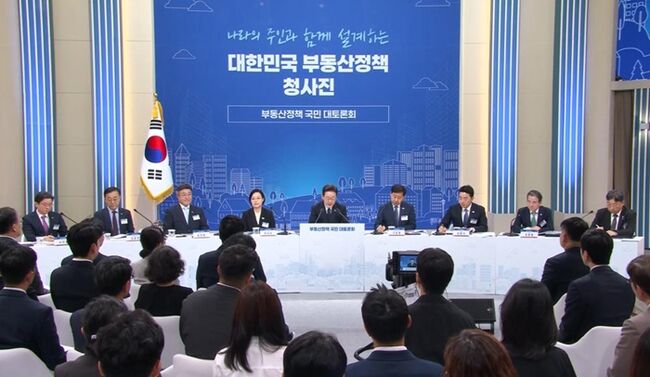 [Liberal Democratic Party Statement] Calling it a Grand Real Estate Debate… It Was Nothing More Than a Private Party Among Themselves
The 'National Grand Debate on Real Estate Policy' held on July 23rd and 27th. [Photo=Yonhap News]The 'National Grand Debate on Real Estate Policy,' hosted by the Lee Jae-myung administration under the
[Liberal Democratic Party Statement] Calling it a Grand Real Estate Debate… It Was Nothing More Than a Private Party Among Themselves
The 'National Grand Debate on Real Estate Policy' held on July 23rd and 27th. [Photo=Yonhap News]The 'National Grand Debate on Real Estate Policy,' hosted by the Lee Jae-myung administration under the
 [Photo] Evidence of Election Fraud Flooding U.S. Media… Trump Had 2.7 Million Votes Stolen
 [Video] U.S. Semiquincentennial Air Show... 'Art in the Sky' streaks across New York
 [Editorial Cartoon] A Draconian Law That Undermines Freedom of Expression

 List
List