The concept of surplus value, presented by Karl Marx in 'Das Kapital,' and the principles of division of labor and the market, explained by Adam Smith in 'The Wealth of Nations,' are conveyed to the world through literature. From the cover of 'Adam Smith and Karl Marx Ask and Answer' (Lee Kyung-tae, 2023). Park Youngsa
Ideas are not initially spoken words that circulate among people. They always begin as concepts. They are organized within the sentences of philosophers and refined through the debates of scholars.
The concept of surplus value, presented by Karl Marx in 'Das Kapital,' and the principles of division of labor and the market, explained by Adam Smith in 'The Wealth of Nations,' were initially theories difficult for the general public to access. At this stage, the ideas clearly exist but do not spread widely. They remain in a realm that requires the will and training to understand.
However, ideas do not remain static for long. They invariably find broader avenues to descend. The core avenue is literature.
The Power of Literature to Transform Abstract Concepts into Human Life
Literature transforms abstract concepts into human lives. It converts abstract theories into concrete scenes and embeds them within the choices and conflicts of characters. Readers do not need to learn theories. By simply following the story, they naturally come to accept a particular perspective.
19th-century European literature clearly illustrates this process. Émile Zola's 'Germinal' vividly depicts class conflict through the lives of coal miners. Readers experience labor issues not as concepts but in a way that is close to firsthand experience.
Charles Dickens' 'Oliver Twist' and 'Hard Times' also repeatedly show poverty and inequality in industrial society, thereby shaping the reader's criteria for judgment. Those who read these works no longer view poverty solely as an individual problem. They naturally begin to consider the framework of social structure.
This trend appears even more directly in Russian literature. Maxim Gorky's 'Mother' is a work that explicitly reveals revolutionary thought. In this novel, the awakening and struggle of laborers are not mere story elements but a form of direction.
Readers, without learning concepts, are already connected to a specific worldview. Conversely, Fyodor Dostoevsky's 'Demons' presents a different kind of judgment by depicting the dangers of revolutionary thought. While dealing with the same era and the same issues, literature conveys different ideas.
At this stage, ideas undergo a significant transformation. They are no longer objects of understanding but objects of empathy. Readers do not follow logic. They follow the suffering, choices, and failures of the characters. In that process, criteria for what is right and wrong are formed. And these criteria, in turn, change language.
Judgments formed through literature descend into everyday language. People no longer use terms like 'surplus value.' Instead, they use expressions like "being exploited." They may not know 'class structure,' but they naturally say sentences like "the weak should be protected." At this moment, the idea completely changes its form.
Language is the Framework that Defines Ideas
This change is repeated in 20th-century literature. Ernest Hemingway's 'A Farewell to Arms' and 'For Whom the Bell Tolls,' while dealing with war and individual choice, instill in readers a sense of personal responsibility and decision-making.
John Steinbeck's 'The Grapes of Wrath' tells stories of social structure and economic issues through farmers during the Great Depression. This work sparked significant debate in American society immediately after its publication in 1939 and influenced the perspective on labor and poverty.
The work that most explicitly reveals the relationship between language and ideas is George Orwell's 'Nineteen Eighty-Four.' The 'Newspeak' in this novel is not mere linguistic reform. It is a tool for limiting thought.
When words disappear, concepts weaken. When expression is limited, the scope of judgment also shrinks. Orwell shows that language is not a vessel containing ideas but a framework that defines them.
This point is confirmed in actual history. In the Soviet Union, words like 'comrade,' 'people,' and 'reactionary' were used daily. These expressions were not mere appellations but criteria for categorizing people. Evaluation differed depending on who was 'people' and who was 'reactionary.' Language became a tool for dividing the world.
Now, ideas enter a completely different stage. Starting from concepts, passing through literature, they solidify into everyday language. People no longer recognize them as ideas. They consider them common sense. Phrases like "that's just how it is" or "everyone does it that way" are not arguments but expressions of internalized standards.
When Specific Words Enter the World of Common Sense
The same trend is repeated in modern Korean literature. Post-liberation social participation literature continuously emphasized social issues, and as specific expressions were repeatedly used, they became part of everyday language.
Words like "oppression," "liberation," and "the masses" spread through literature and later became expressions used without much explanation. The moment these words are used, people have already made a judgment in a certain direction.
Ultimately, everyday language is not mere expression. It is a standard for judgment. Before analyzing an event, people recall words. And those words have already set a direction. Depending on which expressions are used, the same event can be interpreted entirely differently.
Therefore, to understand a society, one must look at language before institutions. What words people naturally accept and which expressions they reject reveal the standards of that society. Language is not a simple tool but an invisible order.
The liberal market order also rests on this principle. It is not maintained solely by laws or institutions. It functions only when expressions like "you get what you pay for," "there's no such thing as a free lunch," and "responsibility lies with the individual" are repeated in daily life. In a society where these words are natural, there is no need to explain the theory. Language is already performing that role.
Ultimately, the final form of an idea is not a book. It is not a sentence. It is a catchphrase. People use ideas without reading philosophical texts because they repeat them in their daily lives. And it is in precisely that state that ideas operate most deeply and powerfully.

◆ Song San (송산)
Poet and researcher of history and philosophy. Former director of the Syngman Rhee Academy. Currently serving as a senior researcher at the Korean Modern and Contemporary History Research Society and as the representative of the philosophy forum Lyceum. He has published four collections of poetry, co-translated 'Heroes of Hook Island,' and published the historical psychology commentary 'Joseon, which Became a Myth' (2026). He is actively engaged in research and practice for the liberal cultural movement. Song San is a pen name.

 [Statement by the Seo-beo-kka Korea Military Academy Save-the-Nation Comrades Association] ㉛ Recount the Votes Publicly, as the Previous Recount Concealed Election Fraud
Tongyeong Mayoral Election Recount [Photo=Yonhap News]South Korea's liberal democracy is dying. The National Election Commission (NEC) and the judiciary, which have plummeted into criminal syndicates
[Statement by the Seo-beo-kka Korea Military Academy Save-the-Nation Comrades Association] ㉛ Recount the Votes Publicly, as the Previous Recount Concealed Election Fraud
Tongyeong Mayoral Election Recount [Photo=Yonhap News]South Korea's liberal democracy is dying. The National Election Commission (NEC) and the judiciary, which have plummeted into criminal syndicates
 What is the significance of the "Trump 2028" red hats that keep making a comeback?
It is noteworthy that President Donald Trump is "intentionally" fueling controversy over whether he can actually run in the 2028 presidential election, even though it is "highly likely he is seriously
What is the significance of the "Trump 2028" red hats that keep making a comeback?
It is noteworthy that President Donald Trump is "intentionally" fueling controversy over whether he can actually run in the 2028 presidential election, even though it is "highly likely he is seriously
 Jin Cummings: “North Korea says it will increase the number of spies, so what is the government doing?”
U.S. political columnist Gene Cummings has publicly questioned the South Korean government, asking, "North Korea is declaring that it will increase its number of spies, so what is the South Kore
Jin Cummings: “North Korea says it will increase the number of spies, so what is the government doing?”
U.S. political columnist Gene Cummings has publicly questioned the South Korean government, asking, "North Korea is declaring that it will increase its number of spies, so what is the South Kore
 “Too little, too late?…” Kim Moon-soo, who previously conceded his presidential election defeat, now demands a special counsel investigation into ‘allegations of election fraud in the 2025 presidential election’
People Power Party presidential candidate Kim Moon-soo concedes defeat during a press conference at the party headquarters in Yeouido, Seoul, on June 4, 2025. [Joint Press Corps]As allegations emerge
“Too little, too late?…” Kim Moon-soo, who previously conceded his presidential election defeat, now demands a special counsel investigation into ‘allegations of election fraud in the 2025 presidential election’
People Power Party presidential candidate Kim Moon-soo concedes defeat during a press conference at the party headquarters in Yeouido, Seoul, on June 4, 2025. [Joint Press Corps]As allegations emerge
 Stock Market Crash 'Black Tuesday'… KOSPI down 10.8%, KOSDAQ down 7.7%
The KOSPI fell by more than 5% in early trading on the 28th, triggering a sell-side sidecar.On the 28th, the KOSPI plunged by more than 10%.Due to the sharp decline, a sell-side sidecar—a temporary
Stock Market Crash 'Black Tuesday'… KOSPI down 10.8%, KOSDAQ down 7.7%
The KOSPI fell by more than 5% in early trading on the 28th, triggering a sell-side sidecar.On the 28th, the KOSPI plunged by more than 10%.Due to the sharp decline, a sell-side sidecar—a temporary
 [World Heritage Committee] 25 New World Heritage Sites Inscribed in Busan… South Korea Successfully Expands 'Getbol' Listing
The Chairperson of the World Heritage Committee speaks at the plenary session of the 48th session of the World Heritage Committee, held at BEXCO in Busan on the 20th. [Photo: Yonhap News]A total of 25
[World Heritage Committee] 25 New World Heritage Sites Inscribed in Busan… South Korea Successfully Expands 'Getbol' Listing
The Chairperson of the World Heritage Committee speaks at the plenary session of the 48th session of the World Heritage Committee, held at BEXCO in Busan on the 20th. [Photo: Yonhap News]A total of 25
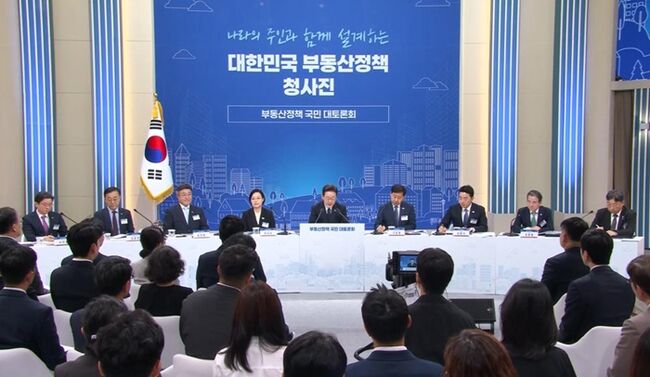 [Liberal Democratic Party Statement] Calling it a Grand Real Estate Debate… It Was Nothing More Than a Private Party Among Themselves
The 'National Grand Debate on Real Estate Policy' held on July 23rd and 27th. [Photo=Yonhap News]The 'National Grand Debate on Real Estate Policy,' hosted by the Lee Jae-myung administration under the
[Liberal Democratic Party Statement] Calling it a Grand Real Estate Debate… It Was Nothing More Than a Private Party Among Themselves
The 'National Grand Debate on Real Estate Policy' held on July 23rd and 27th. [Photo=Yonhap News]The 'National Grand Debate on Real Estate Policy,' hosted by the Lee Jae-myung administration under the
 [Photo] Evidence of Election Fraud Flooding U.S. Media… Trump Had 2.7 Million Votes Stolen
 [Video] U.S. Semiquincentennial Air Show... 'Art in the Sky' streaks across New York
 [Editorial Cartoon] A Draconian Law That Undermines Freedom of Expression

 List
List