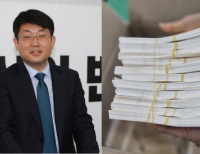
The increase in President Lee Jae-myung's assets, disclosed by the Government Public Officials Ethics Committee on the 26th, requires scrutiny of its substance rather than just the figures.
According to the asset declaration released by the Government Public Officials Ethics Committee, President Lee's assets amount to 4.97 billion won, an increase of approximately 1.88 billion won in one year. While this may appear as a typical asset increase on the surface, a closer look at the detailed breakdown reveals a completely different trend.
The key lies in 'where the increase came from'.
The central driver of this asset increase is not real estate. Nor is it the valuation gains in the financial markets. The largest portion, approximately 1.56 billion won, comes from publication royalties. The declaration explicitly states 'royalties, salary, and ETF valuation gains' as the reasons for the increase in deposits.
In other words, this asset increase was generated not by an appreciation in asset values, but by cash inflow.
This is where a clear distinction arises from the traditional structure of asset growth for public officials.
Generally, the asset growth of high-ranking public officials falls into two main categories:
First, an increase in official real estate prices.
Second, valuation gains in financial assets.
In fact, in this recent disclosure, over 70% of the average asset increase for public officials was attributed to savings and stock price increases. Real estate also saw its official prices rise, serving as a major contributing factor.
However, President Lee's case is different.
The pattern is entirely distinct because the majority of the increase stemmed not from 'appreciation of existing assets' but from income that flowed in externally, specifically from intellectual property revenue.
What warrants even more attention is the scale.
Royalties for high-ranking public officials typically range from a few million to at most tens of millions of won. While it's not uncommon for ministers or politicians to publish books, it is extremely rare for royalties to be the primary factor in asset growth.
In this context, President Lee's royalty income of around 1.5 billion won is not just 'unprecedented' but verges on a structurally unique case.
This suggests that it is less a simple publishing success and more an indication that a mechanism has been at play where a politician's message is consumed by the market, and the resulting income is channeled back into personal assets.
This structure forces a re-evaluation of the relationship between politics and the market.
A politician's statements and philosophies inherently belong to the public domain. However, in this instance, they were commodified in the form of publication, and this flow was confirmed to have led to an increase in personal assets.
This is a different dimension from the existing political funding structure.
While donations and political funds are managed within a system, royalties are private income generated through the market.
In essence, this signifies the existence of a pathway for the same political influence to be converted into assets outside the established system.
Of course, the recent asset increase also partially reflects ETF valuation gains and salary. Real estate also increased to some extent due to rising official prices. However, in the overall proportion, these are merely supplementary elements.
The core point is clear.
President Lee Jae-myung's recent asset increase is a 'growth based on cash flow' rather than an 'appreciation of owned assets'.
The questions raised by this case are not simple.
To what extent is the conversion of a politician's influence into market-generated revenue permissible?
And how should this be differentiated from existing political funding?
This asset disclosure is not merely a change in numbers.
It is a case that demonstrates how the asset structure of public officials can expand from real estate → financial assets → content revenue.
And at the center of this transformation, a new nexus where politics and the market meet is being formed.
Average Assets of High-Ranking Public Officials 2.09 Billion… “Impact of Savings and Stock Increases” According to the Government Public Officials Ethics Committee, the average assets of 1,903 central and local high-ranking public officials were recorded at 2.09563 billion won.
This represents an average increase of 148.7 million won compared to the previous declaration, with 76.1% of the total, or 1,449 individuals, reporting an increase in assets.
Among the factors contributing to the increase, financial asset growth, including savings and stock price rises, accounted for the largest portion at 73.6%, while asset value fluctuations such as increases in official real estate prices constituted 26.4%.
By asset size, those holding over 2 billion won were the most numerous at 32.4%, followed by the 1 billion to 2 billion won bracket at 28.3%.
The highest individual asset holder reported was Lee Se-woong, Governor of North Pyongan Province, who declared 158.7 billion won. |
❄ Integrated Search for Asset Disclosures
https://www.peti.go.kr/peOptpListVie.do

 [Statement by the Seo-beo-kka Korea Military Academy Save-the-Nation Comrades Association] ㉛ Recount the Votes Publicly, as the Previous Recount Concealed Election Fraud
Tongyeong Mayoral Election Recount [Photo=Yonhap News]South Korea's liberal democracy is dying. The National Election Commission (NEC) and the judiciary, which have plummeted into criminal syndicates
[Statement by the Seo-beo-kka Korea Military Academy Save-the-Nation Comrades Association] ㉛ Recount the Votes Publicly, as the Previous Recount Concealed Election Fraud
Tongyeong Mayoral Election Recount [Photo=Yonhap News]South Korea's liberal democracy is dying. The National Election Commission (NEC) and the judiciary, which have plummeted into criminal syndicates
 What is the significance of the "Trump 2028" red hats that keep making a comeback?
It is noteworthy that President Donald Trump is "intentionally" fueling controversy over whether he can actually run in the 2028 presidential election, even though it is "highly likely he is seriously
What is the significance of the "Trump 2028" red hats that keep making a comeback?
It is noteworthy that President Donald Trump is "intentionally" fueling controversy over whether he can actually run in the 2028 presidential election, even though it is "highly likely he is seriously
 Jin Cummings: "North Korea says it will increase the number of spies, so what is the government doing?"
U.S. political columnist Gene Cummings has publicly questioned the South Korean government, asking, "North Korea is announcing plans to increase its number of spies, yet what is the South Korean
Jin Cummings: "North Korea says it will increase the number of spies, so what is the government doing?"
U.S. political columnist Gene Cummings has publicly questioned the South Korean government, asking, "North Korea is announcing plans to increase its number of spies, yet what is the South Korean
 Attorney Do Tae-woo: “Discrepancies in Voter Count and Improper Sealing Confirmed in Tongyeong Mayoral Recount… Official Request for Additional Verification Submitted to Gyeongnam Election Commission”
A bundle of mail-in early voting ballots captured by lawyer Do Tae-woo at the Tongyeong mayoral election recount site. A clear solid line, raising suspicions of election fraud, is visible on the side
Attorney Do Tae-woo: “Discrepancies in Voter Count and Improper Sealing Confirmed in Tongyeong Mayoral Recount… Official Request for Additional Verification Submitted to Gyeongnam Election Commission”
A bundle of mail-in early voting ballots captured by lawyer Do Tae-woo at the Tongyeong mayoral election recount site. A clear solid line, raising suspicions of election fraud, is visible on the side
 Stock Market Crash 'Black Tuesday'… KOSPI down 10.8%, KOSDAQ down 7.7%
The KOSPI fell by more than 5% in early trading on the 28th, triggering a sell-side sidecar.On the 28th, the KOSPI plunged by more than 10%.Due to the sharp decline, a sell-side sidecar—a temporary
Stock Market Crash 'Black Tuesday'… KOSPI down 10.8%, KOSDAQ down 7.7%
The KOSPI fell by more than 5% in early trading on the 28th, triggering a sell-side sidecar.On the 28th, the KOSPI plunged by more than 10%.Due to the sharp decline, a sell-side sidecar—a temporary
 [World Heritage Committee] 25 New World Heritage Sites Inscribed in Busan… South Korea Successfully Expands 'Getbol' Listing
The Chairperson of the World Heritage Committee speaks at the plenary session of the 48th session of the World Heritage Committee, held at BEXCO in Busan on the 20th. [Photo: Yonhap News]A total of 25
[World Heritage Committee] 25 New World Heritage Sites Inscribed in Busan… South Korea Successfully Expands 'Getbol' Listing
The Chairperson of the World Heritage Committee speaks at the plenary session of the 48th session of the World Heritage Committee, held at BEXCO in Busan on the 20th. [Photo: Yonhap News]A total of 25
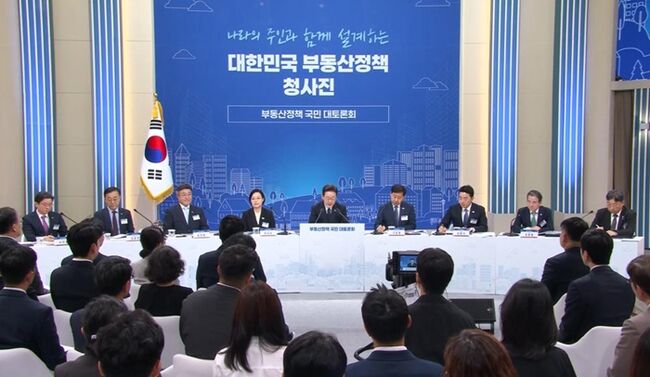 [Liberal Democratic Party Statement] Calling it a Grand Real Estate Debate… It Was Nothing More Than a Private Party Among Themselves
The 'National Grand Debate on Real Estate Policy' held on July 23rd and 27th. [Photo=Yonhap News]The 'National Grand Debate on Real Estate Policy,' hosted by the Lee Jae-myung administration under the
[Liberal Democratic Party Statement] Calling it a Grand Real Estate Debate… It Was Nothing More Than a Private Party Among Themselves
The 'National Grand Debate on Real Estate Policy' held on July 23rd and 27th. [Photo=Yonhap News]The 'National Grand Debate on Real Estate Policy,' hosted by the Lee Jae-myung administration under the
 [Photo] Evidence of Election Fraud Flooding U.S. Media… Trump Had 2.7 Million Votes Stolen
 [Video] U.S. Semiquincentennial Air Show... 'Art in the Sky' streaks across New York
 [Editorial Cartoon] A Draconian Law That Undermines Freedom of Expression

 List
List