Just as the right to life is not a favor from the powerful, so the freedom of navigation on the sea is not a privilege granted by any coastal state. [Reuters=Yonhap News]
Singapore's Minister of Foreign Affairs, Vivian Balakrishnan, pointed out in his country's parliament on the 7th that passage through Hormuz is a "right, not a privilege."
This was a response to a public question about whether Singapore, which borders the Strait of Malacca, would negotiate transit fees with Iran. He emphasized that freedom of navigation is the core principle of the United Nations Convention on the Law of the Sea (UNCLOS), often referred to as the "constitution of the sea."
Just as the right to life is not a favor from the powerful, so the freedom of navigation on the sea is not a privilege granted by any coastal state.
The International Maritime Organization (IMO) also criticized Iran's idea of transit fees as a "dangerous precedent." Iran's attempt to commercialize maritime passages and turn them into permit-based access is essentially 21st-century piracy conducted under the guise of a state.
As civilization progressed, such acts were suppressed. In particular, the freedom of navigation worldwide, sustained by the U.S. naval power for the past 80 years, has widely benefited humanity. The act of combining selective passage, demanding "only ships with our permission may pass," with economic fees for international straits, which are a public good, is no different from the essence of piracy.
The U.S. Counter-Embargo Should Be Understood as "Pressure to Surrender"
The initiative surrounding Hormuz has largely shifted to the U.S. side, significantly diminishing Iran's ability to exert influence. The U.S. embargo is being enforced in the waters of Oman and the Arabian Sea, with six vessels reportedly turned back in the first 24 hours.
While Iran may continue its provocations and threats, it is not in a position to control the entirety of maritime trade according to its will. Iran's threat to blockade Hormuz was a bargaining chip at the threat stage, but with the U.S. counter-embargo now in effect, its leverage has been greatly weakened.
According to a statement from the U.S. Central Command on the 12th, only maritime trade entering and leaving Iranian ports will be blocked; freedom of navigation will continue for vessels not destined for Iran.
The U.S. counter-embargo is choking off Iran's maritime imports and exports to gain leverage in negotiations. Reuters predicts that this measure will effectively halt Iran's crude oil exports, which amount to approximately 2 million barrels per day.
The U.S. counter-embargo is an imposing but justifiable action to restore the order disrupted by Iran. It is a prime example of "peace through strength." Iran was the first to attempt to hold the Strait of Hormuz hostage and demand passage fees, and the U.S. has responded by making Iran bear the cost itself.
It is as if the U.S. responded to Iran's "strategy of seizing other people's ships to extort money" by saying, "Then we will block your ports." The aim is to prevent the Strait of Hormuz from being used as a tool for extortion and profiteering.
China's Strong Words Are a "Love Letter" on the Other Hand
China has protested, stating that the U.S. counter-embargo is not in line with the common interests of the international community. This statement is difficult to take at face value. As Reuters has organized, China was Iran's largest customer for crude oil exports prior to the sanctions. Chinese refiners imported Iranian light crude oil at a price approximately $8-10 per barrel cheaper than Omani crude, and this discount exceeded $10 in February. This has been the foundation supporting the cost competitiveness of China's independent refiners.
China's intentions were also revealed in the UN Security Council vote. On the 7th, China, along with Russia, vetoed a resolution for international cooperation to protect merchant ships in Hormuz. The resolution, even after being watered down to remove the "authorization of the use of force" clause, was ultimately blocked.
By not supporting the restoration of universal freedom of navigation, China has effectively sided with Iran. China's criticism of the U.S. counter-embargo sounds like a lament for the shadow trade benefits it has enjoyed.
While China's military leadership has been vocal, strong enough to be heard by its own citizens, it appears that communication has taken place between the leaders of the U.S. and China regarding this issue.
In a Fox Business interview aired on the 15th, Trump revealed that he had learned of China secretly sending weapons to Iran after the situation in Hormuz became unstable and sent a letter saying, "Don't do that." He stated that Xi Jinping sent a "beautiful reply."
The on-screen caption read, "Xi Jinping Sends Trump a Love Letter." Trump also wrote on social media that he is keeping Hormuz "open forever" and that Xi Jinping will give him a "big hug" in a few weeks.
How Will the U.S. Tighten Iran's Maritime Financial Lifeline?
The U.S. counter-embargo should be accurately interpreted not as indiscriminate action against all general merchant ships, but as "pressure to surrender" targeting maritime trade entering and leaving Iranian ports, the crude oil export network, and the Chinese financial and shipping networks that support them. The U.S. has publicly warned of the possibility of secondary sanctions against purchasers of Iranian crude oil and Chinese banks.
The key to future prospects lies in whether negotiations will reopen and how precisely the U.S. will tighten Iran's maritime financial lifeline. The White House mentioned on the 15th the possibility of Pakistan becoming a venue for talks again, stating that discussions for a second round of negotiations with Iran are progressing productively.
The agenda for the negotiations is also quite specific. The U.S. is proposing a 20-year suspension of Iran's nuclear activities, while Iran has offered a 3-5 year suspension and sanctions relief in exchange. The issue of safe passage in the Omani waters of Hormuz is also reportedly being discussed.
To summarize: Iran attempted to turn Hormuz into a hostage situation, and the U.S. responded with a counter-embargo to make the Iranian regime pay the price. China's opposition in this process is not due to noble principles but because the structure of discounted oil, sanctions evasion, and low-cost procurement that it has long enjoyed is being dismantled.
The fact that the U.S. stepped in when the freedom of navigation, a fundamental right for the prosperity of humanity, was on the verge of being undermined by Iran's piracy, is the fundamental interpretation of the Hormuz situation.

◆ Dr. Lim Myung-shin
Ph.D. in Chinese Studies, Northeast Asian Researcher
Former International Deputy Director of The Sky Daily

 [Statement by the Seo-beo-kka Korea Military Academy Save-the-Nation Comrades Association] ㉛ Recount the Votes Publicly, as the Previous Recount Concealed Election Fraud
Tongyeong Mayoral Election Recount [Photo=Yonhap News]South Korea's liberal democracy is dying. The National Election Commission (NEC) and the judiciary, which have plummeted into criminal syndicates
[Statement by the Seo-beo-kka Korea Military Academy Save-the-Nation Comrades Association] ㉛ Recount the Votes Publicly, as the Previous Recount Concealed Election Fraud
Tongyeong Mayoral Election Recount [Photo=Yonhap News]South Korea's liberal democracy is dying. The National Election Commission (NEC) and the judiciary, which have plummeted into criminal syndicates
 What is the significance of the "Trump 2028" red hats that keep making a comeback?
It is noteworthy that President Donald Trump is "intentionally" fueling controversy over whether he can actually run in the 2028 presidential election, even though it is "highly likely he is seriously
What is the significance of the "Trump 2028" red hats that keep making a comeback?
It is noteworthy that President Donald Trump is "intentionally" fueling controversy over whether he can actually run in the 2028 presidential election, even though it is "highly likely he is seriously
 Jin Cummings: “North Korea says it will increase the number of spies, so what is the government doing?”
U.S. political columnist Gene Cummings has publicly questioned the South Korean government, asking, "North Korea is declaring that it will increase its number of spies, so what is the South Kore
Jin Cummings: “North Korea says it will increase the number of spies, so what is the government doing?”
U.S. political columnist Gene Cummings has publicly questioned the South Korean government, asking, "North Korea is declaring that it will increase its number of spies, so what is the South Kore
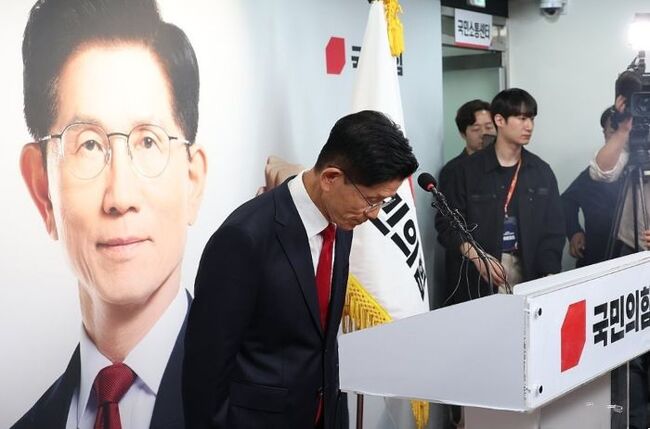 “Too little, too late?…” Kim Moon-soo, who previously conceded his presidential election defeat, now demands a special counsel investigation into ‘allegations of election fraud in the 2025 presidential election’
People Power Party presidential candidate Kim Moon-soo concedes defeat during a press conference at the party headquarters in Yeouido, Seoul, on June 4, 2025. [Joint Press Corps]As allegations emerge
“Too little, too late?…” Kim Moon-soo, who previously conceded his presidential election defeat, now demands a special counsel investigation into ‘allegations of election fraud in the 2025 presidential election’
People Power Party presidential candidate Kim Moon-soo concedes defeat during a press conference at the party headquarters in Yeouido, Seoul, on June 4, 2025. [Joint Press Corps]As allegations emerge
 Stock Market Crash 'Black Tuesday'… KOSPI down 10.8%, KOSDAQ down 7.7%
The KOSPI fell by more than 5% in early trading on the 28th, triggering a sell-side sidecar.On the 28th, the KOSPI plunged by more than 10%.Due to the sharp decline, a sell-side sidecar—a temporary
Stock Market Crash 'Black Tuesday'… KOSPI down 10.8%, KOSDAQ down 7.7%
The KOSPI fell by more than 5% in early trading on the 28th, triggering a sell-side sidecar.On the 28th, the KOSPI plunged by more than 10%.Due to the sharp decline, a sell-side sidecar—a temporary
 [World Heritage Committee] 25 New World Heritage Sites Inscribed in Busan… South Korea Successfully Expands 'Getbol' Listing
The Chairperson of the World Heritage Committee speaks at the plenary session of the 48th session of the World Heritage Committee, held at BEXCO in Busan on the 20th. [Photo: Yonhap News]A total of 25
[World Heritage Committee] 25 New World Heritage Sites Inscribed in Busan… South Korea Successfully Expands 'Getbol' Listing
The Chairperson of the World Heritage Committee speaks at the plenary session of the 48th session of the World Heritage Committee, held at BEXCO in Busan on the 20th. [Photo: Yonhap News]A total of 25
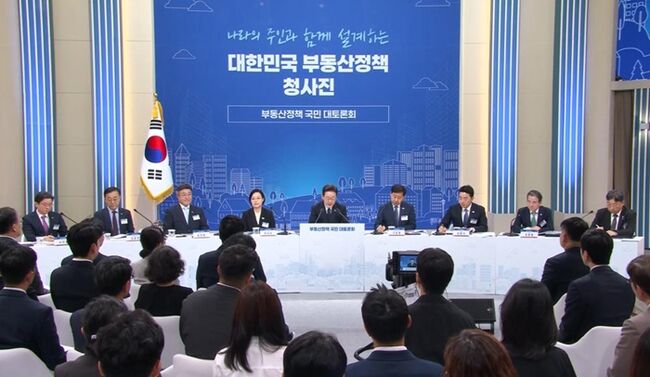 [Liberal Democratic Party Statement] Calling it a Grand Real Estate Debate… It Was Nothing More Than a Private Party Among Themselves
The 'National Grand Debate on Real Estate Policy' held on July 23rd and 27th. [Photo=Yonhap News]The 'National Grand Debate on Real Estate Policy,' hosted by the Lee Jae-myung administration under the
[Liberal Democratic Party Statement] Calling it a Grand Real Estate Debate… It Was Nothing More Than a Private Party Among Themselves
The 'National Grand Debate on Real Estate Policy' held on July 23rd and 27th. [Photo=Yonhap News]The 'National Grand Debate on Real Estate Policy,' hosted by the Lee Jae-myung administration under the
 [Photo] Evidence of Election Fraud Flooding U.S. Media… Trump Had 2.7 Million Votes Stolen
 [Video] U.S. Semiquincentennial Air Show... 'Art in the Sky' streaks across New York
 [Editorial Cartoon] A Draconian Law That Undermines Freedom of Expression

 List
List