Both Israel and South Korea, founded in 1948, share a special bond with the United States, establishing their foundations and receiving protection under the US-led international order. They also share the experience of having to strive and struggle on their own.
JNS (Jewish News Syndicate) and The Jerusalem Post reported on April 24 (local time) about the return of 240 Bnei Menashe Jews from the northeastern Indian states of Mizoram and Manipur.
Arriving at Ben Gurion Airport in Israel the day before, these individuals belong to a community that considers themselves descendants of the tribe of Manasseh, one of the ten "lost tribes" of ancient Israel.
Memories and customs preserved over generations have manifested as choices in reality. They have chosen to live in a country at war, a country with daily missile alerts and security anxieties.
The settlement of diaspora Jews in Israel is called aliyah. The original Hebrew meaning is "ascent" or "going up," signifying people who lived scattered returning to the center of their history, faith, and community.
The opposite of this, "leaving Israel," is "descent," or yerida. The very terminology reveals a worldview. For these individuals, returning to Israel is more than just changing their place of residence; it is an act of "restoring the vertical axis of history." The Israeli Ministry of Foreign Affairs also explains aliyah as immigration imbued with the meaning of "spiritual ascent."
Returning to a War-Torn Israel
European, Middle Eastern, North African, Ethiopian, Indian, and Northeast Asian Jews have diverse skin tones and facial features. While their appearances have changed across time and space, they share memories.
The Israeli Ministry of Immigrant Absorption provides initial settlement funds to returnees and connects them with housing assistance, Hebrew language education, medical insurance, employment counseling, and educational support for their children. It is reported that the 240 Bnei Menashe, upon their arrival, were moved to a center in Nof HaGalil, where they reunited with family members already settled and began their new lives.
According to the Israeli government and the quasi-public Jewish Agency (JAFI), the goal is to facilitate the aliyah of 1,200 Bnei Menashe by the end of 2026 and approximately 6,000 by 2030.
Amidst a steady flow of aliyah, the highest number in 40 years was the return of 742 individuals from the UK last year. The British Jewish community generally has a high proportion of individuals with higher education and professional/managerial roles.
A decline in confidence in British society overall, coupled with the overt rise in antisemitism following the Hamas terror attacks on October 7, 2023, has led to the question of "should we continue living here?" The Jewish Policy Research (JPR) has placed significant importance on their psychological changes, including anxiety.
Of course, the number of people leaving Israel amid war, political conflict, and the burden of living costs has also increased. While not exclusively for Jews, Israeli Central Bureau of Statistics data indicates approximately 82,700 long-term overseas residents in 2024 and about 69,300 in 2025. However, witnessing aliyah proceeding amidst war demonstrates that this country remains a meaningful political community for some, worth risking significant danger for.
What Diaspora Life Gave and Took Away
The word "diaspora," widely used today, has its origins in Jewish dispersion. Derived from the ancient Greek word for "scattering," it became firmly established to describe the fate of Jews scattered across the world after the Babylonian exile and the Roman destruction of Jerusalem.
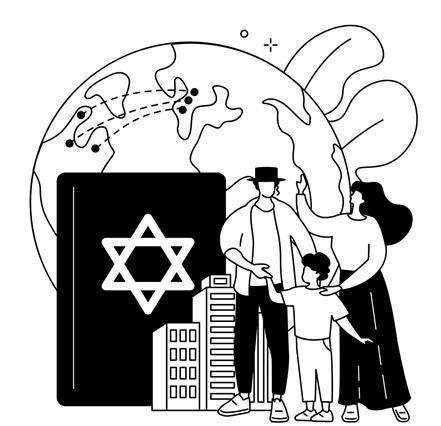 The tragedy of the diaspora made Jews extraordinary.
This tragedy made Jews extraordinary. They cultivated wisdom and aesthetics for survival in fields such as commerce, finance, medicine, art, academia, linguistic skills, and international awareness. Their role as intermediaries connecting various countries and civilizations, rather than relying on any single nation, was also a result of being forced into such a position.
Alongside these paradoxical gains, Jews experienced a fundamental lack. Without land and sovereignty, they were often deprived of the right to determine their present and future. While they prospered during times of tolerance, they were targets of property confiscation, expulsion, and massacre when political situations changed. The conclusion of the long Jewish diaspora is thus simple and clear: the realization that even outstanding individuals, strong communities, or global networks cannot fully replace a state.
Following the Holocaust, which indelibly marked the vulnerability of a stateless nation, the Jewish state of Israel was finally established in its ancient homeland. This was about 2,500 years after the fall of the kingdom and approximately 1,900 years after the destruction of Jerusalem. The nation has lived amidst war and terror since the day after its establishment. Such an Israel has begun to be depicted as a "demonic power." This is a result of the convergence of global anti-American sentiment, political correctness in Western intellectual circles, and a simplistic dichotomy that mechanically divides the weak and the strong.
Similarities and Differences Between Israel and South Korea
Both Israel and South Korea, founded in 1948, share a special bond with the United States, establishing their foundations and receiving protection under the US-led international order. They also share the experience of having to strive and struggle on their own. The difference lies in the "nature of the threat."
While Israel lives under a threat to its physical survival, South Korea, superficially peaceful, faces a strong "threat to its systemic identity." Compared to Israel, where "if borders are pushed, it's over," how much is it recognized in South Korea that losing the identity of a free democratic republic also leads to the erosion of its dignity and substance as a sovereign nation?
What will remain in the shadow of China and North Korea if the standards of freedom, rule of law, private property, elections, and freedom of expression are abandoned? A region where Korean is spoken? A country where Chinese will soon be added as an official language? Just as the world once hoped for China, will we extend the same hope to the North Korean regime, believing that as they become wealthier, freedom and individuals will naturally be respected?
There Is No Freedom Without a State
Is it common sense to side with Iran, a theocratic military regime that rejects coexistence, and to lecture Israel, a rare practical modern state in the Middle East and a parliamentary democracy with rule of law that includes minority groups like its 21.1% Arab population, on respecting a sovereign state's will to possess nuclear weapons? This is something that cannot be left unasked.
The phenomenon of flowing time returning to a tangible state, the continuation of aliyah, seems to testify to this country's enduring persuasive power for the future. At the same time, it poses a question to us: Do we know the reason why South Korea must be a "republic of freedom"?
Observing the return of Jews to Israel, one can conclude the following:
"A nation can endure through memory, but freedom cannot endure without a state."

◆ Dr. Myungshin Im
Former International Deputy Editor-in-Chief, Sky Daily
Northeast Asia Researcher (Ph.D. in Chinese Language and Literature)

 [Statement by the Seobeokka KMA Patriots Association] ㉛ Recount the ballots openly, as the previous recount covered up election fraud
Recount of the Tongyeong mayoral election [Photo=Yonhap News]South Korea's liberal democracy is dying. The National Election Commission (NEC), which has degraded into a criminal organization through t
[Statement by the Seobeokka KMA Patriots Association] ㉛ Recount the ballots openly, as the previous recount covered up election fraud
Recount of the Tongyeong mayoral election [Photo=Yonhap News]South Korea's liberal democracy is dying. The National Election Commission (NEC), which has degraded into a criminal organization through t
 What is the significance of the "Trump 2028" red hat that keeps reappearing?
It is noteworthy that while it is "highly likely" that President Donald Trump is "seriously considering" a run for the presidency in 2028, he is also "deliberately" fueling speculation regarding wheth
What is the significance of the "Trump 2028" red hat that keeps reappearing?
It is noteworthy that while it is "highly likely" that President Donald Trump is "seriously considering" a run for the presidency in 2028, he is also "deliberately" fueling speculation regarding wheth
 First U.S. Ambassador of Trump's Second Term to Arrive This Week… Will It Provide Momentum to Resolve Pending Issues?
U.S. Ambassador to South Korea Michelle Steel speaks at the opening ceremony of the Korea-U.S. Shipbuilding Cooperation Center held at the Mayflower Hotel in Washington, D.C., on the 23rd (local time)
First U.S. Ambassador of Trump's Second Term to Arrive This Week… Will It Provide Momentum to Resolve Pending Issues?
U.S. Ambassador to South Korea Michelle Steel speaks at the opening ceremony of the Korea-U.S. Shipbuilding Cooperation Center held at the Mayflower Hotel in Washington, D.C., on the 23rd (local time)
 The Korean Peninsula wrapped in a thick blanket of scorching high pressure… Will the 1994 record be broken?
On the 28th, as the heatwave continues, a water sprinkler truck sprays water on Hyowon-ro, Gwonseon-gu, Suwon, Gyeonggi Province. [Photo = Yonhap News]The hottest years on record are considered to be
The Korean Peninsula wrapped in a thick blanket of scorching high pressure… Will the 1994 record be broken?
On the 28th, as the heatwave continues, a water sprinkler truck sprays water on Hyowon-ro, Gwonseon-gu, Suwon, Gyeonggi Province. [Photo = Yonhap News]The hottest years on record are considered to be
 Stock Market Crash 'Black Tuesday'… KOSPI down 10.8%, KOSDAQ down 7.7%
The KOSPI fell by more than 5% in early trading on the 28th, triggering a sell-side sidecar.On the 28th, the KOSPI plunged by more than 10%.Due to the sharp decline, a sell-side sidecar—a temporary
Stock Market Crash 'Black Tuesday'… KOSPI down 10.8%, KOSDAQ down 7.7%
The KOSPI fell by more than 5% in early trading on the 28th, triggering a sell-side sidecar.On the 28th, the KOSPI plunged by more than 10%.Due to the sharp decline, a sell-side sidecar—a temporary
 [World Heritage Committee] 25 New World Heritage Sites Inscribed in Busan… South Korea Successfully Expands 'Getbol' Listing
The Chairperson of the World Heritage Committee speaks at the plenary session of the 48th session of the World Heritage Committee, held at BEXCO in Busan on the 20th. [Photo: Yonhap News]A total of 25
[World Heritage Committee] 25 New World Heritage Sites Inscribed in Busan… South Korea Successfully Expands 'Getbol' Listing
The Chairperson of the World Heritage Committee speaks at the plenary session of the 48th session of the World Heritage Committee, held at BEXCO in Busan on the 20th. [Photo: Yonhap News]A total of 25
 [Cho Yang-geon Column] The NEC: Facing a Fate of "Discarding the Dog After the Hunt"
Banner calling for the "dissolution of the NEC" posted by the Democratic Party. [AI-generated image]Banners calling for the "dissolution of the National Election Commission (NEC)" posted by the Democr
[Cho Yang-geon Column] The NEC: Facing a Fate of "Discarding the Dog After the Hunt"
Banner calling for the "dissolution of the NEC" posted by the Democratic Party. [AI-generated image]Banners calling for the "dissolution of the National Election Commission (NEC)" posted by the Democr
 [Photo] Evidence of Election Fraud Flooding U.S. Media… Trump Had 2.7 Million Votes Stolen
 [Video] U.S. Semiquincentennial Air Show... 'Art in the Sky' streaks across New York
 [Editorial Cartoon] A Draconian Law That Undermines Freedom of Expression

 List
List