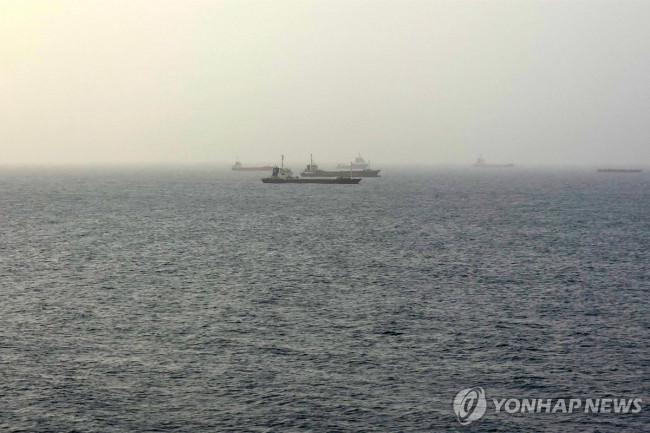
Jordan's Aqaba as seen from southern Israel [Photo courtesy of EPA-Yonhap News]
The U.S. Embassy in Amman, Jordan, announced on the 19th (local time) that Jordanian authorities had issued an evacuation order for the international airport and port in the Aqaba region, which borders the Red Sea.
Although Jordanian authorities denied the evacuation order, tensions escalated immediately after the embassy's warning as Iranian missiles flew into the area, triggering Israel's air defense systems nearby.
The embassy stated this via X (formerly Twitter), explaining that the move was due to a "specific and credible threat."
The embassy advised, "All U.S. citizens should refrain from traveling to the aforementioned airport or port," and also requested that they avoid visiting military bases within Jordan.
In response, Mohammad Al-Momani, spokesperson for the Jordanian government, stated that "no evacuation order has been issued for the Aqaba airport and port" and that these facilities are operating normally, according to the state-run Petra News Agency.
Spokesperson Al-Momani also drew a line, stating that no potential threats had been detected over the past few hours.
However, shortly thereafter, the Jordanian military announced that of the four missiles Iran fired toward Jordanian territory, three were intercepted by air defense systems, while the remaining one landed in a sparsely populated area in southern Jordan.
The Israel Defense Forces (IDF) issued an air raid alert, warning that missiles fired at Aqaba could land in nearby Israeli territory.
The Times of Israel reported that explosions were heard in Eilat, an Israeli port city near Aqaba, when the missiles were intercepted, and that the Israeli military activated its Iron Dome air defense system in response to the attack.
Following the interception, Israeli Defense Minister Israel Katz stated, "If Iran fires missiles at Israel, we will strike back with full firepower," according to Agence France-Presse (AFP).
Minister Katz added, "The U.S. might change its policy, and in that event, we are prepared for both defensive and offensive measures against Iran."
As the recent exchange of hostilities between the U.S. and Iran intensifies, the strength of Iran's retaliatory strikes against U.S. assets in the Middle East is increasing. Concerns over an escalation are growing as the fallout from the conflict reaches Israel, which has been dissatisfied with the ceasefire.
The U.S. Central Command previously announced on the 17th that Iran had attacked the Muwaffaq Salti Air Base in Azraq, Jordan, with ballistic missiles and drones, resulting in the death of two U.S. service members and the disappearance of another.
The Gulf of Aqaba, surrounded by Jordan, Israel, Egypt, and Saudi Arabia, connects to the Red Sea. Recently, there has been speculation that Iran may be mobilizing Yemen's Houthi rebels in the Red Sea region.
The U.S. Department of State previously recommended on March 2nd that U.S. government employees and their families stationed in Jordan evacuate the country.

 [Songsan Column | 80-Year History of the Pro-North Korean Left] ㉛ 1991: The Dissolution of the Soviet Union
On August 22, 1991, Russian President Boris Yeltsin waves the Russian tricolor flag, calling for resistance against the coup forces. On December 26, 1991, the Soviet Union (USSR), once the world’s m
[Songsan Column | 80-Year History of the Pro-North Korean Left] ㉛ 1991: The Dissolution of the Soviet Union
On August 22, 1991, Russian President Boris Yeltsin waves the Russian tricolor flag, calling for resistance against the coup forces. On December 26, 1991, the Soviet Union (USSR), once the world’s m
 U.S. Military: "Iran maritime blockade remains in effect… 2 vessels neutralized, 12 forced to change course"
Gulf of Oman [AFP=Yonhap News]The U.S. military announced on the 25th (local time) that it is maintaining a full maritime blockade against Iran.U.S. Central Command (CENTCOM), which oversees the Middl
U.S. Military: "Iran maritime blockade remains in effect… 2 vessels neutralized, 12 forced to change course"
Gulf of Oman [AFP=Yonhap News]The U.S. military announced on the 25th (local time) that it is maintaining a full maritime blockade against Iran.U.S. Central Command (CENTCOM), which oversees the Middl
 Jang Dong-hyeok suggests unifying slogans, asking, "Is there anyone left who still denies these were rigged or flawed elections?"
People Power Party Representative Jang Dong-hyeok speaks in Daegu on the 25th. [Maeil Shinmun YouTube Video GIF]As the sweat and tears shed by patriotic citizens on the asphalt over the past decade ha
Jang Dong-hyeok suggests unifying slogans, asking, "Is there anyone left who still denies these were rigged or flawed elections?"
People Power Party Representative Jang Dong-hyeok speaks in Daegu on the 25th. [Maeil Shinmun YouTube Video GIF]As the sweat and tears shed by patriotic citizens on the asphalt over the past decade ha
 "Cannot Trust Police Investigations": Objections Double in 4 Years… 34,000 Cases in First Half of This Year
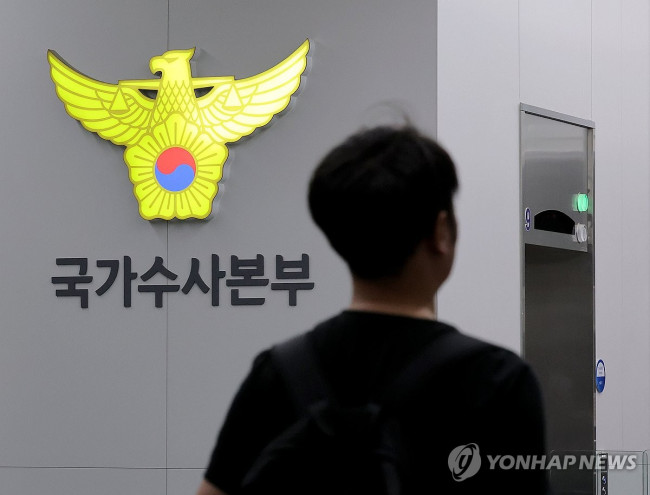
Police officials walk past the lobby of the National Office of Investigation (NOI) as the special investigation team looking into the Jang Yoon-gi case conducts a raid at the National Police Agency he
"Cannot Trust Police Investigations": Objections Double in 4 Years… 34,000 Cases in First Half of This Year
Police officials walk past the lobby of the National Office of Investigation (NOI) as the special investigation team looking into the Jang Yoon-gi case conducts a raid at the National Police Agency he
 Starbucks' 'Aero-cano', first launched in Korea, sells 5.5 million cups in 5 months
Starbucks Aerocano [Courtesy of Starbucks Korea. Yonhap News file photo] Starbucks Korea announced that its "Aerocano," which debuted in South Korea—a world first—on February 26, has surpasse
Starbucks' 'Aero-cano', first launched in Korea, sells 5.5 million cups in 5 months
Starbucks Aerocano [Courtesy of Starbucks Korea. Yonhap News file photo] Starbucks Korea announced that its "Aerocano," which debuted in South Korea—a world first—on February 26, has surpasse
 [New Book] Approaching the Truth of Gwangju… ‘The Memory of Two Gunshots, The Tears of Two Gwangjus’
For a long time, the memory of the May 18 Gwangju Democratization Movement has remained fragmented, never converging into a singular meaning. The new book, Memories of Two Gunshots, Tears of Two Gwang
[New Book] Approaching the Truth of Gwangju… ‘The Memory of Two Gunshots, The Tears of Two Gwangjus’
For a long time, the memory of the May 18 Gwangju Democratization Movement has remained fragmented, never converging into a singular meaning. The new book, Memories of Two Gunshots, Tears of Two Gwang
 [Writer Park Joo-hyun’s Column] The ‘Controversy Over Recommended Summer Reading Lists’ Caused by Blind Idolatry
The cover of the full audio recording file of the so-called "sister-in-law profanity" call, released in 2021 by the pro-Moon Jae-in group "Awakened Citizens' Solidarity Party." [Source: Awakened Citiz
[Writer Park Joo-hyun’s Column] The ‘Controversy Over Recommended Summer Reading Lists’ Caused by Blind Idolatry
The cover of the full audio recording file of the so-called "sister-in-law profanity" call, released in 2021 by the pro-Moon Jae-in group "Awakened Citizens' Solidarity Party." [Source: Awakened Citiz
 [Photo] Evidence of Election Fraud Flooding U.S. Media… Trump Had 2.7 Million Votes Stolen
 [Video] U.S. Semiquincentennial Air Show... 'Art in the Sky' streaks across New York
 [Editorial Cartoon] A Draconian Law That Undermines Freedom of Expression

 List
List