Apple store in Shanghai, China [AFP=Yonhap News file photo]
The Wall Street Journal (WSJ) reported on the 24th (local time) that U.S. President Donald Trump has been thrust into a clash between Apple, which is lobbying aggressively to be allowed to use Chinese-made memory, and Micron, which is strongly demanding that this move be blocked.
Citing anonymous sources, the WSJ reported that in recent weeks, Apple CEO Tim Cook and senior executives have briefed President Trump, Commerce Secretary Howard Lutnick, and Treasury Secretary Scott Bessent on the company's plan to use Chinese memory chips in Apple products.
Apple has communicated to these officials its desire to source memory chips from ChangXin Memory Technologies (CXMT) and Yangtze Memory Technologies (YMTC) for use in Apple products sold outside the United States.
Apple has argued that this move could alleviate global pressure on memory chip supplies and lower prices for U.S. consumers.
However, Micron, the only large-scale U.S. memory manufacturer, is fiercely opposed to Apple's proposal.
 CXMT illustration [Reuters=Yonhap News illustration]
According to sources, Micron executives, including CEO Sanjay Mehrotra, have warned Secretary Lutnick and other administration officials that Chinese memory manufacturers like CXMT must not be allowed to supply major U.S. technology companies such as Apple.
Micron emphasized that if Apple's request is granted, China could dismantle the U.S. memory semiconductor industry in the same way it contributed to the decline of the U.S. steel and manufacturing sectors. They argued that this risk remains even if the Chinese chips are only used in Apple products sold outside the United States.
In recent years, several companies that purchase memory, including Apple, have avoided doing business with CXMT and YMTC after they were designated as Chinese military companies by the U.S. Department of Defense.
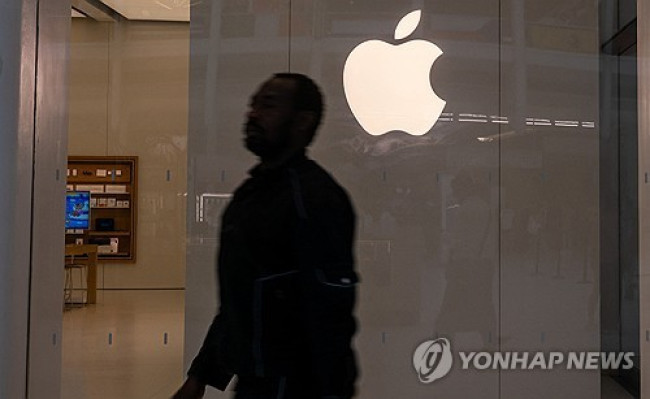 Apple store in New York City, U.S. [Getty Images AFP=Yonhap News file photo]
Among them, YMTC is also on the U.S. government’s trade blacklist, known as the "Entity List."
The WSJ noted that the lobbying war between Apple and Micron puts President Trump in a difficult position, forcing him to choose between two key economic policy priorities: lowering domestic consumer prices versus expanding U.S. semiconductor production to reduce reliance on foreign nations.
White House Deputy Press Secretary Kush Desai stated that the Trump administration will pursue "protecting our national security while simultaneously seeking investments and easing economic burdens for the American people."
According to the WSJ, Micron executives argue that the company can help alleviate memory supply pressure by accelerating the construction of its U.S. domestic plants and increasing investment within the United States.
Micron has maintained that the rise in consumer electronics prices, including those for Apple devices, is not solely due to the increase in memory costs.
Michael Kratsios, the White House Office of Science and Technology Policy Director, recently told federal lawmakers, "The most important thing is that we must build production capacity here. We certainly do not want to do business with anyone on the Entity List."
For years, Apple has pressured memory manufacturers, including Micron, to supply chips at the lowest possible price, which has led to long-standing friction between the two sides.
It is known that Mehrotra, even before becoming Micron CEO and during his time at SanDisk, held a deep dislike for Apple and rarely met with its representatives—a sentiment that reportedly persists today.
 YMTC logo [Provided by YMTC]
With the recent AI boom causing a surge in demand for memory semiconductors, Apple has lost its leverage in negotiating memory supply prices.
According to research firm TechInsights, memory prices have quadrupled over the past year and are expected to rise further. The stock prices of manufacturers have also soared.
Apple currently claims that Micron’s gross margin of over 80% is evidence of profiteering.
Memory industry executives point out that Apple and other customers sowed the seeds for the current memory shortage by squeezing suppliers during past downturns in the memory cycle.
They argue that Apple is now reaping what it sowed by aggressively pressuring suppliers for price cuts.
Both Apple and Micron possess significant lobbying influence; however, Apple has maintained a friendly relationship with President Trump since his first term.
According to anonymous sources interviewed by the WSJ, Secretary of Commerce Lutnick is in regular communication with both Apple CEO Cook and Micron CEO Mehrotra regarding the administration's goals for domestic investment and the expansion of U.S. chip production.
Secretary Lutnick has recently attended several Micron events.
Both Cook and Mehrotra have appeared in public with President Trump in the Oval Office and accompanied him on his state visit to China in May of this year.
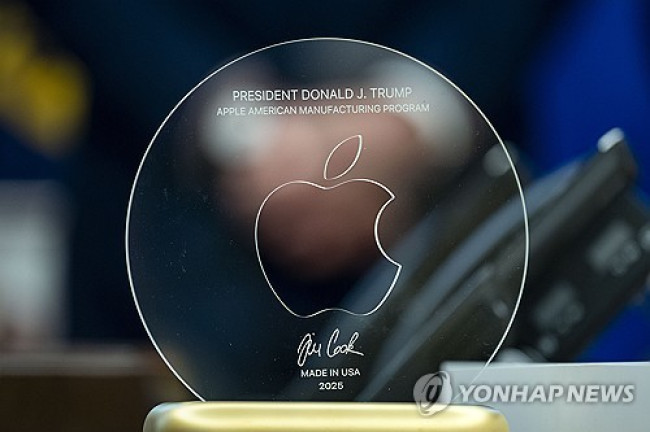 Commemorative plaque provided by Apple with a 24K gold stand received by Trump [EPA=Yonhap News file photo]
Both companies have donated funds for the new White House banquet hall being built by President Trump and have publicly supported the President's policies.
In August of last year, Cook met with President Trump in the Oval Office to announce plans for an additional $100 billion (146 trillion won) investment in the U.S. and presented the President with a commemorative plaque featuring a 24K gold stand.
Apple has succeeded in obtaining tariff exemptions for its products manufactured in China and elsewhere.
Micron recently announced it would invest $250 million (365 billion won) in matching federal grants for the so-called "Trump Savings Account."
Previously, in 2022, Apple attempted to source memory chips from YMTC and even invested in engineering work, but abandoned the plan after facing backlash.
At the time, current Secretary of State Marco Rubio, who was then a U.S. Senator, criticized Apple with strong language, stating they were "playing with fire" by ignoring national security risks.
While Secretary of State Rubio and the State Department are involved to some extent in the current discussions regarding Apple’s request to allow Chinese memory, the WSJ reported that Secretary Lutnick and Secretary Bessent are considered the primary figures spearheading these efforts.

 [Songsan Column | 80-Year History of the Pro-North Korean Left] ㉛ 1991: The Dissolution of the Soviet Union
On August 22, 1991, Russian President Boris Yeltsin waves the Russian tricolor flag, calling for resistance against the coup forces. On December 26, 1991, the Soviet Union (USSR), once the world’s m
[Songsan Column | 80-Year History of the Pro-North Korean Left] ㉛ 1991: The Dissolution of the Soviet Union
On August 22, 1991, Russian President Boris Yeltsin waves the Russian tricolor flag, calling for resistance against the coup forces. On December 26, 1991, the Soviet Union (USSR), once the world’s m
 U.S. Military: "Iran maritime blockade remains in effect… 2 vessels neutralized, 12 forced to change course"
Gulf of Oman [AFP=Yonhap News]The U.S. military announced on the 25th (local time) that it is maintaining a full maritime blockade against Iran.U.S. Central Command (CENTCOM), which oversees the Middl
U.S. Military: "Iran maritime blockade remains in effect… 2 vessels neutralized, 12 forced to change course"
Gulf of Oman [AFP=Yonhap News]The U.S. military announced on the 25th (local time) that it is maintaining a full maritime blockade against Iran.U.S. Central Command (CENTCOM), which oversees the Middl
 Jang Dong-hyeok suggests unifying slogans, asking, "Is there anyone left who still denies these were rigged or flawed elections?"
People Power Party Representative Jang Dong-hyeok speaks in Daegu on the 25th. [Maeil Shinmun YouTube Video GIF]As the sweat and tears shed by patriotic citizens on the asphalt over the past decade ha
Jang Dong-hyeok suggests unifying slogans, asking, "Is there anyone left who still denies these were rigged or flawed elections?"
People Power Party Representative Jang Dong-hyeok speaks in Daegu on the 25th. [Maeil Shinmun YouTube Video GIF]As the sweat and tears shed by patriotic citizens on the asphalt over the past decade ha
 "Cannot Trust Police Investigations": Objections Double in 4 Years… 34,000 Cases in First Half of This Year
Police officials walk past the lobby of the National Office of Investigation (NOI) as the special investigation team looking into the Jang Yoon-gi case conducts a raid at the National Police Agency he
"Cannot Trust Police Investigations": Objections Double in 4 Years… 34,000 Cases in First Half of This Year
Police officials walk past the lobby of the National Office of Investigation (NOI) as the special investigation team looking into the Jang Yoon-gi case conducts a raid at the National Police Agency he
 Starbucks' 'Aero-cano', first launched in Korea, sells 5.5 million cups in 5 months
Starbucks Aerocano [Courtesy of Starbucks Korea. Yonhap News file photo] Starbucks Korea announced that its "Aerocano," which debuted in South Korea—a world first—on February 26, has surpasse
Starbucks' 'Aero-cano', first launched in Korea, sells 5.5 million cups in 5 months
Starbucks Aerocano [Courtesy of Starbucks Korea. Yonhap News file photo] Starbucks Korea announced that its "Aerocano," which debuted in South Korea—a world first—on February 26, has surpasse
 [New Book] Approaching the Truth of Gwangju… ‘The Memory of Two Gunshots, The Tears of Two Gwangjus’
For a long time, the memory of the May 18 Gwangju Democratization Movement has remained fragmented, never converging into a singular meaning. The new book, Memories of Two Gunshots, Tears of Two Gwang
[New Book] Approaching the Truth of Gwangju… ‘The Memory of Two Gunshots, The Tears of Two Gwangjus’
For a long time, the memory of the May 18 Gwangju Democratization Movement has remained fragmented, never converging into a singular meaning. The new book, Memories of Two Gunshots, Tears of Two Gwang
 [Writer Park Joo-hyun’s Column] The ‘Controversy Over Recommended Summer Reading Lists’ Caused by Blind Idolatry
The cover of the full audio recording file of the so-called "sister-in-law profanity" call, released in 2021 by the pro-Moon Jae-in group "Awakened Citizens' Solidarity Party." [Source: Awakened Citiz
[Writer Park Joo-hyun’s Column] The ‘Controversy Over Recommended Summer Reading Lists’ Caused by Blind Idolatry
The cover of the full audio recording file of the so-called "sister-in-law profanity" call, released in 2021 by the pro-Moon Jae-in group "Awakened Citizens' Solidarity Party." [Source: Awakened Citiz
 [Photo] Evidence of Election Fraud Flooding U.S. Media… Trump Had 2.7 Million Votes Stolen
 [Video] U.S. Semiquincentennial Air Show... 'Art in the Sky' streaks across New York
 [Editorial Cartoon] A Draconian Law That Undermines Freedom of Expression

 List
List