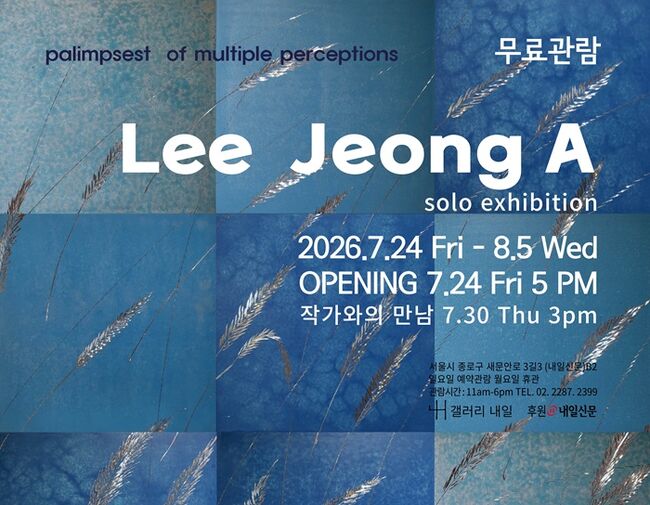
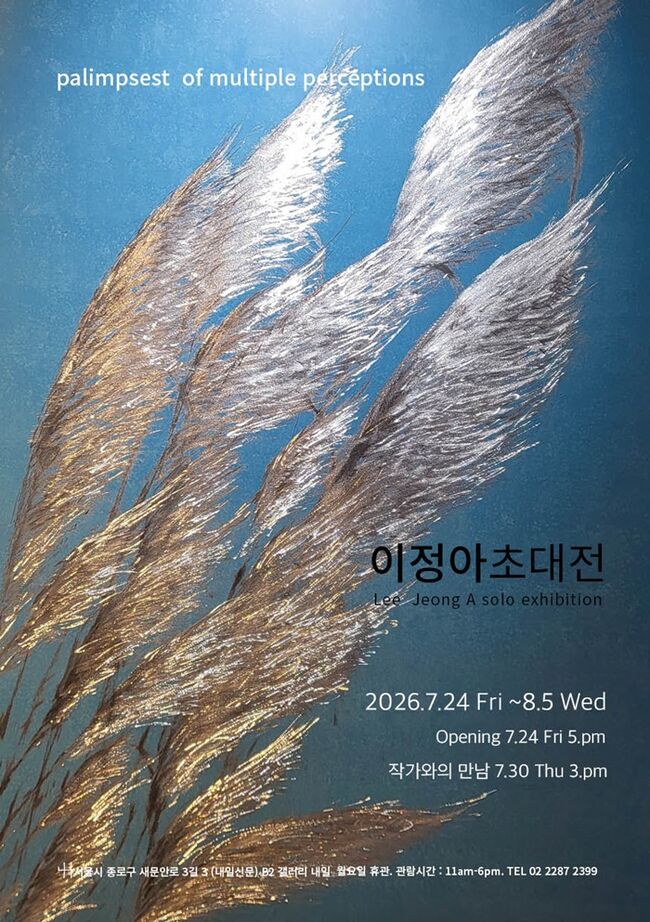
Gallery Naeil in Jongno-gu, Seoul, will host artist Lee Jung-ah's solo exhibition, "Palimpsest of Multiple Perceptions," from the 24th of this month to August 5th.
Artist Lee Jung-ah has consistently offered viewers new perceptual experiences through her unique body of work that traverses the boundaries between metal, light, and painting.
Expanding upon the traditional concepts of two-dimensional painting, the artist utilizes metal plates as her primary medium rather than canvas. She repeatedly leaves numerous traces on the metal surfaces through grinding and sanding, layering transparent resin over them time and time again.
In this process, "light" becomes the core material of the work, creating different images and spatial perceptions depending on the viewer's position and the time of day. The shimmering silver lines within the works evoke images of reeds in the wind while simultaneously displaying ever-changing expressions through the material properties of metal and the reflection of light.
As viewers move in front of the artwork, they experience new colors, depths, and spatial dimensions, encountering a landscape that is not a single fixed image, but one that is generated through time.
The exhibition opening ceremony will be held on Friday the 24th at 5 PM, and an "Artist Talk" will take place on Thursday the 30th at 3 PM. The Artist Talk, in particular, will be a special occasion to hear directly from the artist about the stories behind her work, her creative process, and the moments of inspiration she experienced during creation.
[Critique] Palimpsest of Multiple Perceptions
Seo Gil-heon (Ph.D. in Plastic Arts, Visiting Professor at Mokwon University)
In the work of artist Lee Jung-ah, who has continuously explored the nature of flatness, the canvas does not remain a mere indirect support hidden beneath the picture plane. Instead, it functions as an active element that takes on the responsibility of direct expression. The metal plates, which are carefully scratched or ground down to serve as canvases, are both passive supports and the foundation for actively composing the surface as they engage with light to cultivate perception.
The sharp, lustrous effects produced by scratches and streaks left on the copper plate surfaces by grinders and sanders transform the canvas into a unique medium of expression that reveals optical characteristics. These qualities are realized by extending the realm of expression, as the marks and interstitial spaces created on the metal plane reflect and transform light according to the angle of the viewer's gaze, turning the surface into a vividly moving space.
Here, the surface of the canvas serves as a domain that draws light in as an active element of perception, functioning simultaneously as a physical reality and a potential space of multiplicity. The primary characteristic of Lee's work lies in the emergent tension between visibility and concealment, as well as between instinctive perception and intentional composition. Each piece becomes a potential space—a site of genesis where relationships between chance and memory, traces and erasures, and appearances and disappearances occur.
The wrinkled surfaces of the works, where these effects unfold, are inscribed with the memories of time. This signifies a "palimpsest"—much like the clay tablets, papyrus, or parchment used in ancient Egypt and elsewhere, where previous writings were erased to make room for new text—denoting a multiple-layered surface space where traces or the past remain potentially underneath.
Her work explores perceptual effects by applying the physical phenomena resulting from light reflecting off wrinkles etched into metal surfaces, or by inducing shifts in sensation through color pointillism. Consequently, her works, which manifest as sensitive and variable images that stir both the senses and the mind, are composed around the "potentiality of multiple perceptions" through which visual phenomena are perceived, felt, and interpreted.

 [Issue Commentary] “Who Checks the CIO?”… The Paradox of Prohibiting Direct Supplementary Investigations by the Public Prosecutor’s Office
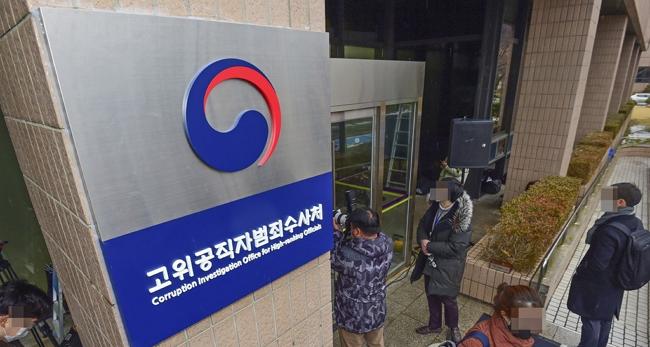
The signboard of the Corruption Investigation Office for High-ranking Officials (CIO) at the Government Complex Gwacheon [Yonhap News file photo] Ahead of the abolition of the Prosecutors' Office and
[Issue Commentary] “Who Checks the CIO?”… The Paradox of Prohibiting Direct Supplementary Investigations by the Public Prosecutor’s Office
The signboard of the Corruption Investigation Office for High-ranking Officials (CIO) at the Government Complex Gwacheon [Yonhap News file photo] Ahead of the abolition of the Prosecutors' Office and
 Trump’s bombshell tweet: “Iranian regime has slaughtered 52,000 protesters”
U.S. President Donald Trump shared a post regarding Iranian youths massacred by the Iranian dictatorship, stating that the number of innocent victims has reached 52,000. [Captured from President Trump
Trump’s bombshell tweet: “Iranian regime has slaughtered 52,000 protesters”
U.S. President Donald Trump shared a post regarding Iranian youths massacred by the Iranian dictatorship, stating that the number of innocent victims has reached 52,000. [Captured from President Trump
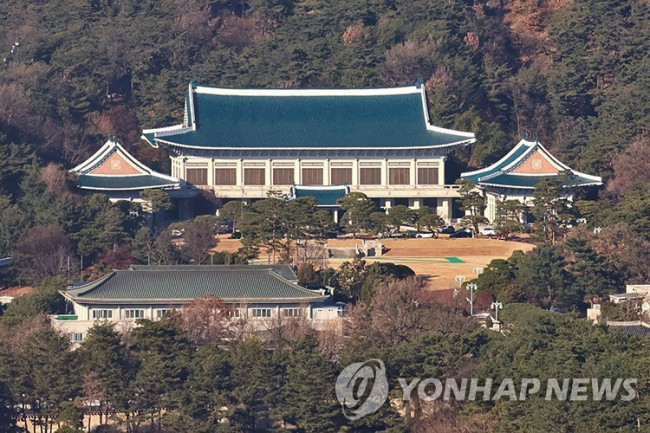 Blue House: "We will respect any conclusion on the right to request supplementary investigations... A prompt decision is needed to minimize confusion."
The Blue House [Photo by Lee Jung-hoon] 2025.12.8Regarding the issue of the prosecution's supplementary investigative authority, the Blue House stated on the 21st, "The decision on whether to abolish
Blue House: "We will respect any conclusion on the right to request supplementary investigations... A prompt decision is needed to minimize confusion."
The Blue House [Photo by Lee Jung-hoon] 2025.12.8Regarding the issue of the prosecution's supplementary investigative authority, the Blue House stated on the 21st, "The decision on whether to abolish
 Heavy rainfall overnight triggers flood of damage reports in Asan and Cheonan… 8 rescued
Road flooded by heavy rain [Yonhap News file photo]As of the early hours of the 22nd, heavy rainfall has caused consecutive damage in the Asan and Cheonan areas of South Chungcheong Province, includin
Heavy rainfall overnight triggers flood of damage reports in Asan and Cheonan… 8 rescued
Road flooded by heavy rain [Yonhap News file photo]As of the early hours of the 22nd, heavy rainfall has caused consecutive damage in the Asan and Cheonan areas of South Chungcheong Province, includin
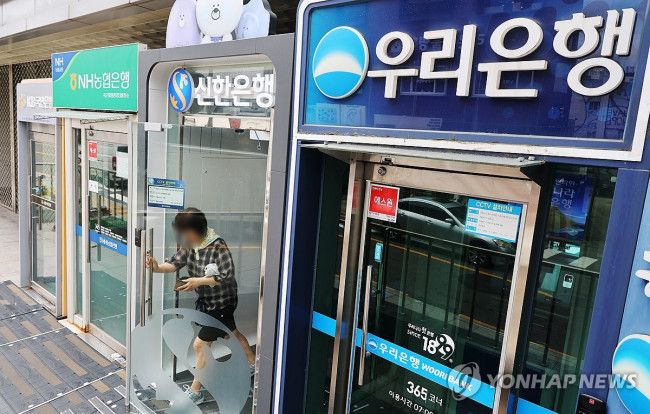 Due to 'Debt-to-Invest' Trend, Major 5 Banks Exceed Other Loan Targets by 2.4 Trillion Won… Tightening Mortgage Loans
An automated teller machine (ATM) at a commercial bank in Seoul on the 19th. [Yonhap News] It has been found that "other loans" at the five major commercial banks (KB Kookmin, Shinhan, Hana, Woor
Due to 'Debt-to-Invest' Trend, Major 5 Banks Exceed Other Loan Targets by 2.4 Trillion Won… Tightening Mortgage Loans
An automated teller machine (ATM) at a commercial bank in Seoul on the 19th. [Yonhap News] It has been found that "other loans" at the five major commercial banks (KB Kookmin, Shinhan, Hana, Woor
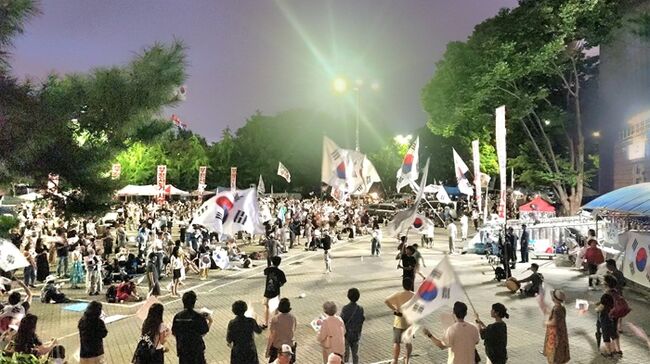 [Kim Jae-soo Column] "What is the ruling party so afraid of?"... The reason why the opposition-recommended special counsel must be implemented
"Members of the National Assembly, can you not hear the calls for 'reruns of fraudulent elections and manual counting of same-day ballots' that have been echoing at Olympic Park for nearly two months?
[Kim Jae-soo Column] "What is the ruling party so afraid of?"... The reason why the opposition-recommended special counsel must be implemented
"Members of the National Assembly, can you not hear the calls for 'reruns of fraudulent elections and manual counting of same-day ballots' that have been echoing at Olympic Park for nearly two months?
 [Photo] Evidence of Election Fraud Flooding U.S. Media… Trump Had 2.7 Million Votes Stolen
 [Video] U.S. Semiquincentennial Air Show... 'Art in the Sky' streaks across New York
 [Editorial Cartoon] A Draconian Law That Undermines Freedom of Expression

 List
List