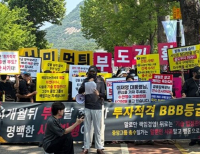
Individual creditors of JTBC are holding a protest in front of the Presidential Office, demanding the return of their retirement funds. [Photo=Yonhap News]
The crisis at JoongAng Group, which is on the verge of total collapse, has thus far been subjected to only limited and repetitive discourse. Attention has been narrowly focused on the downfall of the prominent figures Hong Seok-hyun and Hong Jeong-do, and the decline of the seemingly stable media outlets, JoongAng Ilbo and JTBC. Such circular discussions must end. The core issue lies elsewhere: the suspicion of a "planned bankruptcy" by JoongAng Group.
I am referring to the potential criminal offenses that the father-son duo, Hong Seok-hyun and Hong Jeong-do, may have committed to escape the threat of insolvency. Specifically, if the charge of fraud—issuing corporate bonds while concealing the company's capital erosion—is proven, criminal punishment is unavoidable. While I cannot definitively conclude guilt, it is highly probable that in their desperation to secure funds (corporate bonds and commercial paper) despite their lack of solvency, they engaged in a perilous game of passing the buck.
While the Financial Supervisory Service (FSS) is currently looking into this, that alone is insufficient. If necessary, a prosecution investigation is required, as suggested by lawyer Lee Bok-hyun (former head of the FSS). It is unacceptable for a normal society to avoid proper scrutiny simply because of the reputation of media outlets like JoongAng Ilbo and JTBC. Moreover, it undermines legal equity compared to similar cases involving companies like Homeplus, STX Group, and Tong Yang Group, which were punished for similar actions.
The crux of the matter is the 790 billion won in corporate bonds (an estimate by the union of individual creditors affected by the JoongAng Group crisis). This is the hard-earned money of ordinary people meant for retirement, weddings, or living expenses; once JoongAng Group enters court receivership, these funds will be frozen indefinitely.
Therefore, a thorough, transparent investigation is essential—not only to recover their property rights but also to restore the reputations of Hong Seok-hyun and Hong Jeong-do should they prove to be innocent.
In truth, the more one looks, the more suspicious it becomes. If corporate bonds marketed with investment-grade ratings (BBB) reached default just four months after issuance, it is impossible to avoid a review of the entire process—from issuance and distribution to the sale of JTBC corporate bonds. Naturally, all financial institutions involved, such as Shinhan Investment Corp., Kiwoom Securities, and Hanyang Securities, must also be subject to investigation.
The recurring question is: "Did the management really not know about those distressed bonds?" It is a situation that requires addressing the outcry of creditors who claim, "These are clearly distressed bonds and a case of JoongAng Group investment fraud."
For the record, as a critic, I recognized the capital erosion of JTBC as early as June 2024, two years ago, and warned through newspaper columns and YouTube broadcasts that "JoongAng Ilbo and JTBC are teetering."
And yet, the executives claim they didn't know? That is preposterous. At the time, even left-leaning outlets like Media Today covered the news, which only the "Cho-Joong-Dong" (Chosun, JoongAng, Dong-A) papers had been trying to hush up.
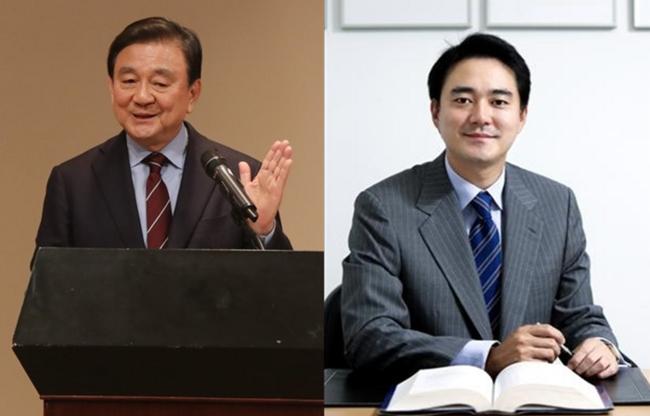 Hong Seok-hyun and Hong Jeong-do. [Photo=Yonhap News]
Shortly thereafter, several articles appeared regarding the Hong family’s urgent attempts to dispose of their real estate. Consequently, lawyer Lee Bok-hyun’s statement that "the FSS is scrutinizing all bonds issued by JoongAng Group from the second half of last year until just before the application for rehabilitation" does not go far enough.
Not only the period around 2024, but all bonds issued by JoongAng Group—especially those heavily issued in August 2025 and February 2026—must be investigated. If they sold bonds to investors while aware that the chances of repayment were significantly low, this may constitute fraudulent and unfair trading under the Capital Markets Act.
Such suspicions bear a resemblance to the recent Homeplus case, where defaults occurred shortly after the issuance of massive amounts of electronic short-term bonds. Former lawmaker Kim Woong pointed out that "the fact that JTBC sold bonds just before default and then suddenly applied for corporate rehabilitation is similar to the Homeplus situation." All of this naturally falls under the definition of fraud or fraudulent and unfair trading.
The prosecution’s request for arrest warrants for executives including Homeplus’s major shareholder, Chairman Kim Byung-joo, last January was rooted in the same context. Kang Duk-soo, the former chairman who was accused of forcing subsidiaries to buy commercial paper from the struggling STX Construction between 2011 and 2012, was also prosecuted and eventually received a definitive sentence of two years in prison, suspended for four years, by the Supreme Court.
That is not all. The JoongAng Group issue is also strikingly similar to the Tong Yang Group crisis that collapsed a decade ago. At the time, former Tong Yang Group Chairman Hyun Jae-hyun was arrested in 2014 on charges of issuing 1.3 trillion won in distressed corporate bonds. He served a full seven-year prison sentence after 170.8 billion won worth of distressed bonds were proven.
What should also be examined at this time is the structural weakness of JTBC's financial structure, which could hardly be considered that of a normal company over the last decade. Since the station's launch, it recorded profits in only two years: 2017 (9.8 billion won) and 2018 (12.9 billion won). Since then, it has suffered massive losses for three consecutive years from 2023 to 2025, with accumulated deficits reaching a staggering 729.3 billion won. As of the end of last year, the accumulated deficit had ballooned to 2.8 trillion won.
Those in the know are aware that this is all due to the bluff-based—or rather, gambling-based—management style of Hong Seok-hyun and Hong Jeong-do. Given the nature of these owners, there is a high—an extremely high—probability that they engaged in immoral acts, such as selling bonds loudly by leveraging the media company's name just before bankruptcy, followed by a surprise application for corporate rehabilitation.
In fact, in my very first column, I referred to Hong Jeong-do, who made the worst statement in media history during the 2015 JoongAng Ilbo 50th-anniversary event by saying "unverified facts are also valuable information," and his father Hong Seok-hyun, who applauded that appalling remark, as the "two worst villains in the media landscape."
That was not an emotionally driven criticism. Could this unhinged pair be capable of carrying out something as heinous as a planned bankruptcy?
My concern is that in the current situation, the Lee Jae-myung administration might lean toward shielding JoongAng Group. They might choose to make a political decision to bury all the allegations raised so far, simply because JoongAng Ilbo and JTBC are on their side.
If they desire a quiet, immediate resolution under the logic that "the easier way is better" for such an unprecedented media bankruptcy, the backlash against both the Lee Jae-myung administration and JoongAng Group will be unavoidable.
Let us reaffirm common sense. Companies can fail. However, suspicions that shake investor confidence must not be neglected. There is only one lesson from the JoongAng Group crisis: media companies are no exception, and no one in the capital market stands above the law. What the public demands right now is not a witch hunt against Hong Seok-hyun and Hong Jeong-do.
In a rule-of-law society, suspicions must be verified through investigation, and responsibility must be determined by evidence. Our conclusion in the current situation is self-evident: an investigation without favors, a thorough search for the truth without sanctuaries, and a fair conclusion based on the law—that is all. It is also clear that this is the only way to protect investors and safeguard the trust in the Republic of Korea’s capital market.
What the public is curious about can be summarized in three points: First, what was the actual financial state of JoongAng Group just before the rehabilitation application? Second, what was the extent of the liquidity risk at that time? Third, were such risks properly reflected in the investment prospectuses and public disclosures when the corporate bonds and commercial papers (CP) were issued? Answering these questions is the duty of the financial authorities and the prosecution under the Lee Jae-myung administration.
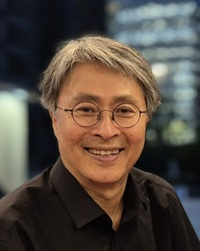
◆ Jo Woo-seok, Critic
Current affairs critic. A leading South Korean cultural authority, having served as a reporter for the Seoul Shinmun, Culture Desk at Munhwa Ilbo, and Cultural Specialist Reporter for JoongAng Ilbo. He served as a member of the KBS Board of Directors and the Park Chung-hee Presidential Memorial Foundation Board, and received the Korea Publishing Criticism Award (2008) and the Column Award at the 25th Seoul Journalist Club Press Awards (2010).

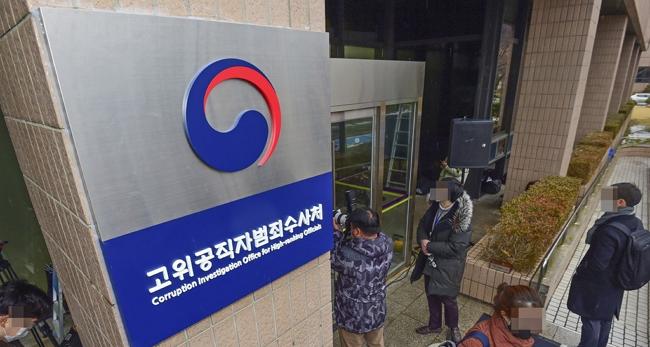 [Issue Commentary] “Who Checks the CIO?”… The Paradox of Prohibiting Direct Supplementary Investigations by the Public Prosecutor’s Office
The signboard of the Corruption Investigation Office for High-ranking Officials (CIO) at the Government Complex Gwacheon [Yonhap News file photo] Ahead of the abolition of the Prosecutors' Office and
[Issue Commentary] “Who Checks the CIO?”… The Paradox of Prohibiting Direct Supplementary Investigations by the Public Prosecutor’s Office
The signboard of the Corruption Investigation Office for High-ranking Officials (CIO) at the Government Complex Gwacheon [Yonhap News file photo] Ahead of the abolition of the Prosecutors' Office and
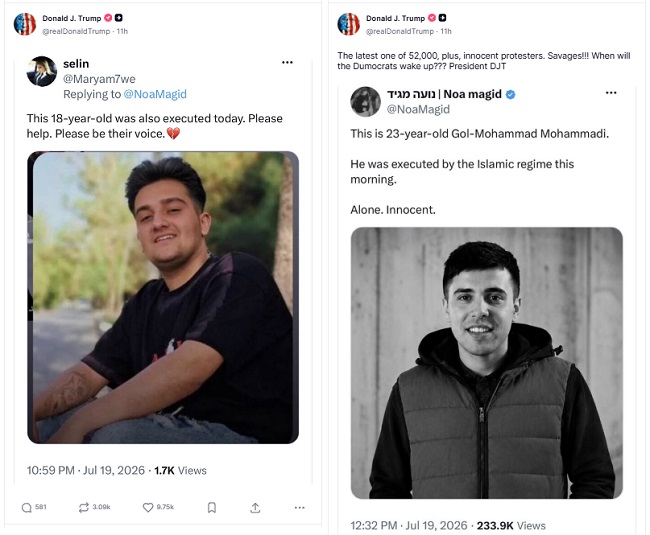 Trump’s bombshell tweet: “Iranian regime has slaughtered 52,000 protesters”
U.S. President Donald Trump shared a post regarding Iranian youths massacred by the Iranian dictatorship, stating that the number of innocent victims has reached 52,000. [Captured from President Trump
Trump’s bombshell tweet: “Iranian regime has slaughtered 52,000 protesters”
U.S. President Donald Trump shared a post regarding Iranian youths massacred by the Iranian dictatorship, stating that the number of innocent victims has reached 52,000. [Captured from President Trump
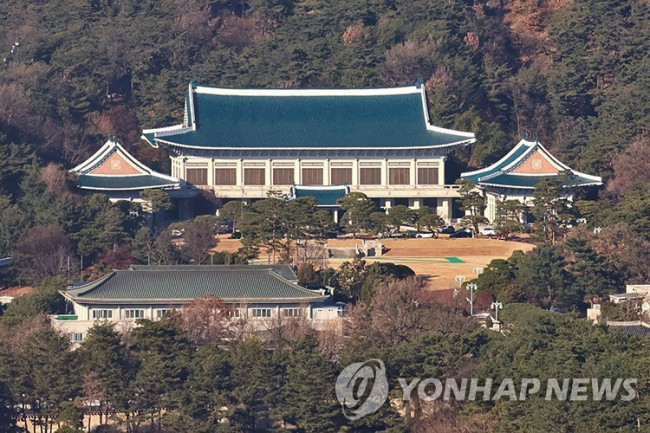 Blue House: "We will respect any conclusion on the right to request supplementary investigations... A prompt decision is needed to minimize confusion."
The Blue House [Photo by Lee Jung-hoon] 2025.12.8Regarding the issue of the prosecution's supplementary investigative authority, the Blue House stated on the 21st, "The decision on whether to abolish
Blue House: "We will respect any conclusion on the right to request supplementary investigations... A prompt decision is needed to minimize confusion."
The Blue House [Photo by Lee Jung-hoon] 2025.12.8Regarding the issue of the prosecution's supplementary investigative authority, the Blue House stated on the 21st, "The decision on whether to abolish
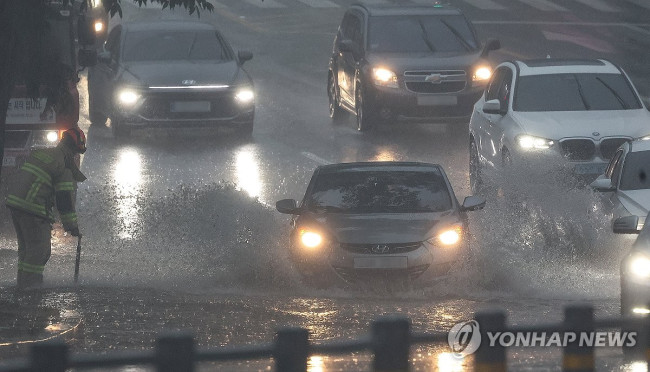 Heavy rainfall overnight triggers flood of damage reports in Asan and Cheonan… 8 rescued
Road flooded by heavy rain [Yonhap News file photo]As of the early hours of the 22nd, heavy rainfall has caused consecutive damage in the Asan and Cheonan areas of South Chungcheong Province, includin
Heavy rainfall overnight triggers flood of damage reports in Asan and Cheonan… 8 rescued
Road flooded by heavy rain [Yonhap News file photo]As of the early hours of the 22nd, heavy rainfall has caused consecutive damage in the Asan and Cheonan areas of South Chungcheong Province, includin
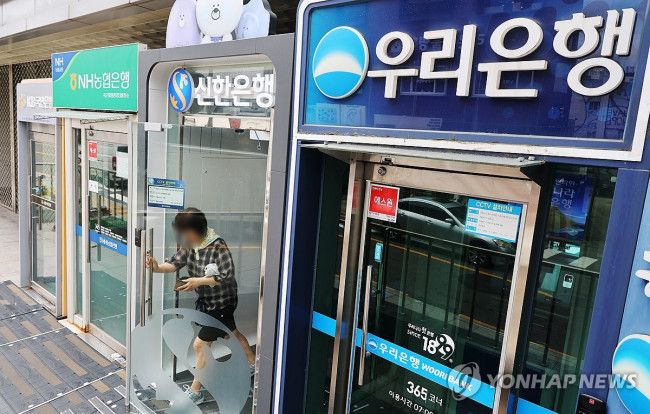 Due to 'Debt-to-Invest' Trend, Major 5 Banks Exceed Other Loan Targets by 2.4 Trillion Won… Tightening Mortgage Loans
An automated teller machine (ATM) at a commercial bank in Seoul on the 19th. [Yonhap News] It has been found that "other loans" at the five major commercial banks (KB Kookmin, Shinhan, Hana, Woor
Due to 'Debt-to-Invest' Trend, Major 5 Banks Exceed Other Loan Targets by 2.4 Trillion Won… Tightening Mortgage Loans
An automated teller machine (ATM) at a commercial bank in Seoul on the 19th. [Yonhap News] It has been found that "other loans" at the five major commercial banks (KB Kookmin, Shinhan, Hana, Woor
 [Exhibition] Lee Jung-a Solo Exhibition ‘Palimpsest of Multiple Perceptions’ Held at Gallery Naeil
Gallery Naeil in Jongno-gu, Seoul, will host artist Lee Jung-ah's solo exhibition, "Palimpsest of Multiple Perceptions," from the 24th of this month to August 5th. Artist Lee Jung-ah has co
[Exhibition] Lee Jung-a Solo Exhibition ‘Palimpsest of Multiple Perceptions’ Held at Gallery Naeil
Gallery Naeil in Jongno-gu, Seoul, will host artist Lee Jung-ah's solo exhibition, "Palimpsest of Multiple Perceptions," from the 24th of this month to August 5th. Artist Lee Jung-ah has co
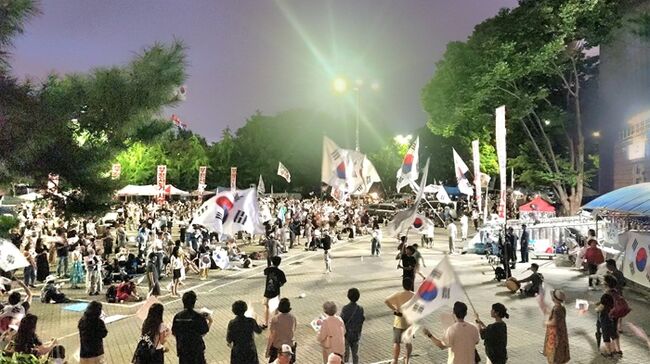 [Kim Jae-soo Column] "What is the ruling party so afraid of?"... The reason why the opposition-recommended special counsel must be implemented
"Members of the National Assembly, can you not hear the calls for 'reruns of fraudulent elections and manual counting of same-day ballots' that have been echoing at Olympic Park for nearly two months?
[Kim Jae-soo Column] "What is the ruling party so afraid of?"... The reason why the opposition-recommended special counsel must be implemented
"Members of the National Assembly, can you not hear the calls for 'reruns of fraudulent elections and manual counting of same-day ballots' that have been echoing at Olympic Park for nearly two months?
 [Photo] Evidence of Election Fraud Flooding U.S. Media… Trump Had 2.7 Million Votes Stolen
 [Video] U.S. Semiquincentennial Air Show... 'Art in the Sky' streaks across New York
 [Editorial Cartoon] A Draconian Law That Undermines Freedom of Expression

 List
List