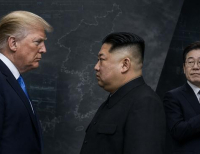
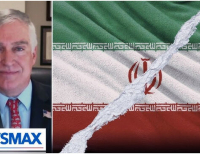
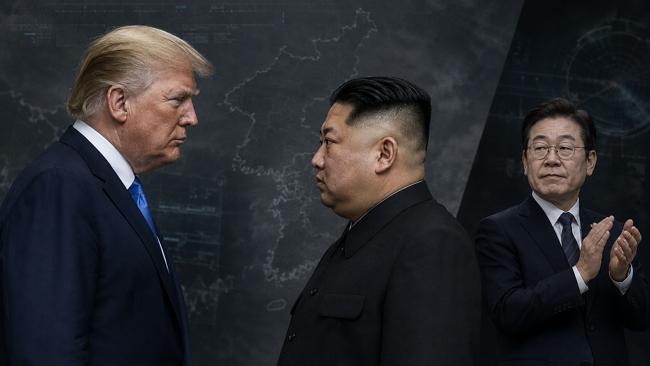
 As direct negotiations between the North Korean and U.S. leaders are being pushed forward, Lee Jae-myung has praised the reduction of South Korea-U.S. joint military drills as a "decision for peace." The image depicts Lee Jae-myung applauding from the sidelines of the face-to-face dynamic between Trump and Kim Jong-un. [Photo = Hanmi Ilbo Graphic]North Korea-U.S. summit diplomacy, which had been at a standstill, has begun to move again. Yet, the Republic of Korea is nowhere to be seen at the center of it.
North Korea has not responded to the repeated dialogue proposals from the Lee Jae-myung administration. When Lee praised the reduction of South Korea-U.S. joint military drills as Trump's effort for peace on the Korean Peninsula, Kim Yo-jong attacked it as a "duplicitous attitude." However, she refrained from criticizing Trump personally, leaving the door to potential communication between the North Korean and U.S. leaders slightly ajar.
Trump’s moves are in the opposite direction. He has publicly stated his intention to meet with Kim Jong-un within this year, and there are developments in the U.S. toward making a summit happen as early as this fall.
While the door between Seoul and Pyongyang remains closed, a direct channel for inter-leader transactions between Washington and Pyongyang seems to be reopening. It is a revival of the "Tongmi-Bongnam" (dealing with the U.S. while excluding the South) strategy that North Korea has long employed.
Yet, Lee Jae-myung has welcomed the reduction of the joint drills, calling it "Trump’s decision for the sake of peace on the Korean Peninsula." He even stated that he would play the role of a "pacemaker" to assist Trump’s "peacemaker" activities.
There is no reason to oppose North Korea-U.S. dialogue. The problem is whether we should be applauding in the name of "peace" while a situation of Tongmi-Bongnam, which excludes the Republic of Korea, is becoming a reality.
North Korea bypassing Seoul is nothing new
It is not a new development for Kim Jong-un to try to exclude South Korea and deal directly with the U.S.
What we need to examine now is not North Korea’s intentions.
It is why we have reached a situation where even the U.S. does not seem to feel any necessity to include the Republic of Korea.
Trump’s distrust of South Korea’s liberal government did not originate with the Lee Jae-myung administration.
During the Moon Jae-in administration, Trump was at odds with Seoul over North Korea policy, mediation between the North and the U.S., and defense cost-sharing. After leaving office, he publicly criticized Moon as a weak leader and negotiator, and expressed frustration that South Korea did not contribute enough to the costs of U.S. military protection.
It is true that the Moon Jae-in government played a role in opening the gate for North Korea-U.S. summit diplomacy. However, the 2019 Hanoi summit collapsed, and denuclearization negotiations stalled. In the meantime, North Korea continued to expand its nuclear and missile capabilities.
This experience can be seen as the background that left Trump with distrust regarding the North Korean mediation capabilities and alliance views of South Korea's liberal governments.
On top of this, the Lee Jae-myung administration's response to the Iran situation has emerged as a new factor of conflict.
From the distrust accumulated during the Moon era to the Iran conflict
On the 16th, Trump publicly revealed that South Korea had rejected a U.S. request for support in military actions related to Iran.
The South Korean government countered that the expression "No thanks" attributed to Trump was not factual. However, the crux of the matter is not the exact wording Lee used.
It is the fact that Trump perceived Lee’s response as a de facto rejection of an ally's request for military cooperation.
The next day, Trump again brought up the South Korean response, raising the issue of reciprocity in the alliance, asking why South Korea does not help the U.S. when the U.S. helps South Korea.
And he did not stop at words.
Trump linked South Korea’s response on Iran, the costs of joint South Korea-U.S. military drills, and his relationship with Kim Jong-un in a single narrative, then ordered a drastic reduction of the joint drills.
This does not mean South Korea should unconditionally participate in America's wars. The President of the Republic of Korea can reject U.S. demands in consideration of South Korea’s national interest, domestic law, and military conditions.
However, diplomacy does not end with a refusal. One must calculate what kind of counteraction such a choice will have on the other party’s alliance policy and the security of the Republic of Korea.
In particular, Trump is a president who views alliances through the lenses of cost, contribution, and reciprocity.
While asserting that the U.S. nuclear umbrella, U.S. Forces Korea, and the South Korea-U.S. combined defense posture are essential to South Korean security, the administration kept its distance when the U.S. requested the ally's role in its own security issues. If they failed to calculate that Trump might perceive this as an "alliance that only seeks the U.S. when it needs to," it is difficult to be free from criticism of diplomatic misjudgment.
This is why critics say that the Lee Jae-myung administration's difference in perception regarding alliance reciprocity has been superimposed on the conflicts over North Korean mediation and defense cost-sharing that accumulated during the Moon Jae-in administration.
The consequences appeared quickly.
The Ulchi Freedom Shield (UFS) drill was shortened from the original 11-day schedule to 5 days. Some field maneuvers were also reduced. Foreign Minister Cho Tae-yul stated in the National Assembly that neither the South Korean government nor U.S. government officials were aware of Trump's initial order to reduce the drills in advance. However, the actual shortening of the schedule was decided after consultations between the South Korean and U.S. military authorities following Trump’s public order.
And Trump moved on to pushing for direct talks with Kim Jong-un.
North Korea originally intended to bypass Seoul. If the U.S. also sees no reason to go through Seoul, what remains is "North Korea-U.S. dialogue without South Korea."
America’s North Korean nuclear threat is not the same as South Korea’s
If this were merely "Lee Jae-myung passing," it could end as a matter of diplomatic face.
However, the North Korean nuclear issue is different.
The Republic of Korea is the party most directly threatened by North Korea's nuclear weapons.
If Trump and Kim Jong-un meet and succeed in securing a suspension of nuclear testing, a limit on nuclear material production, or a freeze and reduction of Intercontinental Ballistic Missiles (ICBMs), it would be a clear achievement.
However, the threats that the U.S. and the Republic of Korea need to eliminate most urgently from North Korea’s arsenal are not necessarily the same.
For the U.S., the key threat is nuclear-tipped ICBMs capable of striking the U.S. mainland. South Korea is within the range of North Korean nuclear weapons even without ICBMs. Short-range ballistic missiles and tactical nuclear weapons alone can directly threaten Seoul and major military facilities.
Defense Minister Ahn Gyu-baek mentioned at the National Assembly on the 20th that domestic research institutes estimate North Korea’s nuclear arsenal at 80 to 120 units. However, he premised this by saying there were limitations in confirming the exact quantity.
Therefore, what South Korea should be looking at is not the holding of a North Korea-U.S. summit itself.
The key is how North Korean nuclear weapons and missiles aimed at the Republic of Korea are treated at that table.
Even if Trump succeeds in containing North Korea’s nuclear threat to the U.S. mainland, if the nuclear assets aimed at South Korea remain intact, a negotiation that is a success for the U.S. could be an incomplete security deal for the Republic of Korea.
Moreover, South Korea-U.S. joint military drills have already been significantly reduced due to Trump's political decisions. One cannot conclude that the combined defense posture will collapse due to this single reduction.
But the situation changes entirely if joint drills become a recurring bargaining chip for North Korea-U.S. negotiations while the nuclear threat aimed at South Korea remains untouched.
What South Korea must assess is not whether North Korea-U.S. dialogue is held, but whether the Republic of Korea's security is excluded from that dialogue.
Where did the "autonomy" you so loudly proclaimed go?
Here arises another problem that the Lee Jae-myung administration must answer.
South Korea’s liberal government has long emphasized "autonomy" (Jaju). They pushed for self-reliant defense in the transfer of wartime operational control and emphasized the resolution of Korean Peninsula issues by the parties directly involved (North and South Korea) in inter-Korean relations.
However, the current situation is the exact opposite.
Inter-Korean dialogue has been severed.
North Korea is attempting to deal directly with the U.S.
Trump ordered the reduction of South Korea-U.S. military drills without sufficient prior coordination with the South Korean government.
Even the future direction of North Korea’s nuclear issue and the security order on the Korean Peninsula is increasingly being dictated by the summit diplomacy between Trump and Kim Jong-un.
Yet, the President of the Republic of Korea is welcoming this as a "decision for peace."
If, while shouting for autonomy on the issue of wartime operational control, one actually leaves the decision-making power over North Korean nuclear weapons and peace on the Korean Peninsula to the U.S. and North Korea, where did that "autonomy" you so loudly proclaimed go?
Lee Jae-myung applauds because he has cast himself as a "pacemaker" for North Korea-U.S. dialogue. His vision is to help ensure that confidence-building and the resumption of dialogue between the North and the U.S. lead to the establishment of a peace regime on the Korean Peninsula.
However, if the "pacemaker" is excluded from the actual path of negotiations and the setting of the finish line, it is closer to "rubber-stamp diplomacy" than mediation diplomacy.
If North Korea-U.S. dialogue succeeds in substantially reducing North Korea’s nuclear and missile capabilities and lowering the risk of war, it is also in the interest of the Republic of Korea. Naturally, it should be welcomed.
However, the role of the President of the Republic of Korea does not end with applauding.
The priority is how to reflect the Republic of Korea’s interests in the North Korea-U.S. negotiations, how to include the North Korean nuclear assets aimed at South Korea in the scope of negotiations, and how to prevent the South Korea-U.S. combined defense posture from becoming a recurring concession card for North Korea-U.S. negotiations.
It is North Korea's choice to exclude South Korea.
It is America's choice for Trump to deal directly with Kim Jong-un.
But maintaining the Republic of Korea's place in the midst of it all is the responsibility of the President of the Republic of Korea.
If South Korea's standing has narrowed due to a failure to manage the distrust accumulated during the Moon Jae-in administration and the exposure of a gap regarding alliance reciprocity in the Iran issue, one cannot simply blame Kim Jong-un's Tongmi-Bongnam or Trump's impulsive actions.
It is easy to applaud North Korea-U.S. dialogue.
The moment Tongmi-Bongnam becomes reality, what the President of the Republic of Korea needs is not applause, but diplomacy that protects the Republic of Korea’s position and security.

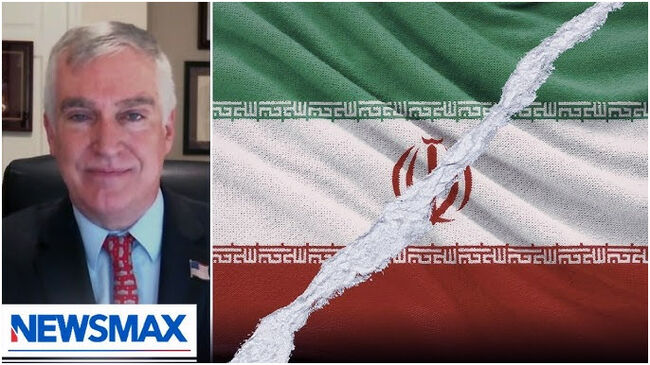 Flights: Iran "Will Begin to Collapse Within 30 to 60 Days"
Fred Fleitz, a former national security official in the Donald Trump administration, said Thursday that the Iranian government could collapse within weeks under the pressure of new U.S. sanctions, as
Flights: Iran "Will Begin to Collapse Within 30 to 60 Days"
Fred Fleitz, a former national security official in the Donald Trump administration, said Thursday that the Iranian government could collapse within weeks under the pressure of new U.S. sanctions, as
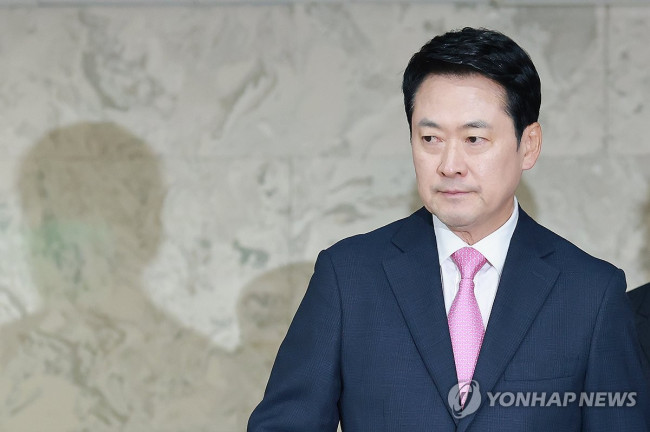 People Power Party slams ruling party's push for "Cho Hee-dae's resignation," calling it "judicial abuse rhetoric and kangaroo court proceedings"
People Power Party Representative Jang Dong-hyeok attending a forum evaluating the second year of the Lee Jae-myung administration [Seoul=Yonhap News]On the 21st, the People Power Party once again cri
People Power Party slams ruling party's push for "Cho Hee-dae's resignation," calling it "judicial abuse rhetoric and kangaroo court proceedings"
People Power Party Representative Jang Dong-hyeok attending a forum evaluating the second year of the Lee Jae-myung administration [Seoul=Yonhap News]On the 21st, the People Power Party once again cri
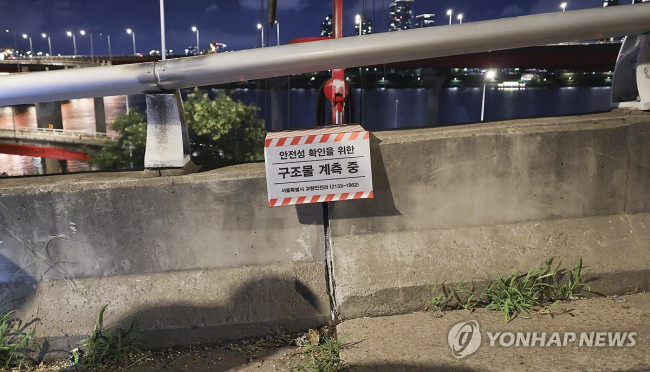 Seoul Metropolitan Government: "Conclusion Reached That Seongsu Bridge Height Difference Poses No Safety Risk... Preemptive Reinforcement Measures to Be Taken"
Monitoring notice board installed on the Seongsu Bridge ramp where a "step difference" occurred. A monitoring-related notice board was installed on the B-ramp at the southern end of Seongsu Bridge in
Seoul Metropolitan Government: "Conclusion Reached That Seongsu Bridge Height Difference Poses No Safety Risk... Preemptive Reinforcement Measures to Be Taken"
Monitoring notice board installed on the Seongsu Bridge ramp where a "step difference" occurred. A monitoring-related notice board was installed on the B-ramp at the southern end of Seongsu Bridge in
 Hyundai Motor Union stages first full-scale strike in 10 years… All plants 'come to a halt'
The Hyundai Motor Company labor union (Hyundai Motor branch of the Korean Metal Workers' Union) launched a full-scale strike on the 21st due to difficulties in this year's wage negotiations.This marks
Hyundai Motor Union stages first full-scale strike in 10 years… All plants 'come to a halt'
The Hyundai Motor Company labor union (Hyundai Motor branch of the Korean Metal Workers' Union) launched a full-scale strike on the 21st due to difficulties in this year's wage negotiations.This marks
 [Park Myung-mi's Kyushu Travel] ② Kaiseki Cuisine, Eating a Garden in a Bowl
When you first encounter kaiseki cuisine, it can feel like playing house. The dishes are small, yet there are so many of them. When I first came to Japan, the food that truly moved me was a cours
[Park Myung-mi's Kyushu Travel] ② Kaiseki Cuisine, Eating a Garden in a Bowl
When you first encounter kaiseki cuisine, it can feel like playing house. The dishes are small, yet there are so many of them. When I first came to Japan, the food that truly moved me was a cours
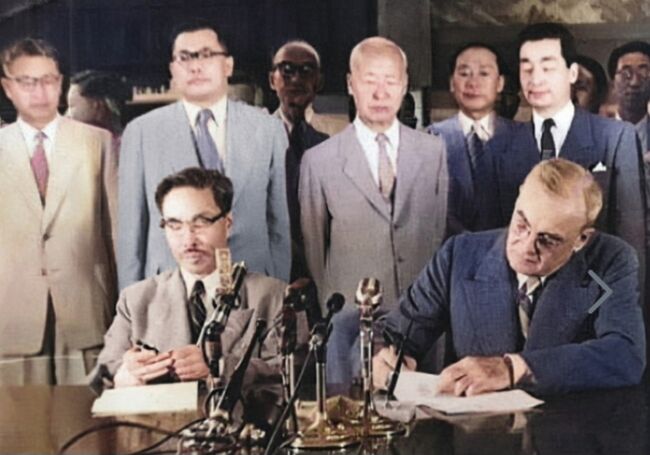 [Shin Dong-chun Column] The History of Korea-U.S. Relations and the ROK-U.S. Alliance
The 1954 signing ceremony of the Mutual Defense Treaty Between the United States and the Republic of Korea. A moment when President Syngman Rhee’s perseverance bore fruit.1. The Encounter and Genesi
[Shin Dong-chun Column] The History of Korea-U.S. Relations and the ROK-U.S. Alliance
The 1954 signing ceremony of the Mutual Defense Treaty Between the United States and the Republic of Korea. A moment when President Syngman Rhee’s perseverance bore fruit.1. The Encounter and Genesi
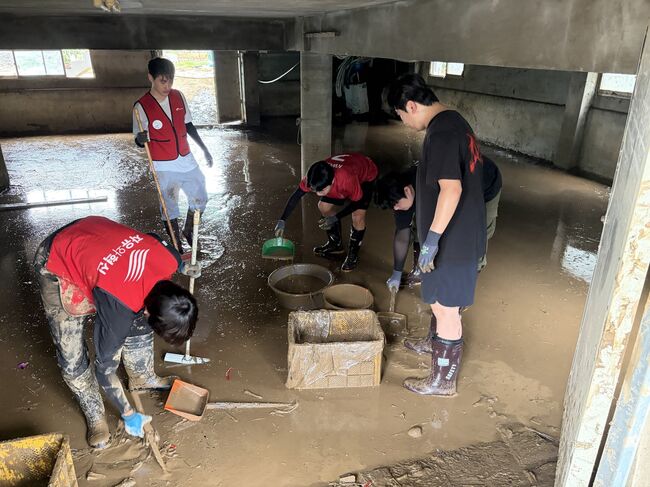 [Photo] Liberty and Innovation Geoje Flood Recovery Support
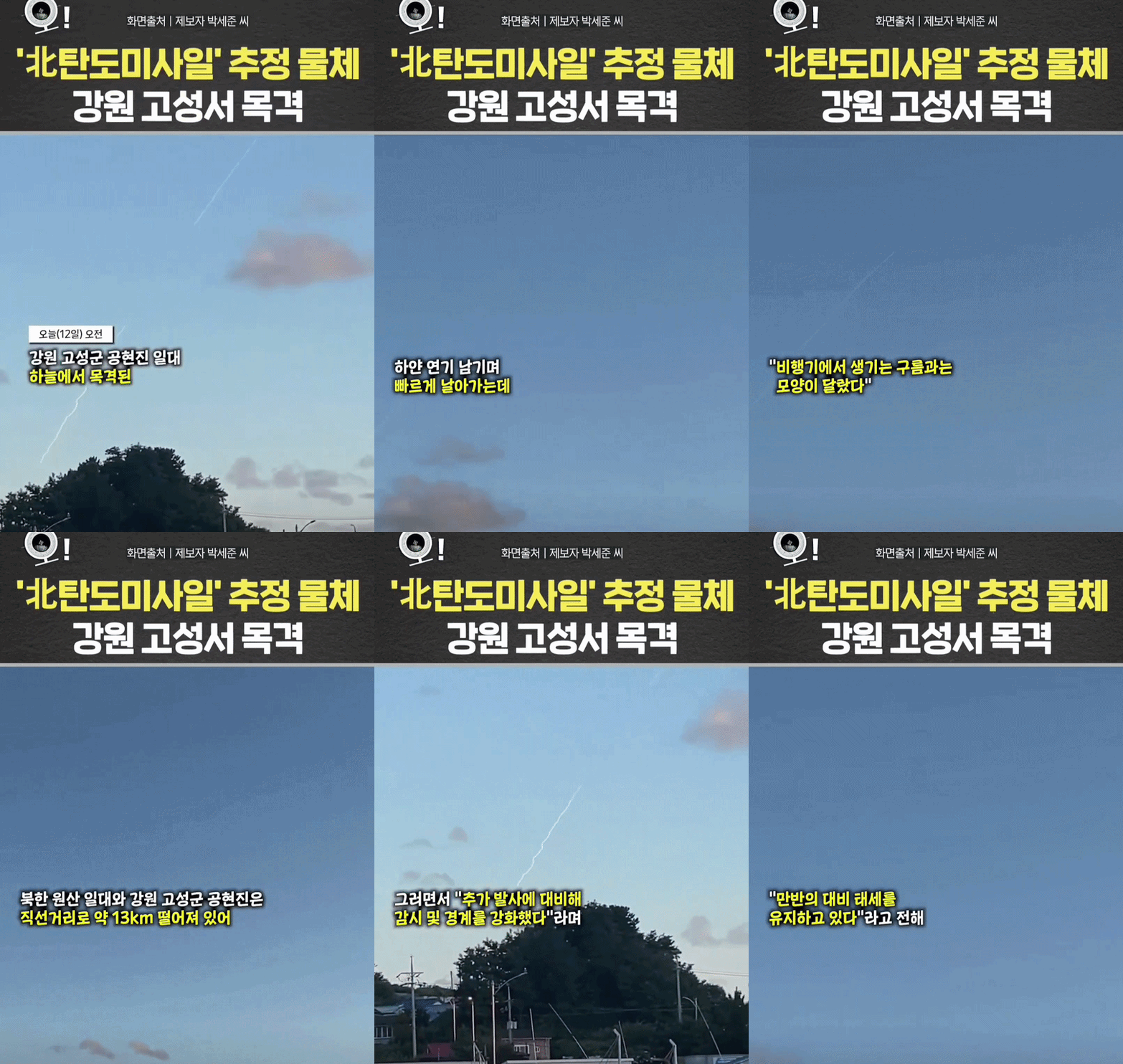 [Video] North Korean ballistic missile filmed by a civilian in Goseong, Gangwon-do
 [Editorial Cartoon] A Draconian Law That Undermines Freedom of Expression

 List
List