Lee Jae-myung presiding over a meeting of senior secretaries at the Blue House on the 20th. In a survey commissioned by the Energy Economy News and conducted by Realmeter from the 18th to the 21st, negative assessment of state affairs performance was 56.9%, while positive assessment was 40.2%. The gap between positive and negative assessments widened to 16.7 percentage points. [Photo=Yonhap News / Graphic=Hanmi Ilbo] The negative assessment of Lee Jae-myung's handling of state affairs has risen to 56.9%. This figure indicates that nearly 6 out of 10 citizens disapprove of his performance.
The notable aspect of this survey is not just that the positive assessment fell to 40.2%. It is the fact that the negative assessment has accumulated for six consecutive weeks, and that the trend is showing signs of spreading beyond conservative and elderly voters to include those in the Honam region and those in their 30s and 50s.
According to the survey results of 2,026 voters aged 18 and older nationwide, commissioned by the Energy Economy News and conducted by Realmeter from the 18th to the 21st, Lee Jae-myung's positive assessment for state affairs stood at 40.2%, down 2.8 percentage points from the previous week. The negative assessment rose by the same margin to 56.9%.
The gap between the positive and negative assessments is 16.7 percentage points, which is outside the margin of error. Those who responded "don't know" stood at only 3.0%. This indicates that it was not an expansion of undecided voters, but rather a simultaneous decline in positive assessments and an increase in negative assessments.
Daily positive assessment already in the 30% range
More noteworthy than the weekly average is the daily trend.
The positive assessment, which was 42.3% on the 14th, the last day of the previous week's survey, fell to 41.5% on the 19th and further dropped to 38.7% on the 20th. Although it saw a slight rise to 39.0% on the 21st, it failed to recover the 40% threshold.
The weekly average of 40.2% reflects the relatively higher figures from the beginning of the survey period. During the last two days of the survey, the positive assessment remained in the 30% range. While it remains to be seen in the next survey whether this is a temporary fluctuation due to short-term adverse factors or a solidification of the collapse of the 40% threshold, it is difficult to see the downward pressure as having weakened.
Moreover, the decline in positive assessment has continued for six consecutive weeks. This is closer to a trend of accumulated dissatisfaction with overall government operations than to a reaction to one or two sudden incidents.
President and Democratic Party ratings drop simultaneously in Honam
By region, the most significant change occurred in Gwangju, South Jeolla, and North Jeolla. The president's positive assessment in this region fell by 8.8 percentage points from the previous week. It also fell by 3.1 percentage points in Daegu/Gyeongbuk, 2.7 percentage points in Daejeon/Sejong/Chungcheong, and 2.3 percentage points in Incheon/Gyeonggi.
The change in Honam was also reflected in the political party approval rating survey. In a survey of 1,009 voters conducted on the 20th and 21st, the Democratic Party's approval rating in Gwangju, South Jeolla, and North Jeolla plummeted by 21.2 percentage points compared to the previous week. Conversely, the People Power Party’s rating in the same region rose by 10.1 percentage points.
Since the regional sample size is smaller than the total sample, it is impossible to conclude that "Honam public sentiment has turned" based on just one week's large fluctuation. In particular, the political party approval survey also had a total sample of only 1,009, leading to greater volatility in regional figures.
Nevertheless, the fact that the president's positive assessment and the Democratic Party's approval rating both fell sharply in Honam simultaneously is difficult to overlook. Rather than assuming that Honam voters have completely shifted to supporting the People Power Party, it is more reasonable to view this as them delivering a warning to the government and the Democratic Party, with some seeking alternatives.
If the same trend continues in the next survey, it will be necessary to investigate the possibility of cracks in the core support base, beyond mere sample fluctuations.
Decline in 30s and 50s more painful than in 70s
By age group, the president's positive assessment fell by 8.2 percentage points among those aged 70 and older. It dropped by 4.7 percentage points among those in their 50s, 4.4 percentage points for those in their 30s, and 2.4 percentage points for those in their 20s. Conversely, it rose by 3.2 percentage points among those in their 60s.
Realmeter analyzed that the defection of conservative voters and the elderly aged 70 and older has expanded. However, it is difficult to explain these results solely by the consolidation of the conservative elderly vote.
The change among those in their 30s was particularly notable. In the party approval survey, the Democratic Party’s support among those in their 30s fell by 8.7 percentage points, while the People Power Party’s rose by 12.2 percentage points. The decline in the president's positive assessment and the change in party approval ratings occurred in the same direction.
Those in their 30s are sensitive to housing prices, loans, wealth accumulation, job security, and tax issues. It is possible that the controversy over housing supply in Yongsan Park and distrust in real estate policies influenced this generation's assessment. However, as this survey did not directly ask for the reasons behind the approval rating changes, a causal relationship between individual issues and the numerical changes cannot be confirmed.
The decline among those in their 50s is also a burden on the government and the ruling party. Those in their 50s are one of the core age groups that have sustained the relative advantage of the Democratic Party. The 4.7 percentage point drop in the president's positive assessment in this age group shows the potential for negative public opinion to spread outside of traditional opposition groups.
However, the published press release presented the increase and decrease of positive assessments, not the increase and decrease of negative assessments by region and age. Therefore, it should not be interpreted that the entire decline in positive assessments among detailed groups has shifted to negative assessments.
Democratic Party drops more sharply than the President
While the president's positive assessment fell by 2.8 percentage points, the Democratic Party's approval rating recorded 41.9%, a drop of 6.0 percentage points. The People Power Party’s stood at 37.6%, up 4.5 percentage points. The gap between the two parties narrowed to 4.3 percentage points, falling within the margin of error.
In effect, the defection from the Democratic Party was larger than the assessment of the president himself. Realmeter analyzed that the end of the convention effect following the party leadership election, the controversy over housing supply in Yongsan Park, and intra-party conflict over the appointment of designated supreme council members by the Kim Min-seok leadership influenced the decline in the Democratic Party's approval rating.
Although the Democratic Party is in a position to defend against the decline in the president's approval rating, its own party approval rating fell even faster. If a structure is formed where the president and the ruling party cannot prevent each other's decline and instead exert negative influence on one another, the pace of the weakening of governance momentum may accelerate.
However, it is too early to conclude that the rise in the People Power Party's approval rating is an independent expansion. Whether it is the result of persuading moderate voters through new policies or visions, or a reflexive absorption of those defecting from the government and ruling party, remains to be seen in follow-up surveys.
Real estate, judicial conflict, and security concerns overlap
Realmeter viewed the decline as a complex interaction of factors: distrust in real estate policy due to the Yongsan Park housing supply controversy, ruling-opposition conflict over Chief Justice of the Supreme Court Cho Hee-dae’s written recommendation and constitutional amendments, and security anxieties due to the scaling back of South Korea-U.S. joint military drills.
These issues are connected to concerns over livelihoods and assets, the exercise of power and the rule of law, and trust in diplomatic and security lines, respectively. However, this survey did not measure how much each individual issue moved the approval ratings. It should be interpreted at the level that major issues and the decline in approval ratings appeared simultaneously during the survey period.
The rapid fluctuations in Honam may involve sample variability, and the rise of the People Power Party also requires further verification to see if it is merely a reflected benefit. However, a negative assessment of 56.9%, six consecutive weeks of decline in positive assessments, and a 16.7 percentage point gap between positive and negative assessments are difficult to explain as a mere temporary adjustment.
The point the government and the ruling party should be especially wary of is the signs of defection appearing simultaneously in the Honam region and among those in their 30s and 50s, rather than the consolidation of the existing opposition.
This survey on the president's performance was conducted using a 100% wireless automated response system with a response rate of 3.2% and a sampling error of ±2.2 percentage points at the 95% confidence level. The response rate for the political party approval survey was 2.9%, with a sampling error of ±3.1 percentage points at the 95% confidence level. Further details can be found on the National Election Survey Deliberation Commission website.

 [Statement by the Seo-beo-kka Korea Military Academy Patriotic Comrades Association] ㊷ We Condemn the Ruling Party Leader's Intimidation and Mockery of Supreme Court Justices, and Acts of Destroying the Judiciary
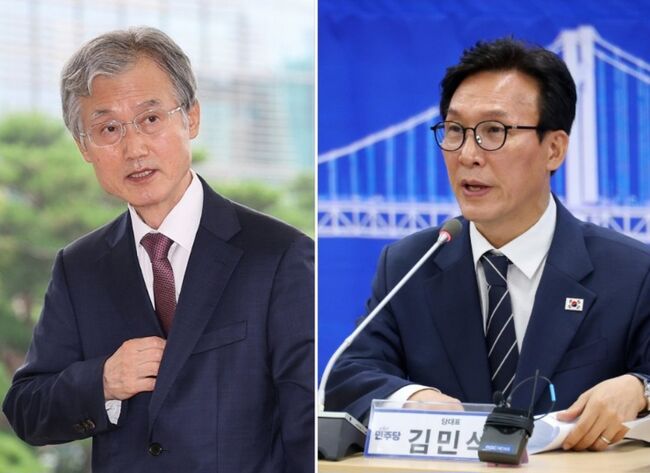
Chief Justice of the Supreme Court Cho Hee-de (left) and Democratic Party of Korea Leader Lee Jae-myung [Photo=Yonhap News]We are witnessing an unprecedented situation where the newly inaugurated lead
[Statement by the Seo-beo-kka Korea Military Academy Patriotic Comrades Association] ㊷ We Condemn the Ruling Party Leader's Intimidation and Mockery of Supreme Court Justices, and Acts of Destroying the Judiciary
Chief Justice of the Supreme Court Cho Hee-de (left) and Democratic Party of Korea Leader Lee Jae-myung [Photo=Yonhap News]We are witnessing an unprecedented situation where the newly inaugurated lead
 Criticizing Trump, yet… Europe also backsliding on climate change response
Greenpeace, an environmental organization calling for renewable energy policies [EPA=Yonhap News file photo]European nations, which previously criticized U.S. President Donald Trump's rollback of clim
Criticizing Trump, yet… Europe also backsliding on climate change response
Greenpeace, an environmental organization calling for renewable energy policies [EPA=Yonhap News file photo]European nations, which previously criticized U.S. President Donald Trump's rollback of clim
 PPP on Nomination of 'Ruling Party-Recommended' Special Inspector Candidate: "We Will Rigorously Verify Them at the Hearing"
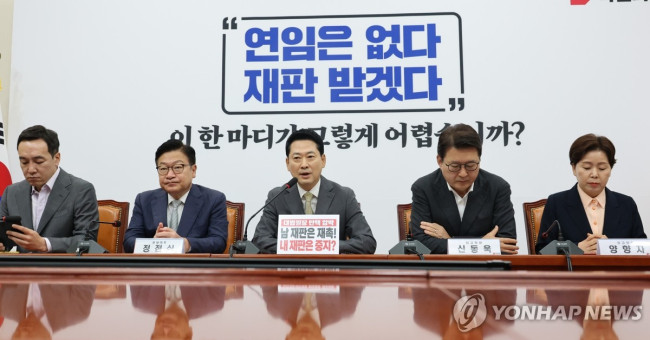
People Power Party representative Jang Dong-hyeok is speaking at the Supreme Council meeting held at the National Assembly on the 24th. [Yonhap News] On the 24th, the People Power Party stated th
PPP on Nomination of 'Ruling Party-Recommended' Special Inspector Candidate: "We Will Rigorously Verify Them at the Hearing"
People Power Party representative Jang Dong-hyeok is speaking at the Supreme Council meeting held at the National Assembly on the 24th. [Yonhap News] On the 24th, the People Power Party stated th
 [Comprehensive] Another body of a missing person discovered in Jeju… 4th in three days
Police conducting an intensive search for missing persons [Yonhap News file photo]Recently, bodies suspected to be those of missing persons have been discovered in succession on Jeju Island. This mark
[Comprehensive] Another body of a missing person discovered in Jeju… 4th in three days
Police conducting an intensive search for missing persons [Yonhap News file photo]Recently, bodies suspected to be those of missing persons have been discovered in succession on Jeju Island. This mark
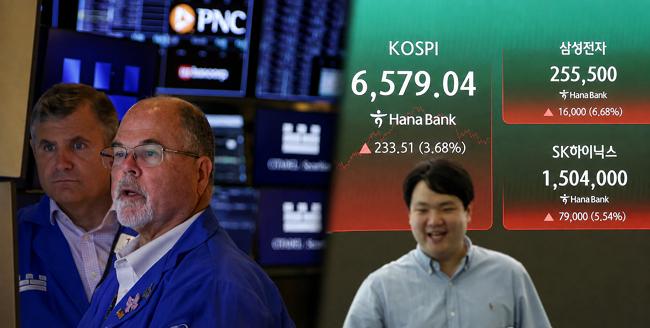 [Korea-US Data Lab] 3rd Week of August (18th–21st) Money Insight
In the U.S., rising long-term Treasury yields lowered the future cash value of tech stocks, while in Korea, shareholder returns from Samsung Electronics and SK Hynix drove a rebound in major semicondu
[Korea-US Data Lab] 3rd Week of August (18th–21st) Money Insight
In the U.S., rising long-term Treasury yields lowered the future cash value of tech stocks, while in Korea, shareholder returns from Samsung Electronics and SK Hynix drove a rebound in major semicondu
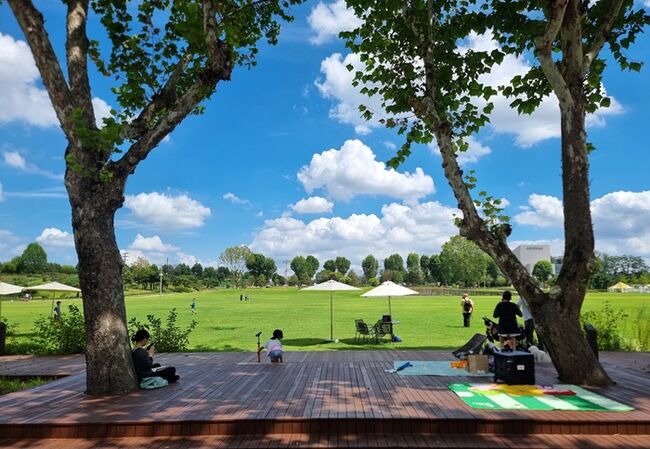 [Trending Travel Destinations] Unlocking a Century of Secrets: ‘Yongsan Children’s Garden’
Family visitors resting in the shade on a picnic mat. [Photo by Reporter Yohi Lim]Throughout history, the wealthy in both the East and the West have enjoyed greenery by creating private gardens on vas
[Trending Travel Destinations] Unlocking a Century of Secrets: ‘Yongsan Children’s Garden’
Family visitors resting in the shade on a picnic mat. [Photo by Reporter Yohi Lim]Throughout history, the wealthy in both the East and the West have enjoyed greenery by creating private gardens on vas
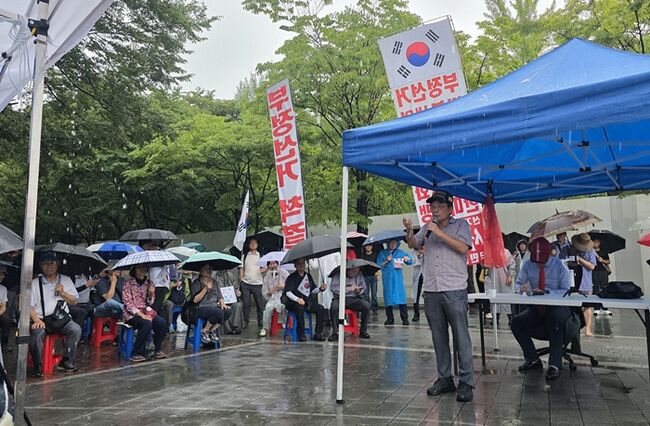 [Photo] Btooyun “We are recruiting 1,600 members for the Olympic Park Scientific Verification Team”… The rainy scenery of Olympic Park on the 22nd
On Saturday the 22nd, amid rainy weather at Olympic Park, the National Coalition for Election Fraud Struggle held a public forum on election integrity. They argued that the "Olympic Park Scientific Ve
[Photo] Btooyun “We are recruiting 1,600 members for the Olympic Park Scientific Verification Team”… The rainy scenery of Olympic Park on the 22nd
On Saturday the 22nd, amid rainy weather at Olympic Park, the National Coalition for Election Fraud Struggle held a public forum on election integrity. They argued that the "Olympic Park Scientific Ve
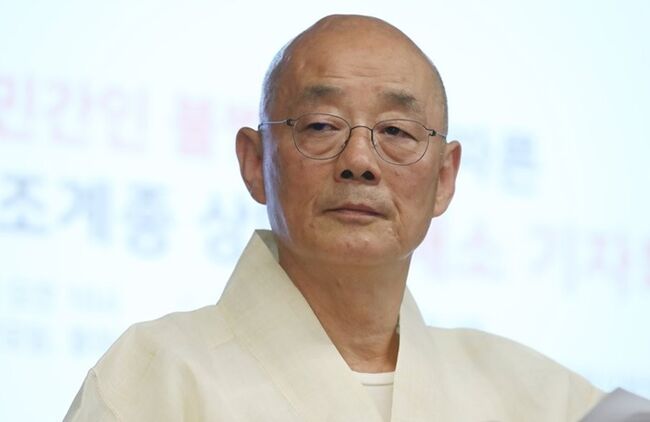 [Special Contribution: Songsan] The Life of a Political Monk Must Also Be Evaluated… What the Passing of Venerable Myeongjin Leaves Behind
Venerable Myeongjin, former head monk of Bongeunsa Temple, passed away on the 22nd. He was 76 years old and had been a monk for 52 years. [Yonhap News File Photo]Various narratives are emerging follow
[Special Contribution: Songsan] The Life of a Political Monk Must Also Be Evaluated… What the Passing of Venerable Myeongjin Leaves Behind
Venerable Myeongjin, former head monk of Bongeunsa Temple, passed away on the 22nd. He was 76 years old and had been a monk for 52 years. [Yonhap News File Photo]Various narratives are emerging follow
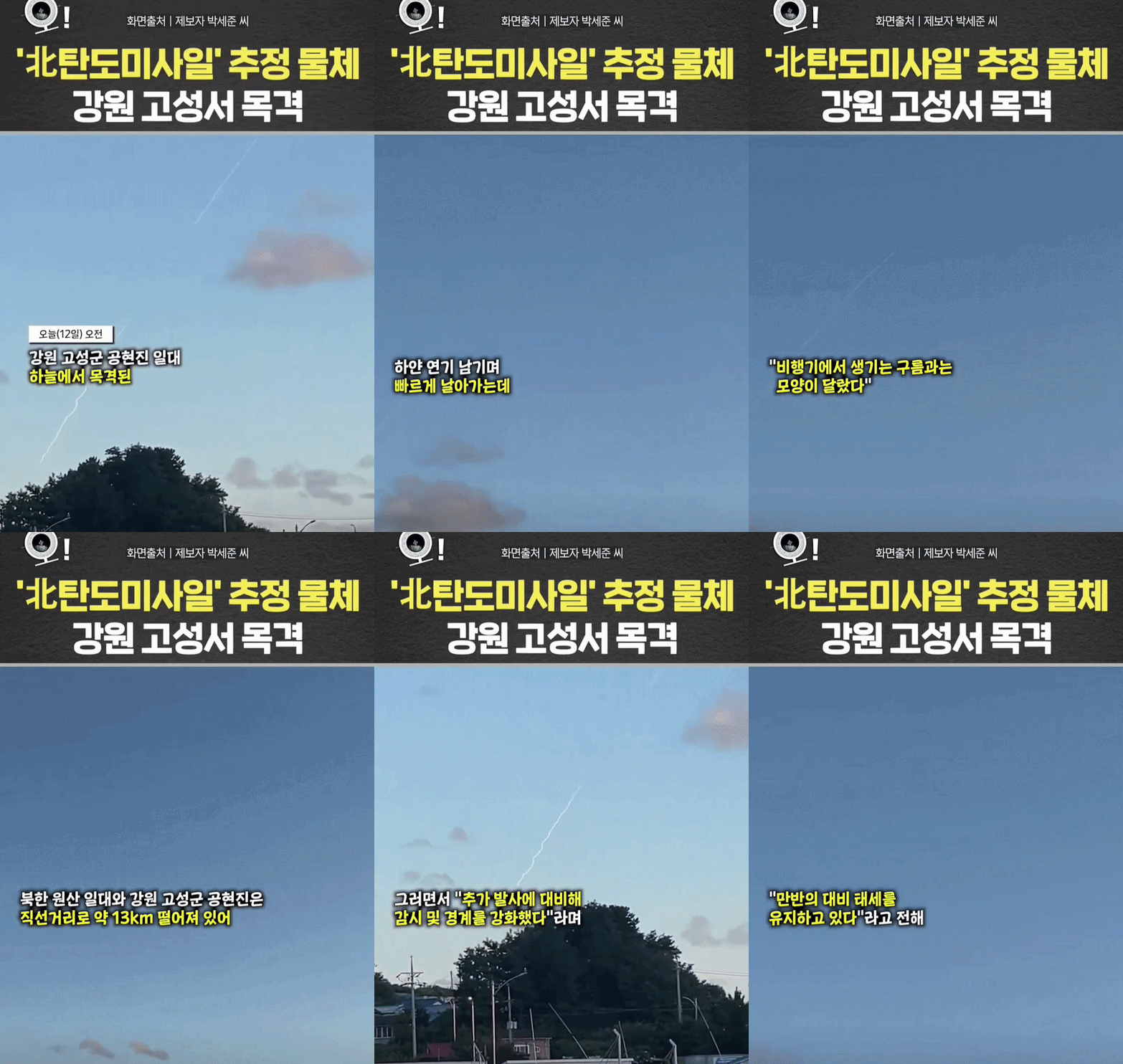 [Video] North Korean ballistic missile filmed by a civilian in Goseong, Gangwon-do
 [Editorial Cartoon] A Draconian Law That Undermines Freedom of Expression

 List
List