- Rising energy costs lead to the withdrawal or reduction of renewable energy targets
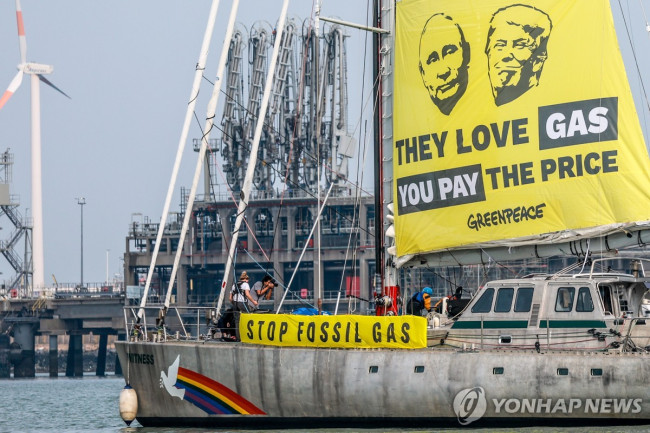 Greenpeace, an environmental organization calling for renewable energy policies [EPA=Yonhap News file photo]
European nations, which previously criticized U.S. President Donald Trump's rollback of climate policies, are now lowering their own climate targets one after another in the face of backlash over rising energy costs and other issues.
According to The Wall Street Journal (WSJ) on the 23rd (local time), governments and energy companies in Europe, including those in Germany and the UK, are easing existing climate policies or scaling back renewable energy development goals.
The German government, Europe's largest economy, has reduced taxes and fees intended to fund renewable energy subsidies amid growing complaints that stagnant economic growth is linked to having some of the world's most expensive electricity rates.
The German parliament also rescinded a mandate that required households to install expensive renewable energy heating systems, allowing for the continued use of oil and gas heating.
The UK, which banned exploratory drilling last year, is now moving toward allowing new oil production in the North Sea, the WSJ reported.
The European Union (EU) has proposed relaxing its carbon pricing system—which aims to reduce emissions by putting a price on greenhouse gas output—and is considering measures to allow automakers to sell gasoline-powered vehicles for a longer period.
European energy companies that once promoted their renewable energy targets are also shifting their existing strategies.
British energy firms Shell and BP have withdrawn or lowered their targets for building renewable energy-related facilities. Shell abandoned plans to build a biofuel plant in the Netherlands, while BP slashed its annual project investment for the transition to eco-friendly energy by more than 70%.
Equinor, the Norwegian state-owned oil and gas company, also abandoned its goal of creating 10–12 GW (gigawatts) of renewable energy by 2030.
This shift in policy in Europe follows criticism that renewable energy policies have driven up energy costs, thereby undermining the competitiveness of local European businesses and stifling economic growth. Rising frustration among citizens, who must bear the burden of high energy costs, is also cited as a cause for the policy shift.
The war between Russia and Ukraine, which led to a sharp drop in Russian natural gas supplies and fueled energy price hikes, has also contributed to the change in European climate policies.
The Trump administration has pointed to the EU as an example of a "failed green policy" to justify its own rapid shift in climate policy. U.S. Secretary of Energy Chris Wright criticized Europe earlier this year, stating that it has weakened itself through a "climate cult" and has reduced economic opportunities for Europeans by losing jobs to Asia.
Despite such criticism and controversy, there are still voices calling for the continued pursuit of climate policies.
Some energy experts emphasize that while some existing policy goals may have been unrealistic, it is still necessary to pursue climate policies to prevent global temperature rise.
Scientists have also warned that climate change is exacerbating extreme weather events, such as wildfires that turn European forests to ash and severe droughts.
John Browne, former CEO of BP, urged action on climate change, stating, "The decarbonization energy mix policy to eliminate carbon in the atmosphere is not accelerating."
What do you think of this article?

 [Statement by the Seo-beo-kka Korea Military Academy Patriotic Comrades Association] ㊷ We Condemn the Ruling Party Leader's Intimidation and Mockery of Supreme Court Justices, and Acts of Destroying the Judiciary
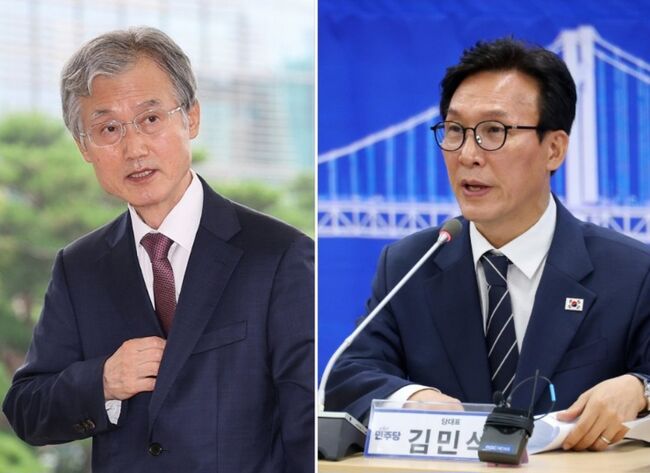
Chief Justice of the Supreme Court Cho Hee-de (left) and Democratic Party of Korea Leader Lee Jae-myung [Photo=Yonhap News]We are witnessing an unprecedented situation where the newly inaugurated lead
[Statement by the Seo-beo-kka Korea Military Academy Patriotic Comrades Association] ㊷ We Condemn the Ruling Party Leader's Intimidation and Mockery of Supreme Court Justices, and Acts of Destroying the Judiciary
Chief Justice of the Supreme Court Cho Hee-de (left) and Democratic Party of Korea Leader Lee Jae-myung [Photo=Yonhap News]We are witnessing an unprecedented situation where the newly inaugurated lead
 PPP on Nomination of 'Ruling Party-Recommended' Special Inspector Candidate: "We Will Rigorously Verify Them at the Hearing"
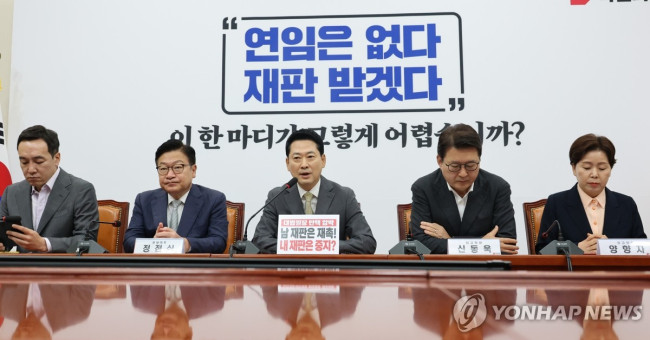
People Power Party representative Jang Dong-hyeok is speaking at the Supreme Council meeting held at the National Assembly on the 24th. [Yonhap News] On the 24th, the People Power Party stated th
PPP on Nomination of 'Ruling Party-Recommended' Special Inspector Candidate: "We Will Rigorously Verify Them at the Hearing"
People Power Party representative Jang Dong-hyeok is speaking at the Supreme Council meeting held at the National Assembly on the 24th. [Yonhap News] On the 24th, the People Power Party stated th
 [Comprehensive] Another body of a missing person discovered in Jeju… 4th in three days
Police conducting an intensive search for missing persons [Yonhap News file photo]Recently, bodies suspected to be those of missing persons have been discovered in succession on Jeju Island. This mark
[Comprehensive] Another body of a missing person discovered in Jeju… 4th in three days
Police conducting an intensive search for missing persons [Yonhap News file photo]Recently, bodies suspected to be those of missing persons have been discovered in succession on Jeju Island. This mark
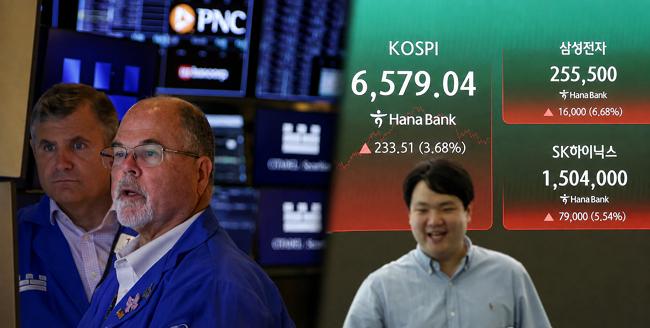 [Korea-US Data Lab] 3rd Week of August (18th–21st) Money Insight
In the U.S., rising long-term Treasury yields lowered the future cash value of tech stocks, while in Korea, shareholder returns from Samsung Electronics and SK Hynix drove a rebound in major semicondu
[Korea-US Data Lab] 3rd Week of August (18th–21st) Money Insight
In the U.S., rising long-term Treasury yields lowered the future cash value of tech stocks, while in Korea, shareholder returns from Samsung Electronics and SK Hynix drove a rebound in major semicondu
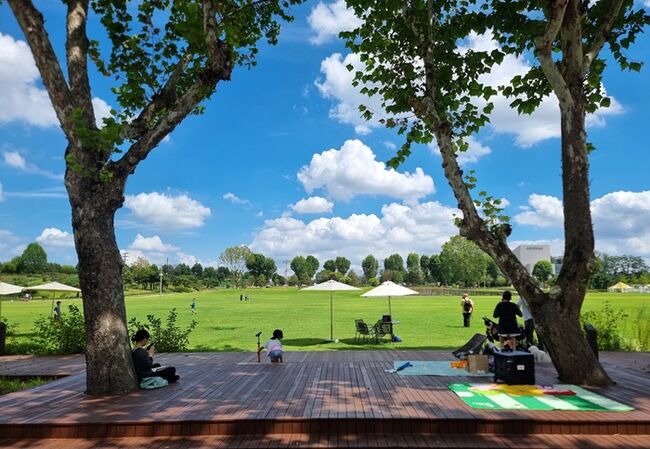 [Trending Travel Destinations] Unlocking a Century of Secrets: ‘Yongsan Children’s Garden’
Family visitors resting in the shade on a picnic mat. [Photo by Reporter Yohi Lim]Throughout history, the wealthy in both the East and the West have enjoyed greenery by creating private gardens on vas
[Trending Travel Destinations] Unlocking a Century of Secrets: ‘Yongsan Children’s Garden’
Family visitors resting in the shade on a picnic mat. [Photo by Reporter Yohi Lim]Throughout history, the wealthy in both the East and the West have enjoyed greenery by creating private gardens on vas
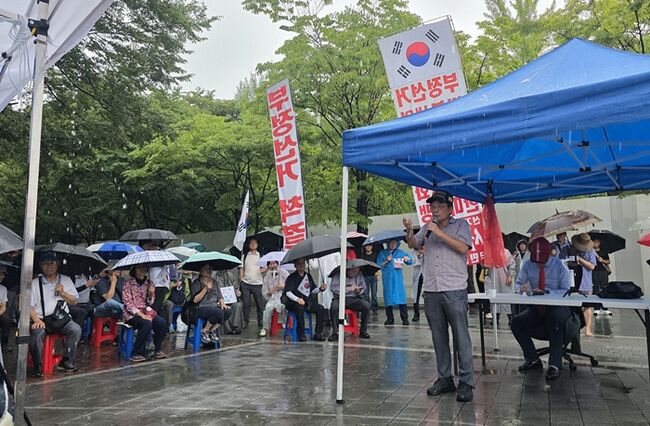 [Photo] Btooyun “We are recruiting 1,600 members for the Olympic Park Scientific Verification Team”… The rainy scenery of Olympic Park on the 22nd
On Saturday the 22nd, amid rainy weather at Olympic Park, the National Coalition for Election Fraud Struggle held a public forum on election integrity. They argued that the "Olympic Park Scientific Ve
[Photo] Btooyun “We are recruiting 1,600 members for the Olympic Park Scientific Verification Team”… The rainy scenery of Olympic Park on the 22nd
On Saturday the 22nd, amid rainy weather at Olympic Park, the National Coalition for Election Fraud Struggle held a public forum on election integrity. They argued that the "Olympic Park Scientific Ve
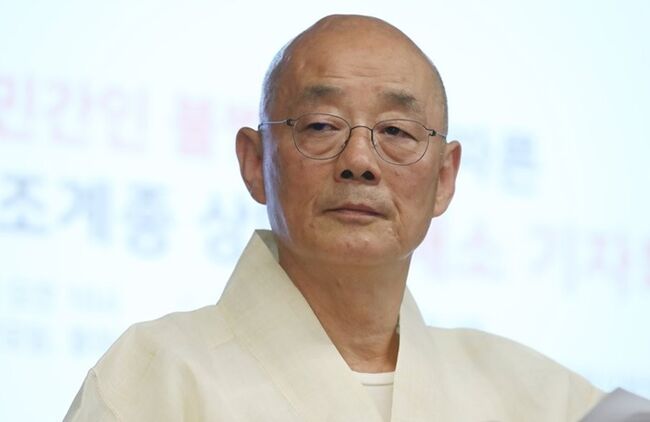 [Special Contribution: Songsan] The Life of a Political Monk Must Also Be Evaluated… What the Passing of Venerable Myeongjin Leaves Behind
Venerable Myeongjin, former head monk of Bongeunsa Temple, passed away on the 22nd. He was 76 years old and had been a monk for 52 years. [Yonhap News File Photo]Various narratives are emerging follow
[Special Contribution: Songsan] The Life of a Political Monk Must Also Be Evaluated… What the Passing of Venerable Myeongjin Leaves Behind
Venerable Myeongjin, former head monk of Bongeunsa Temple, passed away on the 22nd. He was 76 years old and had been a monk for 52 years. [Yonhap News File Photo]Various narratives are emerging follow
 [Video] North Korean ballistic missile filmed by a civilian in Goseong, Gangwon-do
 [Editorial Cartoon] A Draconian Law That Undermines Freedom of Expression

 List
List