Dan-bi Chae (20), who was sexually assaulted while working a part-time job at a pub in Ansan, Gyeonggi Province last December, took her own life after the police decided two months later to close the case without referral, citing "insufficient evidence." [Photo = Screenshot from SBS "Unanswered Questions"]
Whenever the flaws in the system are pointed out in light of the tragedies of a 20-year-old who took their own life out of injustice and a missing person case in Jeju Island, a flood of defensive arguments armed with factional logic inevitably follows.
Arguments such as, "Why bring up the prosecution?", "They're all the same anyway," "If it's unfair, why don't they just use the appeal (objection) system?", and "Why attack the government by linking the past 'complete deprivation of investigative power' with the current abolition of supplementary investigation rights when they are separate issues?" are common.
Putting emotions aside, I intend to explain the timeline and legal truths of this situation as simply and neutrally as possible, so that anyone can truly understand it. I hope you will judge for yourself whether you can still maintain those flimsy defenses after facing these cold, hard facts.
First, the fact is that the past legal system was clearly designed to "consider and protect the victim."
People nowadays casually say that one can just file an objection if they feel wronged, but in the previous system, victims didn't even have to worry about such complex procedures in the first place. This is because, in the past, whenever the police finished an investigation, 100 percent of cases—regardless of whether they resulted in indictment or non-indictment—were automatically transferred to the prosecution.
Even if a victim didn't know the law or how to write a complex objection document, a prosecutor, a state-appointed legal expert, was mandated to cross-check the investigation records and catch any injustices on their own. It was a robust national safety net that prioritized the protection of the weak who lacked money and influence.
However, in January 2020, this victim-centered framework was shattered when the police were granted the power to close cases on their own, under the guise of "adjusting investigative powers." Now, if the police close a case based solely on the perpetrator's account, the victim must personally find a lawyer and navigate complex legal issues to file an objection before the investigative agencies will even reconsider.
The state has stripped away the protective net it was supposed to provide and shifted the massive burden of self-redress onto the individual victim who is already wounded. The reason that 20-year-old took their life in despair before a cold notice of non-referral is precisely because of the hopelessness they felt, realizing that the authorities were no longer on their side.
Second, the argument that the "complete deprivation of investigative power" is unrelated to the current abolition of supplementary investigation rights is sheer ignorance.
These two are not separate events; they are a perfect three-part series designed to dismantle judicial oversight to shield those in power. The politicians who gave the police the authority to bury cases in 2020 used their 180-seat majority to push through the infamous "complete deprivation of investigative power" bills in April and May 2022. At that time, one fatal term was removed from the Criminal Procedure Act: the right of a complainant to file an objection.
In cases where the victim cannot speak for themselves, such as child abuse, crimes against the disabled, or power-related corruption, if a civic group or a third party files a complaint and the police bury the case, the law now completely silences any possibility of an objection.
What happens if a complainant, now blocked from even filing an objection, alerts the media about the injustice of the investigation? According to the bills they are currently pushing, anyone who leaks investigative details to the media could be punished with up to one year in prison. Not only have they deprived people of the legal procedure of filing an objection, but they are also using the law as a weapon to sew the mouths of those trying to expose such injustices—a chilling act of suppression.
And by October, they intend to completely abolish the prosecution's remaining supplementary investigation rights, driving a definitive stake into the police's monopoly on investigations. How can this sequence of granting power to bury cases, blocking objections from complainants, criminalizing media tips, and then cutting off the prosecution's power to demand supplementary investigations be seen as separate issues? It is the completion of a perfect, closed-door ecosystem that prevents the grievances of ordinary people from ever seeing the light of day.
Third, the cowardice of the "both-sides" argument that the prosecution is "just as bad" anyway.
As if trying to muddy the waters, some ask how this is any different from when prosecutors tried to unjustly bury cases. The truth is, the remedies available to a victim when the police now close an investigation at will are fundamentally different in nature.
Under the past victim-centered system, even if a prosecutor tried to dismiss a case without charges while gauging the political winds, there was a multi-layered, legally guaranteed ladder to climb. If wronged, one could appeal to the High Prosecutors' Office, and then again to the Supreme Prosecutors' Office.
If one did not trust the prosecution organization at all, they could ultimately file a petition for a judicial review with the High Court, asking a judge—not a prosecutor—to decide whether to indict. This means there were clear, robust defenses in place that forced state legal experts to scrutinize the case to the end, even if an investigative agency tried to bury it.
But what about the system you are defending now? If a single, unchecked police officer decides a case is a bother and closes it, that file never even reaches the desk of a legal expert like a prosecutor or judge. The aggrieved victim must single-handedly navigate the legal complexities and break through the massive barrier of an "objection" before an agency will even move again. And in many cases, the complainant cannot even file that objection and faces prison time for appealing to the media.
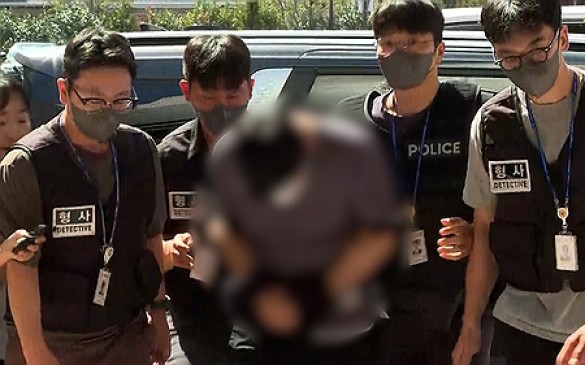 Public sentiment is in turmoil after a court ordered the release on the 24th of a serving Jeju police officer who was arrested for emergency purposes after falsely closing a missing person case he was in charge of. [Photo = Yonhap News TV]
What is even more terrifying is that even if a victim sheds tears of blood to clear the hurdle of an objection and sends the case up to the prosecution, the passage of the bill to abolish supplementary investigation rights would strip prosecutors of the power to personally investigate the police's substandard work.
They have cut all the strong ropes that allowed victims to take their cases to a judge in the past, tossed them a rotten string that could snap at any moment, and now lecture them by asking, "If it's unfair, why don't you just file an objection?" This is the cruel reality of today's judicial landscape.
This is not a turf war between progressives and conservatives, or between the police and the prosecution. It is a matter of real-world survival where ordinary people without money or influence are losing their lives in the blind spots of the law, all because politicians have shredded the framework that protected the weak in order to defend their own judicial risks.
Even as the system breaks down and innocent lives are lost, ignoring the causal relationship of these cold deaths out of a blind, faith-like devotion to the political party and leaders one supports is a cruelty that goes beyond mere ignorance.
I sincerely hope you will set aside flimsy factional logic and face these clear, objective facts. Because in the face of these terrible systemic flaws, you and your family could also become victims in that cold, dark blind spot at any time.

◆ Author Park Joo-hyun
Composer, music director, columnist, and essayist. Actively expresses opinions on political, current, and social issues on Facebook, garnering widespread empathy. Author of the essay collection "Crossing the Sea of Storms."

 [Statement by the Seo-beo-kka Korea Military Academy Patriotic Comrades Association] ㊷ We Condemn the Ruling Party Leader's Intimidation and Mockery of Supreme Court Justices, and Acts of Destroying the Judiciary
Chief Justice of the Supreme Court Cho Hee-de (left) and Democratic Party of Korea Leader Lee Jae-myung [Photo=Yonhap News]We are witnessing an unprecedented situation where the newly inaugurated lead
[Statement by the Seo-beo-kka Korea Military Academy Patriotic Comrades Association] ㊷ We Condemn the Ruling Party Leader's Intimidation and Mockery of Supreme Court Justices, and Acts of Destroying the Judiciary
Chief Justice of the Supreme Court Cho Hee-de (left) and Democratic Party of Korea Leader Lee Jae-myung [Photo=Yonhap News]We are witnessing an unprecedented situation where the newly inaugurated lead
 Criticizing Trump, yet… Europe also backsliding on climate change response
Greenpeace, an environmental organization calling for renewable energy policies [EPA=Yonhap News file photo]European nations, which previously criticized U.S. President Donald Trump's rollback of clim
Criticizing Trump, yet… Europe also backsliding on climate change response
Greenpeace, an environmental organization calling for renewable energy policies [EPA=Yonhap News file photo]European nations, which previously criticized U.S. President Donald Trump's rollback of clim
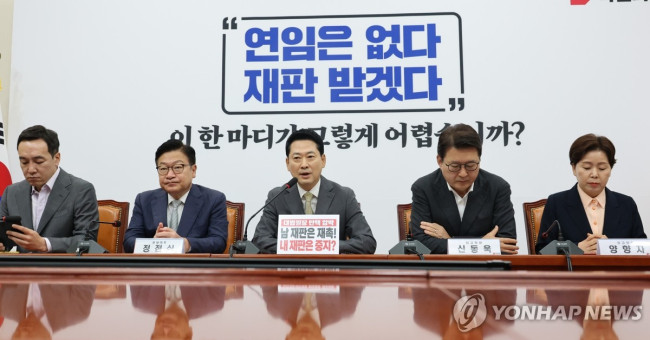 PPP on Nomination of 'Ruling Party-Recommended' Special Inspector Candidate: "We Will Rigorously Verify Them at the Hearing"
People Power Party representative Jang Dong-hyeok is speaking at the Supreme Council meeting held at the National Assembly on the 24th. [Yonhap News] On the 24th, the People Power Party stated th
PPP on Nomination of 'Ruling Party-Recommended' Special Inspector Candidate: "We Will Rigorously Verify Them at the Hearing"
People Power Party representative Jang Dong-hyeok is speaking at the Supreme Council meeting held at the National Assembly on the 24th. [Yonhap News] On the 24th, the People Power Party stated th
 [Comprehensive] Another body of a missing person discovered in Jeju… 4th in three days
Police conducting an intensive search for missing persons [Yonhap News file photo]Recently, bodies suspected to be those of missing persons have been discovered in succession on Jeju Island. This mark
[Comprehensive] Another body of a missing person discovered in Jeju… 4th in three days
Police conducting an intensive search for missing persons [Yonhap News file photo]Recently, bodies suspected to be those of missing persons have been discovered in succession on Jeju Island. This mark
 [Korea-US Data Lab] 3rd Week of August (18th–21st) Money Insight
In the U.S., rising long-term Treasury yields lowered the future cash value of tech stocks, while in Korea, shareholder returns from Samsung Electronics and SK Hynix drove a rebound in major semicondu
[Korea-US Data Lab] 3rd Week of August (18th–21st) Money Insight
In the U.S., rising long-term Treasury yields lowered the future cash value of tech stocks, while in Korea, shareholder returns from Samsung Electronics and SK Hynix drove a rebound in major semicondu
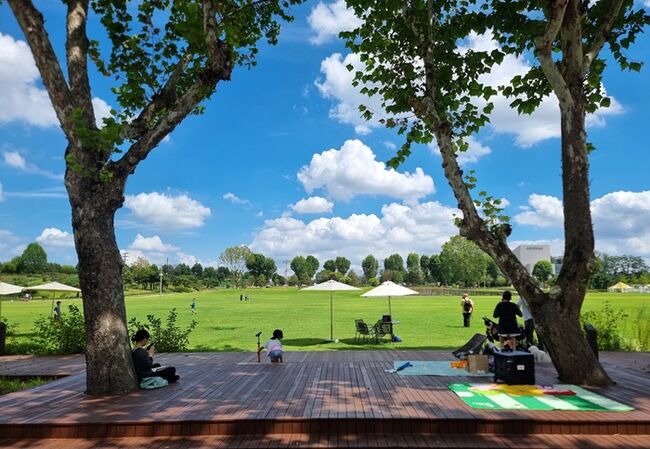 [Trending Travel Destinations] Unlocking a Century of Secrets: ‘Yongsan Children’s Garden’
Family visitors resting in the shade on a picnic mat. [Photo by Reporter Yohi Lim]Throughout history, the wealthy in both the East and the West have enjoyed greenery by creating private gardens on vas
[Trending Travel Destinations] Unlocking a Century of Secrets: ‘Yongsan Children’s Garden’
Family visitors resting in the shade on a picnic mat. [Photo by Reporter Yohi Lim]Throughout history, the wealthy in both the East and the West have enjoyed greenery by creating private gardens on vas
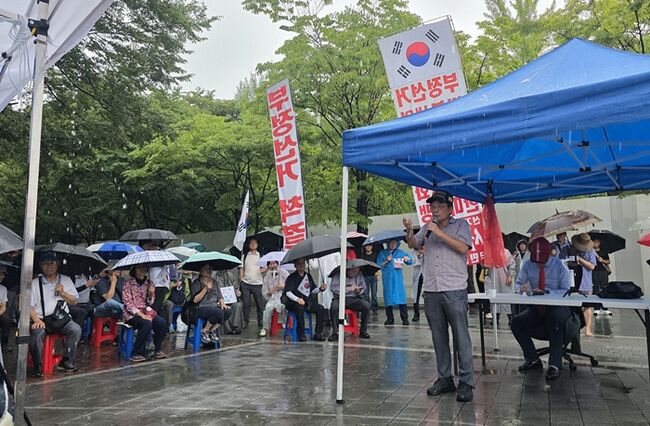 [Photo] Btooyun “We are recruiting 1,600 members for the Olympic Park Scientific Verification Team”… The rainy scenery of Olympic Park on the 22nd
On Saturday the 22nd, amid rainy weather at Olympic Park, the National Coalition for Election Fraud Struggle held a public forum on election integrity. They argued that the "Olympic Park Scientific Ve
[Photo] Btooyun “We are recruiting 1,600 members for the Olympic Park Scientific Verification Team”… The rainy scenery of Olympic Park on the 22nd
On Saturday the 22nd, amid rainy weather at Olympic Park, the National Coalition for Election Fraud Struggle held a public forum on election integrity. They argued that the "Olympic Park Scientific Ve
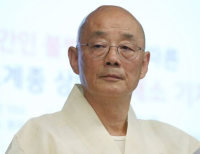
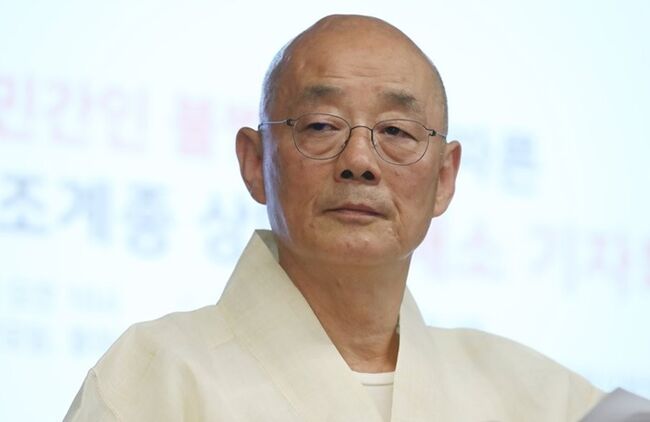 [Special Contribution: Songsan] The Life of a Political Monk Must Also Be Evaluated… What the Passing of Venerable Myeongjin Leaves Behind
Venerable Myeongjin, former head monk of Bongeunsa Temple, passed away on the 22nd. He was 76 years old and had been a monk for 52 years. [Yonhap News File Photo]Various narratives are emerging follow
[Special Contribution: Songsan] The Life of a Political Monk Must Also Be Evaluated… What the Passing of Venerable Myeongjin Leaves Behind
Venerable Myeongjin, former head monk of Bongeunsa Temple, passed away on the 22nd. He was 76 years old and had been a monk for 52 years. [Yonhap News File Photo]Various narratives are emerging follow
 [Video] North Korean ballistic missile filmed by a civilian in Goseong, Gangwon-do
 [Editorial Cartoon] A Draconian Law That Undermines Freedom of Expression

 List
List