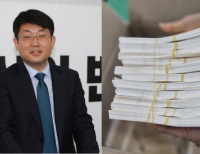
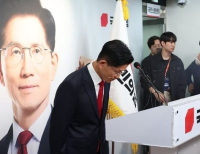
Chairman Song Ki-heon bangs the gavel at a plenary meeting of the Special Committee on Political Reform at the National Assembly on the 26th. [Photo=Yonhap News]
The management of elections by the National Election Commission (NEC) was once again brought into question as the Special Committee on Political Reform convened at the National Assembly on the 26th.
During the committee meeting, opposition party lawmakers sharply criticized the entire pre-voting procedure. The NEC Secretary General, in his response, reiterated the existing stance but couldn't hide his discomfort.
Common issues raised in the debate surrounding the pre-voting system include the method of stamping by election officials and the identity verification procedures. However, these points sidestep the core of the problem.
This is because the legality of the stamping method and the functioning of the identity verification system have already been largely addressed through legal judgments and system explanations.
The crux of the current controversy is not whether criminal acts can be prevented.
It is about how visibly the election procedures are explained to the public and whether the system is designed with a structure that allows for post-election verification.
In other words, it is not a question of 'Can it be forged?', but rather, 'Can the NEC convincingly prove to a third party that ballots were legitimately issued and distributed to voters?'
Nevertheless, the NEC's responses have been limited to explanations such as, "It is not a forgery," "There is no problem according to the Supreme Court ruling," and "Identity verification is being conducted."
Regarding the stamping by election officials, the NEC repeatedly stated its position that printed stamps are also legal, citing Supreme Court ruling 2017su122. However, this ruling only addressed the legality of printed stamps, not the comprehensive consideration of a structure that could allow for post-election verification of whether each ballot was legitimately issued to a specific voter.
The explanation regarding the identity verification device also deviates from the main point.
The NEC explains that the NEC can track fraudulent voting retrospectively through ID checks and fingerprint registration at polling stations. However, this is a description of the procedure for confirming 'who came to the polling station.'
It is far from explaining a structure that allows for verification at the ballot level of 'which ballot was issued to whom.'
The issue of ballot box sealing was also raised at the Political Reform Special Committee.
The NEC explained that ballot boxes are sealed after voting concludes and undergo confirmation by observers and management procedures. However, the issue is not whether they are sealed.
The core issue is how to prove, after the fact, that the seal remained intact until the vote counting, without any tampering.
Sealing is not merely a procedural formality but a crucial mechanism that guarantees the contents of the ballots have not been altered before the vote count.
However,
there are criticisms that specific explanations are lacking regarding:
△ how the unique identification information of the seal is managed,
△ who is responsible for the transportation process,
△ and what objective criteria exist to judge when a controversy regarding seal tampering arises.
Similar to how the stamping by election officials and identity verification procedures remain focused on the 'forgery' debate, the ballot box sealing also fails to adequately address the fundamental questions of procedural transparency and verifiability.
Such evasive answers do not help in restoring trust that has already been shaken.
While there are variations depending on the survey, it is clear that the proportion of respondents who do not trust the NEC is approaching half, or even exceeding it in some surveys.
This indicates that, separate from whether the NEC's procedures are legally illegal, significant doubts remain about whether these procedures are sufficiently explained and understood by the public.
The question raised at this point is clear.
Is it common sense to entrust the nation's most critical democratic process to an institution where explanations are repeatedly contradictory and doubts about the verifiability of its procedures remain unresolved?
Despite this, the NEC continues to repeat its existing stance of "no problem." This means the same explanations are being reiterated even when nearly half of the public, or more, expresses distrust.
The reason for the recurring debates surrounding pre-voting is not a lack of law.
It lies in the unexplained procedures and the unproven management structure.
Beyond citing court rulings and introducing the system, the NEC must provide concrete and verifiable answers on how it records and proves the entire process, from ballot issuance, identity verification, ballot box sealing and transportation, to vote counting.
That is the starting point for restoring trust.
By Kim Young

 [Statement by the Seo-beo-kka Korea Military Academy Save-the-Nation Comrades Association] ㉛ Recount the Votes Publicly, as the Previous Recount Concealed Election Fraud
Tongyeong Mayoral Election Recount [Photo=Yonhap News]South Korea's liberal democracy is dying. The National Election Commission (NEC) and the judiciary, which have plummeted into criminal syndicates
[Statement by the Seo-beo-kka Korea Military Academy Save-the-Nation Comrades Association] ㉛ Recount the Votes Publicly, as the Previous Recount Concealed Election Fraud
Tongyeong Mayoral Election Recount [Photo=Yonhap News]South Korea's liberal democracy is dying. The National Election Commission (NEC) and the judiciary, which have plummeted into criminal syndicates
 What is the significance of the "Trump 2028" red hats that keep making a comeback?
It is noteworthy that President Donald Trump is "intentionally" fueling controversy over whether he can actually run in the 2028 presidential election, even though it is "highly likely he is seriously
What is the significance of the "Trump 2028" red hats that keep making a comeback?
It is noteworthy that President Donald Trump is "intentionally" fueling controversy over whether he can actually run in the 2028 presidential election, even though it is "highly likely he is seriously
 Jin Cummings: "North Korea says it will increase the number of spies, so what is the government doing?"
U.S. political columnist Gene Cummings has publicly questioned the South Korean government, asking, "North Korea is announcing plans to increase its number of spies, yet what is the South Korean
Jin Cummings: "North Korea says it will increase the number of spies, so what is the government doing?"
U.S. political columnist Gene Cummings has publicly questioned the South Korean government, asking, "North Korea is announcing plans to increase its number of spies, yet what is the South Korean
 Attorney Do Tae-woo: “Discrepancies in Voter Count and Improper Sealing Confirmed in Tongyeong Mayoral Recount… Official Request for Further Verification Filed with Gyeongnam Election Commission”
A bundle of out-of-district early voting ballots photographed by attorney Do Tae-woo at the Tongyeong mayoral election recount site. A clear, solid line visible on the side of the ballots raises suspi
Attorney Do Tae-woo: “Discrepancies in Voter Count and Improper Sealing Confirmed in Tongyeong Mayoral Recount… Official Request for Further Verification Filed with Gyeongnam Election Commission”
A bundle of out-of-district early voting ballots photographed by attorney Do Tae-woo at the Tongyeong mayoral election recount site. A clear, solid line visible on the side of the ballots raises suspi
 Stock Market Crash 'Black Tuesday'… KOSPI down 10.8%, KOSDAQ down 7.7%
The KOSPI fell by more than 5% in early trading on the 28th, triggering a sell-side sidecar.On the 28th, the KOSPI plunged by more than 10%.Due to the sharp decline, a sell-side sidecar—a temporary
Stock Market Crash 'Black Tuesday'… KOSPI down 10.8%, KOSDAQ down 7.7%
The KOSPI fell by more than 5% in early trading on the 28th, triggering a sell-side sidecar.On the 28th, the KOSPI plunged by more than 10%.Due to the sharp decline, a sell-side sidecar—a temporary
 [World Heritage Committee] 25 New World Heritage Sites Inscribed in Busan… South Korea Successfully Expands 'Getbol' Listing
The Chairperson of the World Heritage Committee speaks at the plenary session of the 48th session of the World Heritage Committee, held at BEXCO in Busan on the 20th. [Photo: Yonhap News]A total of 25
[World Heritage Committee] 25 New World Heritage Sites Inscribed in Busan… South Korea Successfully Expands 'Getbol' Listing
The Chairperson of the World Heritage Committee speaks at the plenary session of the 48th session of the World Heritage Committee, held at BEXCO in Busan on the 20th. [Photo: Yonhap News]A total of 25
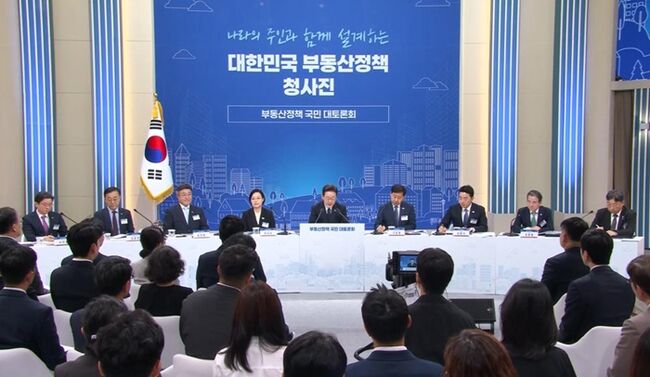 [Liberal Democratic Party Statement] Calling it a Grand Real Estate Debate… It Was Nothing More Than a Private Party Among Themselves
The 'National Grand Debate on Real Estate Policy' held on July 23rd and 27th. [Photo=Yonhap News]The 'National Grand Debate on Real Estate Policy,' hosted by the Lee Jae-myung administration under the
[Liberal Democratic Party Statement] Calling it a Grand Real Estate Debate… It Was Nothing More Than a Private Party Among Themselves
The 'National Grand Debate on Real Estate Policy' held on July 23rd and 27th. [Photo=Yonhap News]The 'National Grand Debate on Real Estate Policy,' hosted by the Lee Jae-myung administration under the
 [Photo] Evidence of Election Fraud Flooding U.S. Media… Trump Had 2.7 Million Votes Stolen
 [Video] U.S. Semiquincentennial Air Show... 'Art in the Sky' streaks across New York
 [Editorial Cartoon] A Draconian Law That Undermines Freedom of Expression

 List
List