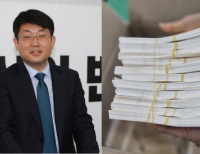
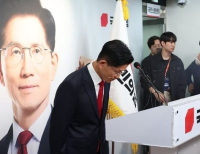
Jang Dong-hyuk (left), leader of the People Power Party, and Chiang Kai-shek, the first President of Taiwan. [Photo = Yonhap News, etc.]
The 'Noh Won-myung Essay' (Maekyung, February 1st) likens the choice of Jang Dong-hyuk, leader of the People Power Party, to the strategic failure of Chiang Kai-shek, the first President of Taiwan.
However, while this analogy may be an interesting rhetorical device, it fails as an analysis explaining political reality. This comparison is flawed in its historical context, political structure, and the dynamics of current Korean politics.
The framework used to conclude that Jang Dong-hyuk's choice is a path to failure is particularly misguided.
Chiang Kai-shek: An Elite Ruler Distrustful of Mass Politics
First, Chiang Kai-shek's failure was not one of 'internal purges' but a 'failure of mass politics'.
Reporter Noh Won-myung connects Chiang Kai-shek's logic of "eliminating the Communists first" to Jang Dong-hyuk's expulsion of Han Dong-hoon. However, this misidentifies the core failure of Chiang Kai-shek's politics.
Chiang Kai-shek accepted the Kuomintang-Communist cooperation after the Xi'an Incident. The problem was not his 'hardline stance' before that, but the elite-centered ruling structure that persisted afterward.
He operated the military, government, and party with elite bureaucrats and warlords; he failed to organize peasants, the urban lower class, and youth as political subjects; and he insisted on order-centered rule, distrusting the masses.
In contrast, the Communist Party organized the masses with language of land, survival, and anger, pulling the center of political gravity downwards. Chiang Kai-shek's defeat was not a matter of military judgment but the collapse of his political base among the populace.
In other words, Chiang Kai-shek was not a 'strong leader who struck internal enemies first,' but an elite ruler who distrusted mass politics.
Jang Dong-hyuk: Expanding the Spectrum Through Multi-Alliance Mass Politics
Jang Dong-hyuk's choice is at the opposite pole from Chiang Kai-shek's.
Therefore, the moment Jang Dong-hyuk is compared to Chiang Kai-shek, the analogy collapses. Jang Dong-hyuk's political choice does not repeat the causes of Chiang Kai-shek's failure; rather, it stands in opposition to them.
What Jang Dong-hyuk eliminated was not the 'entire conservative faction.' What was eliminated was a 'structure of singular worship' centered around an individual. Conversely, what was expanded was the front.
In reality, the spectrum being incorporated under the Jang Dong-hyuk administration has expanded to include the Park Geun-hye faction, the Ahn Cheol-soo/Yoo Seong-min group, the parliamentary and institutional conservatives, and young speakers outside parliament such as Kim Min-soo, Kim Hyo-eun, Park Min-young, and Jang Ye-chan.
This is closer to multi-alliance mass politics than elite purism. The exclusion was singular, but the inclusion was plural. To define this as 'extreme right-wing' or 'narrowing' is to misread the political landscape.
'20% Party' is a Data Illusion
Furthermore, the conclusion of a '20% party' is a selective data bias.
Another key premise of Noh Won-myung is the "support rate in the 20% range based on Gallup." However, asserting this number as a maximum is closer to an illusion created by the perspective of the legacy elite than an analysis.
Gallup's survey is conducted via telephone interview (CATI). This method requires respondents to directly reveal their political orientation to others. Considering social stigma and risks to their workplace/relationships, this structure fails to capture conservative voters outside parliament or institutional politics, the so-called 'shy conservatives'.
Especially in a polarized political landscape, one must also consider that many on the right boycott polling agencies like Gallup, viewing them as left-leaning.
In contrast, Automatic Response System (ARS) surveys repeatedly show a different picture. In numerous ARS surveys, the support rate for the People Power Party faction is comparable to the Democratic Party within the margin of error. It is not that there are no supporters, but that they are not visible.
The issue is not the numbers themselves, but which numbers are recognized as 'reality.' The attitude of using Gallup alone as an irrefutable truth is not empirical analysis but selective data driven by a predetermined conclusion.
The Limits of a Frame Misinterpreting Inclusion as Isolation
Noh Won-myung states that the Jang Dong-hyuk administration is 'parting ways with a comprehensive conservative party.' However, this judgment stems from a misunderstanding of comprehensiveness as the maintenance of existing elite consensus.
The masses who defected from the Han Dong-hoon administration, those disappointed with institutional politics but who have not moved to the left, voters outside parliament, youth, and atypical supporters remain fluid.
Jang Dong-hyuk's strategy is a choice to reclaim this potential front, not a decision to pursue isolation. Only the direction of inclusion has changed.
Faulty Analogies Lead to Faulty Conclusions
Chiang Kai-shek was defeated by elite purism and his distrust of mass politics.
Jang Dong-hyuk is eliminating personal worship and opting for mass inclusion and multi-alliance.
The moment these two are placed on the same track, inclusion is disguised as extremism, and the expansion of the front is distorted into isolation.
Analogies exist to aid analysis.
However, if two figures with different structures are forcibly overlapped, that analogy becomes not an explanation but a framing attack.
The view that sees Jang Dong-hyuk as Chiang Kai-shek is an analogy that fails to read reality.
Rather, the current choice is closer to an attempt to move away from the elite politics that Chiang Kai-shek failed in.
Political analysis should be about understanding structures, not issuing warnings.
In that regard, while Noh Won-myung's column may have contained interesting rhetoric, it failed in explaining reality.

◆ Professor Shim Gyu-jin
Professor at the Department of Digital Media at IE University in Spain. Previously served as a policy advisor to the Ministry of National Defense and as head of the Data Lab at the Yeouido Institute. He also worked as a full-time professor at the University of Melbourne in Australia and as an assistant professor at Singapore Management University. His books include 'K-Drama Yoon Suk-yeol' and 'Hyper Gender'.

 [Statement by the Seo-beo-kka Korea Military Academy Save-the-Nation Comrades Association] ㉛ Recount the Votes Publicly, as the Previous Recount Concealed Election Fraud
Tongyeong Mayoral Election Recount [Photo=Yonhap News]South Korea's liberal democracy is dying. The National Election Commission (NEC) and the judiciary, which have plummeted into criminal syndicates
[Statement by the Seo-beo-kka Korea Military Academy Save-the-Nation Comrades Association] ㉛ Recount the Votes Publicly, as the Previous Recount Concealed Election Fraud
Tongyeong Mayoral Election Recount [Photo=Yonhap News]South Korea's liberal democracy is dying. The National Election Commission (NEC) and the judiciary, which have plummeted into criminal syndicates
 What is the significance of the "Trump 2028" red hats that keep making a comeback?
It is noteworthy that President Donald Trump is "intentionally" fueling controversy over whether he can actually run in the 2028 presidential election, even though it is "highly likely he is seriously
What is the significance of the "Trump 2028" red hats that keep making a comeback?
It is noteworthy that President Donald Trump is "intentionally" fueling controversy over whether he can actually run in the 2028 presidential election, even though it is "highly likely he is seriously
 Jin Cummings: "North Korea says it will increase the number of spies, so what is the government doing?"
U.S. political columnist Gene Cummings has publicly questioned the South Korean government, asking, "North Korea is announcing plans to increase its number of spies, yet what is the South Korean
Jin Cummings: "North Korea says it will increase the number of spies, so what is the government doing?"
U.S. political columnist Gene Cummings has publicly questioned the South Korean government, asking, "North Korea is announcing plans to increase its number of spies, yet what is the South Korean
 Attorney Do Tae-woo: “Discrepancies in Voter Count and Improper Sealing Confirmed in Tongyeong Mayoral Recount… Official Request for Additional Verification Submitted to Gyeongnam Election Commission”
A bundle of mail-in early voting ballots captured by lawyer Do Tae-woo at the Tongyeong mayoral election recount site. A clear solid line, raising suspicions of election fraud, is visible on the side
Attorney Do Tae-woo: “Discrepancies in Voter Count and Improper Sealing Confirmed in Tongyeong Mayoral Recount… Official Request for Additional Verification Submitted to Gyeongnam Election Commission”
A bundle of mail-in early voting ballots captured by lawyer Do Tae-woo at the Tongyeong mayoral election recount site. A clear solid line, raising suspicions of election fraud, is visible on the side
 Stock Market Crash 'Black Tuesday'… KOSPI down 10.8%, KOSDAQ down 7.7%
The KOSPI fell by more than 5% in early trading on the 28th, triggering a sell-side sidecar.On the 28th, the KOSPI plunged by more than 10%.Due to the sharp decline, a sell-side sidecar—a temporary
Stock Market Crash 'Black Tuesday'… KOSPI down 10.8%, KOSDAQ down 7.7%
The KOSPI fell by more than 5% in early trading on the 28th, triggering a sell-side sidecar.On the 28th, the KOSPI plunged by more than 10%.Due to the sharp decline, a sell-side sidecar—a temporary
 [World Heritage Committee] 25 New World Heritage Sites Inscribed in Busan… South Korea Successfully Expands 'Getbol' Listing
The Chairperson of the World Heritage Committee speaks at the plenary session of the 48th session of the World Heritage Committee, held at BEXCO in Busan on the 20th. [Photo: Yonhap News]A total of 25
[World Heritage Committee] 25 New World Heritage Sites Inscribed in Busan… South Korea Successfully Expands 'Getbol' Listing
The Chairperson of the World Heritage Committee speaks at the plenary session of the 48th session of the World Heritage Committee, held at BEXCO in Busan on the 20th. [Photo: Yonhap News]A total of 25
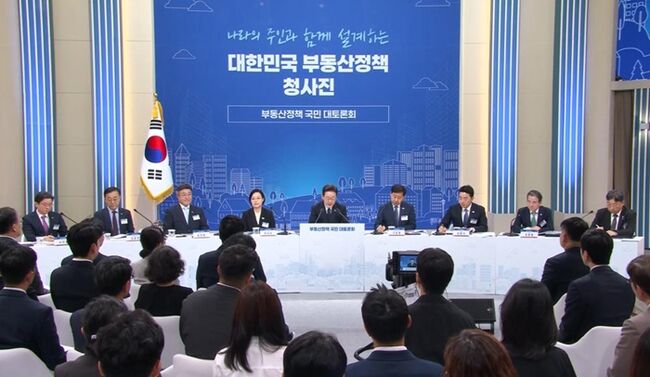 [Liberal Democratic Party Statement] Calling it a Grand Real Estate Debate… It Was Nothing More Than a Private Party Among Themselves
The 'National Grand Debate on Real Estate Policy' held on July 23rd and 27th. [Photo=Yonhap News]The 'National Grand Debate on Real Estate Policy,' hosted by the Lee Jae-myung administration under the
[Liberal Democratic Party Statement] Calling it a Grand Real Estate Debate… It Was Nothing More Than a Private Party Among Themselves
The 'National Grand Debate on Real Estate Policy' held on July 23rd and 27th. [Photo=Yonhap News]The 'National Grand Debate on Real Estate Policy,' hosted by the Lee Jae-myung administration under the
 [Photo] Evidence of Election Fraud Flooding U.S. Media… Trump Had 2.7 Million Votes Stolen
 [Video] U.S. Semiquincentennial Air Show... 'Art in the Sky' streaks across New York
 [Editorial Cartoon] A Draconian Law That Undermines Freedom of Expression

 List
List