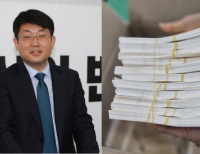
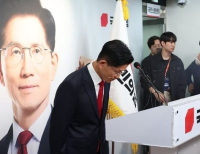
Former People Power Party leader Han Dong-hoon. [Photo=Yonhap News]
The fundamental principle of political commentary is clear. The more incomplete the facts, the more questions the commentator must ask.
However, Yoon Tae-gon's recent column bypasses questions and rushes to conclusions. As a result, his commentary has devolved from analysis into a narrative of partisanship. His piece on the recent "expulsion of Han Dong-hoon" is based on a consistent premise.
"The essence of this expulsion is Yoon Suk-yeol's absolution, and the party board issue is not the essence."
The problem is that this premise has not been proven. More precisely, it has deliberately avoided verifiable facts.
The Logical Fallacy of "Too Few Posts to Constitute Public Opinion Manipulation"
A key sentence in Yoon Tae-gon's column, "The posts in question are only two or three a day. It is an insufficient amount to manipulate public opinion," is a quantitative reductionist fallacy.
Public opinion manipulation is not judged by the 'number' of posts. Pattern, repetition, distribution channels, deletion activities, and organization are key. The allegations raised are as follows:
△ Were the same user names distributed among family members?
△ Were they created from the same or similar IP addresses?
△ Were there a board shutdown and deletion of over 600 posts after the creation time?
△ Did the same phrases spread to external communities and Naver comments?
Yoon Tae-gon does not ask a single one of these questions.
He only throws out the conclusion, "There are too few posts." This is prejudgment, not analysis.
Accepting the "Same Name" Explanation Uncritically is a Surrender of Criticality
Han Dong-hoon's side's key explanation was clear: "I did not join the party members' bulletin board, and the post was written by someone with the same name." If so, a commentator should have at least asked the following questions.
△ Why could they specifically identify the person with the same name born in '68, not '73?
△ If it wasn't them, why didn't they personally provide an explanation during the 10-day appeal period?
△ If they were innocent, why didn't they choose the simplest method, such as requesting an investigation or filing a complaint?
However, these questions are entirely absent from Yoon Tae-gon's article.
The moment an explanation is absorbed into a narrative without verification, commentary abandons fact-checking.
Linking "Yoon Suk-yeol's Visit to Meeting" and "Party Affairs Committee Appointment" is Speculation, and Why is it Unilateral?
While explaining Party Leader Jang Dong-hyuk's actions, Yoon Tae-gon strongly links the timing of his visit to President Yoon Suk-yeol with the appointment of the Party Affairs Committee Chairman. However, he fails to ask.
△ What is the specific evidence that this appointment was Yoon Suk-yeol's intention?
△ Conversely, can it be said that Han Dong-hoon's political influence was entirely absent from the instances where Han Dong-hoon's associates and panelists attacked Yoon Suk-yeol, citing the party members' bulletin board?
Criticizing one side's actions as "wishful thinking" while excluding the other side's influence from analysis is a typical case of selective causality.
The Grand Leap of the "Yoon Suk-yeol Absolution Narrative" Frame
The biggest problem with this column lies in its conclusion. "Ultimately, Han Dong-hoon's expulsion is the formation of a lineage extending from Park Geun-hye, Yoon Suk-yeol, to Jang Dong-hyuk." This sentence is closer to narrative creation than analysis.
To use the concept of a political 'lineage,' at least a shared ideology, organization, policies, and succession structure must be presented.
However, there is no empirical evidence of this anywhere in the article.
Instead, a list of symbols appears.
△ Park Geun-hye's visit
△ Yoon Suk-yeol's visit
△ Han Dong-hoon's expulsion
The moment these are linked into a single linear narrative, commentary becomes drama interpretation rather than explanation.
The Fairness of Commentary Comes Not from "Balance" but from "Symmetry of Questions"
Yoon Tae-gon's writing appears neutral on the surface but actually directs questions in only one direction.
△ Asking Jang Dong-hyuk about motives, intentions, and lineage
△ Not asking Han Dong-hoon about facts, responsibility, and explanation
When this asymmetry accumulates, commentary is no longer commentary. It becomes subcontracted commentary that reinforces a particular individual's victim narrative.
What is needed now is not a "Yoon Suk-yeol absolution narrative" but "completeness of facts."
The evaluation of Han Dong-hoon's expulsion can be divided. Political judgments can also differ. However, the moment a narrative of sympathy is placed before the facts are resolved, the commentary undermines its own credibility.
What is needed now is not a grand lineage chart or a tragic drama.
△ Why were family names mobilized?
△ Why are there allegations of identical IPs?
△ Why was there mass deletion?
△ Why was there no explanation?
Without answering these questions, the narrative of "unreasonable expulsion" will struggle to gain credibility. Commentators should be those who clear the fog on the stage, not those who set up the stage.
It is time to return to the basics.

◆ Professor Shim Kyu-jin
Professor of Digital Media at IE University in Spain. He previously served as a policy advisor to the Ministry of National Defense and as the head of the Data Lab at the Yeouido Research Institute. He also worked as a full-time professor at the University of Melbourne in Australia and as an assistant professor at Singapore Management University. His books include 'K-Drama Yoon Suk-yeol' and 'Hyper Gender.'

 [Statement by the Seo-beo-kka Korea Military Academy Save-the-Nation Comrades Association] ㉛ Recount the Votes Publicly, as the Previous Recount Concealed Election Fraud
Tongyeong Mayoral Election Recount [Photo=Yonhap News]South Korea's liberal democracy is dying. The National Election Commission (NEC) and the judiciary, which have plummeted into criminal syndicates
[Statement by the Seo-beo-kka Korea Military Academy Save-the-Nation Comrades Association] ㉛ Recount the Votes Publicly, as the Previous Recount Concealed Election Fraud
Tongyeong Mayoral Election Recount [Photo=Yonhap News]South Korea's liberal democracy is dying. The National Election Commission (NEC) and the judiciary, which have plummeted into criminal syndicates
 What is the significance of the "Trump 2028" red hats that keep making a comeback?
It is noteworthy that President Donald Trump is "intentionally" fueling controversy over whether he can actually run in the 2028 presidential election, even though it is "highly likely he is seriously
What is the significance of the "Trump 2028" red hats that keep making a comeback?
It is noteworthy that President Donald Trump is "intentionally" fueling controversy over whether he can actually run in the 2028 presidential election, even though it is "highly likely he is seriously
 Jin Cummings: "North Korea says it will increase the number of spies, so what is the government doing?"
U.S. political columnist Gene Cummings has publicly questioned the South Korean government, asking, "North Korea is announcing plans to increase its number of spies, yet what is the South Korean
Jin Cummings: "North Korea says it will increase the number of spies, so what is the government doing?"
U.S. political columnist Gene Cummings has publicly questioned the South Korean government, asking, "North Korea is announcing plans to increase its number of spies, yet what is the South Korean
 Attorney Do Tae-woo: “Discrepancies in Voter Count and Improper Sealing Confirmed in Tongyeong Mayoral Recount… Official Request for Additional Verification Submitted to Gyeongnam Election Commission”
A bundle of mail-in early voting ballots captured by lawyer Do Tae-woo at the Tongyeong mayoral election recount site. A clear solid line, raising suspicions of election fraud, is visible on the side
Attorney Do Tae-woo: “Discrepancies in Voter Count and Improper Sealing Confirmed in Tongyeong Mayoral Recount… Official Request for Additional Verification Submitted to Gyeongnam Election Commission”
A bundle of mail-in early voting ballots captured by lawyer Do Tae-woo at the Tongyeong mayoral election recount site. A clear solid line, raising suspicions of election fraud, is visible on the side
 Stock Market Crash 'Black Tuesday'… KOSPI down 10.8%, KOSDAQ down 7.7%
The KOSPI fell by more than 5% in early trading on the 28th, triggering a sell-side sidecar.On the 28th, the KOSPI plunged by more than 10%.Due to the sharp decline, a sell-side sidecar—a temporary
Stock Market Crash 'Black Tuesday'… KOSPI down 10.8%, KOSDAQ down 7.7%
The KOSPI fell by more than 5% in early trading on the 28th, triggering a sell-side sidecar.On the 28th, the KOSPI plunged by more than 10%.Due to the sharp decline, a sell-side sidecar—a temporary
 [World Heritage Committee] 25 New World Heritage Sites Inscribed in Busan… South Korea Successfully Expands 'Getbol' Listing
The Chairperson of the World Heritage Committee speaks at the plenary session of the 48th session of the World Heritage Committee, held at BEXCO in Busan on the 20th. [Photo: Yonhap News]A total of 25
[World Heritage Committee] 25 New World Heritage Sites Inscribed in Busan… South Korea Successfully Expands 'Getbol' Listing
The Chairperson of the World Heritage Committee speaks at the plenary session of the 48th session of the World Heritage Committee, held at BEXCO in Busan on the 20th. [Photo: Yonhap News]A total of 25
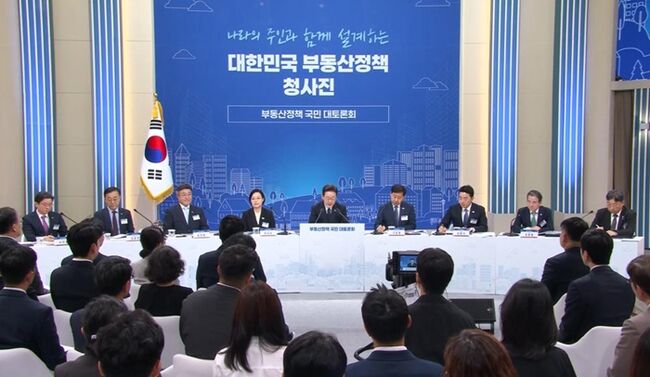 [Liberal Democratic Party Statement] Calling it a Grand Real Estate Debate… It Was Nothing More Than a Private Party Among Themselves
The 'National Grand Debate on Real Estate Policy' held on July 23rd and 27th. [Photo=Yonhap News]The 'National Grand Debate on Real Estate Policy,' hosted by the Lee Jae-myung administration under the
[Liberal Democratic Party Statement] Calling it a Grand Real Estate Debate… It Was Nothing More Than a Private Party Among Themselves
The 'National Grand Debate on Real Estate Policy' held on July 23rd and 27th. [Photo=Yonhap News]The 'National Grand Debate on Real Estate Policy,' hosted by the Lee Jae-myung administration under the
 [Photo] Evidence of Election Fraud Flooding U.S. Media… Trump Had 2.7 Million Votes Stolen
 [Video] U.S. Semiquincentennial Air Show... 'Art in the Sky' streaks across New York
 [Editorial Cartoon] A Draconian Law That Undermines Freedom of Expression

 List
List