The defendant and his legal team listening to Judge Ji Gwi-hyun’s first-instance verdict on the 19th. Photo = Broadcast screen capture]
The debate following President Yoon Suk Yeol’s first-instance ruling on the charge of insurrection on the 19th has been intense. Unlike other cases, this controversy is difficult to explain through simple pros and cons.
This is because four different criteria—legal interpretation, political assessment, democratic narrative, and international perspective—are clashing simultaneously, each asserting its own legitimacy.
This scene suggests that South Korean politics is moving beyond the phase of "legitimacy conflict," which has been repeated for a long time, into a phase of "legitimacy competition," where each side promotes a different set of standards.
The verdict has been reached, but the battle over legitimacy has only just begun.
One of the most notable changes in this debate is the surge in the citation of foreign media.
It is difficult to view this merely as an expansion of international interest.
The more a situation fails to converge into a single interpretation, the more the media tends to call upon external perspectives to reinforce their chosen interpretation.
While foreign media are observers rather than parties to the event, in this phase of competitive legitimacy, their words take on significance beyond mere facts.
It is a moment where foreign media reports function not as information, but as a mechanism to amplify legitimacy.
Foreign media reports are, by nature, explanatory language for a global audience.
They simplify narratives to condense political context and aid understanding.
However, when such descriptions are repurposed in domestic reporting as if they were legal judgments or social consensus, foreign media begin to be consumed as standards rather than sources of information.
Foreign media are mirrors, not judges.
Yet, in a situation where legitimacy is contested, these mirrors are sometimes read as if they were the verdict itself.
The surge in foreign media citations may be a sign that a single language of legitimacy no longer works domestically, rather than a signal of internationalization.
The current debate is less of a conflict over a single standard, and more of a structure where different systems of legitimacy operate simultaneously.
The first is legal legitimacy.
This is a trend that seeks to judge based on the verdict and the logic of criminal law, using procedures and legal standards themselves as the basis for legitimacy.
This framework emphasizes process and legal stability over political evaluation.
The second is democratic narrative legitimacy.
This is a method of interpreting the event not just as a criminal case but as an issue of constitutional order, placing the meaning of the verdict and its historical context at the forefront.
The third is political legitimacy.
This is a perspective that reads the trial and the verdict within the context of power relations, interpreting them through political intent and the balance of power rather than legal logic.
The fourth is international perspective legitimacy.
This is a flow that attempts to reconstruct domestic debates through foreign media reports or overseas reactions, where the language of explanation is sometimes used as a basis for judgment.
These four types of legitimacy do not completely negate each other, nor do they merge into one.
Instead, they operate simultaneously while maintaining their own languages, deconstructing a single event into multiple narratives.
This is also why the debate after the verdict does not easily subside.
If the past saw repeated conflicts over a single standard, we have now entered a stage where the different standards themselves are competing.
In a society where legitimacy competition has begun, the method of debate also changes.
The core issue is no longer a fight to determine who is right, but rather which standard is more persuasive.
A verdict may be the end of legal procedure, but it can also be the starting point for political interpretation.
This is why the time after the verdict becomes longer.
In a situation where different forms of legitimacy coexist, it is difficult for any one to win completely, and the debate is repeatedly reproduced.
The position of the media also shifts at this point.
Simply delivering facts is no longer enough; explaining the structure of which standards are being used becomes essential.
The increase in foreign media citations or the diversification of interpretative language is both a sign of confusion and a symptom of change.
In an era of competing legitimacy, the media is expected to play the role of exposing how each legitimacy is constructed, rather than forcing a single interpretation.
The verdict is over, but the time for politics is not.
In an era of legitimacy competition, those who hold power need an attitude of showing when to stop rather than exerting more force.
In the era of legitimacy conflict, persuading the opponent ended the debate, but in the era of legitimacy competition, no one completely retreats.
Therefore, this verdict is closer to a new starting point than a conclusion.
The question of how South Korean politics will now describe itself remains long after the ruling.

 [Statement by the Seo-beo-kka Korea Military Academy Save-the-Nation Comrades Association] ㉛ Recount the Votes Publicly, as the Previous Recount Concealed Election Fraud
Tongyeong Mayoral Election Recount [Photo=Yonhap News]South Korea's liberal democracy is dying. The National Election Commission (NEC) and the judiciary, which have plummeted into criminal syndicates
[Statement by the Seo-beo-kka Korea Military Academy Save-the-Nation Comrades Association] ㉛ Recount the Votes Publicly, as the Previous Recount Concealed Election Fraud
Tongyeong Mayoral Election Recount [Photo=Yonhap News]South Korea's liberal democracy is dying. The National Election Commission (NEC) and the judiciary, which have plummeted into criminal syndicates
 What is the significance of the "Trump 2028" red hats that keep making a comeback?
It is noteworthy that President Donald Trump is "intentionally" fueling controversy over whether he can actually run in the 2028 presidential election, even though it is "highly likely he is seriously
What is the significance of the "Trump 2028" red hats that keep making a comeback?
It is noteworthy that President Donald Trump is "intentionally" fueling controversy over whether he can actually run in the 2028 presidential election, even though it is "highly likely he is seriously
 Jin Cummings: "North Korea says it will increase the number of spies, so what is the government doing?"
U.S. political columnist Gene Cummings has publicly questioned the South Korean government, asking, "North Korea is announcing plans to increase its number of spies, yet what is the South Korean
Jin Cummings: "North Korea says it will increase the number of spies, so what is the government doing?"
U.S. political columnist Gene Cummings has publicly questioned the South Korean government, asking, "North Korea is announcing plans to increase its number of spies, yet what is the South Korean
 Attorney Do Tae-woo: “Discrepancies in Voter Count and Improper Sealing Confirmed in Tongyeong Mayoral Recount… Official Request for Further Verification Filed with Gyeongnam Election Commission”
A bundle of out-of-district early voting ballots photographed by attorney Do Tae-woo at the Tongyeong mayoral election recount site. A clear, solid line visible on the side of the ballots raises suspi
Attorney Do Tae-woo: “Discrepancies in Voter Count and Improper Sealing Confirmed in Tongyeong Mayoral Recount… Official Request for Further Verification Filed with Gyeongnam Election Commission”
A bundle of out-of-district early voting ballots photographed by attorney Do Tae-woo at the Tongyeong mayoral election recount site. A clear, solid line visible on the side of the ballots raises suspi
 Stock Market Crash 'Black Tuesday'… KOSPI down 10.8%, KOSDAQ down 7.7%
The KOSPI fell by more than 5% in early trading on the 28th, triggering a sell-side sidecar.On the 28th, the KOSPI plunged by more than 10%.Due to the sharp decline, a sell-side sidecar—a temporary
Stock Market Crash 'Black Tuesday'… KOSPI down 10.8%, KOSDAQ down 7.7%
The KOSPI fell by more than 5% in early trading on the 28th, triggering a sell-side sidecar.On the 28th, the KOSPI plunged by more than 10%.Due to the sharp decline, a sell-side sidecar—a temporary
 [World Heritage Committee] 25 New World Heritage Sites Inscribed in Busan… South Korea Successfully Expands 'Getbol' Listing
The Chairperson of the World Heritage Committee speaks at the plenary session of the 48th session of the World Heritage Committee, held at BEXCO in Busan on the 20th. [Photo: Yonhap News]A total of 25
[World Heritage Committee] 25 New World Heritage Sites Inscribed in Busan… South Korea Successfully Expands 'Getbol' Listing
The Chairperson of the World Heritage Committee speaks at the plenary session of the 48th session of the World Heritage Committee, held at BEXCO in Busan on the 20th. [Photo: Yonhap News]A total of 25
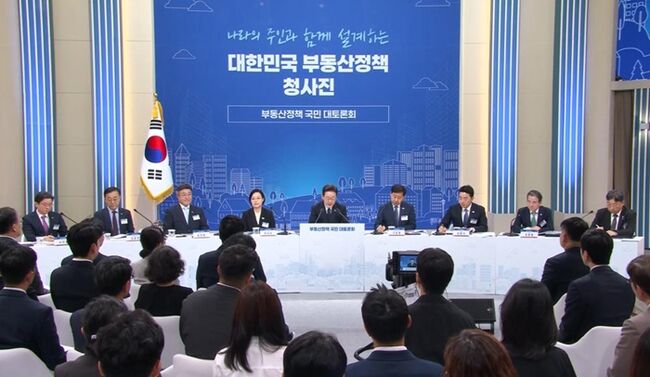 [Liberal Democratic Party Statement] Calling it a Grand Real Estate Debate… It Was Nothing More Than a Private Party Among Themselves
The 'National Grand Debate on Real Estate Policy' held on July 23rd and 27th. [Photo=Yonhap News]The 'National Grand Debate on Real Estate Policy,' hosted by the Lee Jae-myung administration under the
[Liberal Democratic Party Statement] Calling it a Grand Real Estate Debate… It Was Nothing More Than a Private Party Among Themselves
The 'National Grand Debate on Real Estate Policy' held on July 23rd and 27th. [Photo=Yonhap News]The 'National Grand Debate on Real Estate Policy,' hosted by the Lee Jae-myung administration under the
 [Photo] Evidence of Election Fraud Flooding U.S. Media… Trump Had 2.7 Million Votes Stolen
 [Video] U.S. Semiquincentennial Air Show... 'Art in the Sky' streaks across New York
 [Editorial Cartoon] A Draconian Law That Undermines Freedom of Expression

 List
List