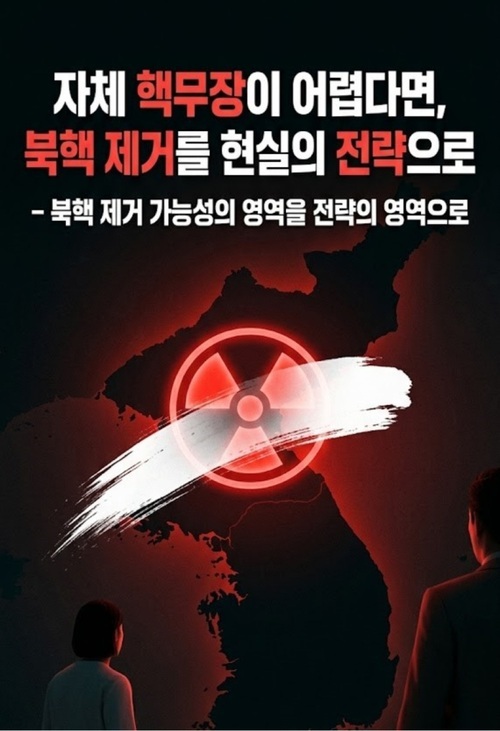
North Korea's nuclear armament has now become a practical variable for Korean Peninsula security. The actual deployment of North Korea's tactical nuclear weapons, the multi-warhead capability of its ICBMs, and its more covert underground nuclear facilities signify that North Korea has moved beyond mere nuclear possession into a stage where it can use nuclear weapons as a means of actual warfare. In particular, Kim Jong Un's recent designation of inter-Korean relations as those between 'hostile states,' discarding even the notion of a single people, is a dangerous signal that lowers the threshold for nuclear use and considers South Korea a primary enemy targetable at any time.
In this grave situation, we must ask ourselves: Should we persuade the U.S. establishment to pursue our own nuclear armament? Or should we forcibly eliminate North Korea's nuclear weapons? These two choices are not emotional slogans but matters of cold strategy for our survival.
The past 30 years of North Korean nuclear negotiations have failed to deter or even slow down its nuclear development. North Korea has exploited negotiations as a deceptive tactic to buy time, during which its nuclear capabilities have dramatically strengthened. Sanctions against North Korea have also lost their effectiveness due to the departure of China and Russia and North Korea's evasion capabilities. We must now acknowledge that the existing methods are not working and strategically consider even military options for the elimination of North Korea's nuclear weapons.
Are military options for the elimination of North Korea's nuclear weapons feasible?
Military means should always be the last resort. To even taboo the discussion of such options is strategic incompetence. North Korea's nuclear and missile facilities, like those in Iran, are dispersed underground, making complete physical elimination realistically difficult. However, the capability to neutralize the enemy's core facilities, command structure, and launch systems is, in itself, a powerful deterrent and a key element of our security.
The proposal for utilizing Electromagnetic Pulse (EMP) weapons, raised by some, also warrants attention. Conceptually, EMP is a means to paralyze North Korea's command and control systems by disabling its power grids, communication networks, and electronic equipment. Although uncertainties exist regarding civilian damage concerns and the difficulty of predicting its impact, making it risky for actual implementation, the current desperate security situation demands that even these theoretical alternatives be considered as realistic strategic assets. Securing precision strike capabilities to paralyze the core command hierarchy and electromagnetic disabling means will be one of the practical deterrent measures to counter the North Korean nuclear threat.
Do we have internal strategic consistency and the resolve to not recognize North Korea's nuclear status?
The attitude of the Ministry of Unification and related departments, which dismisses even discussions of our own nuclear armament as 'agitation' and blocks any debate, reveals strategic incompetence. Particularly, suspicions that high-level intelligence was leaked to North Korea and China during past progressive administrations have led to fatal consequences, causing even our ally, the United States, to distrust us, and has become a fundamental reason for blocking our own nuclear armament.
Without internal and external trust in our leadership, we cannot move even one step further from the current nuclear umbrella. Due to a lack of strategic consistency, inter-Korean policy fluctuates with each change of administration, and a lack of coordination with allies likely results in neighboring countries opposing even the redeployment of tactical nuclear weapons in South Korea.
Will fundamental changes occur within North Korea for the elimination of its nuclear weapons?
Nuclear weapons are a tool for the survival of the North Korean regime, and an opportunity for their elimination will only arise when the regime itself is shaken. Strategies to sow discord among the North Korean elite and weaken resident control by expanding external information inflow, though time-consuming, are the most realistic paths to minimize the cost of nuclear elimination.
However, the starting point for all these strategies lies in securing overwhelming deterrence. South Korea-U.S.-Japan security cooperation and the advancement of South Korea's "three-axis system" are not choices but preconditions for survival. Negotiations or pressure without the backing of deterrence will inevitably be ignored by Kim Jong Un and lose momentum.
Ultimately, the elimination of North Korea's nuclear weapons is not a task that the United States or the international community can solve on our behalf. Only when we, the principal parties, regain strategic consistency and maximize the effectiveness of extended deterrence based on alliance trust will the elimination of North Korea's nuclear weapons become a realistic goal. Only prepared nations can control nuclear weapons and, if necessary, secure strategic flexibility that includes independent nuclear options.
If, despite these strategic considerations, it is judged that the elimination of North Korea's nuclear weapons is realistically impossible, then we must proudly pursue our own nuclear armament by persuading U.S. President Trump. This is our last resort for national survival.
National security is a realm of survival for all citizens, irrespective of political parties. Therefore, national security is not a subject for political maneuvering but the highest policy for national survival. The security line should not dismiss but listen to critical voices regarding security. I hope that the security steering wheel, which has been self-removed by going against international trends, will be regained as soon as possible.

◆ Park Pil-gyu, Committee Member
Editor, Hankook-Ilbo
40th graduating class, Korea Military Academy

 [Statement by the Seo-beo-kka Korea Military Academy Save-the-Nation Comrades Association] ㉛ Recount the Votes Publicly, as the Previous Recount Concealed Election Fraud
Tongyeong Mayoral Election Recount [Photo=Yonhap News]South Korea's liberal democracy is dying. The National Election Commission (NEC) and the judiciary, which have plummeted into criminal syndicates
[Statement by the Seo-beo-kka Korea Military Academy Save-the-Nation Comrades Association] ㉛ Recount the Votes Publicly, as the Previous Recount Concealed Election Fraud
Tongyeong Mayoral Election Recount [Photo=Yonhap News]South Korea's liberal democracy is dying. The National Election Commission (NEC) and the judiciary, which have plummeted into criminal syndicates
 What is the significance of the "Trump 2028" red hats that keep making a comeback?
It is noteworthy that President Donald Trump is "intentionally" fueling controversy over whether he can actually run in the 2028 presidential election, even though it is "highly likely he is seriously
What is the significance of the "Trump 2028" red hats that keep making a comeback?
It is noteworthy that President Donald Trump is "intentionally" fueling controversy over whether he can actually run in the 2028 presidential election, even though it is "highly likely he is seriously
 Jin Cummings: "North Korea says it will increase the number of spies, so what is the government doing?"
U.S. political columnist Gene Cummings has publicly questioned the South Korean government, asking, "North Korea is announcing plans to increase its number of spies, yet what is the South Korean
Jin Cummings: "North Korea says it will increase the number of spies, so what is the government doing?"
U.S. political columnist Gene Cummings has publicly questioned the South Korean government, asking, "North Korea is announcing plans to increase its number of spies, yet what is the South Korean
 Attorney Do Tae-woo: “Discrepancies in Voter Count and Improper Sealing Confirmed in Tongyeong Mayoral Recount… Official Request for Additional Verification Submitted to Gyeongnam Election Commission”
A bundle of mail-in early voting ballots captured by lawyer Do Tae-woo at the Tongyeong mayoral election recount site. A clear solid line, raising suspicions of election fraud, is visible on the side
Attorney Do Tae-woo: “Discrepancies in Voter Count and Improper Sealing Confirmed in Tongyeong Mayoral Recount… Official Request for Additional Verification Submitted to Gyeongnam Election Commission”
A bundle of mail-in early voting ballots captured by lawyer Do Tae-woo at the Tongyeong mayoral election recount site. A clear solid line, raising suspicions of election fraud, is visible on the side
 Stock Market Crash 'Black Tuesday'… KOSPI down 10.8%, KOSDAQ down 7.7%
The KOSPI fell by more than 5% in early trading on the 28th, triggering a sell-side sidecar.On the 28th, the KOSPI plunged by more than 10%.Due to the sharp decline, a sell-side sidecar—a temporary
Stock Market Crash 'Black Tuesday'… KOSPI down 10.8%, KOSDAQ down 7.7%
The KOSPI fell by more than 5% in early trading on the 28th, triggering a sell-side sidecar.On the 28th, the KOSPI plunged by more than 10%.Due to the sharp decline, a sell-side sidecar—a temporary
 [World Heritage Committee] 25 New World Heritage Sites Inscribed in Busan… South Korea Successfully Expands 'Getbol' Listing
The Chairperson of the World Heritage Committee speaks at the plenary session of the 48th session of the World Heritage Committee, held at BEXCO in Busan on the 20th. [Photo: Yonhap News]A total of 25
[World Heritage Committee] 25 New World Heritage Sites Inscribed in Busan… South Korea Successfully Expands 'Getbol' Listing
The Chairperson of the World Heritage Committee speaks at the plenary session of the 48th session of the World Heritage Committee, held at BEXCO in Busan on the 20th. [Photo: Yonhap News]A total of 25
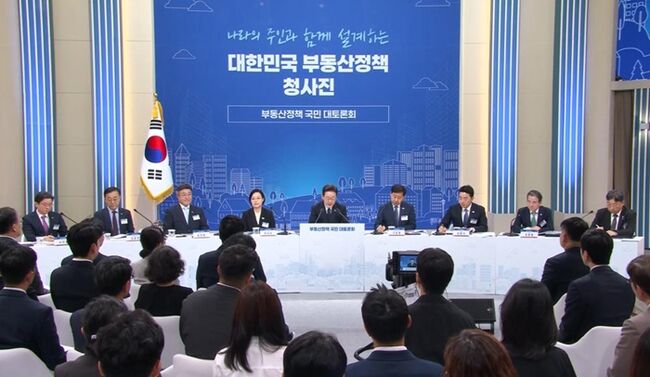 [Liberal Democratic Party Statement] Calling it a Grand Real Estate Debate… It Was Nothing More Than a Private Party Among Themselves
The 'National Grand Debate on Real Estate Policy' held on July 23rd and 27th. [Photo=Yonhap News]The 'National Grand Debate on Real Estate Policy,' hosted by the Lee Jae-myung administration under the
[Liberal Democratic Party Statement] Calling it a Grand Real Estate Debate… It Was Nothing More Than a Private Party Among Themselves
The 'National Grand Debate on Real Estate Policy' held on July 23rd and 27th. [Photo=Yonhap News]The 'National Grand Debate on Real Estate Policy,' hosted by the Lee Jae-myung administration under the
 [Photo] Evidence of Election Fraud Flooding U.S. Media… Trump Had 2.7 Million Votes Stolen
 [Video] U.S. Semiquincentennial Air Show... 'Art in the Sky' streaks across New York
 [Editorial Cartoon] A Draconian Law That Undermines Freedom of Expression

 List
List