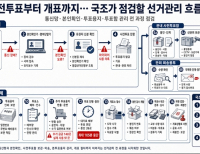
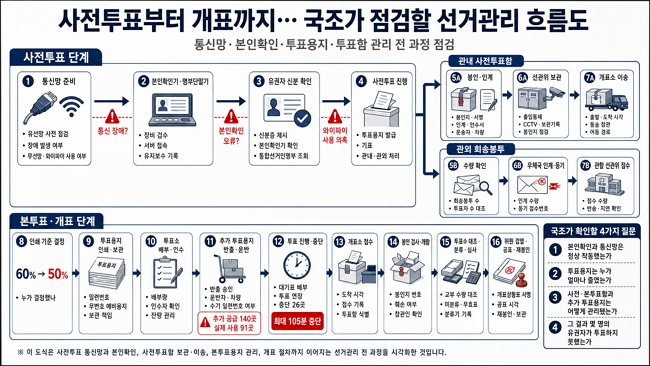
What Needs to Be Verified from the Storage of Early Voting Ballot Boxes to the Counting? The verification of ballot counting should not begin when the ballot boxes arrive at the counting center. It is necessary to first confirm how the ballot boxes and return envelopes were handed over, stored, and transported after the early voting concluded. Without a connected record from the end of early voting to the counting, it is difficult to judge the appropriateness of management solely based on the final counting figures.
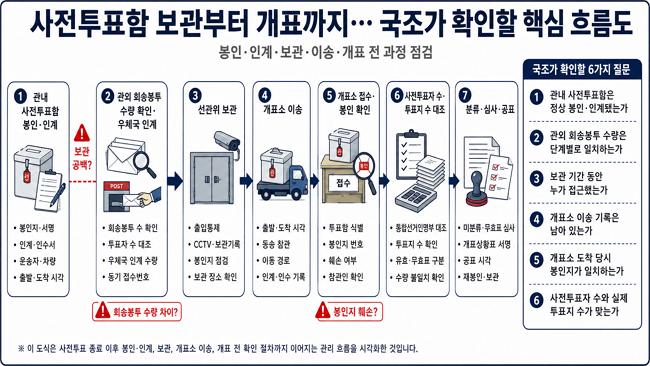 [Photo by Hanmi Ilbo Graphics] [Photo by Hanmi Ilbo Graphics]
① Sealing and Handover of In-District Early Voting Ballot Boxes After in-district early voting concludes, the ballot box slot and lock are sealed in the presence of early voting observers, and the early voting supervisors and observers sign the seals before handing them over to the relevant district/city/county election commission. The special committee for the national investigation must verify the following data: * Early voting end time * Ballot box sealing time * Seal number and signatories * Departure time from polling station and arrival time at the election commission * Transporter and vehicle number * Accompanying observers and police officers * Original handover and receipt form * Sealing status at departure and arrival In particular, the transportation route from the polling station to the election commission's storage location must be verified using vehicle operation records and video footage to check for any changes in route or unscheduled stops. ② Handover of Return Envelopes for Out-of-District Early Voting The procedure for out-of-district early voting differs from that of in-district early voting. After early voting concludes, the ballot box is opened in the presence of observers, the number of return envelopes is counted, and they are then handed over to the relevant post office for dispatch via registered mail. The items to be verified are as follows: * Number of out-of-district early voters on the integrated voter list * Number of return envelopes from the ballot box * Quantity handed over to the post office * Dispatch time and tracking number for registered mail * Observer accompanying to the post office * Final received quantity by the election commission for the respective electoral district * Number of returned, delayed, or undelivered envelopes * Number of return envelopes actually opened during counting The following figures must be cross-referenced for each electoral district: > Number of out-of-district early voters > = Number of return envelopes handed over to the post office > = Quantity received by the competent election commission > = Number of return envelopes for counting If any discrepancies arise, it must be determined at which stage and for what reason the quantities differed. ③ Storage Process at the Election Commission Upon receiving in-district early voting ballot boxes, the relevant district/city/county election commission must confirm the sealing and seal status in the presence of party-recommended members and store them. The special committee for the national investigation must examine the following: * Seal status upon ballot box receipt * Participation of party-recommended members * Storage location and duration * List of authorized personnel for storage room access * Door opening/closing and access logs * Records of seal inspections during storage * Original CCTV footage of the storage area and blind spots, if available * Occurrence of power outages, equipment failures, or access control anomalies * Final confirmation records before transport to the counting center Early voting ballot boxes are stored for a certain period until the in-person voting day. Therefore, it is necessary to verify not only that the seals at the time of initial sealing and arrival at the counting center are the same, but also who had access to the storage area during the intermediate storage period and who actually entered. ④ Transport from Storage to Counting Center On the day of counting, the early voting ballot boxes are transported again from the election commission's storage location to the counting center. This second transportation process must also be verified with separate handover and receipt records. * Departure time from storage location * Person who confirmed seals before departure * Transport vehicle and driver * Accompanying election commission members, observers, and police * Route and arrival time * Recipient at the counting center * Seal numbers at departure and arrival * Receipt ledger for ballot boxes at the counting center The first transport from the early voting station to the election commission and the second transport from the election commission to the counting center should not be lumped together. The responsible parties and records for each segment must be verified separately. ⑤ Receipt and Seal Verification at the Counting Center At the counting center, it must be confirmed which early voting station's ballot box arrived and at what time. The seals must be inspected in the presence of counting observers before opening the boxes. If seals are damaged or signatures/numbers do not match, photographs, objections, committee decisions, and their outcomes must be recorded. ⑥ Comparison of Early Voter Numbers and Ballot Counts After opening the ballot boxes, the number of ballots inside must be compared with the number of early voters. For in-district early voting, the following figures are verified: > Number of in-district early voters on the integrated voter list > = Number of ballots from the ballot box > = Valid votes + Invalid votes For out-of-district early voting, the number of received return envelopes, the number of envelopes excluded from opening, and the actual number of ballots must be compared separately. ⑦ Classification, Review, Tallying, and Announcement of Results The input quantity to the ballot sorter, the quantity classified by candidate, and the quantity of unclassified and reclassified ballots must be confirmed. The process of judging unclassified and suspect invalid ballots must also be recorded. The results must be announced after review and tallying, verification by election commission members, and signing/stamping of the counting results sheet. The time of electronic data entry, the official announcement time, and any revision history of the counting results sheet must also be checked. The key questions the national investigation must address regarding early voting and the counting process are as follows: * Were the in-district early voting ballot boxes normally handed over in a sealed state? * Who accessed the storage location during the storage period? * Do the numbers of return envelopes for out-of-district early voting match at each stage? * Are there records of transport from the storage location to the counting center? * Did the seals at the arrival at the counting center match the original seals? * Do the number of early voters and the actual number of ballots accurately match? Verification of the counting process, excluding the storage and transport of early voting ballot boxes, is only half of the story. The national investigation must connect and verify the entire process from the moment early voting ends until the ballot boxes are opened at the counting center, not just observe the opening of the boxes.
| 
 [Special Feature - Deprivation of Political Rights National Investigation ②] The Full Picture of the June 3rd Election Management That the National Investigation Should Reveal
[Photo by Hanmi Ilbo Graphics]Table of Contents① A National Investigation Without Witness Testimony is like a 'Steamed Bun Without the Red Bean Filling'② The Full Story of the June 3rd Election Ma
[Special Feature - Deprivation of Political Rights National Investigation ②] The Full Picture of the June 3rd Election Management That the National Investigation Should Reveal
[Photo by Hanmi Ilbo Graphics]Table of Contents① A National Investigation Without Witness Testimony is like a 'Steamed Bun Without the Red Bean Filling'② The Full Story of the June 3rd Election Ma
 Trump: "Obama gave away billions but didn't get things done... I changed that"
President Trump [EPA=Yonhap News Photo]U.S. President Donald Trump on the 20th (local time) reiterated his criticism of the Iran nuclear deal (Joint Comprehensive Plan of Action, JCPOA) spearheaded by
Trump: "Obama gave away billions but didn't get things done... I changed that"
President Trump [EPA=Yonhap News Photo]U.S. President Donald Trump on the 20th (local time) reiterated his criticism of the Iran nuclear deal (Joint Comprehensive Plan of Action, JCPOA) spearheaded by
 Politico "US security role reduction is an opportunity for Korea…K-defense industry rapid growth"
YIDEX 2026, held in Changwon, Gyeongsangnam-do in April [Yonhap News Archive] An analysis suggests that South Korea's defense industry is benefiting from the U.S. stepping back from its role of e
Politico "US security role reduction is an opportunity for Korea…K-defense industry rapid growth"
YIDEX 2026, held in Changwon, Gyeongsangnam-do in April [Yonhap News Archive] An analysis suggests that South Korea's defense industry is benefiting from the U.S. stepping back from its role of e
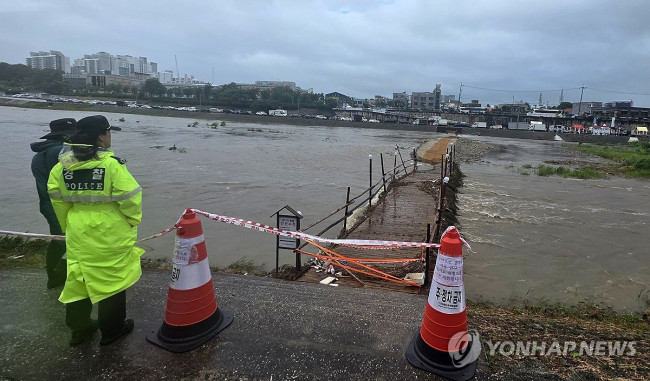 Miryeong 223.0mm heavy rain… Seoraksan is controlled and Gangneung Danoje also faces disruptions.
The Seopdari, a traditional wooden bridge set up for the Gangneung Danoje Festival, is being controlled due to rising water levels in the Namdaecheon River caused by heavy rain in Gangneung, Gangwon P
Miryeong 223.0mm heavy rain… Seoraksan is controlled and Gangneung Danoje also faces disruptions.
The Seopdari, a traditional wooden bridge set up for the Gangneung Danoje Festival, is being controlled due to rising water levels in the Namdaecheon River caused by heavy rain in Gangneung, Gangwon P
 [Hanmi Data Lab] Money Radar, Week 3 of June (15-19)
The image captures rising stock indices, falling international oil prices, and the trends of the US Federal Reserve and Treasury yields against the backdrop of the New York financial market and a worl
[Hanmi Data Lab] Money Radar, Week 3 of June (15-19)
The image captures rising stock indices, falling international oil prices, and the trends of the US Federal Reserve and Treasury yields against the backdrop of the New York financial market and a worl
 [Travel Destinations for the Month of National Defense] ③ Walking the Border Area of the Demilitarized Zone... DMZ Peace Trail Goseong Course
'DMZ Peace Road,' where visitors can see the ecological, cultural, and historical resources of the border areas of the Demilitarized Zone and experience the preciousness of peace firsthand. [Photo by
[Travel Destinations for the Month of National Defense] ③ Walking the Border Area of the Demilitarized Zone... DMZ Peace Trail Goseong Course
'DMZ Peace Road,' where visitors can see the ecological, cultural, and historical resources of the border areas of the Demilitarized Zone and experience the preciousness of peace firsthand. [Photo by
 [Photo] Current status of Chairman Hwang Kyo-ahn and lawyer Park Joo-hyun attending the US election fraud fighter summit
Lawyer Park Joo-hyun with lawyer Peter Ticktin, who was pardoned by U.S. President Donald Trump. [Facebook]Hwang Kyo-ahn, leader of the Liberty and Innovation Party (second from left), informing about
[Photo] Current status of Chairman Hwang Kyo-ahn and lawyer Park Joo-hyun attending the US election fraud fighter summit
Lawyer Park Joo-hyun with lawyer Peter Ticktin, who was pardoned by U.S. President Donald Trump. [Facebook]Hwang Kyo-ahn, leader of the Liberty and Innovation Party (second from left), informing about
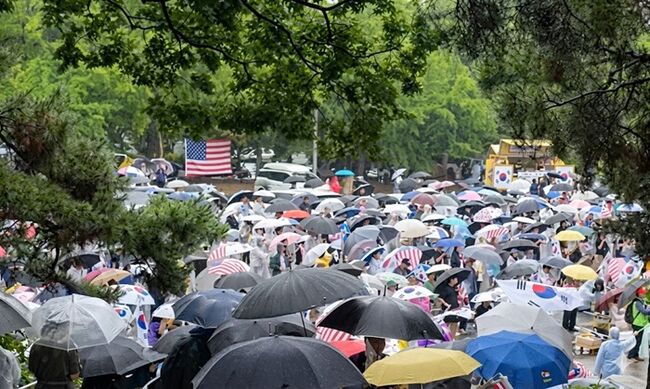 [Cho Yang-kun Column] The reason for the ever-increasing heat at Olympic Park
At noon on the 20th, citizens chanted "Re-election for fraudulent elections, same-day voting and manual counting!" at Olympic Park in Seoul, even amidst heavy rain. ⒸHanmi Ilbo The fervor of th
[Cho Yang-kun Column] The reason for the ever-increasing heat at Olympic Park
At noon on the 20th, citizens chanted "Re-election for fraudulent elections, same-day voting and manual counting!" at Olympic Park in Seoul, even amidst heavy rain. ⒸHanmi Ilbo The fervor of th
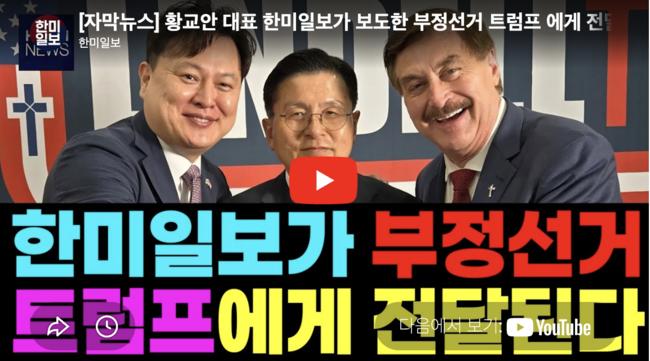 [Video] 'Trump's close friend' Lindell "I will inform Trump about South Korea's fraudulent election"
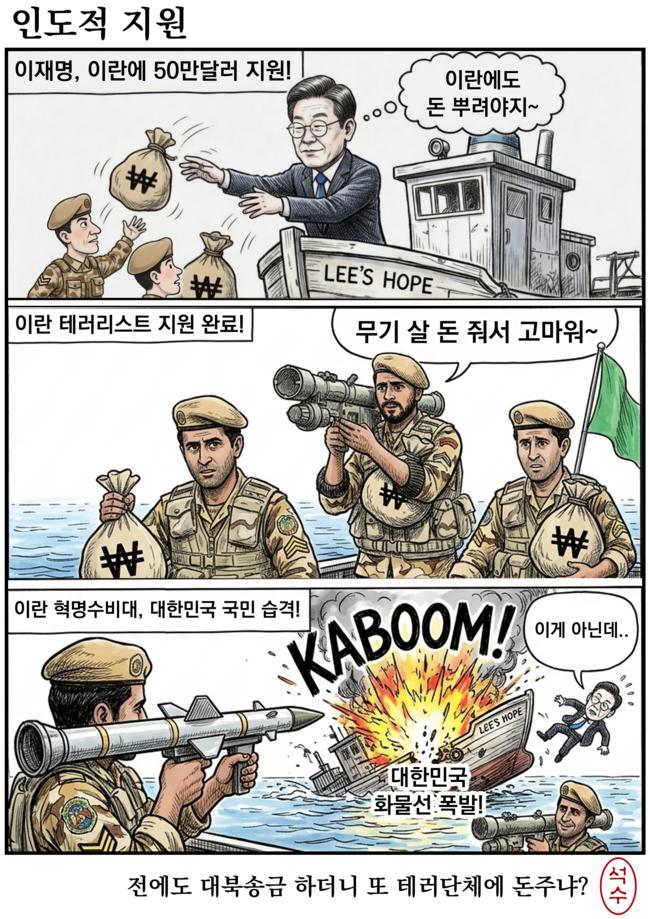 [Editorial Cartoon] Humanitarian Aid

 List
List