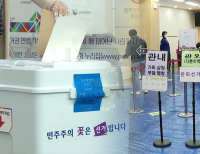
Shocking allegations of election fraud, which undermine the fairness of elections, have been confirmed in the 6·3 local elections. [Photo=Yonhap News]
Shocking allegations of election fraud, which undermine the fairness of elections, have been confirmed in the 6·3 local elections. The Anti-Election Fraud and Corruption Prevention Association (AEFCPA) received a total of 49 cases of alleged election fraud through its reporting center. Numerous calls and emails to suggest that the fraud this time was even more serious than in previous elections.
①Additional set of early voting ballot printers deployed on election day
The first report to the AEFCPA was received on May 29, the day of early voting. The informant sent a text message stating, "An additional set of early voting ballot printers, which was not present during the mock test observation, was deployed on the day of early voting."
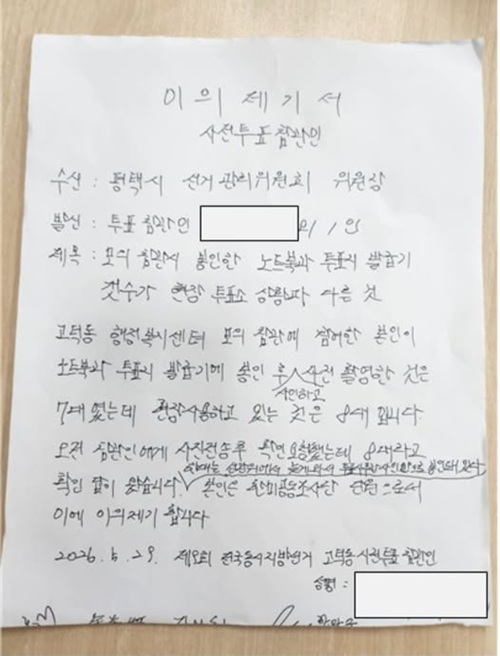 An objection letter stating that an additional set of early voting ballot printers was deployed on election day. [Photo=AEFCPA]
According to the informant, a mock test was conducted at an early voting polling station in Godeok-dong, Pyeongtaek-si, Gyeonggi-do, the previous day. The election observers and early voting officials signed seals on a total of 7 sets of ballot printers (laptops and printers). However, on May 29, the first day of early voting, 8 sets of ballot printers were in operation at the polling station, one more than expected.
When an observer asked for the reason, the election official replied, "Because the Election Commission sent an additional set late." The observer submitted an objection letter, which included the election official's explanation that the Election Commission had delivered the additional set late.
The AEFCPA stated, "It is a serious problem that a printer that has not undergone a mock test was deployed. We cannot know if that printer is functioning properly, and it is a very concerning situation as we don't know what operations were performed on the unsealed printer overnight."
②Objection to photographing the seal signature
The second case involved being prevented from photographing the seal. According to the informant, at an early voting polling station in Socho-myeon, Wonju-si, Gangwon-do, around 8 a.m. on May 29, the first day of early voting, an election official prevented an observer from taking a photo after signing the seal.
If the seal is not photographed, it becomes impossible to compare signatures later. Why did the election official obstruct the observer's legitimate activity? In previous elections, discrepancies in seal signatures have led to allegations of election fraud. The principle of photographing the seal must be strictly followed.
③Prevention of voter count
The third report also came from Wonju, Gangwon-do. Around 8 a.m. on May 29, the first day of early voting, at an early voting polling station in Haenggu-dong, Wonju-si, Gangwon-do, an election official prevented an observer from counting the number of voters.
④Refusal to accept an objection form
The fourth case was a refusal to accept an objection form. Around 7:40 a.m. on May 29, the first day of early voting, at an early voting polling station in Naeson 1-dong, Uiwang-si, Gyeonggi-do, an observer requested the election official to stamp their personal seal, but was refused.
When the observer attempted to submit an objection form regarding this, it was also refused. Furthermore, when the observer requested to relay the instruction to voters to fold their ballots before inserting them, they were instead warned.
⑤CCTV obstruction
The fifth case reported that the CCTV in the polling station was covered. Around 8 a.m. on May 29, the first day of early voting, in Naeson 2-dong, Uiwang-si, Gyeonggi-do, an observer noticed that the CCTV was covered. When the observer attempted to submit an objection form regarding this, the election official refused to accept it.
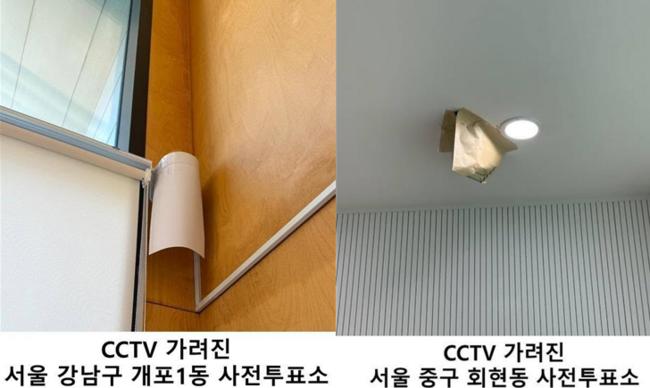
The election official refused to accept two other objection forms in addition to this one. An objection form submitted by an observer regarding the refusal to stamp their personal seal was refused, as was an objection form submitted regarding the refusal of a random test of the seals.
In conclusion, the election official at the Naeson 2-dong polling station refused to accept a total of three objection forms.
Meanwhile, CCTV obstruction was also reported in Hoehyeon-dong, Jung-gu, Seoul, and Gaepo 1-dong, Gangnam-gu.
⑥Suspected cases of duplicate voting
The sixth case involves suspected duplicate voting. Several instances of duplicate voters were observed at the Jakjeonseo-un Administrative Welfare Center in Gyeyang-gu, Incheon. A man who voted around 12:30 p.m. voted again around 2 p.m., and a woman who voted around 1 p.m. voted again around 2 p.m. The Korea-US Daily also received a report from the Gyeongbuk region about a suspected duplicate voter.
Unfortunately, it is impossible to compare the faces of duplicate voters before and after their votes, as it is difficult to photograph all voters. However, photos of two individuals suspected of duplicate voting, with parts of their faces obscured, have been publicly available on the Facebook page of Hwang Kyo-ahn, leader of the Freedom and Unity Party, for over two weeks. The lack of any rebuttal from the individuals concerned lends weight to the suspicions of duplicate voting.
⑦"Is the Cho Kuk Innovation Party worth 10 votes?"
The eighth case is somewhat bewildering. Around 1:50 p.m. on May 29, at an early voting polling station in Paengseong-eup, Pyeongtaek-si, Gyeonggi-do, two men, estimated to be in their 50s, entered the polling station and immediately told a female observer from the Cho Kuk Innovation Party, "We've come from Ulsan to Pyeongtaek on purpose," and "We're going to vote 10 times here (Pyeongtaek)."
The female observer, with a bewildered expression, told them, "You shouldn't say such things here" and cautioned them to be quiet. The voters who allegedly engaged in "election tourism" voted using mobile identification. The voter who made the remark was approximately 163 cm tall, wearing a white windbreaker with three vertical blue stripes in the center, while the other person wore plain clothing.
Another male observer from the Cho Kuk Innovation Party was speaking with a strong Ulsan dialect. The informant expressed concern that a large contingent from Ulsan might have come to Pyeongtaek to ensure Cho Kuk's election. The AEFCPA asked, "The Democratic Party of Korea promoted '3 votes,' but is the Cho Kuk Innovation Party worth 10 votes?" and "Does this mean that a specific identification can be programmed to issue multiple ballot papers?"
They added, "This is not an impossible scenario, as early voting is a system completely controlled and processed exclusively by the National Election Commission. The central computer server verifies the voter's identity and issues ballot papers with the election official's stamp printed on them. The officials and staff at the polling station merely act as extensions of the National Election Commission's server. Regardless of the number of people involved, organized computer manipulation cannot be detected."
Furthermore, the AEFCPA questioned, "Can we trust the results of an election conducted with this electoral system, where there is no voter register, detached serial number portions of ballots are not kept, destroyed, and the computer server is not disclosed even in case of litigation?"
⑧Early voter numbers inflated by up to 10%
The transparency of early voting is the core of fair elections. However, significant discrepancies were found between the numbers recorded by observers and the official figures released by the Election Commission at various in-district early voting polling stations on the first day of early voting.
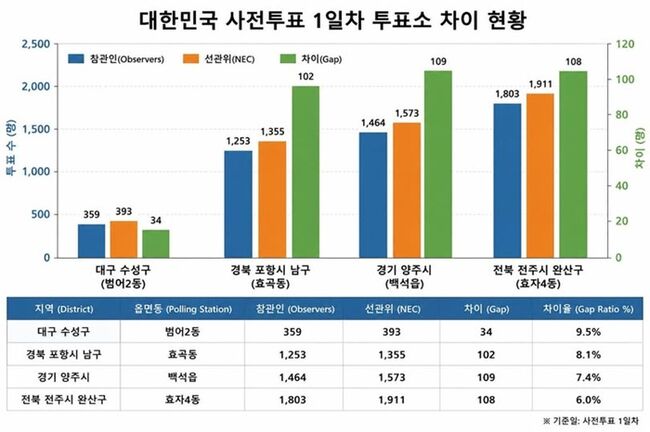 A chart comparing the number of early voters announced by the Election Commission and the numbers manually counted by observers by time slot shows that the number of voters announced by the Election Commission is higher. [Graph=AEFCPA]
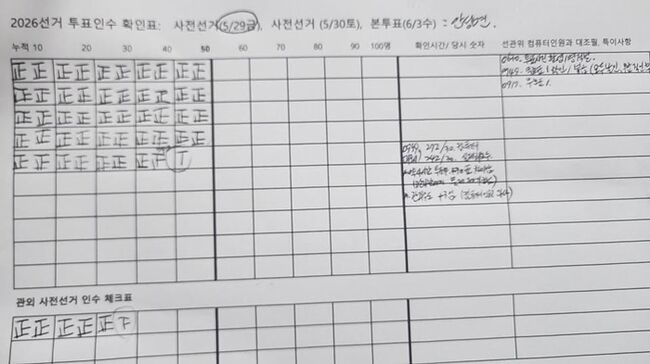 A voter count sheet where observers counted using tally marks. [Photo=AEFCPA]
At 10 a.m. on May 29, the first day of early voting, at an early voting polling station in Anseong-myeon, Muju-gun, Jeonbuk, the number of voters counted by an observer was 242. However, the number of voters announced by the Election Commission was 272, an increase of 30. While a slight error in counting one or two people is understandable, is it possible to miss more than 10% (30 people) out of fewer than 300 voters?
On the same day, May 29, a similar case to the one reported in Muju, Jeonbuk, was reported at an early voting polling station in Beomeo 2-dong, Suseong-gu, Daegu. The total number of in-district early voters manually counted by observers in the morning and afternoon was 359. However, the number officially announced by the Election Commission was 393. This represents an increase of 34 people, or 9.5%.
A chart comparing the number of early voters announced by the Election Commission and the numbers manually counted by observers by time slot shows that the number of voters announced by the Election Commission is higher. The difference was as much as over 25% between 9 a.m. and 11 a.m.
Observers sit for 6 hours and meticulously record the counts on tally sheets. In the case of Muju, as in Daegu, two people sat for 12 hours and counted 359 voters. While a difference of one or two might be attributed to error, a discrepancy of 34 people and a 9.5% gap is too substantial to be dismissed as a simple administrative error or oversight.
Given that election outcomes can be decided by a single vote, if such a discrepancy occurs at one polling station, can we truly trust all other early voting polling stations nationwide?
In fact, at an early voting polling station in Hyogok-dong, Nam-gu, Pohang-si, Gyeongbuk, observers counted 1253 voters, but the Election Commission announced 1355, an increase of 102 people, or 8.1%.
At Baekseok-eup, Yangju-si, Gyeonggi-do, observers counted 1464 voters, but the Election Commission announced 1573. This is an increase of 109 people, or 7.4%.
In Hyoja 4-dong, Wansan-gu, Jeonju-si, Jeonbuk, the observer count was 1803. However, the Election Commission announced 1911. This is an increase of 108 people, or 6.0%.
If these were mere mechanical errors or administrative oversights, the numbers should appear random. However, in all cases shown in the graph, the Election Commission's data is unilaterally inflated, suggesting the possibility of structural data distortion.
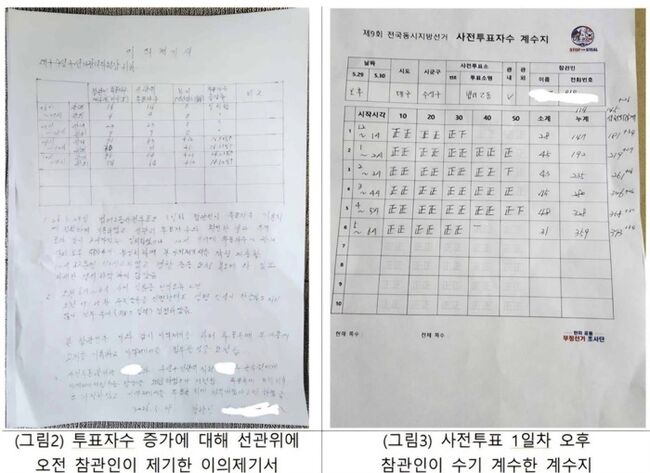
The most concerning issue is the opacity of the digital computer system. Due to the nature of early voting, which relies on digital equipment such as laptops, central computer servers, and ballot printers, discrepancies between physical voters and computer records during real-time communication are a fatal flaw that can shake the legitimacy of the entire election result.
The simultaneous occurrence of discrepancies in voter numbers across polling stations nationwide highlights how vulnerable the current election management system is. The Election Commission should not rely solely on computer networks but should establish robust cross-verification mechanisms, such as comparing with physical paper registers. In elections, the flower of democracy, the most important values are not 'convenience' but 'accuracy and reliability.'
The AEFCPA stated, "The manual counting by observers at the election site uses the most primitive yet reliable 'human eyes.' When computer systems or mechanical counts err or lose credibility, this manual record is the last resort for verification. The fact that the numbers released through the Election Commission's computer network are higher than the actual voter numbers counted before the observers' eyes is proof of a fatal system flaw or fraud."
Furthermore, they stated, "The Election Commission must not hide behind machines and computer data but must clearly explain through physical evidence why the actual measured values obtained through observers' hands and the official announcements are so far apart. It is imperative to transparently disclose computer log records to explain these abnormal numerical differences, as well as to thoroughly investigate the causes and introduce transparent verification procedures to end the recurring distrust in early voting and ensure the fairness of elections."
Reporter Lim Yo-hee

 US Typhoon, deployed for US-Japan joint training from the 22nd… stored in Japan afterward
The US military's mid-range missile system 'Typhon' [Photo courtesy of the US military website]The US military's latest mid-range missile system, 'Typhon,' will be deployed in joint US-Japan exercises
US Typhoon, deployed for US-Japan joint training from the 22nd… stored in Japan afterward
The US military's mid-range missile system 'Typhon' [Photo courtesy of the US military website]The US military's latest mid-range missile system, 'Typhon,' will be deployed in joint US-Japan exercises
 Min Kyeong-wook "PPP Floor Leader of the Special Committee on the State Affairs Investigation is treating [the issue] as a conspiracy theory about election fraud," expresses distrust.
Former lawmaker Min Kyung-wook is interviewed by this newspaper on April 15, the 6th anniversary of the April 15th fraudulent election. ⓒHanmi IlboFormer lawmaker Min Kyung-wook of the then United F
Min Kyeong-wook "PPP Floor Leader of the Special Committee on the State Affairs Investigation is treating [the issue] as a conspiracy theory about election fraud," expresses distrust.
Former lawmaker Min Kyung-wook is interviewed by this newspaper on April 15, the 6th anniversary of the April 15th fraudulent election. ⓒHanmi IlboFormer lawmaker Min Kyung-wook of the then United F
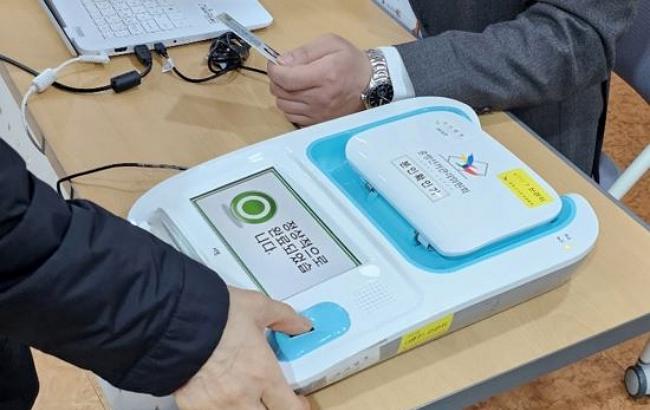 [Analysis] The 'Identity Verification Device' seen in the Daegu case... Concerns about infringement of voting rights 'become reality'
The identity verification device installed at a pre-voting station. [Photo=Yonhap News] The First Gateway to Guaranteeing Voting Rights Has Collapsed The essence of the pre-voting identity v
[Analysis] The 'Identity Verification Device' seen in the Daegu case... Concerns about infringement of voting rights 'become reality'
The identity verification device installed at a pre-voting station. [Photo=Yonhap News] The First Gateway to Guaranteeing Voting Rights Has Collapsed The essence of the pre-voting identity v
 [HANMI DATA LAB] June Week 3 (15-19) Money Insight
The left side of the screen contrasts growth assets such as AI, semiconductors, automobiles, and industrial equipment, while the right side displays defensive assets like the Federal Reserve, banks, a
[HANMI DATA LAB] June Week 3 (15-19) Money Insight
The left side of the screen contrasts growth assets such as AI, semiconductors, automobiles, and industrial equipment, while the right side displays defensive assets like the Federal Reserve, banks, a
 [Travel Destinations for the Month of National Defense] ③ Walking the Border Area of the Demilitarized Zone... DMZ Peace Trail Goseong Course
'DMZ Peace Road,' where visitors can see the ecological, cultural, and historical resources of the border areas of the Demilitarized Zone and experience the preciousness of peace firsthand. [Photo by
[Travel Destinations for the Month of National Defense] ③ Walking the Border Area of the Demilitarized Zone... DMZ Peace Trail Goseong Course
'DMZ Peace Road,' where visitors can see the ecological, cultural, and historical resources of the border areas of the Demilitarized Zone and experience the preciousness of peace firsthand. [Photo by
 [Photo] Current status of Chairman Hwang Kyo-ahn and lawyer Park Joo-hyun attending the US election fraud fighter summit
Lawyer Park Joo-hyun with lawyer Peter Ticktin, who was pardoned by U.S. President Donald Trump. [Facebook]Hwang Kyo-ahn, leader of the Liberty and Innovation Party (second from left), informing about
[Photo] Current status of Chairman Hwang Kyo-ahn and lawyer Park Joo-hyun attending the US election fraud fighter summit
Lawyer Park Joo-hyun with lawyer Peter Ticktin, who was pardoned by U.S. President Donald Trump. [Facebook]Hwang Kyo-ahn, leader of the Liberty and Innovation Party (second from left), informing about
 [Park Joo-hyun Author's Column] The 21st-Century "Outsourcing of Censorship" The Gagging Law
The so-called 'Fake News Punishment Act (Information and Communications Network Act Amendment)' will be fully implemented in July. The so-called 'Fake News Punishment Act (Information and Communi
[Park Joo-hyun Author's Column] The 21st-Century "Outsourcing of Censorship" The Gagging Law
The so-called 'Fake News Punishment Act (Information and Communications Network Act Amendment)' will be fully implemented in July. The so-called 'Fake News Punishment Act (Information and Communi
 [Video] 'Trump's close friend' Lindell "I will inform Trump about South Korea's fraudulent election"
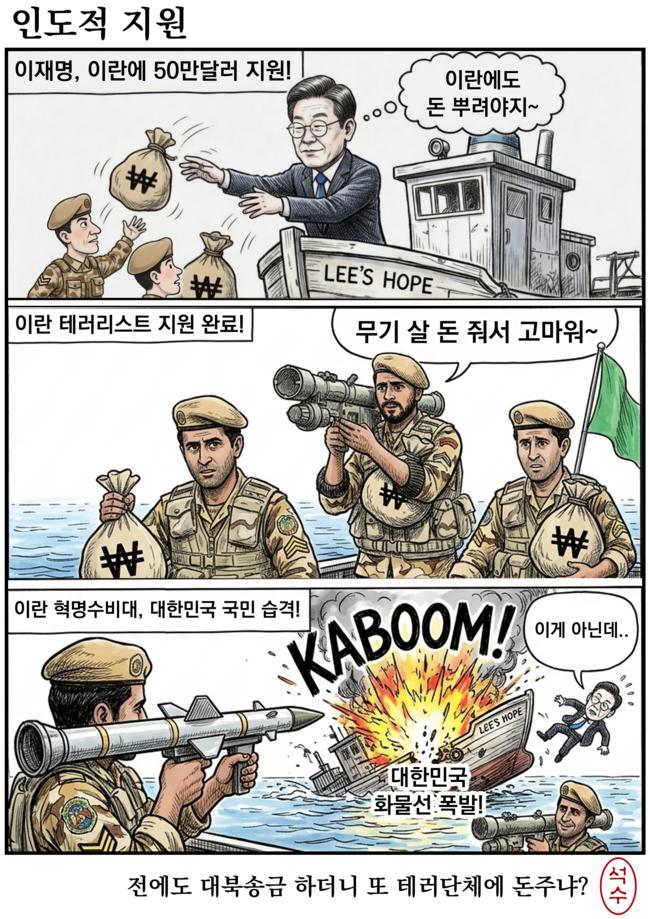 [Editorial Cartoon] Humanitarian Aid

 List
List