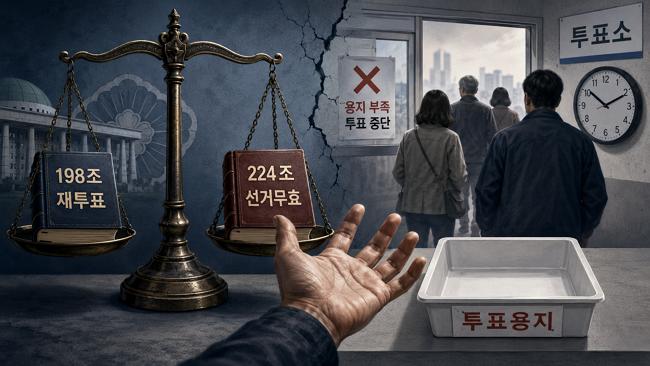
 An image illustrating the situation where voters were unable to vote due to a shortage of ballots, framed as a legal issue under Article 198 (Rerun Voting) and Article 224 (Election Invalidation) of the Public Official Election Act. The core of this incident lies not in its simple impact on election outcomes, but in whether the state guaranteed the opportunity to vote itself. [Photo=Hanmi Ilbo Graphic]The shortage of ballots during the June 3rd local elections cannot be dismissed as a mere administrative error. Voters arrived at polling stations only to be unable to receive ballots, some polling stations had to suspend voting, and there were even instances of waiting voters leaving the scene. In some areas, voting continued late into the time when vote counting was already underway, raising further issues.
Amidst this situation, some in the political and legal circles claim that "reruns are difficult under current law." This is based on the Supreme Court's narrow interpretation of the phrase "recognized as having affected the election results" in Article 224 of the Public Official Election Act, limiting it to the possibility of a change in a candidate's victory or defeat.
However, this argument is only half true. It is true that, based on existing precedents, the threshold for a rerun election or rerun voting is high. But it is hasty to judge this incident solely by the legal principle of candidate victory/defeat under Article 224. This case is not about miscounting votes after the election concluded; it is about whether the state election management body guaranteed voters the opportunity to vote in the first place.
It is not that there are no provisions for a rerun election.
First, it is important to confirm that the Public Official Election Act clearly provides for systems of rerun elections and rerun voting.
Article 195 of the Public Official Election Act stipulates that a rerun election shall be held if there is a judgment or decision of the complete invalidation of an election. Article 197 provides that if a judgment or decision of partial invalidation of an election becomes final, a rerun election shall be held in the invalidated polling district, and then a winner shall be determined again.
Article 198 stipulates that rerun voting shall be conducted in cases where voting could not be held in a polling district due to natural disaster or other unavoidable circumstances, or in cases of loss or destruction of ballot boxes. However, paragraph 2 of the same Article allows for the winner to be determined without a rerun vote if it is recognized that the rerun vote is unlikely to affect the election results of that district.
Article 224 is a provision that stipulates that even if there is a violation of election regulations in an election dispute, a judgment of complete or partial invalidation of the election or invalidation of a candidate's victory shall be made only when it is recognized as having affected the election results.
Therefore, the statement "rerun elections are difficult under current law" is incorrect in the sense that "there is no procedure for a rerun election." The law provides for procedures for complete invalidation rerun elections, partial invalidation rerun elections, and rerun voting. The real issue is how to interpret the threshold of "having affected the election results."
This incident should be reviewed starting with Article 198.
Bringing this incident directly under Article 224 is an overly narrow legal framing.
Article 224 is a limiting provision applied when finally judging the validity of an election in an election invalidation or candidate invalidation lawsuit. In contrast, Article 198 deals with cases where the voting itself was not conducted.
If voters were unable to vote due to a shortage of ballots, the first thing to consider is whether it falls under Article 198's provision of "when voting could not be conducted in a polling district due to other unavoidable circumstances." Just because the polling station was open does not mean that all voters were able to vote. Voting is considered to have been conducted only when a voter, after identification, can receive a ballot and cast their vote.
If voting was suspended for a certain period due to a lack of ballots, and waiting voters left without voting, then for at least that period and for those voters, it is as if voting was not conducted. This is why this incident should be viewed as a problem of "loss of opportunity to vote," not merely a procedural defect.
Of course, Article 198 is not a provision with a low threshold. Paragraph 2 of the same Article stipulates that a rerun vote may not be conducted if it is recognized that it is unlikely to affect the election results. In other words, Article 198 also requires an assessment of the impact on the outcome.
However, there is an important difference here. Article 198 makes a rerun vote the principle in paragraph 1, and the exception for omitting the rerun vote in paragraph 2. On the other hand, Article 224 is a provision that limits the invalidation judgment in election litigation. Even though the phrase "impact on election results" is used, the legal function is different.
The precedent of Article 224 cannot be directly applied to Article 198.
The Supreme Court has consistently interpreted "when recognized as having affected the election results" in Article 224 as cases where it is possible that a different outcome occurred concerning a candidate's victory or defeat.
According to this legal principle, even if there are violations of election management or procedural defects, it is difficult for them to lead to the invalidation of an election unless there is a recognized possibility of changing a candidate's victory or defeat. This is the basis for some in the legal community saying that "reruns are difficult under current law."
However, it is difficult to directly apply this precedent to Article 198.
The "impact on results" in Article 224 is closer to an affirmative requirement for recognizing election invalidity. In contrast, the "impact on results" in paragraph 2 of Article 198 is an exceptional requirement for omitting a rerun vote. The structure is different. If the grounds in paragraph 1 of Article 198 are recognized, a rerun vote is the principle, and paragraph 2 allows for the omission of a rerun vote only when it is recognized as unlikely to affect the election results.
Therefore, in cases under Article 198, the question to ask is not "Did the petitioner prove the possibility of a change in victory or defeat?" Rather, it should be "Were there grounds for not conducting the vote?" And then, "Can it be reasonably recognized that the rerun vote is unnecessary because it is unlikely to affect the election results?"
In this regard, Article 198 is a separate area of review where the legal principle of victory/defeat from Article 224 precedent cannot be directly transplanted. While a court may refer to the precedent of Article 224 when interpreting the same phrase "election results," this is merely an advisory legal principle and cannot be a direct basis for applying and overturning the principle of rerun voting and the exception structure of Article 198.
Existing precedents and this incident differ in nature.
The nature of the cases handled by existing Supreme Court precedents and the current incident are also different.
Existing precedents have generally dealt with cases where elections were conducted normally, and issues arose regarding campaign violations, vote counting procedures, ballot box management, claims of computer manipulation, or the toleration of third-party illegal acts. In many cases, the election had proceeded, and the impact of subsequent procedural defects or illegal acts on the election results was examined.
In contrast, this incident is a case where the state election management body failed to adequately prepare and supply ballots, thereby preventing voters from exercising their right to vote. The issue is not how votes were counted, but whether votes could be cast.
Therefore, even if existing precedents are cited, they should not be directly linked to the conclusion of this case. Rather, existing precedents should be cited as a basis for distinguishing this incident.
Elections are not simply a matter of tallying votes. It is a series of processes that guarantee equal and substantive voting opportunities to citizens with voting rights and determine the winner through the lawful tabulation of their intentions. If the guarantee of voting opportunity, which is the initial part of that process, has collapsed, the problem goes beyond a simple calculation of victory or defeat.
The burden of proof cannot be solely placed on the voters.
Another important issue in this incident is the burden of proof.
In previous election invalidation lawsuits, the legal principle that the party claiming election invalidity must specifically argue and prove the perpetrator, timing, method, and impact on results of the election regulation violation has been applied. However, it is difficult to apply the same standard directly to this incident.
Voters who left the polling station due to a shortage of ballots are unlikely to have their absence recorded officially. It is virtually impossible to subsequently identify all individuals who arrived at the polling station but did not vote, those who waited for a long time and left due to work, or those who did not learn of the resumption of voting late.
However, the entity responsible for creating and preserving those records is not the voter, but the election commission. If the burden of proving damages is shifted to the petitioners and voters simply because such records do not exist, despite the election commission's failure to manage them leading to a lack of proper records, it results in transferring the disadvantage of management failure to the victims.
In this case, the first thing to verify is not "Did the plaintiff prove the impact on victory or defeat?" but rather, "Did the election commission properly record the voting suspension times, the number of waiting individuals, the number of voters who left, the time of additional ballot dispatch, the on-site guidance provided, the time of voting resumption, and whether vote counting overlapped with voting?"
If the data to confirm the scale of the damage lies within the election commission's purview, it is first necessary to secure and verify that data through a parliamentary investigation and special prosecution.
Can 'Impact on Election Results' be interpreted solely as Victory or Defeat?
Both Article 198 and Article 224 have "impact on election results" as a threshold. However, the question is whether this "impact" can always be interpreted solely as the possibility of a change in a candidate's victory or defeat.
Victory or defeat is the final product of election results. However, election results are not solely formed by the sum of numbers. The legality of the process by which those numbers are formed, whether all voters were given equal opportunity to vote, and whether the voting and vote counting procedures were managed reliably also constitute the legitimacy of the election results.
If this incident had been a mere temporary confusion in some polling stations, the legal principle of victory/defeat from existing precedents would likely apply. However, if a parliamentary investigation and special prosecution reveal systemic illegal acts throughout election management, including not only ballot shortages but also issues with voter identification procedures, ballot issuance records, advance voting management, ballot box storage and transport, voting during counting, restrictions on observer rights, and the absence of records for affected voters, the situation changes.
In that case, this incident is not simply a matter of a few missing votes. It becomes a question of whether the election management system guaranteed the free and equal voting opportunities of the electorate. The court may also find it difficult to narrowly interpret "impact on election results" solely as the possibility of a change in candidate victory or defeat.
Elections are not justified solely by their results. If the process collapses, the credibility of the results also wavers.
Fact Check Verdict: Half True
The statement "rerun elections are difficult under current law" is half true.
It is true that existing Supreme Court precedents have narrowly interpreted the "impact on election results" in Article 224 of the Public Official Election Act as the possibility of a change in a candidate's victory or defeat. Based solely on this standard, the threshold for rerun elections or rerun voting is high.
However, it is inappropriate to judge this incident from the outset solely by the legal principle of victory/defeat under Article 224. If voters were unable to vote due to a shortage of ballots, the first step is to review whether it falls under the grounds for rerun voting in Article 198, namely, "when voting could not be conducted due to other unavoidable circumstances."
In particular, the precedent of Article 224 cannot be directly applied to Article 198. Article 224 is a provision that limits the judgment of invalidity in election invalidation litigation, while Article 198 is a provision that anticipates a rerun vote in cases where voting could not be conducted. Article 198 makes a rerun vote the principle, and only allows for the omission of a rerun vote if it is recognized as unlikely to affect the election results. Therefore, the core issue in cases under Article 198 is not whether the petitioner has proven the possibility of a change in victory or defeat, but whether there were grounds for not conducting the vote and whether it can be recognized that there is no concern of impact on the results to justify omitting the rerun vote.
Furthermore, even though both Articles 198 and 224 have the threshold of "impact on results," their meaning is not always fixed as solely the impact on victory or defeat. If a parliamentary investigation and special prosecution reveal systemic illegal acts in election management beyond the deprivation of suffrage, the Supreme Court may also find it difficult to interpret "impact on election results" solely as a simple vote difference and the possibility of a change in victory or defeat, as has been the case.
Ultimately, the conclusion of this fact-check is clear.
The reason why rerun elections are difficult is not because there are no procedures in the law. It is because existing precedents have narrowly interpreted the impact on results as centered on victory or defeat. However, this incident differs in nature from the cases envisioned by existing precedents. Due to the failure of the state election management body, voters' opportunity to vote itself was deprived, and the data to confirm the scale of that damage is also within the scope that the election commission should have possessed or preserved.
Therefore, while the statement "rerun elections are difficult under current law" is true according to existing precedent standards, it is insufficient to explain the legal nature of this incident. What is needed now is not an interpretation that prematurely closes the possibility of a rerun election, but a re-examination of the applicability of Article 198 and the meaning of "impact on election results" under Article 224 through a parliamentary investigation and special prosecution.

 US Typhoon, deployed for US-Japan joint training from the 22nd… stored in Japan afterward
The US military's mid-range missile system 'Typhon' [Photo courtesy of the US military website]The US military's latest mid-range missile system, 'Typhon,' will be deployed in joint US-Japan exercises
US Typhoon, deployed for US-Japan joint training from the 22nd… stored in Japan afterward
The US military's mid-range missile system 'Typhon' [Photo courtesy of the US military website]The US military's latest mid-range missile system, 'Typhon,' will be deployed in joint US-Japan exercises
 Politico "US security role reduction is an opportunity for Korea…K-defense industry rapid growth"
YIDEX 2026, held in Changwon, Gyeongsangnam-do in April [Yonhap News Archive] An analysis suggests that South Korea's defense industry is benefiting from the U.S. stepping back from its role of e
Politico "US security role reduction is an opportunity for Korea…K-defense industry rapid growth"
YIDEX 2026, held in Changwon, Gyeongsangnam-do in April [Yonhap News Archive] An analysis suggests that South Korea's defense industry is benefiting from the U.S. stepping back from its role of e
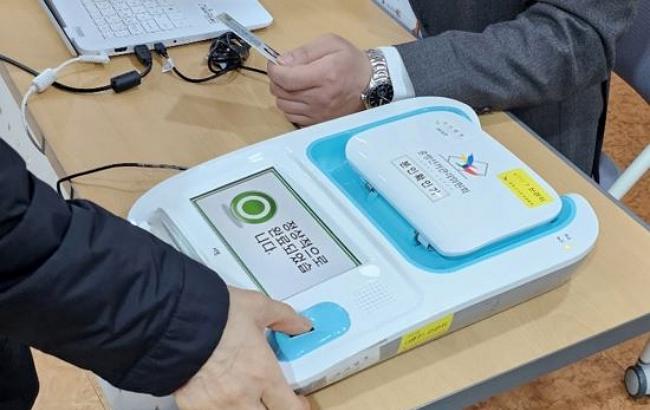 [Analysis] The 'Self-Verification Device' Seen in the Daegu Case... Concerns of Infringement on the Right to Vote 'Become Reality'
Identity verification device installed at an early voting station. [Photo=Yonhap News] The First Gateway to Guaranteeing the Right to Vote Has Collapsed The essence of the controversy surrou
[Analysis] The 'Self-Verification Device' Seen in the Daegu Case... Concerns of Infringement on the Right to Vote 'Become Reality'
Identity verification device installed at an early voting station. [Photo=Yonhap News] The First Gateway to Guaranteeing the Right to Vote Has Collapsed The essence of the controversy surrou
 [HANMI DATA LAB] June Week 3 (15-19) Money Insight
The left side of the screen contrasts growth assets such as AI, semiconductors, automobiles, and industrial equipment, while the right side displays defensive assets like the Federal Reserve, banks, a
[HANMI DATA LAB] June Week 3 (15-19) Money Insight
The left side of the screen contrasts growth assets such as AI, semiconductors, automobiles, and industrial equipment, while the right side displays defensive assets like the Federal Reserve, banks, a
 [Travel Destinations for the Month of National Defense] ③ Walking the Border Area of the Demilitarized Zone... DMZ Peace Trail Goseong Course
'DMZ Peace Road,' where visitors can see the ecological, cultural, and historical resources of the border areas of the Demilitarized Zone and experience the preciousness of peace firsthand. [Photo by
[Travel Destinations for the Month of National Defense] ③ Walking the Border Area of the Demilitarized Zone... DMZ Peace Trail Goseong Course
'DMZ Peace Road,' where visitors can see the ecological, cultural, and historical resources of the border areas of the Demilitarized Zone and experience the preciousness of peace firsthand. [Photo by
 [Photo] Current status of Chairman Hwang Kyo-ahn and lawyer Park Joo-hyun attending the US election fraud fighter summit
Lawyer Park Joo-hyun with lawyer Peter Ticktin, who was pardoned by U.S. President Donald Trump. [Facebook]Hwang Kyo-ahn, leader of the Liberty and Innovation Party (second from left), informing about
[Photo] Current status of Chairman Hwang Kyo-ahn and lawyer Park Joo-hyun attending the US election fraud fighter summit
Lawyer Park Joo-hyun with lawyer Peter Ticktin, who was pardoned by U.S. President Donald Trump. [Facebook]Hwang Kyo-ahn, leader of the Liberty and Innovation Party (second from left), informing about
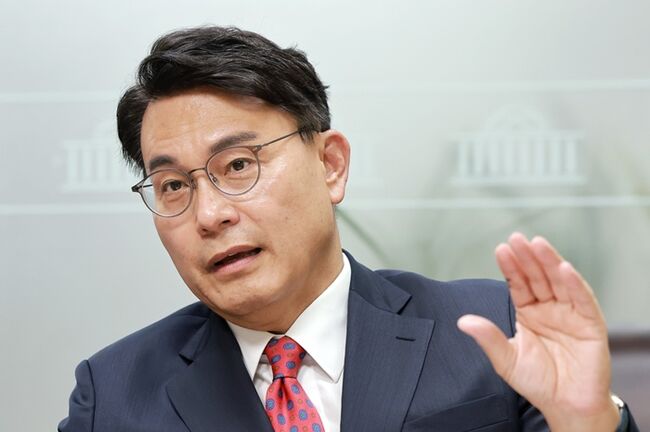 [Reporter Lee Sang-ro's Open Letter] "Chairman Yoon Sang-hyun of the National Assembly Audit and Inspection Committee, this cannot be glossed over with a flawed election"
Chairman of the Special Committee for National Audit, Yoon Sang-hyun [Photo=Yonhap News]To Chairman Yoon Sang-hyun of the Special Committee for National Audit, I extend my best wishes and write t
[Reporter Lee Sang-ro's Open Letter] "Chairman Yoon Sang-hyun of the National Assembly Audit and Inspection Committee, this cannot be glossed over with a flawed election"
Chairman of the Special Committee for National Audit, Yoon Sang-hyun [Photo=Yonhap News]To Chairman Yoon Sang-hyun of the Special Committee for National Audit, I extend my best wishes and write t
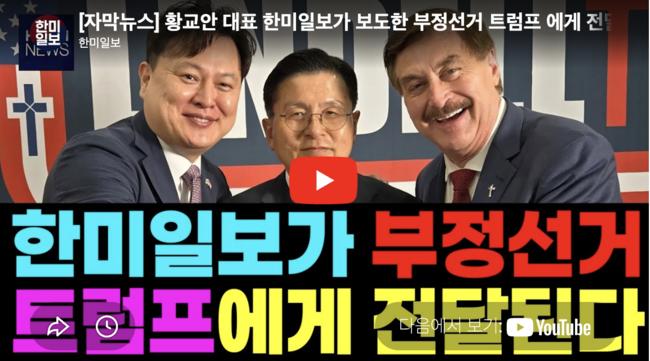 [Video] 'Trump's close friend' Lindell "I will inform Trump about South Korea's fraudulent election"
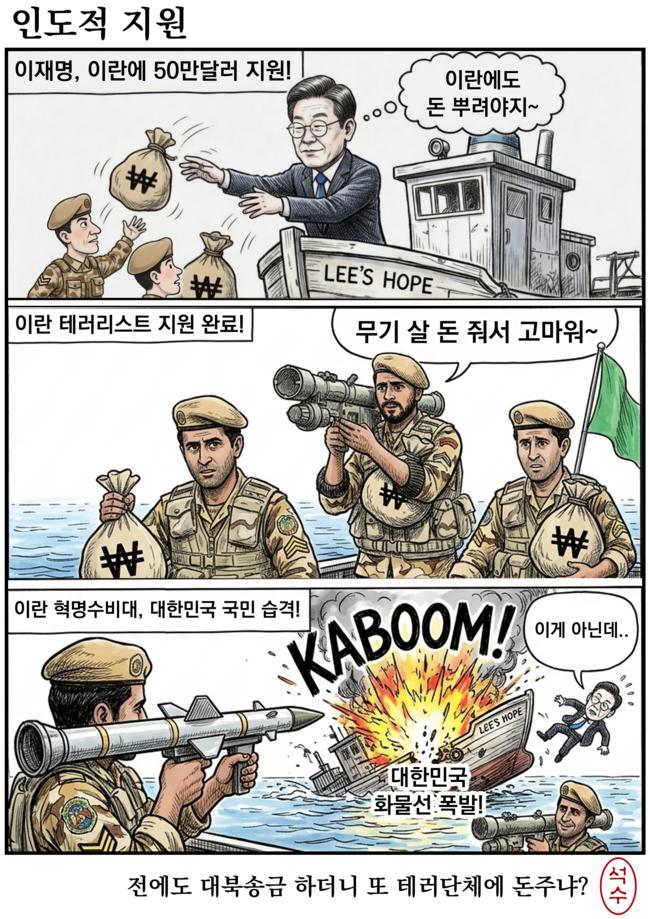 [Editorial Cartoon] Humanitarian Aid

 List
List