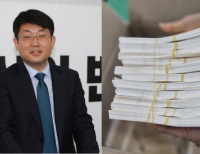
Leftist poet Ko Un and his poetry. [Photo=SBS News (2016.12.28.)] Reading the poetry of leftist poets evokes a strangely similar feeling.
The poets may differ, their backgrounds may differ, and the eras may differ, yet the emotions left after reading them are largely the same.
A heavy heart, lingering anger, a sense of apology, and an pressure to not look away. This indicates that leftist poetry has a consistent method of emotional manipulation.
The Core Emotions of Leftist Poetry: 'Anger,' 'Compassion,' and 'Guilt'
In leftist poetry, emotions do not originate from personal daily life.
The morning sunlight, trivial love affairs, or personal joys are rarely the starting point.
Instead, society appears from the outset. Large, weighty subjects like systems, nations, power, capital, and history are laid out first. Then, the wounded are placed beneath them. Their poems always begin with this structure.
At this point, the characters in the poem are individuals, but they are also symbols. They may appear as people with specific faces, but in reality, they are presented within the single framework of "oppressed beings."
These characters are without fault. They are not foolish, not cowardly, and are free from any sense of responsibility. Their suffering is always externally imposed. This setup ensures that the direction of anger remains unwavering.
The first core emotion in leftist poetry is anger. However, this anger does not explode. It does not involve shouting or the outpouring of curses. Instead, it persists for a long time in a low tone. It is a subdued anger, close to resentment.
This method is quite effective. The reader feels a sense of shared suffering rather than feeling attacked. Thus, their emotional defenses are lowered.
Following anger comes compassion. Compassion is extremely important in leftist poetry. The objects of compassion are generally the poor, the excluded, the defeated, and the unremembered.
These figures are less like individuals with concrete lives and more like moral markers. They are to be pitied, protected, and should not be doubted.
When enough compassion has accumulated, another emotion arises in the reader's heart: guilt. The question, "What have I done about that suffering?" naturally surfaces.
The poem does not ask directly. Instead, through the flow of emotion, it brings the reader to that point. After reading, there remains an uncomfortable feeling that one shouldn't feel at ease.
At this juncture, leftist poetry does not let the reader off the hook. While it may seem to demand action, what it actually demands is not action, but an attitude.
It demands more suffering, greater sensitivity, and increased anger. It does not state what one should do, but it clearly dictates what one should feel.
In Leftist Poetry, Emotion is Morality
Therefore, in leftist poetry, emotion becomes morality. If one does not feel sufficient anger, they become insensitive; if they do not feel compassion, they become cold; and if they do not feel guilt, they become immoral.
If one's heart is not significantly moved after reading a poem, the reader begins to self-examine. The poem functions less as art and more as a moral yardstick.
This emotional structure is also repeated in the way history is handled. In leftist poetry, the past is not an object of analysis. Factual details or complex circumstances are not important.
What matters are the grievances and the wounds. Past events are invoked in the form of mourning. This mourning never ends. The wounds are always kept in the present tense.
When emotions are continuously maintained in this way, a community is formed. Those who read the same poem and feel the same emotions naturally become allies. A sense of identity emerges: "We are the rememberers, we are the angry ones, we are the suffering ones." This emotional community is very strong. It cannot be broken by debate. Emotion is always more powerful than explanation.
The personal history of the leftist poet also reinforces this structure. Experiences such as imprisonment, surveillance, exclusion, and frustration become the poet's moral assets. The experience of suffering lends weight to the words.
Consequently, in the sphere of leftist poetry, the poet's life experiences are often mentioned before their work. The extent of their suffering is equated with their qualification to speak.
As this emotional structure has been repeated for a long time, one problem arises and becomes familiar. While the poetry uses new language, the flow of emotion is always the same.
The reader is initially moved, but at some point, they begin to anticipate. They know anger will come, they know compassion will follow, and they know it will conclude with guilt. Surprise disappears.
Despite this, leftist poetry continues to wield influence. Emotion is faster than explanation and more direct than logic. The power to move people always stems from emotion. Leftist poetry has accurately utilized this point for a long time.
Understanding this emotional structure removes the need to necessarily respect leftist poetry. When emotions are so deliberately constructed and repeatedly used to guide the reader's reaction in a specific direction, it is closer to propaganda than poetry.
Leftist poetry leaves no room for the reader to think. It predetermines the sequence of anger, compassion, and guilt, and demands that one follow only that path. At this point, the poem becomes moralistic instruction rather than art.
The problem is that this method has been repeated for decades. Only the poetic language has changed; the emotional framework remains the same. There is no novelty, and no complexity of the human inner self.
It covers reality with emotion and simplifies human beings with symbols. Instead of broadening the world through emotion, writing that confines the world with emotion is difficult to call literature. Therefore, contemporary leftist poetry is neither dangerous nor profound. It is merely cliché, and close to waste that parasitically clings to sentiment.
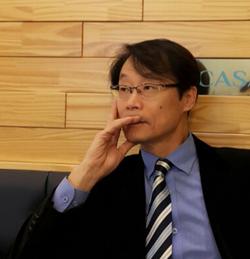
◆ Songsan
Poet and researcher of history and philosophy. He served as a director of the Syngman Rhee Institute and currently works as a research advisor for the Korean Modern and Contemporary History Research Society and as the representative of the philosophical forum Lyceum. He has published four poetry collections and co-translated 'Hero of Hook Point'. Songsan is a pen name.

 [Statement by the Seo-beo-kka Korea Military Academy Save-the-Nation Comrades Association] ㉛ Recount the Votes Publicly, as the Previous Recount Concealed Election Fraud
Tongyeong Mayoral Election Recount [Photo=Yonhap News]South Korea's liberal democracy is dying. The National Election Commission (NEC) and the judiciary, which have plummeted into criminal syndicates
[Statement by the Seo-beo-kka Korea Military Academy Save-the-Nation Comrades Association] ㉛ Recount the Votes Publicly, as the Previous Recount Concealed Election Fraud
Tongyeong Mayoral Election Recount [Photo=Yonhap News]South Korea's liberal democracy is dying. The National Election Commission (NEC) and the judiciary, which have plummeted into criminal syndicates
 What is the significance of the "Trump 2028" red hats that keep making a comeback?
It is noteworthy that President Donald Trump is "intentionally" fueling controversy over whether he can actually run in the 2028 presidential election, even though it is "highly likely he is seriously
What is the significance of the "Trump 2028" red hats that keep making a comeback?
It is noteworthy that President Donald Trump is "intentionally" fueling controversy over whether he can actually run in the 2028 presidential election, even though it is "highly likely he is seriously
 Jin Cummings: "North Korea says it will increase the number of spies, so what is the government doing?"
U.S. political columnist Gene Cummings has publicly questioned the South Korean government, asking, "North Korea is announcing plans to increase its number of spies, yet what is the South Korean
Jin Cummings: "North Korea says it will increase the number of spies, so what is the government doing?"
U.S. political columnist Gene Cummings has publicly questioned the South Korean government, asking, "North Korea is announcing plans to increase its number of spies, yet what is the South Korean
 Attorney Do Tae-woo: “Discrepancies in Voter Count and Improper Sealing Confirmed in Tongyeong Mayoral Recount… Official Request for Further Verification Filed with Gyeongnam Election Commission”
A bundle of out-of-district early voting ballots photographed by attorney Do Tae-woo at the Tongyeong mayoral election recount site. A clear, solid line visible on the side of the ballots raises suspi
Attorney Do Tae-woo: “Discrepancies in Voter Count and Improper Sealing Confirmed in Tongyeong Mayoral Recount… Official Request for Further Verification Filed with Gyeongnam Election Commission”
A bundle of out-of-district early voting ballots photographed by attorney Do Tae-woo at the Tongyeong mayoral election recount site. A clear, solid line visible on the side of the ballots raises suspi
 Stock Market Crash 'Black Tuesday'… KOSPI down 10.8%, KOSDAQ down 7.7%
The KOSPI fell by more than 5% in early trading on the 28th, triggering a sell-side sidecar.On the 28th, the KOSPI plunged by more than 10%.Due to the sharp decline, a sell-side sidecar—a temporary
Stock Market Crash 'Black Tuesday'… KOSPI down 10.8%, KOSDAQ down 7.7%
The KOSPI fell by more than 5% in early trading on the 28th, triggering a sell-side sidecar.On the 28th, the KOSPI plunged by more than 10%.Due to the sharp decline, a sell-side sidecar—a temporary
 [World Heritage Committee] 25 New World Heritage Sites Inscribed in Busan… South Korea Successfully Expands 'Getbol' Listing
The Chairperson of the World Heritage Committee speaks at the plenary session of the 48th session of the World Heritage Committee, held at BEXCO in Busan on the 20th. [Photo: Yonhap News]A total of 25
[World Heritage Committee] 25 New World Heritage Sites Inscribed in Busan… South Korea Successfully Expands 'Getbol' Listing
The Chairperson of the World Heritage Committee speaks at the plenary session of the 48th session of the World Heritage Committee, held at BEXCO in Busan on the 20th. [Photo: Yonhap News]A total of 25
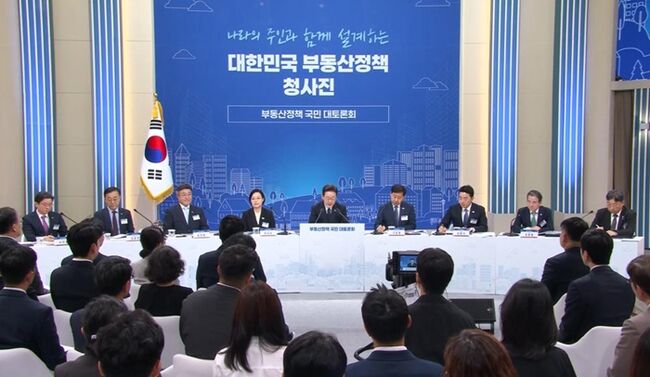 [Liberal Democratic Party Statement] Calling it a Grand Real Estate Debate… It Was Nothing More Than a Private Party Among Themselves
The 'National Grand Debate on Real Estate Policy' held on July 23rd and 27th. [Photo=Yonhap News]The 'National Grand Debate on Real Estate Policy,' hosted by the Lee Jae-myung administration under the
[Liberal Democratic Party Statement] Calling it a Grand Real Estate Debate… It Was Nothing More Than a Private Party Among Themselves
The 'National Grand Debate on Real Estate Policy' held on July 23rd and 27th. [Photo=Yonhap News]The 'National Grand Debate on Real Estate Policy,' hosted by the Lee Jae-myung administration under the
 [Photo] Evidence of Election Fraud Flooding U.S. Media… Trump Had 2.7 Million Votes Stolen
 [Video] U.S. Semiquincentennial Air Show... 'Art in the Sky' streaks across New York
 [Editorial Cartoon] A Draconian Law That Undermines Freedom of Expression

 List
List