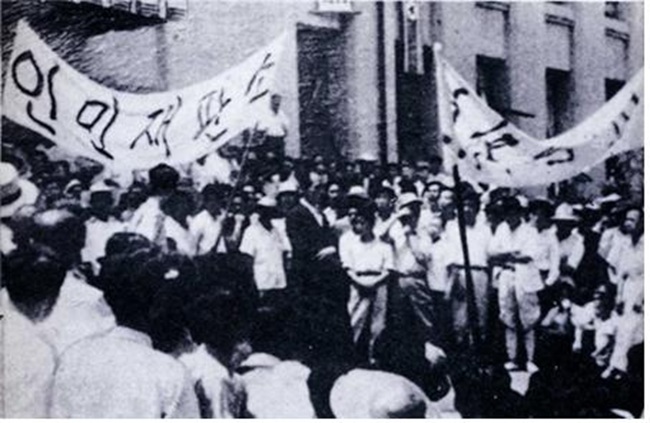
Three days after the outbreak of the Korean War, the People's Army occupied Seoul and held people's trials throughout the city, where defendants were pierced in the chest with death-dealing spears and their heads were smashed with clubs on the spot, leading to their execution.
On June 28, 1950, the Korean People's Army entered Seoul. This was just three days after the war began.
For the approximately three months until September 28, when the ROK Army and UN forces recaptured Seoul, the city was not merely a combat zone. During this period, Seoul was an occupied city where the North Korean regime tested its direct governance methods in the capital of South Korea.
While this period is often collectively described as a time of chaos in the early stages of the war, North Korea actually managed and controlled Seoul in a very organized and consistent manner during this time.
People's Trials Without Judges or Lawyers
North Korea did not stop at militarily occupying Seoul. They rapidly deployed a comprehensive control system encompassing administration, public security, propaganda, and punishment.
One of the core mechanisms was the so-called "people's trial." While the name might suggest a judicial procedure, people's trials were entirely different from what we understand as a trial.
There were no judges, no lawyers, and no procedures for contesting evidence. People's trials were not a system for making judgments but merely a format to publicly stigmatize and justify the elimination of already categorized individuals.
Immediately after the occupation, a system of People's Committees was established in Seoul. The Provisional Seoul People's Committee simultaneously seized administrative, public security, and judicial functions. The key figure in this system was Lee Seung-yeop of the South Korean Labor Party.
The People's Committees and security units replaced existing police organizations and administrative networks, rapidly dismantling and reorganizing the pre-occupation social order. In this process, law was not the standard for establishing social order. The criteria were class, background, and social standing in South Korea before the occupation.
People's trials were not held in formal courtrooms. Everyday spaces such as school playgrounds, in front of community centers, and neighborhood open lots became the trial venues. Residents were not gathered voluntarily. They were forcibly mobilized.
The purpose was to make everyone witness who was brought forward, for what reason, and what few words led to their punishment. When one person was publicly dealt with, the remaining people immediately learned.
They internalized the fact that it was safer not to ask questions, that not drawing attention was directly linked to survival, and that silence was the most rational attitude.
Priority targets for trials included former police officers, civil servants, teachers, religious figures, members of right-wing organizations, and individuals with a history of anti-communist activities. The crucial point here was not what individuals had actually done. Their occupations and backgrounds in South Korea before the occupation themselves became the charges.
People Lost to Summary Executions and Massacres
Following the people's trials, massacres and summary executions ensued.
 The moment the words "reactionary elements," "collaborators," or "targets for liquidation" were attached, the person ceased to be an individual and became a target for elimination.
Shootings, beatings, and mass executions were repeated, and people disappeared along the Han River, near cemeteries, and around prisons.
A representative case frequently mentioned among these is the Seoul National University Hospital massacre. Around June 28, 1950, patients and wounded soldiers at Seoul National University Hospital were collectively murdered.
While the scale of casualties varies by source, it is generally described as being around 700 to 900 people. This was a large-scale massacre difficult to explain as accidental casualties during combat.
The violence during the occupation did not stop at trials and massacres. Abductions and forced displacements were carried out systematically.
After the tide of the war changed rapidly following the Incheon Landing Operation on September 15, 1950, efforts to move prisoners from detention facilities in Seoul and Gyeonggi Province to the north accelerated.
According to data from the Truth and Reconciliation Commission, around September 17, 1950, prisoners from Seodaemun Prison were collectively transported, with records indicating a scale of up to 3,000 people. Other facilities, such as Mapo Prison, experienced similar events.
The targets of these abductions were broadly defined, including those in the legal profession, civil servants, police officers, educators, religious figures, anti-communist activists, and businessmen.
This was not mere retribution but the result of categorizing human resources that needed to be eliminated or secured in the occupied territories. The idea of "securing necessary personnel," which had existed even before the war, was materialized within the governance of the occupation period.
Such violence was not solely composed of large-scale incidents. Roundups and disappearances at the neighborhood level were repeated. In areas like Gongdeok-dong in Mapo-gu, Jongno, and Yeongdeungpo, people who were in hiding due to their backgrounds were discovered and taken away.
Their families searched for them, holding petitions, without knowing where they were taken. However, in many cases, they never returned.
These incidents were not widely reported in newspapers and were not detailed in official records. However, the accumulation of these events led the city of Seoul to rapidly descend into silence.
All of this was not an accidental event occurring amidst the chaos of war. It was a case where the North Korean regime applied the method of class elimination, which it had already implemented in the northern regions, directly to the capital of South Korea.
Truth Buried Under the Phrase "Tragedy of War"
Although cloaked in the guise of justice, it was, in reality, political elimination. Background and connections, rather than specific actions of individuals, became the criteria for judgment, and trials functioned as a mechanism to rationalize punishment.
Despite this, these events were not properly discussed for a long time after the war ended. The damage of the Korean War was so immense that the events that occurred during the occupation of Seoul were all bundled under the phrase "tragedy of war."
In that process, it was spoken who died, but it was rarely mentioned who killed them. The victims remained, while the perpetrators faded.
This silence was not formed naturally over time. The post-liberation historical narrative, centered on the left, consistently placed itself in the position of the victim. Within the discourse of being oppressed by the Japanese, the US military government, and the South Korean government, the left was always the one being subjected to oppression and was depicted as never having committed violence. The perpetrators were always external, and the narrative of themselves as victims solidified.
However, the people's trials and massacres during the 1950 Seoul occupation directly clashed with this narrative. The events that occurred in Seoul during this period were examples of how the left, when it seized power, categorized and eliminated people.
Therefore, these events became an uncomfortable presence. The more they were examined, the more they did not align with the existing victim narrative.
As a result, these events remain unexplained. Over time, the people's trials and massacres came to be remembered not as specific incidents but as vague tragedies. The problem is not the past itself. The bigger problem is that the state of not speaking about who did what then continues to this day.
In Seoul in 1950, there were recurring scenes. People were summoned to neighborhood open lots, a name was called, and someone was dragged forward. There were no lengthy explanations. There were only a few pronouncements, and afterward, that person never returned.
What drove this process was not law or evidence. It was words like "reactionary elements," "collaborators," and "targets for liquidation." The moment these words were attached, the person ceased to be an individual and became a target for elimination. Judgment vanished, and the next step followed too quickly.
History should not be a tool for providing comfort. The reason for speaking about the people's trials and massacres during the Seoul occupation is not to repeat sorrow. It is to leave behind how methods that could isolate and eliminate people, even without killing them, solely through words and pronouncements, actually functioned.
If this is not recorded, violence may seem to have disappeared, but its methods remain. Silence is not neutrality. Silence is a seal. And concealed perpetration, over time, reappears under different words, different names.
◆ Matsuyama
A poet and researcher of history and philosophy. Former director of the Syngman Rhee Institute. Currently serves as a senior researcher at the Korean Modern and Contemporary History Research Association and as the representative of the philosophy forum Rikeion. He has published four collections of poetry, co-translated "Heroes of Hooko Gorge," and authored the historical psychology commentary "Joseon Became a Myth" (2026). He is actively engaged in research and practice within the liberal cultural movement. Matsuyama is a pen name.

 [Statement by the Seo-beo-kka Korea Military Academy Save-the-Nation Comrades Association] ㉛ Recount the Votes Publicly, as the Previous Recount Concealed Election Fraud
Tongyeong Mayoral Election Recount [Photo=Yonhap News]South Korea's liberal democracy is dying. The National Election Commission (NEC) and the judiciary, which have plummeted into criminal syndicates
[Statement by the Seo-beo-kka Korea Military Academy Save-the-Nation Comrades Association] ㉛ Recount the Votes Publicly, as the Previous Recount Concealed Election Fraud
Tongyeong Mayoral Election Recount [Photo=Yonhap News]South Korea's liberal democracy is dying. The National Election Commission (NEC) and the judiciary, which have plummeted into criminal syndicates
 What is the significance of the "Trump 2028" red hats that keep making a comeback?
It is noteworthy that President Donald Trump is "intentionally" fueling controversy over whether he can actually run in the 2028 presidential election, even though it is "highly likely he is seriously
What is the significance of the "Trump 2028" red hats that keep making a comeback?
It is noteworthy that President Donald Trump is "intentionally" fueling controversy over whether he can actually run in the 2028 presidential election, even though it is "highly likely he is seriously
 Jin Cummings: "North Korea says it will increase the number of spies, so what is the government doing?"
U.S. political columnist Gene Cummings has publicly questioned the South Korean government, asking, "North Korea is announcing plans to increase its number of spies, yet what is the South Korean
Jin Cummings: "North Korea says it will increase the number of spies, so what is the government doing?"
U.S. political columnist Gene Cummings has publicly questioned the South Korean government, asking, "North Korea is announcing plans to increase its number of spies, yet what is the South Korean
 Attorney Do Tae-woo: “Discrepancies in Voter Count and Improper Sealing Confirmed in Tongyeong Mayoral Recount… Official Request for Further Verification Filed with Gyeongnam Election Commission”
A bundle of out-of-district early voting ballots photographed by attorney Do Tae-woo at the Tongyeong mayoral election recount site. A clear, solid line visible on the side of the ballots raises suspi
Attorney Do Tae-woo: “Discrepancies in Voter Count and Improper Sealing Confirmed in Tongyeong Mayoral Recount… Official Request for Further Verification Filed with Gyeongnam Election Commission”
A bundle of out-of-district early voting ballots photographed by attorney Do Tae-woo at the Tongyeong mayoral election recount site. A clear, solid line visible on the side of the ballots raises suspi
 Stock Market Crash 'Black Tuesday'… KOSPI down 10.8%, KOSDAQ down 7.7%
The KOSPI fell by more than 5% in early trading on the 28th, triggering a sell-side sidecar.On the 28th, the KOSPI plunged by more than 10%.Due to the sharp decline, a sell-side sidecar—a temporary
Stock Market Crash 'Black Tuesday'… KOSPI down 10.8%, KOSDAQ down 7.7%
The KOSPI fell by more than 5% in early trading on the 28th, triggering a sell-side sidecar.On the 28th, the KOSPI plunged by more than 10%.Due to the sharp decline, a sell-side sidecar—a temporary
 [World Heritage Committee] 25 New World Heritage Sites Inscribed in Busan… South Korea Successfully Expands 'Getbol' Listing
The Chairperson of the World Heritage Committee speaks at the plenary session of the 48th session of the World Heritage Committee, held at BEXCO in Busan on the 20th. [Photo: Yonhap News]A total of 25
[World Heritage Committee] 25 New World Heritage Sites Inscribed in Busan… South Korea Successfully Expands 'Getbol' Listing
The Chairperson of the World Heritage Committee speaks at the plenary session of the 48th session of the World Heritage Committee, held at BEXCO in Busan on the 20th. [Photo: Yonhap News]A total of 25
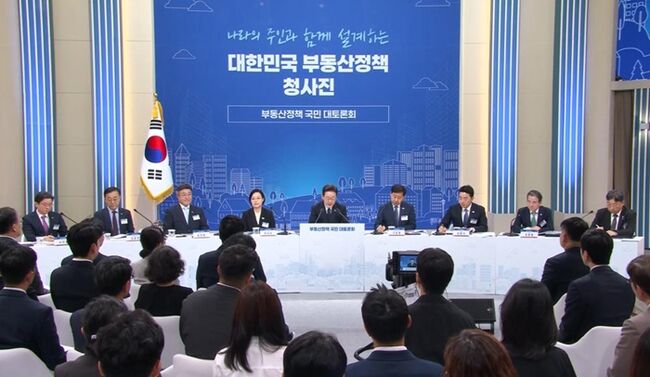 [Liberal Democratic Party Statement] Calling it a Grand Real Estate Debate… It Was Nothing More Than a Private Party Among Themselves
The 'National Grand Debate on Real Estate Policy' held on July 23rd and 27th. [Photo=Yonhap News]The 'National Grand Debate on Real Estate Policy,' hosted by the Lee Jae-myung administration under the
[Liberal Democratic Party Statement] Calling it a Grand Real Estate Debate… It Was Nothing More Than a Private Party Among Themselves
The 'National Grand Debate on Real Estate Policy' held on July 23rd and 27th. [Photo=Yonhap News]The 'National Grand Debate on Real Estate Policy,' hosted by the Lee Jae-myung administration under the
 [Photo] Evidence of Election Fraud Flooding U.S. Media… Trump Had 2.7 Million Votes Stolen
 [Video] U.S. Semiquincentennial Air Show... 'Art in the Sky' streaks across New York
 [Editorial Cartoon] A Draconian Law That Undermines Freedom of Expression

 List
List