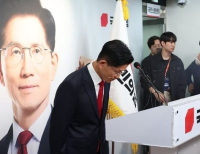
On June 2, one day before the 21st presidential election, an employee is checking the screen of the integrated CCTV control center for ballot box storage at the National Election Commission in Gwacheon. 2025.6.2 [Photo = Yonhap News]
It's a matter of 'record,' not 'trust'
The most persistent and recurring point in the controversy over fraudulent elections has been the ballot boxes.
Beyond who voted (voter verification) and how they were processed (electronically), there are questions about where the ballots actually went, how they were transported, and under what conditions they were stored.
These questions did not suddenly arise from a specific incident.
They are questions that have structurally accumulated since the introduction of the out-of-district absentee voting system.
The Realistic Journey of Out-of-District Absentee Ballots
After being sent from polling stations, out-of-district absentee ballots are transported to their respective electoral districts through the Korea Post's sorting and transportation system.
Subsequently, the National Election Commission receives and stores them, and they are then transported to the counting stations on the day of the count.
A single ballot follows this path:
Polling station → Post office sorting → Post office transportation → Election Commission receipt → Storage → Transport to counting station
The issue is not that this route is illegal.
The problem is that this long physical transit route is not connected with 'verifiable records.'
The Longest Leg, the Fewest Records
The core of the out-of-district absentee voting controversy is not the post office itself.
It is the fact that the postal route remains a 'trust-based segment.'
In logistics, exports, and pharmaceutical transport, the time of sorting, route of travel, duration of stops, and handover are all recorded.
However, for out-of-district absentee ballots, only explanations of "processed without issues" are repeated, with limited externally reproducible records.
The segment that involves the most hands and travels the longest time is structurally the one with the least records.
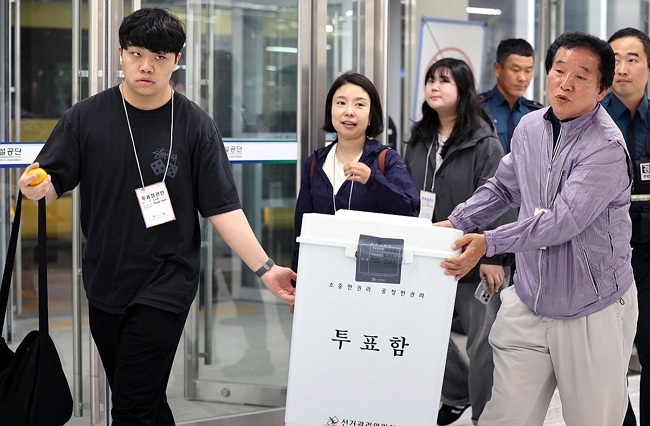 On the afternoon of the 21st presidential election day, March 3, National Election Commission officials move ballot boxes at the Nam-gu counting station set up at Munsu Gymnasium in Nam-gu, Ulsan. 2025.6.3 [Photo = Yonhap News]
The Solution is Simple: Electronic Seals + GPS + Chain of Custody
The issues of transportation and storage of out-of-district absentee ballots do not require new technologies. Standard management practices already used across industries can be applied.
• Electronic Seals: Automatically record whether they have been opened or tampered with.
• GPS Tracking: Objective recording of travel routes and stop times.
• Chain of Custody (CoC): Continuous record of the entire process of receipt, storage, and transport.
Combining these three elements allows for post-event reconstruction of when, where, under whose responsibility, and in what condition the ballot box was.
This is a record of status, not 'surveillance.'
Not an Infringement on Postal Authority, but Separation of Responsibility
Such a recording system does not infringe upon the authority of the postal service. The post office continues to perform sorting and transportation as before.
The only difference is that the process is left as an automatic record. There is no judgment or intervention. Only movement and status remain.
This approach actually protects both the postal service and the election commission.
This is because it creates a structure where records speak for themselves, rather than individuals or institutions bearing the responsibility for explanations.
The Period After the Election Commission's Storage Must Also Be Bound into a Single Chain
After the postal segment, the election commission receives and stores the ballot boxes. It is meaningful only when all subsequent processes—access records to storage, CCTV footage, seal status checks, and transport to the counting station—are connected as a single chain.
It is unacceptable for only the postal segment to be recorded while the election commission's segment is blank, or vice versa.
A chain is only a chain when it is unbroken.
Without physical management, electronic verification is also incomplete. No matter how sophisticated electronic records are, the controversy will not end without records of physical movement and storage.
Voting is a physical act before it is data.
Electronic systems and ballot boxes are not separate issues but a single system. Therefore, the discussion of ③ electronic systems must necessarily lead to ④ the movement and storage of ballot boxes.
The essence of the ballot box issue is not 'distrust.' The ballot box controversy is not a problem caused by excessive public distrust. It is a problem arising from the lack of verifiable records.
With records, suspicions turn into questions, and questions are closed by verification.
Without records, no explanation will suffice.
Click here to reserve your subscription to Weekly Hanmi Ilbo
Inquiries: 02-2088-1201
⑤ The Custodian of Records — Who holds the records determines trust
The reason why a third party, neither the election commission nor investigative agencies, must store the records. The final link in the system is outlined, focusing on the roles of the Board of Audit and Inspection and the National Assembly.

 [Statement by the Seo-beo-kka Korea Military Academy Save-the-Nation Comrades Association] ㉛ Recount the Votes Publicly, as the Previous Recount Concealed Election Fraud
Tongyeong Mayoral Election Recount [Photo=Yonhap News]South Korea's liberal democracy is dying. The National Election Commission (NEC) and the judiciary, which have plummeted into criminal syndicates
[Statement by the Seo-beo-kka Korea Military Academy Save-the-Nation Comrades Association] ㉛ Recount the Votes Publicly, as the Previous Recount Concealed Election Fraud
Tongyeong Mayoral Election Recount [Photo=Yonhap News]South Korea's liberal democracy is dying. The National Election Commission (NEC) and the judiciary, which have plummeted into criminal syndicates
 What is the significance of the "Trump 2028" red hats that keep making a comeback?
It is noteworthy that President Donald Trump is "intentionally" fueling controversy over whether he can actually run in the 2028 presidential election, even though it is "highly likely he is seriously
What is the significance of the "Trump 2028" red hats that keep making a comeback?
It is noteworthy that President Donald Trump is "intentionally" fueling controversy over whether he can actually run in the 2028 presidential election, even though it is "highly likely he is seriously
 Jin Cummings: "North Korea says it will increase the number of spies, so what is the government doing?"
U.S. political columnist Gene Cummings has publicly questioned the South Korean government, asking, "North Korea is announcing plans to increase its number of spies, yet what is the South Korean
Jin Cummings: "North Korea says it will increase the number of spies, so what is the government doing?"
U.S. political columnist Gene Cummings has publicly questioned the South Korean government, asking, "North Korea is announcing plans to increase its number of spies, yet what is the South Korean
 Attorney Do Tae-woo: “Discrepancies in Voter Count and Improper Sealing Confirmed in Tongyeong Mayoral Recount… Official Request for Further Verification Filed with Gyeongnam Election Commission”
A bundle of out-of-district early voting ballots photographed by attorney Do Tae-woo at the Tongyeong mayoral election recount site. A clear, solid line visible on the side of the ballots raises suspi
Attorney Do Tae-woo: “Discrepancies in Voter Count and Improper Sealing Confirmed in Tongyeong Mayoral Recount… Official Request for Further Verification Filed with Gyeongnam Election Commission”
A bundle of out-of-district early voting ballots photographed by attorney Do Tae-woo at the Tongyeong mayoral election recount site. A clear, solid line visible on the side of the ballots raises suspi
 Stock Market Crash 'Black Tuesday'… KOSPI down 10.8%, KOSDAQ down 7.7%
The KOSPI fell by more than 5% in early trading on the 28th, triggering a sell-side sidecar.On the 28th, the KOSPI plunged by more than 10%.Due to the sharp decline, a sell-side sidecar—a temporary
Stock Market Crash 'Black Tuesday'… KOSPI down 10.8%, KOSDAQ down 7.7%
The KOSPI fell by more than 5% in early trading on the 28th, triggering a sell-side sidecar.On the 28th, the KOSPI plunged by more than 10%.Due to the sharp decline, a sell-side sidecar—a temporary
 [World Heritage Committee] 25 New World Heritage Sites Inscribed in Busan… South Korea Successfully Expands 'Getbol' Listing
The Chairperson of the World Heritage Committee speaks at the plenary session of the 48th session of the World Heritage Committee, held at BEXCO in Busan on the 20th. [Photo: Yonhap News]A total of 25
[World Heritage Committee] 25 New World Heritage Sites Inscribed in Busan… South Korea Successfully Expands 'Getbol' Listing
The Chairperson of the World Heritage Committee speaks at the plenary session of the 48th session of the World Heritage Committee, held at BEXCO in Busan on the 20th. [Photo: Yonhap News]A total of 25
 [Liberal Democratic Party Statement] Calling it a Grand Real Estate Debate… It Was Nothing More Than a Private Party Among Themselves
The 'National Grand Debate on Real Estate Policy' held on July 23rd and 27th. [Photo=Yonhap News]The 'National Grand Debate on Real Estate Policy,' hosted by the Lee Jae-myung administration under the
[Liberal Democratic Party Statement] Calling it a Grand Real Estate Debate… It Was Nothing More Than a Private Party Among Themselves
The 'National Grand Debate on Real Estate Policy' held on July 23rd and 27th. [Photo=Yonhap News]The 'National Grand Debate on Real Estate Policy,' hosted by the Lee Jae-myung administration under the
 [Photo] Evidence of Election Fraud Flooding U.S. Media… Trump Had 2.7 Million Votes Stolen
 [Video] U.S. Semiquincentennial Air Show... 'Art in the Sky' streaks across New York
 [Editorial Cartoon] A Draconian Law That Undermines Freedom of Expression

 List
List