Iran's large-scale attack was not a simple missile launch but a saturation attack involving the simultaneous deployment of multi-layered, multi-type forces. Since the start of the war, Iran has operated over 500 ballistic and cruise missiles and more than 2,000 drones, a significant number of which were fired simultaneously targeting Israel and U.S. military bases.
Some drones utilized AI-based path alteration and evasion maneuvers, making interception calculations difficult. The missiles dispersed the interception systems through multiple, staggered flight paths. Israel and the United States, mobilizing their combined air defense network, intercepted most of them. The Iranian leadership appeared to be in a state of panic, and their forces seemed to be at a standstill.
This event demonstrated that warfare has shifted towards AI-centric operations, surpassing human decision-making speed. The entire process unfolded in milliseconds, leaving little room for human intervention. War has already transitioned into a domain led by AI.
Meanwhile, South Korea's debate over the transfer of wartime operational control (OPCON) remains stuck on a childish question of 'who holds wartime command authority,' akin to a Joseon Dynasty dispute. The speed of warfare has accelerated to the speed of light in the 21st century, yet the debate's frame is trapped in the past, reminiscent of factional strife during the Joseon Dynasty.
The most significant lesson from Iran's massive attack is that the outcome of modern warfare is determined not by command authority but by the 'connectivity of the battlefield network.' Israel was able to withstand the saturation attack not due to its independent capabilities but thanks to an automated combined air defense network involving the U.S., UK, France, and Jordan.
U.S. early warning satellites, long-range radars, electronic warfare equipment, integrated command and control systems, and global data links operated in real-time, with detection, tracking, and interception functioning as a single system. Without this network, the outcome would have been vastly different. This case clearly shows that modern warfare can no longer be handled by individual nations' forces alone, and that alliance-based intelligence, reconnaissance, and command and control systems are crucial for survival.
If we consider whether South Korea can independently create a combined battlefield network, the answer is clear. To establish such a combined system, we need early warning satellites that detect enemy missiles first from the sky, a combination of ultra-long-range radars monitoring hundreds of kilometers away and human intelligence (HUMINT), and electronic warfare equipment to disrupt enemy communications and radar. In addition, an international data network connecting military equipment from various countries like a single system, and AI combat management technology to automatically classify incoming targets and calculate interception priorities are required.
All of this is possible only with substantial budgets and decades of technological accumulation, like the United States possesses. South Korea lacks the cost, technology, and time to build this alone. While South Korea has a strong military, it cannot independently create the 'brain and nervous system that binds the entire war together.'
Despite this, the debate over OPCON transfer, which began during the Roh Moo-hyun administration, ignores the changes in the battlefield environment. While gaining OPCON might yield the symbolic representation of 'autonomy,' it would weaken automatic interoperability with U.S. early warning satellites, Indo-Pacific regional radar networks, electronic warfare platforms, and global data links.
South Korea's air defense system is equipped with robust systems like THAAD, Cheongung, and Patriot. However, a multi-layered defense is only completed when most of these are interconnected with U.S. intelligence, reconnaissance, and electronic warfare assets. If North Korea were to launch an Iran-style saturation attack, with hundreds of drones infiltrating at low altitudes, ballistic and cruise missiles approaching on multiple axes, and some performing evasive maneuvers, the possibility of the South Korean military independently conducting detection, tracking, and interception would be extremely slim.
OPCON transfer is not a matter of 'command authority' but a matter of who can survive on the actual battlefield. OPCON transfer is merely a declaration to hoist the flag of political autonomy for a select few, and it appears to be a treasonous choice to lower the security shield that protects the lives of the citizens.
Warfare is driven by analog physics and digital algorithms, not emotions. Transferring OPCON does not enhance wartime operational capabilities. Instead, the moment you detach from the battlefield network, your chances of survival drastically decrease.
The Iranian situation delivers a stark message to South Korea's military and security apparatus. Modern warfare cannot be sustained without an alliance network; security preparedness is needed more than ever when things appear peaceful; and a modern security system focused on alliances, technology, and intelligence is the core of national survival. Network warfare issues a final ultimatum: OPCON transfer is a 'delusion that endangers national survival, an act of suicide, and a dangerous gamble that denies the reality of allied battlefields.'
What South Korea needs to do now is not pursue OPCON transfer, which harms the survival of its citizens for political pride, but to intensely research the changed nature of warfare and integrate more deeply and tightly with the U.S. on the battlefield network. Thus, we must restore the spirit of alliance championed by President Syngman Rhee. We must stop the childish act of losing the substantial right to survival for the nation and its people in pursuit of symbolic autonomy.

◆ Park Pil-kyu
Editorial Board Member, The Hankyoreh
40th graduating class, Korea Military Academy

 [Statement by the Seo-beo-kka Korea Military Academy Save-the-Nation Comrades Association] ㉛ Recount the Votes Publicly, as the Previous Recount Concealed Election Fraud
Tongyeong Mayoral Election Recount [Photo=Yonhap News]South Korea's liberal democracy is dying. The National Election Commission (NEC) and the judiciary, which have plummeted into criminal syndicates
[Statement by the Seo-beo-kka Korea Military Academy Save-the-Nation Comrades Association] ㉛ Recount the Votes Publicly, as the Previous Recount Concealed Election Fraud
Tongyeong Mayoral Election Recount [Photo=Yonhap News]South Korea's liberal democracy is dying. The National Election Commission (NEC) and the judiciary, which have plummeted into criminal syndicates
 What is the significance of the "Trump 2028" red hats that keep making a comeback?
It is noteworthy that President Donald Trump is "intentionally" fueling controversy over whether he can actually run in the 2028 presidential election, even though it is "highly likely he is seriously
What is the significance of the "Trump 2028" red hats that keep making a comeback?
It is noteworthy that President Donald Trump is "intentionally" fueling controversy over whether he can actually run in the 2028 presidential election, even though it is "highly likely he is seriously
 Jin Cummings: "North Korea says it will increase the number of spies, so what is the government doing?"
U.S. political columnist Gene Cummings has publicly questioned the South Korean government, asking, "North Korea is announcing plans to increase its number of spies, yet what is the South Korean
Jin Cummings: "North Korea says it will increase the number of spies, so what is the government doing?"
U.S. political columnist Gene Cummings has publicly questioned the South Korean government, asking, "North Korea is announcing plans to increase its number of spies, yet what is the South Korean
 Attorney Do Tae-woo: “Discrepancies in Voter Count and Improper Sealing Confirmed in Tongyeong Mayoral Recount… Official Request for Further Verification Filed with Gyeongnam Election Commission”
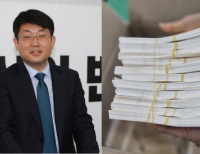
A bundle of out-of-district early voting ballots photographed by attorney Do Tae-woo at the Tongyeong mayoral election recount site. A clear, solid line visible on the side of the ballots raises suspi
Attorney Do Tae-woo: “Discrepancies in Voter Count and Improper Sealing Confirmed in Tongyeong Mayoral Recount… Official Request for Further Verification Filed with Gyeongnam Election Commission”
A bundle of out-of-district early voting ballots photographed by attorney Do Tae-woo at the Tongyeong mayoral election recount site. A clear, solid line visible on the side of the ballots raises suspi
 Stock Market Crash 'Black Tuesday'… KOSPI down 10.8%, KOSDAQ down 7.7%
The KOSPI fell by more than 5% in early trading on the 28th, triggering a sell-side sidecar.On the 28th, the KOSPI plunged by more than 10%.Due to the sharp decline, a sell-side sidecar—a temporary
Stock Market Crash 'Black Tuesday'… KOSPI down 10.8%, KOSDAQ down 7.7%
The KOSPI fell by more than 5% in early trading on the 28th, triggering a sell-side sidecar.On the 28th, the KOSPI plunged by more than 10%.Due to the sharp decline, a sell-side sidecar—a temporary
 [World Heritage Committee] 25 New World Heritage Sites Inscribed in Busan… South Korea Successfully Expands 'Getbol' Listing
The Chairperson of the World Heritage Committee speaks at the plenary session of the 48th session of the World Heritage Committee, held at BEXCO in Busan on the 20th. [Photo: Yonhap News]A total of 25
[World Heritage Committee] 25 New World Heritage Sites Inscribed in Busan… South Korea Successfully Expands 'Getbol' Listing
The Chairperson of the World Heritage Committee speaks at the plenary session of the 48th session of the World Heritage Committee, held at BEXCO in Busan on the 20th. [Photo: Yonhap News]A total of 25
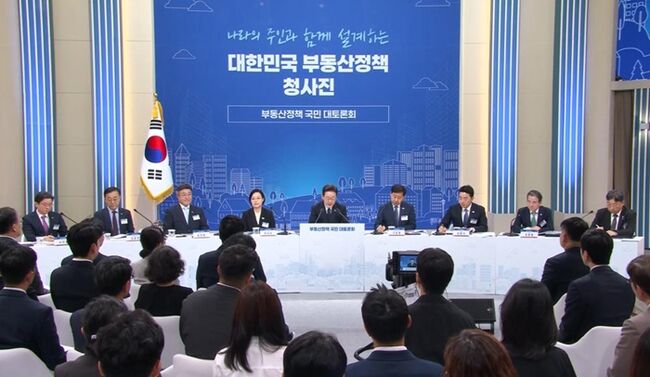 [Liberal Democratic Party Statement] Calling it a Grand Real Estate Debate… It Was Nothing More Than a Private Party Among Themselves
The 'National Grand Debate on Real Estate Policy' held on July 23rd and 27th. [Photo=Yonhap News]The 'National Grand Debate on Real Estate Policy,' hosted by the Lee Jae-myung administration under the
[Liberal Democratic Party Statement] Calling it a Grand Real Estate Debate… It Was Nothing More Than a Private Party Among Themselves
The 'National Grand Debate on Real Estate Policy' held on July 23rd and 27th. [Photo=Yonhap News]The 'National Grand Debate on Real Estate Policy,' hosted by the Lee Jae-myung administration under the
 [Photo] Evidence of Election Fraud Flooding U.S. Media… Trump Had 2.7 Million Votes Stolen
 [Video] U.S. Semiquincentennial Air Show... 'Art in the Sky' streaks across New York
 [Editorial Cartoon] A Draconian Law That Undermines Freedom of Expression

 List
List