The recent case of the US military swiftly rescuing a WSO (Weapons Systems Officer) isolated behind enemy lines has once again confirmed that 'rescue capability' in modern military operations is not just a matter of humanitarian aid, but a comprehensive indicator of a nation's capabilities. Immediately after detecting the isolation signal, the US military activated satellite, high-altitude drone, and electronic intelligence assets simultaneously to pinpoint the location. A dedicated unit directly under the US President then deployed forces according to automated procedures. This will be recorded as a textbook example of combat search and rescue.
Despite the dangerous area, the rescue operation was carried out seamlessly, involving swift political decisions, air superiority, electronic warfare support, and the deployment of special forces. Ultimately, the WSO isolated behind enemy lines returned alive. This case vividly demonstrates how military respect philosophy, intelligence, command, power, and cultural foundations were integrated and operated for the sake of even a single comrade. We examine the reasons for the US military's success in this rescue operation and the current state of our military from the perspective of a retired officer.
The First Element of a Rescue Operation: Intelligence, Surveillance, and Reconnaissance (ISR) Capability
The speed and accuracy with which the location of the isolated individual is determined dictate the success or failure of the operation. The US military analyzes the isolated individual's survival signals in real-time by integrating real-time satellite intelligence, high-altitude drones, and electronic intelligence gathering assets. The strength of the US ISR lies not merely in the quantity of machines, but in the 'fusion performance' where AI integrates collected data in real-time.
Conversely, South Korea's core reconnaissance assets are limited, and its information fusion system is not yet fully mature. If South Korea takes over wartime operational control (OPCON), even if US assets are 'provided,' their 'control' will be outside our grasp, leading to a sharp decline in intelligence resolution. Lacking independent intelligence assets is akin to shooting blindfolded.
The Second Success Factor: Speed and Simplicity of the Command and Control System
In a rescue operation, situations change by the minute. If the command system is complex or approval processes are lengthy, the golden time disappears in an instant. The US military has dedicated units and automated response protocols, allowing them to deploy forces immediately if necessary, even in dangerous areas. In contrast, South Korea, where politics directly intervene in security, experiences slow and sluggish decision-making due to the possibility of military conflict, diplomatic burdens, and a multi-layered command structure. These structural differences play a crucial role in determining the speed and intensity of actions in actual operations.
The Third Element: Force Projection Capability
A rescue operation must be capable of deploying war-level forces even for a single individual. Rescue helicopters, close air support aircraft, electronic warfare aircraft, aerial refueling tankers, and special forces must move simultaneously, requiring air superiority and operational authority to support them. While the US military can immediately assemble such a package, South Korea faces difficulties in assembling an operation of the same caliber due to a shortage or limitations in some forces.
The Fourth Element: A Culture of Respect for Soldiers and Citizens
The principle of "We do not abandon our comrades" must be consistently reflected in doctrine, training, budget, and operations for risky rescues to be possible. This value is embedded in the DNA of the US military organization. In contrast, as seen in the case of the murder of a Ministry of Maritime Affairs and Fisheries official, responses in South Korea have varied depending on political situations, and judgments have repeatedly wavered according to public opinion. Active-duty soldiers may lack the conviction that they will surely return. This signifies an insufficient accumulation of the 'social contract' between the state and its citizens.
Taken together, the level of rescue operations is not merely a measure of military capability but an indicator of a nation's systemic maturity. Independence of intelligence assets, simplification of command systems, force structure capabilities, a culture of protecting comrades, and the willingness of leadership to accept political and diplomatic burdens in critical security threats are all necessary. Without any one of these, an operation fails before it even begins.
At this juncture, the debate over the transfer of wartime operational control (OPCON) resurfaces.
President Lee's recent remarks at the US Congress, stating that the "early recovery of wartime operational control will reduce the US defense burden," can be interpreted as a pursuit of self-reliant defense. However, there are concerns that this could lead to a weakening of the alliance's deterrence. South Korea's past maintenance of the ROK-US Combined Forces Command system, which kept US military command structures tied to the Korean Peninsula's security framework, was not due to a lack of pride but an unavoidable survival strategy.
While our military has grown into a global force, the transfer of wartime operational control is still premature. This is not a matter of symbolic sovereignty but of the practical capability to command an entire war. The question arises whether we can fully exercise command authority to manage the complex variables of a full-scale war when we are not even capable of swiftly and completely protecting a single isolated citizen. This is not a political debate but a matter of practical completeness.
The transfer of wartime operational control is a futile argument to claim all the alliance equity earned through the US military's contributions and dedicated efforts. It is like letting the tail wag the dog. Transferring wartime operational control is tantamount to dismantling the safety mechanism that guarantees automatic alliance intervention and opening the fortress of security from within. After the transfer of wartime operational control, if military decisions are hindered by political considerations, South Korea could face unimaginable risks.
The success of the US military's rescue operation for a soldier isolated behind enemy lines serves as a stark reminder. Independent command authority is not achieved through declaration alone; it becomes a reality only when an 'security immune system' comprising decisiveness, intelligence, command, power, and culture is in place. What is needed now is not a hasty transfer of wartime operational control, but introspection and preparation to learn from the US military's fourth-dimensional combat system and strengthen our internal capabilities. There can be no partisan division in the security discourse for the survival of South Korea.

◆ Park Pil-gyu
Editor, The Hankook Ilbo
Graduated from Korea Military Academy, Class of 40

 [Statement by the Seo-beo-kka Korea Military Academy Save-the-Nation Comrades Association] ㉛ Recount the Votes Publicly, as the Previous Recount Concealed Election Fraud
Tongyeong Mayoral Election Recount [Photo=Yonhap News]South Korea's liberal democracy is dying. The National Election Commission (NEC) and the judiciary, which have plummeted into criminal syndicates
[Statement by the Seo-beo-kka Korea Military Academy Save-the-Nation Comrades Association] ㉛ Recount the Votes Publicly, as the Previous Recount Concealed Election Fraud
Tongyeong Mayoral Election Recount [Photo=Yonhap News]South Korea's liberal democracy is dying. The National Election Commission (NEC) and the judiciary, which have plummeted into criminal syndicates
 What is the significance of the "Trump 2028" red hats that keep making a comeback?
It is noteworthy that President Donald Trump is "intentionally" fueling controversy over whether he can actually run in the 2028 presidential election, even though it is "highly likely he is seriously
What is the significance of the "Trump 2028" red hats that keep making a comeback?
It is noteworthy that President Donald Trump is "intentionally" fueling controversy over whether he can actually run in the 2028 presidential election, even though it is "highly likely he is seriously
 Jin Cummings: “North Korea says it will increase the number of spies, so what is the government doing?”
U.S. political columnist Gene Cummings has publicly questioned the South Korean government, asking, "North Korea is declaring that it will increase its number of spies, so what is the South Kore
Jin Cummings: “North Korea says it will increase the number of spies, so what is the government doing?”
U.S. political columnist Gene Cummings has publicly questioned the South Korean government, asking, "North Korea is declaring that it will increase its number of spies, so what is the South Kore
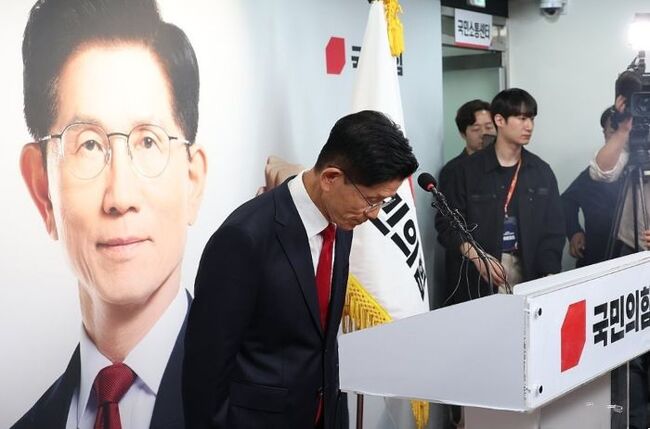 “Too little, too late?…” Kim Moon-soo, who previously conceded his presidential election defeat, now demands a special counsel investigation into ‘allegations of election fraud in the 2025 presidential election’
People Power Party presidential candidate Kim Moon-soo concedes defeat during a press conference at the party headquarters in Yeouido, Seoul, on June 4, 2025. [Joint Press Corps]As allegations emerge
“Too little, too late?…” Kim Moon-soo, who previously conceded his presidential election defeat, now demands a special counsel investigation into ‘allegations of election fraud in the 2025 presidential election’
People Power Party presidential candidate Kim Moon-soo concedes defeat during a press conference at the party headquarters in Yeouido, Seoul, on June 4, 2025. [Joint Press Corps]As allegations emerge
 Stock Market Crash 'Black Tuesday'… KOSPI down 10.8%, KOSDAQ down 7.7%
The KOSPI fell by more than 5% in early trading on the 28th, triggering a sell-side sidecar.On the 28th, the KOSPI plunged by more than 10%.Due to the sharp decline, a sell-side sidecar—a temporary
Stock Market Crash 'Black Tuesday'… KOSPI down 10.8%, KOSDAQ down 7.7%
The KOSPI fell by more than 5% in early trading on the 28th, triggering a sell-side sidecar.On the 28th, the KOSPI plunged by more than 10%.Due to the sharp decline, a sell-side sidecar—a temporary
 [World Heritage Committee] 25 New World Heritage Sites Inscribed in Busan… South Korea Successfully Expands 'Getbol' Listing
The Chairperson of the World Heritage Committee speaks at the plenary session of the 48th session of the World Heritage Committee, held at BEXCO in Busan on the 20th. [Photo: Yonhap News]A total of 25
[World Heritage Committee] 25 New World Heritage Sites Inscribed in Busan… South Korea Successfully Expands 'Getbol' Listing
The Chairperson of the World Heritage Committee speaks at the plenary session of the 48th session of the World Heritage Committee, held at BEXCO in Busan on the 20th. [Photo: Yonhap News]A total of 25
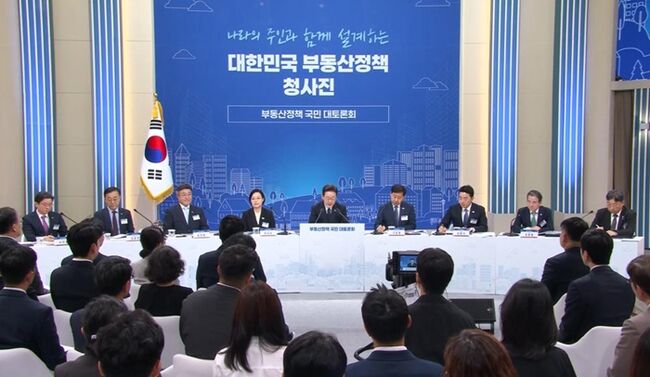 [Liberal Democratic Party Statement] Calling it a Grand Real Estate Debate… It Was Nothing More Than a Private Party Among Themselves
The 'National Grand Debate on Real Estate Policy' held on July 23rd and 27th. [Photo=Yonhap News]The 'National Grand Debate on Real Estate Policy,' hosted by the Lee Jae-myung administration under the
[Liberal Democratic Party Statement] Calling it a Grand Real Estate Debate… It Was Nothing More Than a Private Party Among Themselves
The 'National Grand Debate on Real Estate Policy' held on July 23rd and 27th. [Photo=Yonhap News]The 'National Grand Debate on Real Estate Policy,' hosted by the Lee Jae-myung administration under the
 [Photo] Evidence of Election Fraud Flooding U.S. Media… Trump Had 2.7 Million Votes Stolen
 [Video] U.S. Semiquincentennial Air Show... 'Art in the Sky' streaks across New York
 [Editorial Cartoon] A Draconian Law That Undermines Freedom of Expression

 List
List