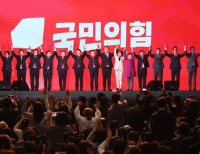
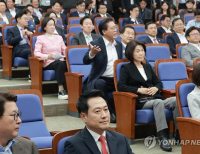
National Power's leader Jang Dong-hyuk attends a general meeting of lawmakers at the National Assembly on the 17th, with lawmaker Song Seok-jun requesting to speak to the moderator. [Photo=Yonhap News]The People Power Party limited the scope of election appeals following the June 3rd local elections after a general meeting of lawmakers on the 17th.
While leader Jang Dong-hyuk advocated for filing election invalidation appeals in all 16 cities and provinces, floor leader Jung Jin-suk countered that efforts should be concentrated on the six to seven regions where issues like ballot shortages and voting suspensions were confirmed.
The majority of lawmakers attending the general meeting supported limiting the appeals to seven regions, and Leader Jang accepted this decision. This structure, rather than a formal party vote, involved the leader accepting the majority opinion of the lawmakers and confirming it as the party's operational policy.
The central party filed appeals for seven regions: Seoul, Gyeonggi, Incheon, Busan, Ulsan, Gwangju/Jeonnam, and Chungbuk. Subsequently, as the gubernatorial candidates for Daejeon, Chungnam, Sejong, and Jeonbuk expressed their intent to file appeals directly, the actual number of regions where appeals were filed increased to 11.
However, the addition of four regions at the request of candidates does not mean that the People Power Party lawmakers united in their belief in the necessity of nationwide relief for their rights.
Appeals Reduced Amidst Party Leadership Struggle
At the general meeting on the 17th, the scope of election appeals and the future of leader Jang Dong-hyuk's position were discussed together.
When lawmaker Song Seok-jun requested to speak publicly, lawmakers supporting the current leadership clashed with those opposing them, leading to shouting. In the closed-door session, demands for Leader Jang's resignation and opposing opinions collided. The legal response regarding the deprivation of suffrage and the leader's position following the local election defeat were intertwined within a single meeting.
Whether Leader Jang used the call for a re-election for his political survival is a separate issue. However, this does not make the judgment of those who advocated for limited appeals the correct one.
In the main vote of the June 3rd local elections, 7,194 ballots were insufficient across 91 polling stations nationwide. Voting was suspended at 26 locations, with suspension times ranging from a minimum of 4 minutes to a maximum of 105 minutes. The extent of the shortage increased to approximately 1.5 times compared to the 50 locations and 4,726 ballots initially reported by the election commission.
The fact that the scope of the problem expanded during the investigation means that it cannot be definitively concluded that there were no issues in areas that have not yet been confirmed.
‘Unconfirmed’ and ‘non-existent’ are different.
Was the Rationale for Limited Appeals Sufficient?
The rationale for limited appeals can be broadly categorized into two points.
One argument is that filing appeals in regions where infringement of suffrage has not been confirmed could weaken the legal basis. Another is that nationwide appeals could be perceived as a rejection of the entire local election, potentially providing the Democratic Party with an opportunity for a counterattack.
Neither argument is entirely without merit. Broad appeals filed without evidence of illegality or damage in specific regions may lack legal persuasiveness. Focusing solely on the political slogan of a nationwide re-election could escalate the controversy over election denial rather than clarifying the infringement of suffrage.
However, whether these concerns justify reducing the scope of legal action before the investigation is even complete is a separate matter.
Article 219 of the Public Official Election Act stipulates that voters, political parties, or candidates who dispute the validity of local elections can file appeals within 14 days of the election. Conversely, Article 224 states that if a violation of election regulations is found to have affected the election results, the entire election or a part thereof may be declared invalid.
Filing an appeal and a ruling of election invalidity are not the same stages.
The approach of limited appeals effectively resulted in applying the strict criteria required for a final invalidity judgment at the stage of determining the scope of the appeal.
The fact that not all evidence has been presented to warrant a re-election at this moment is entirely different from the issue of whether there is no need to investigate the extent of damage and preserve legal rights through appeals.
Furthermore, the period for election appeals is limited to 14 days.
Once the deadline passes, even if new facts emerge, the avenues for contesting the validity of that election may narrow. The legal vulnerability of a full appeal and the risk of losing the opportunity for legal remedy due to the expiration of the appeal period should have been considered together.
What the People Power Party should have done first was not to politically choose between all 16 regions and only 7 regions.
They should have secured data on the initial print run and additional deliveries at each polling station nationwide, voting suspension times, the number of voters who left polling stations, polling station records and situation reports, and the status of missing voter lists to determine the necessity of appeals by region.
If the acquisition of data was not complete, they should have sought ways to preserve voters' rights to the fullest extent within the appeal period by combining evidence preservation and a comprehensive investigation.
Is the Call for Re-election the Demand of ‘Some Hardline Supporters’?
Recent public opinion polls show that the demands of young people and citizens calling for "election rigging re-election, same-day vote count" cannot be dismissed as merely the voices of some rally participants or hardline supporters.
A survey conducted by Penseum & Mike for 1001 adults nationwide on the 12th-13th revealed that 54.7% favored re-election, while 38.8% opposed it. 55.2% also responded in favor of abolishing the advance voting system. Support for re-election was 71.2% among those in their 20s and younger, and 74.5% among those in their 30s.
A Korea Gallup poll showed 44% in favor of nationwide re-election and 48% against it, but support among those aged 18-29 was 67%, and among those in their 30s was 62%. 67% of respondents perceived the current situation as a "problem of poor election management and infringement of suffrage."
In a Realmeter survey, 45.6% favored re-election and 51.0% opposed it, with the margin within the margin of error. Support among those aged 18-29 was 58.5%, and among those in their 30s was 63.2%. 91.6% responded that the election commission should be held strictly accountable for its poor management.
While public opinion polls cannot replace the legal requirements for a re-election, they can serve as an indicator of the public's will, showing the direction a political party should take in investigating the truth and seeking relief for rights.
Although the proportion of pro-re-election sentiment varied across surveys, support ranged from 44% to 54.7%.
In no survey could the call for re-election be considered a minority opinion to be ignored. Notably, in the Korea Gallup and Realmeter surveys, support for re-election among those in their 20s and 30s reached 58.5% to 67%, and the proportion demanding strict accountability for the election commission exceeded 90%.
This is why some argue that the People Power Party should fear not only the political label of "election denial" that the Democratic Party might attach.
They should be more fearful of public assessment: that the party limited the scope of legal relief for rights out of concern for attacks from the opposing party, even though voting was suspended and ballots were insufficient due to the state institutions' failure to prepare.
The slogan "election rigging re-election, same-day vote count" spreading nationwide from Olympic Park does not, in itself, legally prove election rigging.
However, it seems necessary to reflect on whether it is the stance of a responsible political party to dismiss the demands for suffrage restoration and election system reform contained in that slogan with the phrase "election denial."
It is also worth considering the suggestion that what the People Power Party should do now is not to engage in infighting over party leadership, but to concretize citizens' demands through evidence preservation, comprehensive investigation, election appeals, parliamentary inquiries, election commission reform, and discussions on expanding same-day voting and vote counting.
Are they afraid of the attack of "election denial," but not afraid of denying the public's will to uncover the truth of suffrage deprivation?
The People Power Party must answer this question.

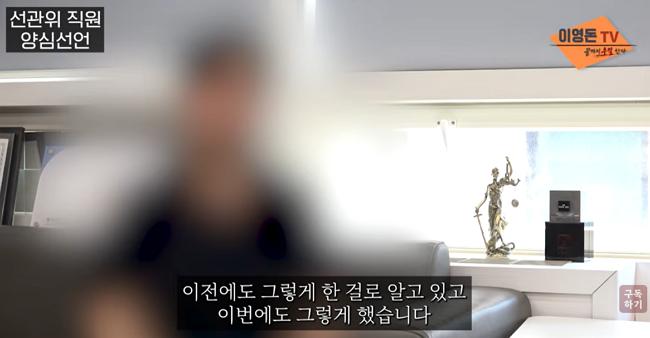 [Focus] Why did the dedicated communication network, checked three times, stop?... Three questions about the "Wi-Fi connection" for early voting
In the broadcast of Lee Young-don TV on the 16th, a current National Election Commission official exposes the reality of the 6.3 local elections based on direct experience. [Photo=Screenshot fr
[Focus] Why did the dedicated communication network, checked three times, stop?... Three questions about the "Wi-Fi connection" for early voting
In the broadcast of Lee Young-don TV on the 16th, a current National Election Commission official exposes the reality of the 6.3 local elections based on direct experience. [Photo=Screenshot fr
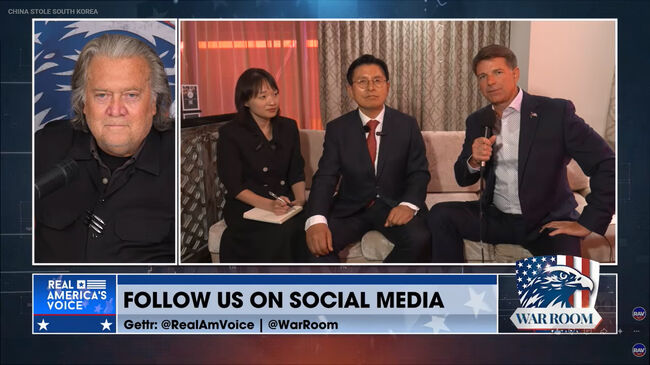 Hwang Kyo-ahn Urges President Trump's "Direct and Decisive Intervention"
Hwang Kyo-ahn, leader of the Liberty and Innovation Party, who is visiting the United States, appeared on Steve Bannon's podcast "War Room," known for its significant influence among the American cons
Hwang Kyo-ahn Urges President Trump's "Direct and Decisive Intervention"
Hwang Kyo-ahn, leader of the Liberty and Innovation Party, who is visiting the United States, appeared on Steve Bannon's podcast "War Room," known for its significant influence among the American cons
 National Election Commission Special Committee for State Audit Officially Launched... State Audit Plan Adopted
  "Let's go to the special prosecutor!"... A mysterious 'three-year-old ballot' found in the ballot box
Past ballots were discovered belatedly during the vote counting and tabulation process of the 21st presidential election last year. [Photo=Yonhap News]Past ballots used in previous elections were conf
"Let's go to the special prosecutor!"... A mysterious 'three-year-old ballot' found in the ballot box
Past ballots were discovered belatedly during the vote counting and tabulation process of the 21st presidential election last year. [Photo=Yonhap News]Past ballots used in previous elections were conf
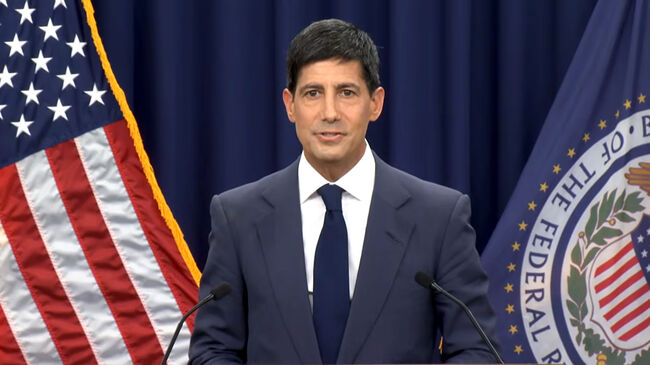 Wash: Fed committed to maintaining 2% inflation target
Federal Reserve (Fed) Chair Jerome Powell stated on Wednesday that the central bank is unanimously committed to bringing inflation down to its 2% target.In his first press conference since taking offi
Wash: Fed committed to maintaining 2% inflation target
Federal Reserve (Fed) Chair Jerome Powell stated on Wednesday that the central bank is unanimously committed to bringing inflation down to its 2% target.In his first press conference since taking offi
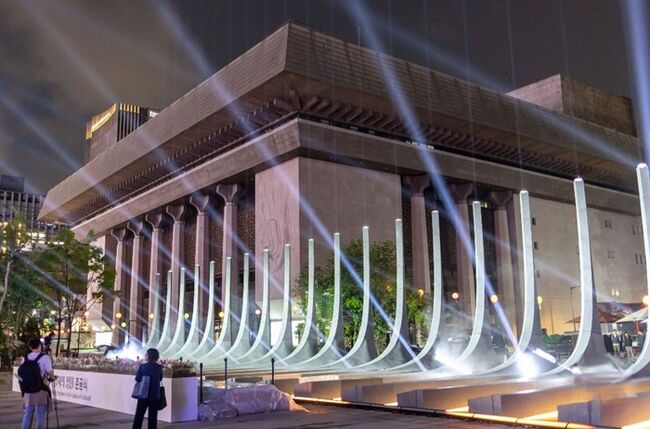 [Patriotism Month Travel Destinations] ② "Freedom is not free"... Gwanghwamun Square 'Garden of Gratitude'
Night view of the Garden of Gratitude [Photo: Yonhap News]Gratitude, beyond mere politeness, bestows positive energy and freedom upon life. On the 12th, a meaningful space was established in Gwan
[Patriotism Month Travel Destinations] ② "Freedom is not free"... Gwanghwamun Square 'Garden of Gratitude'
Night view of the Garden of Gratitude [Photo: Yonhap News]Gratitude, beyond mere politeness, bestows positive energy and freedom upon life. On the 12th, a meaningful space was established in Gwan
 [Photo] Current status of Chairman Hwang Kyo-ahn and lawyer Park Joo-hyun attending the US election fraud fighter summit
Lawyer Park Joo-hyun with lawyer Peter Ticktin, who was pardoned by U.S. President Donald Trump. [Facebook]Hwang Kyo-ahn, leader of the Liberty and Innovation Party (second from left), informing about
[Photo] Current status of Chairman Hwang Kyo-ahn and lawyer Park Joo-hyun attending the US election fraud fighter summit
Lawyer Park Joo-hyun with lawyer Peter Ticktin, who was pardoned by U.S. President Donald Trump. [Facebook]Hwang Kyo-ahn, leader of the Liberty and Innovation Party (second from left), informing about
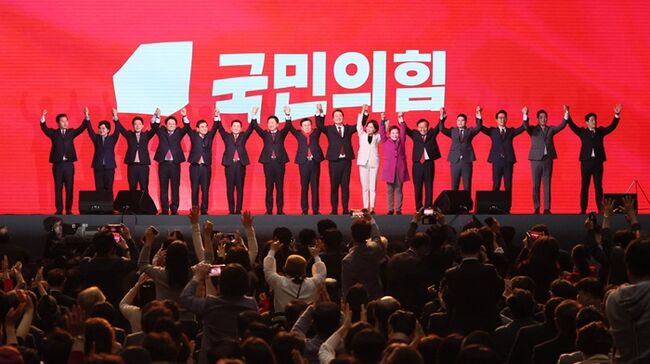 [Kim Taesan Column] I See People Power Politicians Worse Than X
[Photo = Yonhap News]There is a Korean proverb: "Even a dog remembers the kindness of those who raise it." It means to be wary of those who are ungrateful. If a human betrays the person who raised the
[Kim Taesan Column] I See People Power Politicians Worse Than X
[Photo = Yonhap News]There is a Korean proverb: "Even a dog remembers the kindness of those who raise it." It means to be wary of those who are ungrateful. If a human betrays the person who raised the
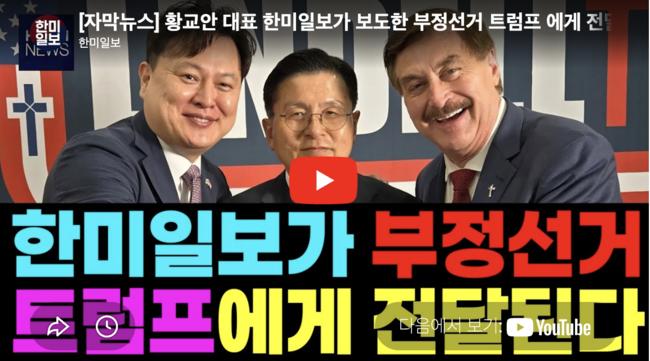 [Video] 'Trump's close friend' Lindell "I will inform Trump about South Korea's fraudulent election"
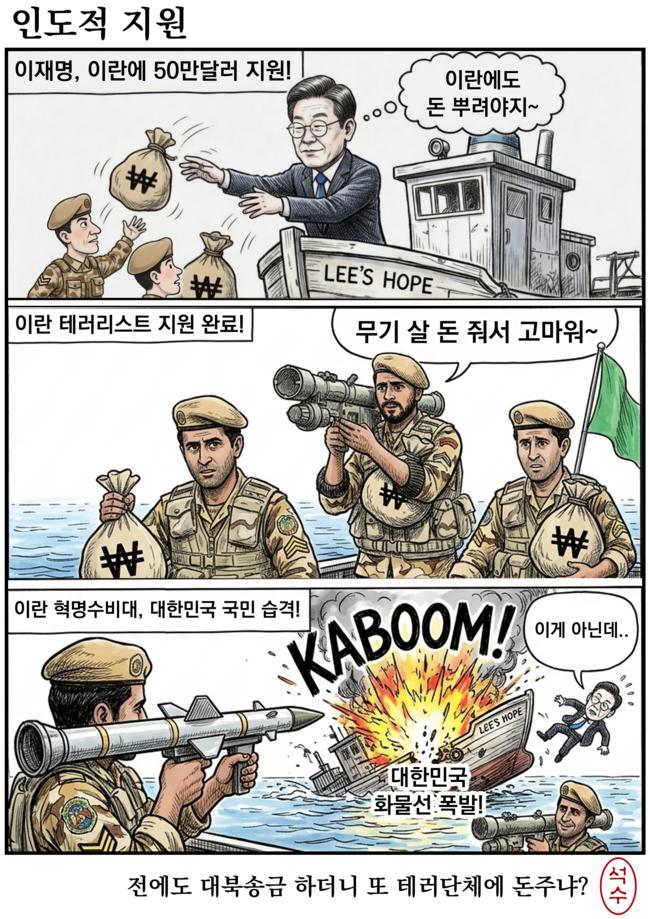 [Editorial Cartoon] Humanitarian Aid

 List
List